
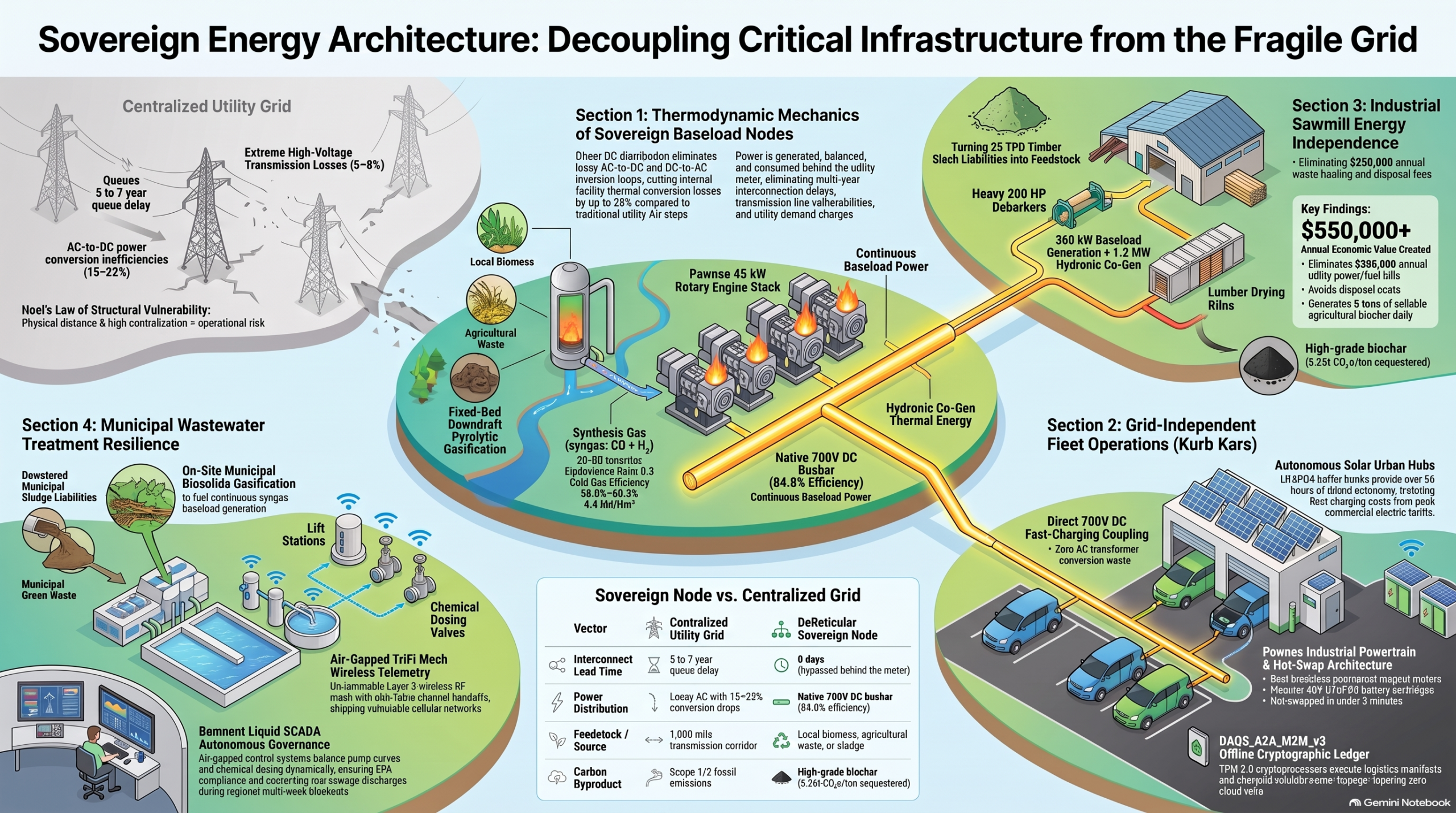
Concept Primer: Energy Sovereignty and Decentralized Microgrids
- The Monolithic Grid and Structural Vulnerability
1.1 The Centralized Utility Grid (“The Reticular Complex”)
For over a century, modern industrial architecture has operated under an unexamined paradigm: the assumption that electrical power is an external commodity purchased from an Investor-Owned Utility (IOU) monopoly at the municipal boundary. This legacy model relies on a centralized distribution framework—termed “The Reticular Complex”—that transmits high-voltage electricity across thousands of miles of exposed transmission corridors. While this centralized topology enabled rapid twentieth-century electrification, it has reached severe thermodynamic and structural diminishing returns. Industrial facilities bounded within this legacy network are exposed to acute operational failure modes:
- Long-Distance Transmission Line Vulnerabilities: High-voltage transmission lines extending across complex topographies suffer physical exposure to thermal sag, severe ice loading, and extreme wildfire events. A localized line trip can propagate instability across the broader state-space boundary, stranding downstream industrial facilities without primary power.
- Interconnection Queue Delays: Commercial operations seeking new or expanded electrical services face severe administrative and capacity bottlenecks. Regional commercial interconnection waitlists span 5 to 7 years, with North American Independent System Operators (ISOs) reporting an average national queue delay of 5.4 years simply to secure substation interconnect approval.
- Severe Equipment Lead Times: Sourcing essential high-voltage grid infrastructure has encountered severe supply chain friction. Procuring standard high-voltage utility substation transformers currently requires lead times of 3 to 4 years from order placement to site energization.
- Weather Blackouts and Power Quality Sags: Stressed regional transmission grids subject commercial ratepayers to rolling brownouts, complete power outages, and transient voltage sags. These power quality anomalies trip sensitive variable-frequency drives (VFDs), corrupt digital control loops, and cause catastrophic material loss in continuous process manufacturing.
So What? Relying on a distant transmission grid renders an enterprise or municipal facility structurally captive to external single points of failure (SPOFs). When a transmission line trips or a substation transformer fails hundreds of miles away, an operation that maintains flawless internal quality control still suffers catastrophic operational disruption.
1.2 Deconstructing Noel’s Law of Structural Vulnerability
To evaluate how physical distance and centralized authority generate operational risk within an industrial facility, systems engineering applies a formal analytical framework known as Noel’s Law of Structural Vulnerability:
\text{Vulnerability} \propto \frac{\text{Distance of Dependency} \times \text{Centralization Factor}}{\text{Local Autonomous Capacity}}
This structural equation formalizes the relationship between system topology and operational risk across three primary variables:
- \text{Distance of Dependency}: The physical and logistical length of the energy supply line connecting the facility to its primary generation source. As power travels across a 1,000-mile transmission corridor, exposure to environmental hazards, switching faults, and thermal line losses scales directly with distance.
- \text{Centralization Factor}: The structural proportion of energy generation and operational authority concentrated within a single utility monopoly or transmission hub. A high centralization factor establishes single points of failure where the collapse of a central node cascades across all dependent downstream systems.
- \text{Local Autonomous Capacity}: The continuous power density a facility can generate, balance, and control directly within its local state-space boundary (“behind the meter”).
System Risk Calculation Scenario: Comparative Numerical Walkthrough
To understand the mathematical dynamics of Noel’s Law, consider two operational configurations evaluated for a 1,000 kW continuous industrial load:
\begin{aligned} \text{Scenario A (Legacy Utility Connection):} \quad & \text{Distance} = 1,000 \text{ miles}, \quad \text{Centralization} = 0.90, \quad \text{Local Capacity} = 10 \text{ kW} \ &\text{Vulnerability Score} \propto \frac{1000 \times 0.90}{10} = \mathbf{90.0} \ \ \text{Scenario B (DeReticular Sovereign Node):} \quad & \text{Distance} = 0.1 \text{ miles (BTM)}, \quad \text{Centralization} = 0.05, \quad \text{Local Capacity} = 1,000 \text{ kW} \ &\text{Vulnerability Score} \propto \frac{0.1 \times 0.05}{1000} = \mathbf{0.000005} \end{aligned}
In Scenario A, the high distance of dependency and total utility centralization, combined with minimal local backup, yield a massive structural vulnerability score. In Scenario B, transitioning to behind-the-meter (BTM) generation drives the distance of dependency near zero and expands local capacity to match full load requirements. This structural shift reduces systemic operational risk by more than seven orders of magnitude.
Understanding structural vulnerability forces us to rethink energy generation from the ground up, leading directly to the sovereign alternative.
- Core Engineering Pillars of Sovereign Energy
2.1 Sustained “Island Mode” vs. Legacy Backup
In conventional facility engineering, “Island Mode” is categorized strictly as an emergency posture—a brief, high-cost operational state activated when the central utility grid collapses. Legacy configurations rely on standby diesel generators designed to supply short-term emergency power. However, these legacy installations exhibit severe failure modes: they frequently fail to start under heavy inductive motor starting loads, depend on fragile, real-time diesel fuel supply chains, and exhaust their on-site fuel reserves within 48 to 72 hours of sustained grid failure.
In a sovereign microgrid architecture, Island Mode is not an emergency backup measure; it is the native, continuous operational state. The facility generates, balances, and consumes its own electrical power behind the utility meter 24/7/365, operating fully decoupled from the regional transmission grid.
The Core Principle of Energy Sovereignty: True energy resilience is not an emergency posture activated during a blackout; it is a permanent, native operational state where a facility continuously generates, balances, and consumes its own power behind the meter.
2.2 Baseload Power via Pyrolytic Gasification
Decentralized microgrids must solve the operational challenge of renewable intermittency without relying exclusively on massive, capital-intensive chemical battery energy storage systems (BESS). Sovereign microgrids resolve this constraint by generating continuous, dispatchable behind-the-meter baseload power through sub-stoichiometric thermochemical pyrolytic gasification.
The structural workflow of this thermochemical conversion process is detailed in the system schematic below:
[Local Biomass / Forestry Slash / Agricultural Waste]
│
▼
┌─────────────────────────────────────────────────────────┐
│ Fixed-Bed Downdraft Pyrolytic Reactor │
│ • Input: 20–30 TPD Dry Feedstock │
│ • Thermochemistry: Sub-Stoichiometric (ER 0.3) │
│ • Efficiency: 58.0%–59.5% Cold Gas Efficiency │
└─────────────────────────────────────────────────────────┘
│
┌───────────────┴───────────────┐
▼ ▼
┌──────────────────────────┐ ┌──────────────────────────┐
│ Energy-Dense Syngas │ │ High-Grade Biochar │
│ • CO + H₂ Chemistry │ │ • 3.26t CO₂e/ton Char │
│ • 4.4 MJ/Nm³ Caloric Val │ │ • Soil Amendment Export │
└──────────────────────────┘ └──────────────────────────┘
│
▼
┌──────────────────────────┐
│ Pawnee 45 kW Rotary │
│ Internal Combustion Array│
│ • Valveless Architecture │
│ • Zero Tar Fouling │
└──────────────────────────┘
│
├──────────────────────────────┐
▼ ▼
┌──────────────────────────┐ ┌──────────────────────────┐
│ 24/7/365 Continuous BTM │ │ Hydronic Co-Gen Thermal │
│ Electrical Baseload │ │ Process Capture │
└──────────────────────────┘ └──────────────────────────┘
- Sub-Stoichiometric Thermochemistry: High-temperature, fixed-bed downdraft pyrolytic reactors process 20 to 30 tons per day (TPD) of dry agricultural residues, timber slash, or municipal biomass. The reactor operates at an Equivalence Ratio (ER) of 0.3—meaning oxygen is strictly metered to approximately 30% of the theoretical air required for complete stoichiometric combustion. Rather than fully oxidizing the organic material into low-energy \text{CO}_2 and water vapor, this partial oxidation reaction thermally cracks complex organic polymers into clean synthesis gas (syngas: \text{CO} + \text{H}_2) with a net caloric heating value of 4.4 MJ/Nm³ at a cold gas efficiency of 58.0%–59.5%.
- Rotary Engine Powertrain Dynamics: Standard reciprocating piston generators suffer severe operational failure when fueled by raw syngas; trace tar vapors condense on intake valves, cause valve-guide sticking, contaminate oil sumps, and trigger catastrophic carbon fouling. Sovereign architectures resolve this by deploying modular arrays of Pawnee 45 kW Wankel-type rotary internal combustion engines. The Pawnee rotary engine operates without poppet valves or complex valve trains, exhibits minimal vibration, and utilizes continuous porting swept by eccentric rotors. This valveless mechanical architecture permits direct combustion of raw, low-BTU syngas without requiring capital-intensive thermal tar-scrubbing equipment.
- Carbon-Negative Ecological Balance: Pyrolytic gasification operates as an inherently carbon-negative baseline process. In addition to delivering continuous 24/7/365 electrical power and direct hydronic thermal energy export, the reactor isolates solid elemental carbon as high-grade biochar. This byproduct permanently sequesters 3.26 tons of \text{CO}_2 equivalent per ton of biochar produced, while yielding pyroligneous acid (wood vinegar) for agricultural soil conditioning.
LEARNER CHECKPOINT: Thermochemical Dynamics
System Architecture Question: Why does operating a gasifier at an Equivalence Ratio (\text{ER}) of 0.3 yield combustible fuel gas, whereas operating at an \text{ER} of 1.0 yields non-combustible exhaust?
Synthesis Answer: An \text{ER} of 1.0 supplies 100% of theoretical stoichiometric air, causing complete combustion that converts all carbon and hydrogen into fully oxidized, non-reactive \text{CO}_2 and \text{H}_2\text{O}. An \text{ER} of 0.3 imposes sub-stoichiometric oxygen starvation, driving partial oxidation that releases thermal energy while preserving chemical energy in molecular bonds (\text{CO} and \text{H}_2).
2.3 Native 700V DC Distribution (Eliminating the Inversion Tax)
Standard utility infrastructure distributes electrical energy using Alternating Current (AC). However, modern high-density industrial loads—including electric vehicle (EV) DC fast-chargers, variable-frequency motor drives (VFDs), battery storage banks, and liquid-cooled GPU compute clusters—operate natively on Direct Current (DC).
In a legacy AC facility topology, electricity undergoes repetitive, lossy conversion cycles:
\text{Grid High-Voltage AC} \xrightarrow{\text{Loss 1}} \text{Substation Transformer} \xrightarrow{\text{Loss 2}} \text{AC Rectification} \xrightarrow{\text{Loss 3}} \text{DC Storage} \xrightarrow{\text{Loss 4}} \text{AC Inversion} \xrightarrow{\text{Loss 5}} \text{Device DC Feed}
Cumulative Inversion Loss Mathematics
Traditional grid connections suffer compounding, cascaded efficiency losses across transmission and conversion stages:
\begin{aligned} \eta_{\text{Legacy System}} &= \eta_{\text{Transmission}} \times \eta_{\text{Conversion Steps}} \ \eta_{\text{Transmission}} &= 92% \text{ to } 94% \quad (6% \text{ to } 8% \text{ high-voltage line loss; average factor } 0.93) \ \eta_{\text{Conversion}} &= 78% \text{ to } 85% \quad (15% \text{ to } 22% \text{ thermal conversion waste; average factor } 0.80) \ \mathbf{\eta_{\text{Net Net System}}} &= 0.93 \times 0.80 = \mathbf{74.4%} \quad (\mathbf{25.6% \text{ Total Thermal Waste}}) \end{aligned}
The structural alternative is illustrated in the architectural comparative flow below:
LEGACY AC DISTRIBUTION TOPOLOGY (Cumulative Losses: 21% – 30%)
[Central Plant] ──(6-8% Line Loss)──> [AC Grid] ──(15-22% Conversion Loss)──> [DC Loads]
SOVEREIGN NATIVE 700V DC BUSBAR (Overall Distribution Efficiency: 84.8%)
[Local Generation] ────────────────> [Native 700V DC Bus] ───────────────> [DC Loads]
Sovereign microgrids eliminate these parasitic conversion losses by deploying a Native 700V DC busbar operating at an overall distribution efficiency of 84.8%. Electricity generated by local Pawnee rotary gen-sets is rectified directly onto the centralized 700V DC busbar. Direct current flows straight into native DC loads without intermediate AC inversion loops or transformer step-down stages, eliminating up to 22% of facility thermal rejection load.
LEARNER CHECKPOINT: Electrical Architecture & Thermal Management
Systems Engineering Reflection: How does transitioning from a 480V AC distribution bus with localized rectifiers to a native 700V DC busbar alter the thermal cooling requirements of an Edge AI data center?
Synthesis Answer: Eliminating localized AC-to-DC rectification and DC-to-AC inversion loops removes heat sources that generate 15% to 22% thermal losses directly inside server racks. This reduces the HVAC/chiller cooling demand by nearly a quarter, lowering total facility parasitic power load and enabling direct liquid-immersion cooling setups.
Connecting these technical engineering mechanics to operational realities highlights their profound practical advantages over legacy infrastructure.
- Paradigm Shift: Centralized Grids vs. Sovereign Nodes
3.1 Comparative Analysis Matrix
Operational Dimension The Reticular Complex (Centralized Model) DeReticular Sovereign Node (Island Model) Key Mechanism Learner Takeaway (“So What?”)
Energy Source & Proximity 1,000-mile centralized transmission line; utility-controlled generation. Behind-the-meter thermochemical biomass gasification; 100% on-premises. Fixed-bed downdraft pyrolytic gasifiers converting 20–30 TPD local biomass into syngas. Eliminates distance-based exposure and total reliance on utility generation monopolies.
Grid Interconnection Delay 5 to 7 year administrative queue; 5.4-year ISO national average wait. Bypassed entirely; deploys immediately behind the meter. Autonomous BTM microgrid statutes (e.g., WV Code §5B-2-21) decoupling site from utility franchises. Facilities expand and energize in months rather than waiting years for substation approvals.
Power Distribution Architecture (AC vs. DC Losses) Lossy 480V/120V AC subject to voltage sags; 21–30% total system loss. Native 700V DC microgrid busbar operating at 84.8% efficiency. Direct DC rectification feeding loads directly without intermediate AC conversion loops. Eliminates up to 22% thermal conversion waste while shielding VFDs and GPU racks from grid sags.
Network Communications & Control Public telco fiber and cell towers; vulnerable to backhoe cuts and overload. Layer 3 TriFi Mesh network; self-healing, air-gapped control. Omnidirectional RF channels providing sub-16ms failover paired with local cryptoprocessors. Operational SCADA and telemetry remain fully online during complete public network collapses.
Disaster Posture & Endurance Fragile dependency; backup diesel generators run out of fuel in 48–72 hours. Permanent Island Mode; continuous self-sufficiency. On-site biomass gasification coupled with hydronic co-generation process heat capture. Critical industrial assets survive multi-week regional blackout events without operational interruption.
3.2 Real-World Sector Deployments
Deployment 1: Commercial Sawmills & Hardwood Processors
- The Vulnerability: A commercial hardwood mill in Central Appalachia processes timber slash and sawdust while drawing power from a rural regional utility. The mill generates 40 tons of green sawdust and bark daily, paying $35 per ton in waste hauling fees. Simultaneously, starting the facility’s heavy 200 HP head-rig saw creates severe electrical voltage sags on the utility line, triggering $18,000 per month in utility peak demand charges and forcing lumber drying kilns offline during regional brownouts.
- The Sovereign Deployment: The mill installs an on-site pyrolytic gasifier fed by 25 TPD of dried sawdust and timber slash. An array of modular 45 kW Pawnee rotary engines generates 360 kW of continuous baseload electricity over a native 700V DC busbar to drive heavy debarker motors, while 1.2 MW of hydronic thermal energy is captured from engine cooling jackets and piped directly into the lumber drying kilns.
- The Value Created: The facility eliminates $300,000 in annual utility power and natural gas heating bills, avoids $250,000 per year in waste disposal expenses, and harvests 5 tons of biochar daily for commercial sale as a soil amendment and carbon credit asset.
Deployment 2: Edge AI & Sovereign Compute Bunkers
- The Vulnerability: An enterprise artificial intelligence firm requires 2 megawatts of continuous power to energize an 800-GPU training and inference cluster. The local electric utility delivers an interconnection study quoting an 18-month delay, a $3.2 million mandatory substation upgrade fee, and an energization date set 5 years out. Furthermore, routing sensitive AI model telemetry across public cloud APIs creates data privacy exposure and incurs high network egress charges.
- The Sovereign Deployment: The facility registers as a Certified Microgrid District under West Virginia Code §5B-2-21, legally carving out the site from public service commission monopoly oversight. It deploys a 2.5 MW modular syngas farm paired with a 700V DC native busbar, feeding power directly to direct-DC liquid-immersion GPU cooling tanks equipped with RIOS-CC-1000 hardware running Remnant air-gapped silicon.
- The Value Created: The compute facility is fully energized in 120 days rather than 5 years. Levelized energy costs drop to $0.038 per kilowatt-hour, with zero risk of grid brownouts, zero reliance on external water cooling towers, and zero sensitive telemetry leaving the physical perimeter.
Deployment 3: Municipal Wastewater Reclamation Districts
- The Vulnerability: During coastal storms, regional grid blackouts cut main power to municipal raw sewage lift stations. Backup diesel generators frequently fail to start under heavy inductive motor starting loads, while public cellular towers lose backup battery power within 2 hours. This blinds central SCADA systems and causes raw sewage spills into public waterways, exposing the municipality to severe statutory EPA environmental fines.
- The Sovereign Deployment: A municipal treatment district installs a behind-the-meter pyrolytic gasifier fueled by dewatered municipal biosolids and city green waste. The plant produces continuous electricity on a native 700V DC bus to run high-lift pumps, while chemical dosing sensors communicate across an air-gapped Layer 3 TriFi wireless mesh network featuring sub-16ms RF channel handoff capabilities.
- The Value Created: The municipality transforms an expensive sludge disposal liability into a continuous energy asset. The facility operates in sustained Island Mode through multi-week regional blackouts, guaranteeing environmental compliance and eliminating regulatory fine exposure.
Moving from these real-world industrial deployments to a broader view helps summarize the core conceptual framework of energy sovereignty.
- Summary & Synthesis for the Learner
4.1 Key Conceptual Takeaways
- Dependency Creates Fragility (Noel’s Law): Systemic operational vulnerability is directly proportional to the physical distance energy must travel and the degree of centralization governing its control. Relying on a distant, centralized transmission grid concentrates single-point failure risks. Expanding local autonomous capacity behind the meter is the primary systems engineering method to reduce operational vulnerability toward zero.
- Thermodynamic Efficiency Requires Native DC Power and Local Baseload Generation: Modern solid-state electronics, GPU clusters, variable-frequency motor drives, and fast-charging platforms operate natively on Direct Current (DC). Standard Alternating Current (AC) grids waste up to 22% of total energy through repetitive conversion loops and 6% to 8% in transmission losses. Native 700V DC microgrids paired with localized thermochemical pyrolytic gasification capture this wasted energy, achieving 84.8% distribution efficiency while delivering dispatchable 24/7/365 baseload power without the intermittency of solar or wind.
- True Resilience Requires Native “Island Mode” Rather Than Temporary Emergency Backup: Legacy emergency setups rely on short-term diesel generators that are vulnerable to fuel supply chain collapses and starting failures under heavy motor starting loads. True energy sovereignty establishes Island Mode as the native, continuous operational state, continuously generating, balancing, and consuming power behind the utility meter.
By shifting from centralized grid dependency to decentralized microgrid nodes, critical facilities transform from passive utility tenants vulnerable to external power failures into fully autonomous, resilient power producers capable of sustaining continuous operations through any external crisis.


