Island Mode: Inside the Autonomous Crusade to Save Guam’s Forests
For over seven decades, the island of Guam has served as a grim case study in ecological collapse. The catalyst is the brown tree snake (BTS), an invasive predator that has extirpated 10 of Guam’s 12 native forest bird species and crippled the island’s infrastructure. The crisis reached a technical inflection point in 2021 with the discovery of “lasso locomotion”—a unique biomechanical movement allowing the snakes to scale smooth vertical utility poles previously deemed snake-proof. This adaptation costs the Guam Power Authority (GPA) an estimated $4.5 million annually in repairs and lost productivity.
However, the primary hurdle to eradication is not just the snake’s agility, but a biological phenomenon known as the “Prey Abundance Trap.” In Guam’s prey-rich environments, snakes ignore passive baits and traps because their predatory drives are fully saturated by the abundant lizards and rodents that filled the void left by native birds. Traditional methods have failed because they rely on the snake seeking out the trap. To overcome this, the Sovereign Eradication Services (SES) joint venture—led by technical authorities like Ben (Chief Vehicle Engineer) and Melissa (Capital Procurement)—has deployed a $101,500,000 “Sovereign Stack.” This modular architecture of robotics and edge-AI shifts the strategy from passive suppression to active, autonomous hunting.
Takeaway 1: The “Pay-Per-Snake” (PPS) Economic Flip
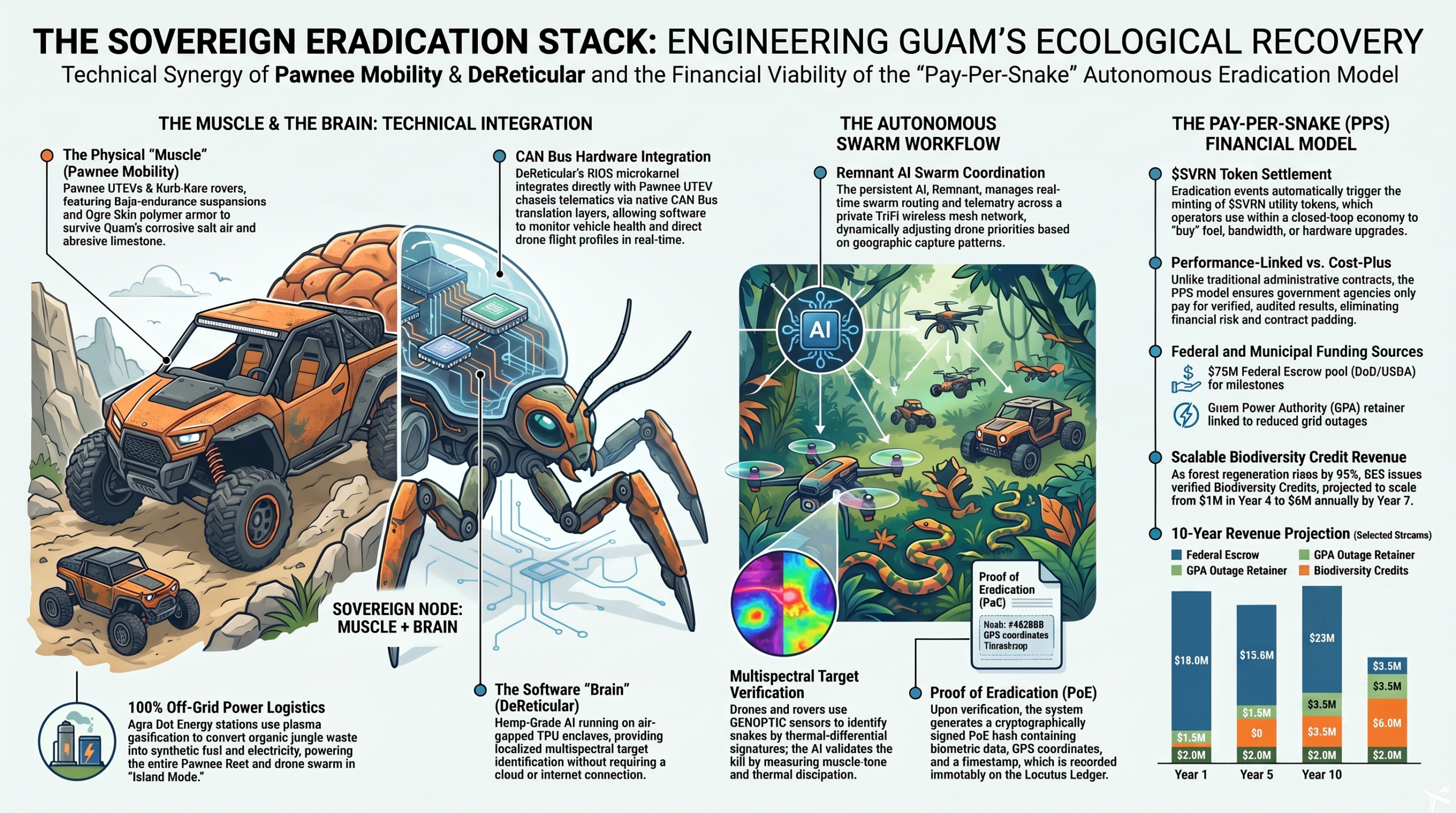
The SES model represents a fundamental shift in conservation economics, moving away from traditional “cost-plus-fixed-fee” government contracts that often prioritize administrative effort over ecological results. Instead, the project utilizes a decentralized Pay-Per-Snake (PPS) framework. Under this model, federal capital is held in an escrow account managed by InVentures Capital and disbursed strictly for verified outcomes via the $SVRN utility token.
This creates a high-velocity, Closed-Loop Economy. Operators earn $SVRN for every verified eradication, but the innovation lies in the token’s recirculating utility: field operators use $SVRN to purchase synthetic fuel from Agra Dot Energy and high-speed bandwidth from the TriFi mesh network. This “recirculating capital” model ensures that every dollar remains within the operational ecosystem, fueling the crusade rather than being lost to administrative friction.
“The model replaces traditional administrative cost-plus federal contracts with a performance-driven, decentralized, and audited Pay-Per-Snake (PPS) framework… establishing an Outcome-Linked Settlement Mechanism.”
Takeaway 2: RIOS and the Un-Spoofable Audit
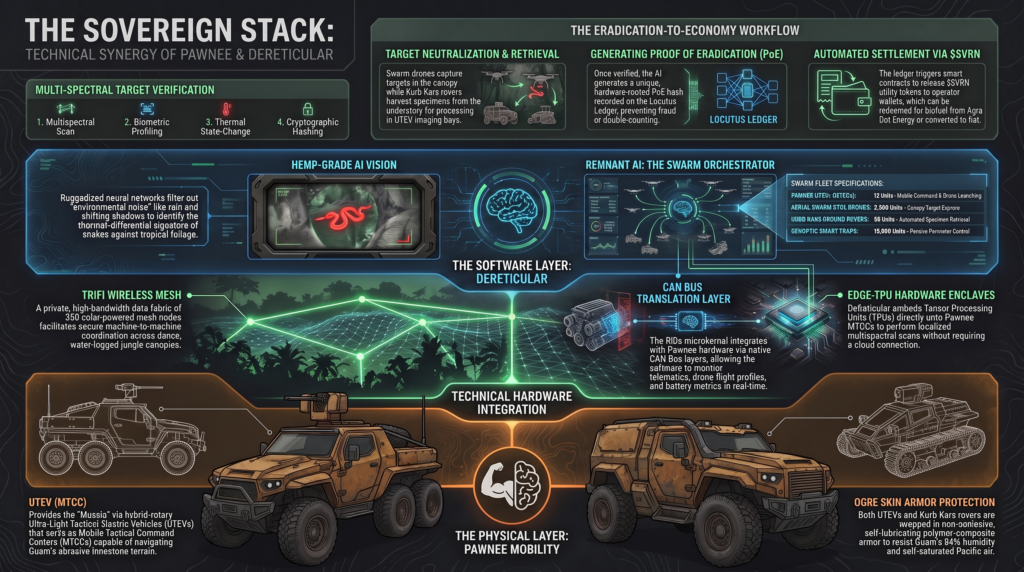
In a bounty-driven system, the risk of “identity spoofing”—re-submitting dead snakes or using synthetic imagery—is a critical vulnerability. SES mitigates this through the Rural Infrastructure Operating System (RIOS), a microkernel that integrates the system’s hardware and software layers. Target detection is handled by “Hemp-Grade AI,” a ruggedized neural network designed for air-gapped, edge-native inference.
To ensure a “Proof of Eradication” (PoE) is fraud-proof, the audit process is rooted in the hardware itself. Every GENOPTIC sensor is equipped with hardware-rooted TPM (Trusted Platform Module) chips, allowing the video stream to be cryptographically signed at the lens level. The system utilizes a mandatory 4-step verification:
- Multi-spectral Scan: Near-infrared and thermal imaging to penetrate dense canopy shadows.
- Biometric Profiling: Analysis of unique scale patterns, volume, and weight.
- Thermal State-Change Validation: The system monitors active tissue thermal dissipation over a set timeframe to ensure the specimen was newly neutralized and organic.
- Cryptographic Hashing: The PoE is written to the Locutus Ledger, creating an immutable, unique record that prevents any double-counting.
Takeaway 3: “Ogre Skin” and the Hybrid Muscle
Guam’s interior is an operational chasm of abrasive limestone, volcanic clay, and 84% relative humidity. Standard hardware fails within months. The “Muscle” layer of the Sovereign Stack consists of Pawnee Mobility’s range-extended hybrid Ultra-Light Tactical Electric Vehicles (UTEVs), functioning as Mobile Tactical Command Centers (MTCCs).
These vehicles are engineered with Baja-inspired endurance suspensions and high-output hybrid-rotary engines that act as on-the-move generators. To survive the “sandpaper” effect of the limestone forests, the UTEVs and Kurb Kars rovers are armored in “Ogre Skin”—a specialized polymer-composite plating. This material is non-corrosive and self-lubricating, allowing the rovers to slide over jagged terrain that would shred conventional aluminum skid plates. Within this hardware enclave, RIOS manages the real-time coordination of 2,500 VTOL drones and 50 rovers.
Takeaway 4: Total “Island Mode” Sovereignty
The strategic value of the SES deployment lies in its total “Island Mode” capability—the ability to operate 100% off-grid without reliance on municipal power, imported fuel, or cloud connectivity. This is essential in “Typhoon Alley,” where events like Super Typhoon Mawar can decapitate traditional infrastructure.
- Agra Dot Energy: These mobile units use plasma gasification to convert jungle biomass, wood waste, and even discarded tires into ASTM-grade synthetic diesel and electrical power.
- TriFi Wireless Mesh: A private, high-bandwidth data fabric that allows the machines to communicate through water-logged foliage and limestone ravines. By remaining air-gapped from the public internet, the fleet is resilient to both natural disasters and cyber disruptions, ensuring continuous 24/7 operations in the deepest interior.
Takeaway 5: The Financial Loop of Biodiversity Credits
The SES project is framed not as a perpetual expense, but as a one-time premium to permanently mitigate a multi-billion dollar liability. For underwriters like the Department of Defense and the State of Hawaii, the ROI is stark: the $101.5 million campaign is a strategic insurance policy against the $456 million to $761 million in annual damages projected if the brown tree snake reaches the Hawaiian archipelago.
This model is further sustained by the Global Biodiversity Credit Market. Successful snake removal is projected to trigger a 92% increase in native forest seedling recruitment as birds return to disperse seeds. This “measurable environmental lift” is audited via GENOPTIC spatial mapping and monetized as high-grade biodiversity credits. Corporate off-takers purchase these credits to satisfy environmental mandates, creating a secondary revenue stream that retires $SVRN tokens and funds the long-term biosecurity lock-in at Guam’s ports.
Conclusion: The Future of Ecological Defense
The Sovereign Eradication Services project marks the end of “perpetual suppression.” By converging Baja-proven hardware, hardware-rooted cryptographic truth, and decentralized finance, the Sovereign Stack provides a definitive 6-year timeline for the total removal of the brown tree snake.
As this autonomous framework proves its efficacy in the punishing jungles of the Pacific, it poses a strategic question for environmentalists and global policymakers: is this “Sovereign Stack” the modular blueprint required to save the Galápagos, Hawaii, and other endangered ecosystems from the Trophic Takeover of invasive species? The era of manual conservation is ending; the era of autonomous ecological reclamation has begun.


