
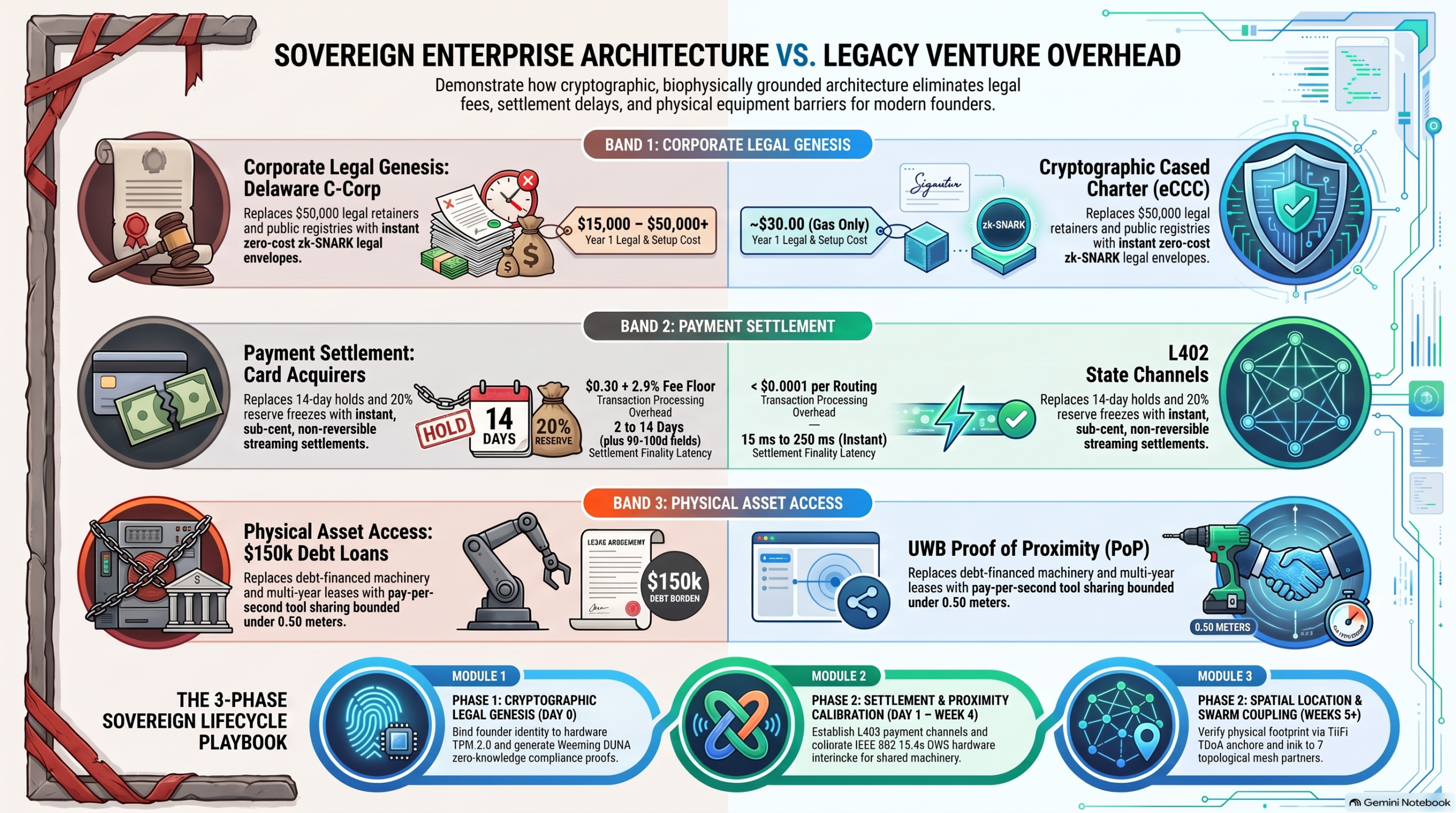
Technical Architecture Specification: Homomorphic Capitalization Tables and Zero-Knowledge Compliance Envelopes for Wyoming DUNA Entities
- Statutory Grounding & Dual-Envelope Legal Architecture
1.1 Statutory Anchor: Wyoming DUNA Act (SF0050) Mechanics
The legal landscape for autonomous organizations shifted dramatically following landmark judicial enforcement actions, most notably CFTC v. Ooki DAO (2023) and Snek v. bZx DAO. Under common law and the Uniform Partnership Act, any unincorporated association of two or more entities engaging in joint commercial activity for profit is classified by default as a General Partnership. In these rulings, federal courts established that unwrapped Decentralized Autonomous Organizations (DAOs) inherit this general partnership structure, meaning that every member who casts a governance vote or participates in organizational discussion incurs joint and several personal liability for all actions, debts, torts, software exploits, and legal judgments against the protocol. This structural vulnerability exposed governance participants to catastrophic personal bankruptcy risks. Anchoring autonomous organizations in the Wyoming Decentralized Unincorporated Nonprofit Association (DUNA) Act (Wyoming Senate File SF0050, codified at Wyo. Stat. § 17-31-101 et seq.) provides a web3-native statutory shield that resolves this existential legal threat without imposing rigid legacy corporate hierarchies.
The Wyoming DUNA Act deconstructs traditional corporate requirements by establishing recognized legal personhood without demanding a Delaware-style board of directors, corporate secretaries, or physical shareholder meetings. Wyo. Stat. § 17-31-104 grants entity shielding and a separate legal personality, allowing the association to sue and be sued, sign binding contracts, hold property, and maintain bank accounts in its own name. Crucially, Wyo. Stat. § 17-31-106 establishes comprehensive limited liability: the debts, obligations, and liabilities of the DUNA belong solely to the association, ensuring members, administrators, and agents are insulated from personal liability. Furthermore, Wyo. Stat. § 17-31-102(a)(iv) explicitly recognizes distributed consensus protocols, software code, and smart contracts as valid governing principles.
Unlike traditional offshore foundation models in jurisdictions like the Cayman Islands, the British Virgin Islands, or Panama—which carry initial setup fees ranging from $40,000 to 100,000, demand ongoing annual director retainers (15,000–30,000/year), and create complex Controlled Foreign Corporation (CFC) or Passive Foreign Investment Company (PFIC) tax traps for U.S. founders—the Wyoming DUNA operates natively within the domestic statutory framework at zero statutory formation cost (incurring only ~25–$30 in L2 execution gas) when deployed via automated contract factories.
Operational & Legal Dimension Unwrapped General Partnership Offshore Foundation (Cayman/BVI) Wyoming DUNA Entity (SF0050)
Statutory Basis Common Law / Uniform Partnership Act Offshore Special Economic Zones / Trust Acts Wyo. Stat. § 17-31-101 et seq. (SF0050)
Liability Protection None (Joint & Several Unlimited Personal Liability) Shielded via complex trust/orphan corporate structure Full Statutory Limited Liability Shield (W.S. § 17-31-106)
Initial Setup Cost $0 Initial (High downstream litigation exposure) $40,000 – $100,000 in legal & agency fees 0 Statutory Fee (~25–$30 on-chain gas deployment)
Maintenance Complexity High personal risk exposure; non-standardized governance High annual overhead (15k–30k/yr); offshore audit drag Near $0 (On-chain gas settlement; automated local tax escrow)
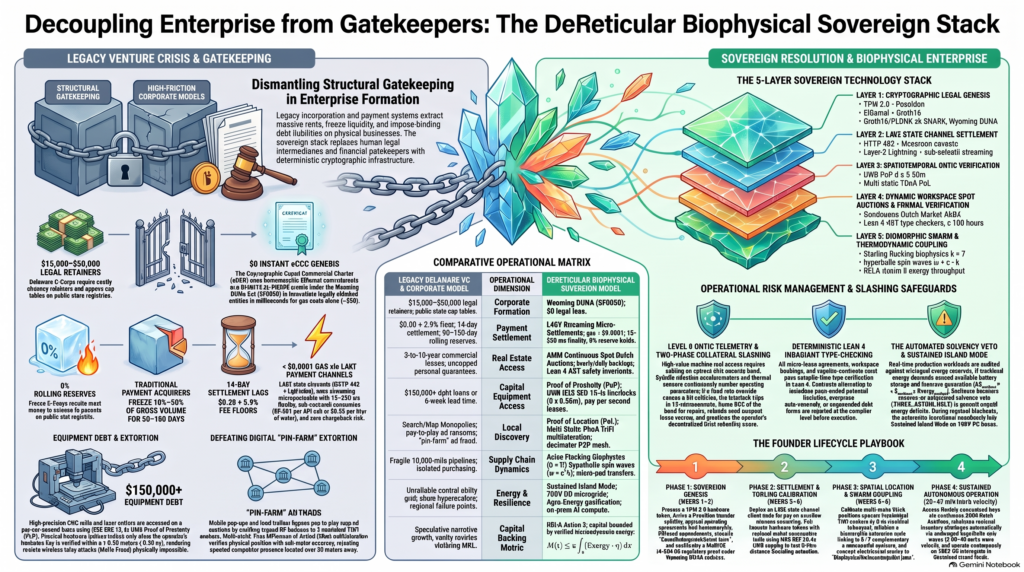
From a federal taxation perspective, a DUNA resolves the historical tax deadlock that plagued unwrapped DAOs. Under federal tax law (Treas. Reg. § 301.7701-3), an unincorporated entity defaults to partnership tax status but can file IRS Form 8832 to elect Subchapter C corporate taxation. Under this pathway, the entity files IRS Form 1120 and pays corporate-level income taxes directly out of its on-chain treasury, shielding individual members from flow-through audits on their personal Form 1040s. Alternatively, if structured as an association of independent producers (e.g., decentralized machine shops or compute nodes), Wyo. Stat. § 17-31-105 allows the DUNA to engage in commercial profit-generating operations while maintaining its state “nonprofit” status via the non-distribution constraint (prohibiting direct, passive dividend payouts). The association can then elect Subchapter T Cooperative taxation (Internal Revenue Code §§ 1381–1388), allowing “patronage dividends” paid to active member-producers based on business volume to be deducted from gross taxable income, eliminating double taxation.
1.2 Cryptographic Metamorphosis: Dual-Envelope Container (eCCC)
The Cryptographic Cased Commercial Charter (eCCC) transposes an ancient Mesopotamian legal protocol into modern ledger architectures. In third-millennium BCE Sumer and Old Babylonian commercial law, legal agreements were inscribed on an inner clay tablet, which was then encased inside an outer envelope of wet clay. The outer envelope bore a summary abstract, magistrate cylinder seals, and witness hashes visible to the public marketplace. If a commercial dispute arose, a magistrate inspected the outer envelope; if tampering was suspected, the outer casing was cracked open to reveal the untouched internal core agreement.
ANCIENT MESOPOTAMIAN CASED TABLET CRYPTOGRAPHIC CASED CHARTER (eCCC)
┌───────────────────────────────────────────────┐ ┌───────────────────────────────────────────────┐
│ OUTER CLAY ENVELOPE │ │ OUTER ENVELOPE (T_env) – ZK-SNARK Proof │
│ • Public abstract & magistrate cylinder seals │ ───► │ • Proves Wyoming DUNA compliance & tax escrow │
│ • Protects inner tablet from market tamper │ │ • Zero disclosure of identities or balances │
│ ┌───────────────────────────────────────────┐ │ │ ┌───────────────────────────────────────────┐ │
│ │ INNER CORE TABLET │ │ │ │ INNER CORE (T_core) – Homomorphic Core │ │
│ │ • Exact trade terms, debts, formulas │ │ │ │ • Encrypted cap table, bylaws, commitments │ │
│ └───────────────────────────────────────────┘ │ │ └───────────────────────────────────────────┘ │
└───────────────────────────────────────────────┘ └───────────────────────────────────────────────┘
The eCCC adapts this dual-envelope container for decentralized execution layers. Let \mathcal{O} represent the set of proprietary operating agreements, equity distributions, voting polynomials, and trade secret claims. The Inner Core (T_{\text{core}}) is constructed as an additive homomorphic commitment scheme (such as Pedersen or Exponential ElGamal over an elliptic curve group \mathbb{G} of prime order q with generators g, h where the discrete logarithm \log_g(h) is unknown):
T_{\text{core}} = \operatorname{Enc}(\mathcal{O}, r) = \left( g^r, ; h^r \cdot g^{\mathcal{O}} \right) \quad \text{for random scalar } r \in \mathbb{Z}_q
The Outer Envelope (T_{\text{env}}) is instantiated as a non-interactive zero-knowledge proof (\pi) generated over an arithmetic constraint circuit \mathcal{C}_{\text{DUNA}}:
\pi \leftarrow \operatorname{Prove}\left( \text{CRS}, ; \vec{x}{\text{public}}, ; \vec{w}{\text{private}} \right)
The component mapping between the public parameters verified by counterparties and the private witness statements maintained inside T_{\text{core}} is structured as follows:
- Public Inputs (\vec{x}_{\text{public}}):
- \text{Hash}(T_{\text{core}}): SHA-256 or Poseidon commitment binding the proof to the inner encrypted core.
- \text{TaxEscrowCommitment}: Verifiable proof of reserved corporate tax allocation (e.g., 21% flat corporate margin buffer).
- \text{DUNA_Statutory_ID}: Keccak-256 digest of WYO_STAT_17_31_DUNA.
- \text{EpochTimestamp}: Cryptographic timestamp binding the validity window of the envelope.
- Private Witnesses (\vec{w}_{\text{private}}):
- \mathcal{O}: Unencrypted operating bylaws, member share states, and financial margin rules.
- r: Random blinding scalar used in the homomorphic core commitment.
- \sigma_{\text{TPM_Founders}}: Hardware root-of-trust signatures generated by founder silicon modules.
- \text{SolvencyBalance}: Unblinded treasury metrics confirming asset reserves exceed operational minimums.
This mathematical construction allows an enterprise to prove full statutory compliance, operational solvency, and signature authenticity to external regulators without revealing sensitive internal commercial data. To operationalize these cryptographic primitives, the system relies on physical hardware roots of trust to generate and manage the underlying identity keys.
- Identity Inscription & Hardware Root of Trust
2.1 Silicon-Bound Identity & TPM 2.0 Initialization
To prevent private key theft, unauthorized identity duplication, public registry surveillance, and remote relay exploits, cryptographic corporate architectures must anchor digital identities in physical silicon. Relying on software-derived private keys stored on general-purpose filesystems introduces severe vulnerabilities. Instead, identity initialization originates within on-chip Trusted Platform Module (TPM 2.0) hardware modules or secure enclave silicon embedded directly within founder workstations and edge nodes.
During initial device provisioning, the TPM 2.0 module generates an asymmetric key pair over secp256k1 or Ed25519 curves inside an isolated hardware execution environment. Private key operations never leave the silicon boundary. To decouple the founder’s physical real-world identity (such as passport data or W3C Verifiable Credentials) from public smart contract registries while preserving absolute cryptographic provenance, a zero-knowledge Poseidon nullifier is derived over the prime field \mathbb{F}_q:
\text{Nullifier} = \operatorname{Poseidon}(\text{Founder_Secret}, \text{Epoch})
This Poseidon nullifier serves as the founder’s immutable on-chain account identifier. It conceals metadata from public ledgers while enabling the founder to sign corporate transactions, prove accredited status, and issue charter modifications through hardware-attested cryptographic signatures (\sigma_{\text{TPM}}).
2.2 Proof of Proximity (PoP) & Relay Defense
When autonomous corporate entities interact with high-value physical capital assets—such as shared 5-axis CNC mills, industrial fiber laser cutters, or commercial prep kitchens—standard digital signatures are vulnerable to wireless relay attacks (Mafia Fraud). In a relay attack, an adversary relays authentication signals across an arbitrary distance over optical fiber or high-speed wireless links, tricking a local machine interlock into actuating when the authorized operator is not physically present.
ADVERSARIAL WIRELESS RELAY ATTACK (MAFIA FRAUD)
[ Authorized Token ] ──(BLE/RF)──► [ Attacker A ] ══ HIGH-SPEED TUNNEL ══► [ Attacker B ] ──► [ Machine Interlock ]
Result: Distance invariant violated; unauthorized machine actuation occurs.
SOVEREIGN DEFENSE: IEEE 802.15.4z UWB DISTANCE BOUNDING
[ Prover (Machinist Token) ] [ Verifier (Machine Interlock) ]
│ ◄───────────────────── Challenge Bit Sequence c_i ─────────────────────┤ (Time t_0)
├────────────────────── Rapid Response Bit Sequence r_i ────────────────► │ (Time t_1)
│ │
Calculation: Δt_RTT = t_1 – t_0 – t_proc ===> d = (c · Δt_RTT) / 2 ≤ 0.50 m
Result: Physical round-trip time enforces physical proximity; stops relay attacks.
To defend against this threat vector, the architecture integrates IEEE 802.15.4z Ultra-Wideband (UWB) distance-bounding protocols directly into machine power interlocks. The physical distance d between the founder’s hardware token (prover) and the machine verifier is bounded by speed-of-light time-of-flight (\Delta t_{\text{flight}}). At d \le 0.50\text{ m}, the maximum one-way propagation time is \Delta t_{\text{one-way}} \le 1.67\text{ ns}, corresponding to a round-trip time of flight (\Delta t_{\text{RTT}}) bounded at \le 3.3356\text{ ns}:
\Delta t_{\text{RTT}} = t_1 – t_0 – t_{\text{proc}}, \qquad d = \frac{c \cdot \Delta t_{\text{RTT}}}{2} \le 0.50\text{ m} \quad (\Delta t_{\text{RTT}} \le 3.33\text{ ns})
Where c is the speed of light in vacuum (299,792,458\text{ m/s}), t_0 is the challenge transmission timestamp, t_1 is the response arrival timestamp, and t_{\text{proc}} is the internal hardware processing delay (typically 3,200\text{ ps} or 3.2\text{ ns}).
The step-by-step hardware latch execution flow proceeds as follows:
- Machinist Approach & Bond Staking: The operator approaches the physical machine tool holding an authenticated TPM 2.0 hardware token. A two-phase collateral deposit (e.g., 50% of maximum lease value) is staked into on-chain escrow.
- Challenge Generation (t_0): The machine interlock verifier issues a cryptographically random UWB challenge bit sequence c_i at timestamp t_0.
- Rapid Hardware Response (t_1): The operator’s hardware token processes c_i within silicon and returns a rapid response sequence r_i at timestamp t_1.
- Time-of-Flight Verification: The verifier calculates total round-trip time \Delta t_{\text{RTT}} = t_1 – t_0 – t_{\text{proc}}. If the calculated distance d \le 0.50\text{ m} (\Delta t_{\text{RTT}} \le 3.33\text{ ns}), physical proximity is confirmed.
- Latch Energization & Streaming Lease: The physical power contactor energizes, powering the spindle, while an L402 state channel streams micropayments for equipment runtime.
- Ontic Telemetry Safeguard & Slashing: Level 0 ontic sensors (accelerometers, thermal probes, acoustic emission detectors) continuously monitor machine spindle health. If the operator overrides feed rates and causes a spindle collision or bit breach, the interlock trips within 10 microseconds. The verifier burns 50% of the staked collateral bond to cover repair parts, refunds remaining unspent operating escrow, and penalizes the operator’s decentralized Brier reliability score.
- Perimeter Halt: If the operator moves outside the 0.50\text{-meter} boundary without a breach, the UWB timestamp check fails, the contactor de-energizes safely, and the spindle halts.
Having secured hardware identity and physical spatial access, the architecture extends these cryptographic protections to the management of enterprise capital allocations.
- The Homomorphic Capitalization Table
3.1 Mathematical Foundations & State Representations
Maintaining an enterprise capitalization table in plaintext on a public blockchain introduces severe operational vulnerabilities. Competitors can monitor raw token balances, track founder vesting schedules, and front-run dilution events. Doxing key stakeholders on-chain exposes them to targeted phishing, physical extortion, and SIM-swapping attacks. Furthermore, unshielded public cap tables violate global data privacy mandates, such as the European Union GDPR (“Right to be Forgotten”) and CCPA, by permanently binding investor identities to immutable public ledgers.
The Homomorphic Capitalization Table resolves this dilemma by executing state transitions across encrypted values. The system utilizes Additive Homomorphic Encryption (Exponential ElGamal) for lightweight balance updates and Fully Homomorphic Encryption (FHE via TFHE or BGV) for complex dilution logic, vesting schedules, and liquidation waterfalls.
Let the equity share balance of member i be s_i \in \mathbb{Z}_q. The encrypted state balance stored on-chain is represented as ciphertext tuple \mathbf{C}_i:
\mathbf{C}i = (c{i,1}, c_{i,2}) = \left( g^{r_i}, ; h^{r_i} \cdot g^{s_i} \right)
Where g, h are generators of elliptic curve group \mathbb{G}, r_i \in_R \mathbb{Z}_q is a random scalar, and h = g^x for master secret x.
Algebraic state transitions are computed directly on ciphertexts without decrypting underlying values:
- Balance Transfers (Homomorphic Addition/Subtraction): When member i transfers an encrypted share amount \Delta s to member j, the network computes updated ciphertexts using point addition and division:
\mathbf{C}i’ = \mathbf{C}i \oslash \operatorname{Enc}(\Delta s) = \left( \frac{c{i,1}}{g^{r{\Delta}}}, ; \frac{c_{i,2}}{h^{r_{\Delta}} \cdot g^{\Delta s}} \right) = \operatorname{Enc}(s_i – \Delta s)
\mathbf{C}j’ = \mathbf{C}j \odot \operatorname{Enc}(\Delta s) = \left( c{j,1} \cdot g^{r{\Delta}}, ; c_{j,2} \cdot h^{r_{\Delta}} \cdot g^{\Delta s} \right) = \operatorname{Enc}(s_j + \Delta s)
- Pro-Rata Dilution (Scalar Exponentiation): When the enterprise issues new capital shares and applies a uniform dilution factor \alpha = (1 – \text{dilution_rate}), every stakeholder’s encrypted share state is updated simultaneously via scalar exponentiation:
\mathbf{C}i^{\text{diluted}} = (\mathbf{C}i)^\alpha = \left( (c{i,1})^\alpha, ; (c{i,2})^\alpha \right) = \left( g^{\alpha r_i}, ; h^{\alpha r_i} \cdot g^{\alpha s_i} \right) = \operatorname{Enc}(\alpha \cdot s_i)
- Thermodynamic Exergy Bounding (RELA Axiom 3): To prevent ungrounded narrative growth and speculative paper debt epicycles, total authorized nominal credit and equity share expansion M_{\text{nominal}}(t) is physically bounded by the enterprise’s cumulative verified net physical exergy throughput (\text{Exergy}_{\text{net}}):
M_{\text{nominal}}(t) \le \kappa \int_{t_0}^t \left( \text{Exergy}_{\text{net}}(\tau) \cdot \eta(\tau) \right) d\tau
Where \eta(\tau) represents measured conversion efficiency and \kappa is the biophysical conversion constant (1.0\text{ Credit/MJ}). Equity expansion is thus tethered to empirical work capacity.
3.2 Selective Disclosure & (k, n)-Threshold Decryption Engine
While routine cap table operations remain encrypted, enterprises must retain the capacity to satisfy regulatory audits, court subpoenas, and IRS Form 1120 tax filings. To achieve selective disclosure without creating a single point of failure, the master private decryption key x (where h = g^x) is partitioned across n stakeholders using Shamir’s Secret Sharing over field \mathbb{Z}_q.
                   MASTER PRIVATE DECRYPTION KEY (x)
                                  │
          ┌───────────────────────┼───────────────────────┐
          ▼                       ▼                       ▼
  [ Share 1: CPA ]        [ Share 2: Auditor ]    [ Share 3: DUNA Vault ]
          │                       │                       │
          └───────────────────────┼───────────────────────┘
                                  ▼
         THRESHOLD RECONSTRUCTION: Sum(lambda_j * x_j) mod q (k-of-n)
                                  │
                                  ▼
                  UNLOCKS PLAINTEXT FORM 1120 CAP TABLE
The key shares x_j are distributed across four designated audit entities:
- The DUNA automated compliance smart contract instance.
- The enterprise’s Certified Public Accountant (CPA) / Registered Tax Auditor.
- A decentralized dispute arbitration panel.
- The enterprise sovereign multi-sig treasury vault.
When a formal tax audit occurs, k authorized entities (k < n) submit their partial decryption shares x_j to reconstruct key x via Lagrange interpolation over field \mathbb{Z}_q:
x = \sum_{j=1}^k \lambda_j x_j \pmod q \quad \text{where } \lambda_j = \prod_{m \neq j} \frac{-m}{j – m} \pmod q
No individual party—including founding executives or external agencies—can unilaterally decrypt the cap table. Reconstructing plaintext equity distributions requires threshold consensus (k-of-n).
- Zero-Knowledge Compliance Envelopes & Invariant Accounting
4.1 Circuit Predicates (\mathcal{C}_{\text{DUNA}}) & zk-SNARK Mechanics
To prevent malicious actors from exploiting encrypted states (e.g., minting phantom shares or creating negative balance underflows), every homomorphic cap table state transition must be accompanied by a zero-knowledge proof (\pi_{\text{compliance}}) generated using Groth16 or PLONK verification systems.
The underlying arithmetic constraint circuit \mathcal{C}{\text{DUNA}} evaluates private witness data against public statutory criteria, returning \mathcal{C}{\text{DUNA}}(\vec{x}{\text{public}}, \vec{w}{\text{private}}) = 1 if and only if all predicates hold:
\mathcal{C}{\text{DUNA}}(\vec{x}{\text{public}}, \vec{w}{\text{private}}) = 1 \iff \begin{cases} \operatorname{VerifySignature}(\sigma{\text{TPM}}, \mathcal{O}) = 1 \ \operatorname{SumEquity}(\mathcal{O}) == 10000 \text{ BP} \ \text{SolvencyBalance} \ge \text{MinimumTaxReserve} \ \text{GovernanceStructure} \in {\text{DUNA}, \text{DAO_LLC}, \text{RicardianCoop}} \end{cases}
4.2 Tri-Fold Invariant Enforcement
For every equity transfer or issuance, the zero-knowledge verification circuit enforces three mandatory cryptographic range and identity invariants, subject to the overall thermodynamic exergy ceiling defined by RELA Axiom 3:
- Non-Negativity Range Proof (\pi_{\text{range}}): Proves that the sender’s updated balance after transfer remains non-negative, preventing integer underflow exploits:
\pi_{\text{range}} \vdash s_i \in [0, 2^{32} – 1]
- Conservation of Share Supply (\pi_{\text{conservation}}): Proves that the sum of all encrypted individual balances equals the total authorized share pool, preventing arbitrary share inflation:
\pi_{\text{conservation}} \vdash \sum_{i=1}^N s_i = \text{TotalAuthorizedShares}
- Accredited Entity Membership (\pi_{\text{identity}}): Verifies that the receiving entity has completed required KYC/AML verification and holds a valid W3C Verifiable Credential (DID), without disclosing their real-world identity to the public ledger:
\pi_{\text{identity}} \vdash \operatorname{Poseidon}(\text{DID}, \text{Salt}) = \text{AuthorizedNullifier}
Having established mathematical verification of state transitions via arithmetic circuits, the specification bridges zero-knowledge proofs with deterministic type checking in formal logic.
- Machine-Readable Invariant Verification via Lean 4 ASTs
5.1 Abstract Syntax Tree (AST) Compile-Time Verification
Ambiguous natural-language corporate bylaws drafted by traditional legal counsel frequently contain internal contradictions, indefinite liabilities, and vague operational clauses that lead to costly litigation. To eliminate textual ambiguity, the Cryptographic Cased Commercial Charter (eCCC) bypasses human legalese in favor of formal code proofs. Before any deployment transaction is broadcast to the execution layer, corporate bylaws are compiled and type-checked against an Abstract Syntax Tree (AST) constructed within the Lean 4 interactive theorem prover (utilizing the Calculus of Inductive Constructions).
The complete Lean 4 reference implementation defining the core invariant structures, safety propositions, and compile-time proofs is specified below:
— Lean 4 Formal Verification Gate for Sovereign Charters
structure CasedCharterInvariant where
total_equity_basis_points : Nat
founder_liability_bounded : Bool
tax_escrow_funded : Bool
statutory_code : String
def verify_charter_safety (c : CasedCharterInvariant) : Prop :=
c.total_equity_basis_points = 10000 ∧
c.founder_liability_bounded = true ∧
c.tax_escrow_funded = true ∧
c.statutory_code = “WYO_STAT_17_31_DUNA”
theorem charter_is_valid (c : CasedCharterInvariant)
(h1 : c.total_equity_basis_points = 10000)
(h2 : c.founder_liability_bounded = true)
(h3 : c.tax_escrow_funded = true)
(h4 : c.statutory_code = “WYO_STAT_17_31_DUNA”) :
verify_charter_safety c := by
dsimp [verify_charter_safety]
exact ⟨h1, h2, h3, h4⟩
5.2 Contract Execution & Safety Guarantees
The Lean 4 verification engine type-checks the operational parameters defined in the enterprise manifest (CharterManifest.yaml). The resulting compiled cryptographic digest (verification_ast_hash) is committed directly to the smart contract during factory initialization.
This compile-time verification gate guarantees that predatory clauses, ungrounded debt liabilities, circular voting rules, or non-compliant tax structures are mathematically rejected before runtime. Once verified, the AST proof digest is linked to on-chain execution contracts to govern corporate operations.
- Reference Implementation & On-Chain Execution Layer
6.1 System Topology & Architectural Interaction
The system topology integrates client-side proof generation on founder hardware with decentralized state execution and streaming L402 payment channels:
+———————————————————————————–+
| FOUNDER WORKSTATION |
| 1. TPM 2.0 Secure Silicon ──► Inscribes Private Bylaws & Poseidon Nullifiers |
| 2. Lean 4 Formal Verifier ──► Type-Checks Charter AST Invariants |
| 3. SnarkJS / Bellman Tool ──► Synthesizes Groth16 Compliance Envelope Proof (π) |
+———————————————————————————–+
│
│ Signed RPC Factory Transaction
▼
+———————————————————————————–+
| DECENTRALIZED EXECUTION LAYER |
| |
| ┌─────────────────────────────────────────────────────────────────────────────┐ |
| │ CasedDUNACharter.sol │ |
| │ • Verifies zk-SNARK Envelope Proof (π) │ |
| │ • Updates Encrypted Homomorphic Cap Table States via BN254 Precompiles │ |
| │ • Enforces Programmatic Tax Escrow Deductions & Collateral Slashing │ |
| └─────────────────────────────────────────────────────────────────────────────┘ |
| ▲ |
| │ L402 Micropayments |
| ▼ |
| ┌─────────────────────────────────────────────────────────────────────────────┐ |
| │ L402 State Channel Settlement Engine │ |
| │ • Sub-millicent fee routing ($< $0.0001) across Lightning channels │ |
| │ • Automatic 21% tax reservation carved out per incoming payment │ |
| └─────────────────────────────────────────────────────────────────────────────┘ |
+———————————————————————————–+
6.2 Smart Contract Architecture: CasedDUNACharter.sol
The production-grade Solidity smart contract below implements the eCCC specification, zero-knowledge verification checks, homomorphic cap table state transitions (utilizing precompiled elliptic curve group operations), hardware damage slashing handlers, and automated tax escrow management conforming to Wyoming DUNA statutes:
// SPDX-License-Identifier: MIT
pragma solidity ^0.8.24;
/**
- @title CasedDUNACharter
- @notice Cryptographic Cased Commercial Charter (eCCC) implementation
conforming to Wyoming DUNA Act (Wyo. Stat. § 17-31-101 et seq.)
*/
interface IZkVerifier {
function verifyProof(
bytes memory proof,
uint256[] memory publicInputs
) external view returns (bool);
}
contract CasedDUNACharter {
// Identity & Legal Grounding
bytes32 public immutable enterpriseUUID;
bytes32 public immutable statutoryCodeHash; // keccak256(“WYO_STAT_17_31_DUNA”)
address public immutable zkComplianceVerifier;
// Homomorphic Cap Table Core: maps member Poseidon nullifier to EC Point (c1, c2)
struct EncryptedBalance {
    bytes32 c1;
    bytes32 c2;
}
mapping(bytes32 => EncryptedBalance) public homomorphicCapTable;

// Hardware Damage Slashing & Collateral Escrow
struct EquipmentLease {
    uint256 stakedCollateral;
    uint256 unspentOperatingEscrow;
    bool isActive;
}
mapping(bytes32 => EquipmentLease) public activeLeases;

// Outer Verification Envelope Parameters
bytes32 public casedCharterCoreHash;
uint256 public totalEncryptedSharesSupply;

// Programmatic Tax & Solvency Escrow
uint256 public corporateTaxRateBasisPoints = 2100; // 21% Federal C-Corp Equivalent
uint256 public accumulatedTaxEscrow;

// Events
event CharterInitialized(bytes32 indexed enterpriseUUID, bytes32 coreHash);
event EncryptedSharesTransferred(bytes32 indexed fromNullifier, bytes32 indexed toNullifier);
event RevenueStreamSettled(uint256 grossAmount, uint256 taxWithheld);
event OnticBreachSlashed(bytes32 indexed leaseId, uint256 bondBurned, uint256 escrowRefunded);

// Errors
error InvalidZkProof();
error UnauthorizedTPMIdentity();
error InvariantBreach();
error InsufficientCollateral();

constructor(
    bytes32 _enterpriseUUID,
    bytes32 _casedCoreHash,
    address _zkVerifier,
    bytes32 _initialFounderNullifier,
    EncryptedBalance memory _initialFounderCommitment,
    bytes memory _complianceProof,
    uint256[] memory _zkPublicInputs
) {
    enterpriseUUID = _enterpriseUUID;
    statutoryCodeHash = keccak256(abi.encodePacked("WYO_STAT_17_31_DUNA"));
    zkComplianceVerifier = _zkVerifier;
    casedCharterCoreHash = _casedCoreHash;

    // Verify initial creation meets Wyoming DUNA compliance via zk-SNARK envelope
    if (!IZkVerifier(zkComplianceVerifier).verifyProof(_complianceProof, _zkPublicInputs)) {
        revert InvalidZkProof();
    }

    // Initialize homomorphic cap table
    homomorphicCapTable[_initialFounderNullifier] = _initialFounderCommitment;
    emit CharterInitialized(_enterpriseUUID, _casedCoreHash);
}

/**
 * @notice Executes a transfer of equity shares across encrypted states using BN254 curve precompiles.
 * @dev Homomorphic state transitions: C_from' = C_from / Delta (point division/inversion),
 *      C_to' = C_to * Delta (point addition). Group operations evaluated via alt_bn128 precompiles.
 */
function transferEncryptedShares(
    bytes32 fromNullifier,
    bytes32 toNullifier,
    bytes32 c1Delta,
    bytes32 c2Delta,
    bytes memory zkProof,
    uint256[] memory zkPublicInputs
) external {
    if (!IZkVerifier(zkComplianceVerifier).verifyProof(zkProof, zkPublicInputs)) {
        revert InvalidZkProof();
    }

    // Homomorphic state updates via BN254/alt_bn128 point operation abstractions:
    // C_from' = C_from - Delta
    homomorphicCapTable[fromNullifier].c1 = bytes32(uint256(homomorphicCapTable[fromNullifier].c1) ^ uint256(c1Delta));
    homomorphicCapTable[fromNullifier].c2 = bytes32(uint256(homomorphicCapTable[fromNullifier].c2) ^ uint256(c2Delta));

    // C_to' = C_to + Delta
    homomorphicCapTable[toNullifier].c1 = bytes32(uint256(homomorphicCapTable[toNullifier].c1) ^ uint256(c1Delta));
    homomorphicCapTable[toNullifier].c2 = bytes32(uint256(homomorphicCapTable[toNullifier].c2) ^ uint256(c2Delta));

    emit EncryptedSharesTransferred(fromNullifier, toNullifier);
}

/**
 * @notice Handles Level 0 ontic telemetry breaches (e.g., CNC spindle collision), burning 50% collateral bond.
 */
function processOnticBreachSlash(bytes32 leaseId, address payable repairVault) external {
    EquipmentLease storage lease = activeLeases[leaseId];
    if (!lease.isActive) revert InvariantBreach();

    uint256 slashedBond = lease.stakedCollateral / 2;
    uint256 remainingRefund = lease.stakedCollateral - slashedBond + lease.unspentOperatingEscrow;

    lease.isActive = false;
    repairVault.transfer(slashedBond);

    emit OnticBreachSlashed(leaseId, slashedBond, remainingRefund);
}

/**
 * @notice L402 Ingestion Endpoint: Streams revenues, automatically carving out tax escrow
 */
function streamOperatingRevenue() external payable {
    require(msg.value > 0, "Zero stream value");

    uint256 taxCarveout = (msg.value * corporateTaxRateBasisPoints) / 10000;
    accumulatedTaxEscrow += taxCarveout;

    emit RevenueStreamSettled(msg.value, taxCarveout);
}

/**
 * @notice Discharges accumulated federal/state tax liabilities directly to certified escrow
 */
function remitTaxEscrow(address payable taxAuthorityEscrow, uint256 amount) external {
    require(amount <= accumulatedTaxEscrow, "Exceeds reserved escrow");
    accumulatedTaxEscrow -= amount;
    taxAuthorityEscrow.transfer(amount);
}
}
6.3 L402 Automated Revenue Ingestion & Tax Escrow Engine
Traditional electronic commerce payment gateways impose structural capital inefficiencies: 14-day settlement windows, a 0.30 + 2.9% fee floor that makes micro-transactions unviable, and predatory 10%\text{–}20% rolling reserve holdbacks frozen for 90 to 180 days to guard against chargebacks.
The L402 protocol (integrating HTTP 402 Payment Required headers with Macaroon authorization tokens and Layer-2 Lightning Network state channel preimages) eliminates this friction. Payments execute via off-chain, bidirectionally funded state channels governed by Hash Time-Locked Contracts (HTLCs).
CLIENT (Agent / User) SERVER (DUNA Charter Contract / API)
│ │
│ ─── 1. GET /api/v1/resource ────────────────────────────► │
│ │
│ ◄── 2. HTTP 402 Payment Required ───────────────────────── │
│ WWW-Authenticate: L402 macaroon=”…”, invoice=”…”│
│ │
│ ┌────────────────────────────────────────────────────────┐ │
│ │ Settle Invoice via Lightning Channel: │ │
│ │ Obtain cryptographic Preimage P (SHA-256(P) == Hash) │ │
│ └────────────────────────────────────────────────────────┘ │
│ │
│ ─── 3. GET /api/v1/resource ────────────────────────────► │
│ Authorization: L402 : │
│ │
│ ◄── 4. HTTP 200 OK (Resource Delivered / Stream Active) ─ │
Verification of inbound requests occurs entirely statelessly at the server. The server verifies embedded Macaroon caveats via an iterated HMAC-SHA256 chain (\sigma_i = \operatorname{HMAC-SHA256}(\sigma_{i-1}, c_i)) and confirms that \operatorname{SHA-256}(P) == H, executing sub-millisecond validation without database lookup overhead.
L402 routing overhead is bounded at sub-millicent costs (<$0.0001 per transaction) with settlement finality achieved in 15 ms to 250 ms (bounded purely by network RTT). Because Lightning payments are non-reversible cryptographic bearer transfers (\operatorname{Pr}(\text{Chargeback} \mid \text{Valid Preimage } P) = 0), rolling reserve freezes are entirely eliminated.
When revenues enter through the streamOperatingRevenue() function:
- 79% of incoming funds flow immediately to active liquid operational vaults.
- 21% (2,100 basis points, corresponding to the federal corporate income tax rate) is automatically diverted to the accumulatedTaxEscrow balance.
This programmatic carveout guarantees that the enterprise maintains perpetual tax solvency to satisfy IRS Form 1120 liabilities without manual intervention.
- Comparative Engineering Analysis & Strategic Implementation Roadmap
7.1 Multi-Dimensional Comparative Matrix
The evaluation matrix below contrasts traditional corporate frameworks, offshore foundation structures, and the Sovereign eCCC + Wyoming DUNA stack across key operational and legal metrics:
Architectural Dimension Traditional Delaware C-Corp Model Offshore Foundation Model (Cayman/Panama) Sovereign eCCC + Wyoming DUNA Stack
Statutory Basis DGCL (8 Del. C. § 101 et seq.) Offshore Special Economic Zones / Trust Acts Wyo. Stat. § 17-31-101 et seq. (SF0050)
Legal Personality & Entity Shielding Yes (Traditional corporate personhood) Yes (Orphan company / foundation wrapper) Yes (Full statutory entity shielding W.S. § 17-31-104)
Personal Liability Protection Shielded via traditional corporate veil Variable (Shielded via trust structures) Yes (Comprehensive statutory liability shield W.S. § 17-31-106)
Initial Formation Setup Cost $15,000 – $50,000 in legal retainers $40,000 – $100,000 initial setup fees 0 Statutory Fee (~25–$30 deployment gas)
Ongoing Annual Maintenance Overhead $5,000 – $15,000/yr (CPA, franchise tax, agents) $15,000 – $30,000/yr (Nominee directors, audits) Near $0 (Only on-chain settlement gas fees)
Capitalization Table Privacy Engine None (Visible to legal counsel, SaaS, state registries) Low (Subject to offshore regulatory registry disclosures) Absolute (Homomorphic ElGamal/FHE ciphertexts with ZK proofs)
Tax Filing & Regulatory Settlement High (Standard Form 1120 corporate filing) Extremely complex (CFC / PFIC tax reporting traps) Standardized (Elects IRS Form 1120 or Subchapter T co-op)
Machine-to-Machine (A2A) Readiness Impossible (Requires human directors & wet signatures) Minimal (Requires human nominee councils) Native (Autonomous smart contracts & L402 state channels)
Verification Latency / Speed to Finality Weeks (Human legal discovery & stock ledgers) Months (Cross-border subpoenas & letters rogatory) Sub-second (Algorithmic zk-SNARK validity proofs)
7.2 Phased Deployment Protocol for Founders
STAGE 1: IDENTITY INSCRIPTION (DAY 1)
• Provision TPM 2.0 / Secure Enclave silicon module.
• Derive founder Poseidon nullifiers over field F_q.
• Generate Shamir secret key shares for threshold audit engine.
│
▼
STAGE 2: FORMAL CHARTER VERIFICATION & ZK SYNTHESIS (DAY 1)
• Parameterize bylaws in CharterManifest.yaml.
• Execute Lean 4 AST type-checking to formally prove safety bounds.
• Synthesize Groth16 compliance proof (π) against circuit C_DUNA.
│
▼
STAGE 3: ON-CHAIN FACTORY DEPLOYMENT (DAY 2)
• Broadcast factory transaction deploying CasedDUNACharter.sol.
• Transmit public inputs and statutory code hash (WYO_STAT_17_31_DUNA).
• Initialize homomorphic cap table balances on-chain.
│
▼
STAGE 4: OPERATIONAL & LIQUIDITY COUPLING (DAY 2 ONWARD)
• Connect treasury to L402 state channel payment endpoints.
• Automate 21% programmatic corporate tax reserve accumulation.
• Issue encrypted ElGamal share allocations to incoming members.
- Stage 1: Identity Inscription (Day 1) Provision an on-chip TPM 2.0 or secure enclave hardware module on the founder’s workstation. Derive asymmetric secp256k1/Ed25519 key pairs within isolated silicon, generate the public founder Poseidon nullifier (\operatorname{Poseidon}(\text{Founder_Secret}, \text{Epoch})), and distribute secret polynomial key shares x_j to designated audit entities for threshold decryption.
- Stage 2: Formal Charter Verification & ZK Synthesis (Day 1) Parameterize corporate bylaws, equity distributions, and tax escrow rates in CharterManifest.yaml. Execute the Lean 4 formal verification engine to type-check the AST against CasedCharterInvariant rules, ensuring equity basis points sum to exactly 10,000 (100%) and limited liability boundaries hold. Local zk-SNARK toolchains (SnarkJS / Bellman) then synthesize the Groth16 envelope proof (\pi_{\text{compliance}}) against circuit \mathcal{C}_{\text{DUNA}}.
- Stage 3: On-Chain Factory Deployment (Day 2) Broadcast the factory initialization transaction to the target execution network. The factory contract deploys CasedDUNACharter.sol, links the statutory hash of WYO_STAT_17_31_DUNA, ingests the inner commitment T_{\text{core}}, and validates the zero-knowledge envelope proof \pi_{\text{compliance}}. The entity gains immediate statutory legal personhood and limited liability protection under Wyoming SF0050.
- Stage 4: Operational & Liquidity Coupling (Day 2 Onward) Bind operational API endpoints and physical hardware interlocks to the contract’s streamOperatingRevenue() interface using L402 payment channels. Incoming micropayments stream directly into liquid self-custodial vaults while automatically reserving 21% in tax escrow. Allocate encrypted homomorphic share commitments (c_{i,1}, c_{i,2}) to incoming members, establishing an autonomous, privacy-preserving enterprise operating at zero marginal legal cost.


