
Research Report: Metacognitive Swarms of Intelligences (MSI)
Date: March 2025
Topic: Metacognitive Swarm Intelligence (MSI) & Self-Regulating Multi-Agent
Ecosystems
Scope: Theoretical Foundations, System Architectures, Practical Applications,
Risks, and Future Trajectories
Executive Summary
The convergence of Swarm Intelligence (SI), Large Multi-Agent Systems (MAS), and
Machine Metacognition has given rise to a new paradigm: Metacognitive Swarms of
Intelligences (MSI).
Classical swarm intelligence relies on simple, reactive agents that follow basic
local rules to generate emergent collective behavior (e.g., ant colony
optimization, bird flocking). In contrast, an MSI consists of autonomous,
heterogeneous cognitive agents capable of metacognition—the ability to monitor,
assess, explain, and regulate their own and the collective’s cognitive
processes.
By operating across dual levels of reflection (individual micro-metacognition
and collective macro-metacognition), MSIs achieve unprecedented levels of
resilience, dynamic specialization, self-healing, and complex problem-solving in
non-deterministic environments.
   ┌─────────────────────────────────────────────────────────┐
   │                MACRO-METACOGNITION                      │
   │  (Swarm-level reflection: Strategy, Allocation, Ethos)  │
   └────────────────────────────┬────────────────────────────┘
                                │
       ┌────────────────────────┼────────────────────────┐
       ▼                        ▼                        ▼
┌──────────────┐         ┌──────────────┐         ┌──────────────┐
│ Agent A      │         │ Agent B      │         │ Agent C      │
│ ┌──────────┐ │         │ ┌──────────┐ │         │ ┌──────────┐ │
│ │Micro-Meta│ │◄───────►│ │Micro-Meta│ │◄───────►│ │Micro-Meta│ │
│ └──────────┘ │         │ └──────────┘ │         │ └──────────┘ │
│ Task Logic   │         │ Task Logic   │         │ Task Logic   │
└──────────────┘ └──────────────┘ └──────────────┘- Conceptual Foundations
1.1 The Evolution from Classical Swarms to Cognitive Swarms
- First Generation (Reactive Swarms): Homogeneous, stateless, rule-bound
agents (e.g., Cellular Automata, PSO). - Second Generation (Agentic Swarms): Heterogeneous Large Language Model (LLM)
agents with planning and memory (e.g., AutoGen, CrewAI). - Third Generation (Metacognitive Swarms): Heterogeneous agents endowed with
recursive self-monitoring, epistemic uncertainty quantification, and
collective strategy recalibration.
1.2 Defining Metacognition in Distributed Systems
In artificial cognitive architectures, metacognition comprises three core
pillars:
- Metacognitive Knowledge: An agent’s understanding of its own capabilities,
limitations, available tools, and the swarm’s structure. - Metacognitive Monitoring: Real-time tracking of task progress, cognitive
load, logical coherence, bias, and epistemic confidence. - Metacognitive Control: Dynamic adaptation—such as switching strategies,
querying peer agents for verification, reallocating compute, or pruning
erroneous paths. - Structural Architecture of an MSI
An MSI functions across a two-tier nested metacognitive loop:
Tier 1: Micro-Metacognition (Intra-Agent Level)
Every individual agent runs a dedicated sub-process that continuously evaluates
its primary reasoning loop:
- Confidence Calibration: Assigns probabilistic uncertainty scores to internal
outputs before broadcasting them to the swarm. - Introspection & Error Detection: Identifies hallucinations, deadlocks, or
circular logic using self-reflection frameworks (e.g., Reflexion,
Tree-of-Thought meta-evaluation). - Resource Optimization: Decides whether a sub-task requires a high-compute
reasoning model (e.g., deep chain-of-thought) or a fast, lightweight
heuristic model.
Tier 2: Macro-Metacognition (Inter-Agent & Swarm Level)
The swarm dynamically coordinates its collective cognition through decentralized
protocols or meta-evaluator nodes:
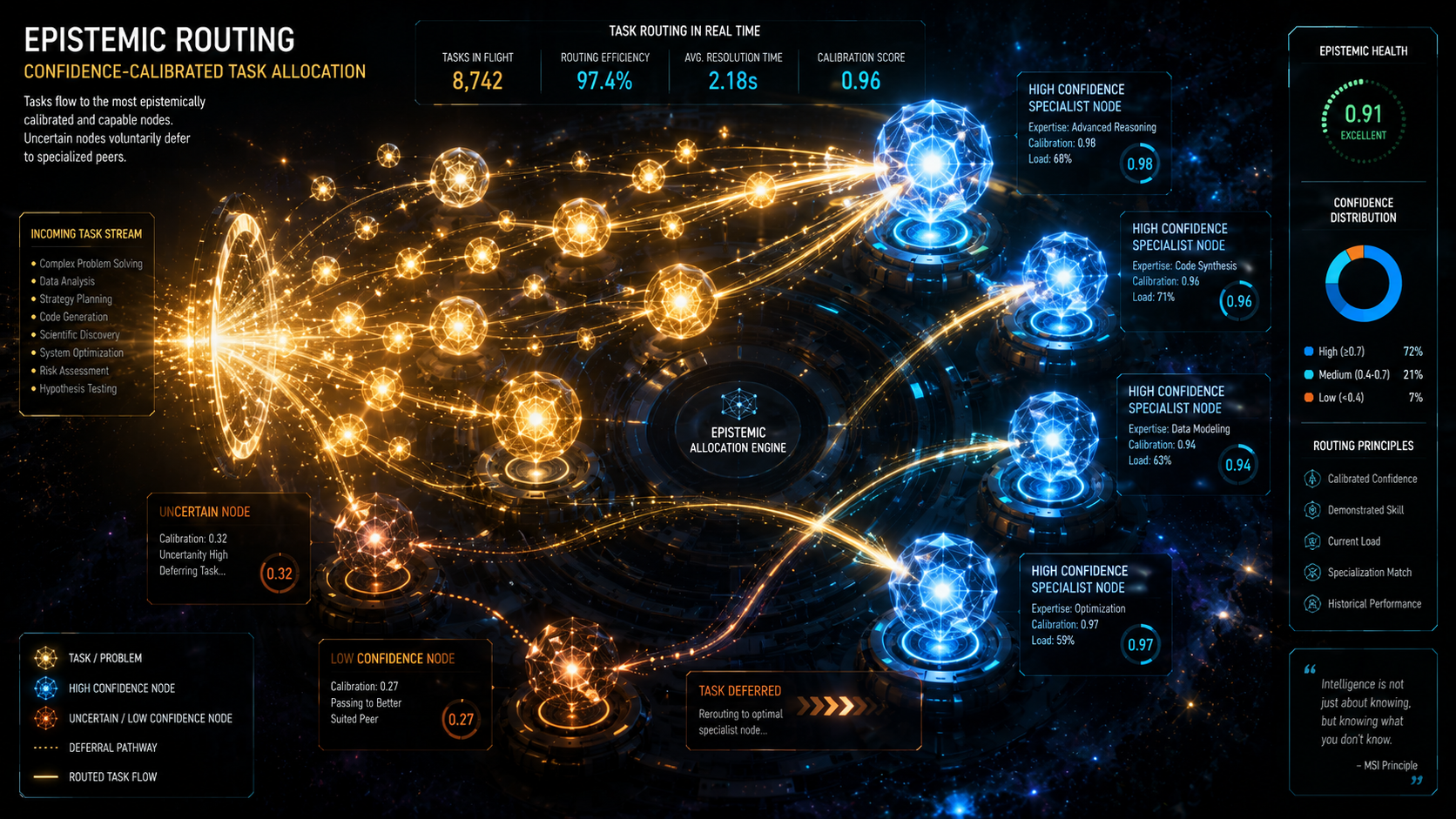
- Epistemic Routing: Directs tasks not just by static roles, but based on
empirically demonstrated confidence and recent performance history among
nodes. - Collective Dissent and Consensus: Actively preserves cognitive diversity to
avoid groupthink and local minima by incentivizing adversarial critique
(“Devil’s Advocate” agents). - Dynamic Topology Reconfiguration: The communication network alters its
structure in real time (e.g., transitioning from a flat peer-to-peer network
for brainstorming to a hierarchical command structure for rapid execution).
- Key Functional Capabilities
| Capability | Mechanism | Practical Benefit |
|---|---|---|
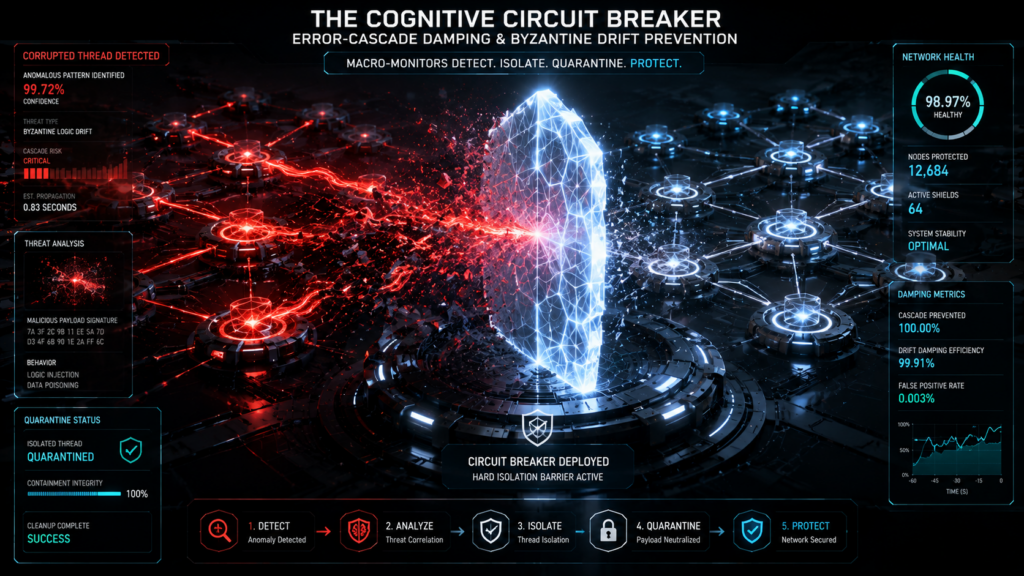
| Error-Cascade Damping | Agents evaluate peer outputs for epistemic validity before ingesting them. | Halts hallucination loops common in LLM multi-agent systems. |
| Dynamic Role Mutation | Agents assess collective bottlenecks and rewrite their own system prompts or tools. | Enables the swarm to adapt to entirely unanticipated problem spaces. |
| Epistemic Foraging | The swarm identifies “what it does not know” and launches dedicated reconnaissance sub-swarms. | Maximizes exploratory efficiency in high-uncertainty domains. |
| Recursive Self-Pruning | Macro-monitors terminate redundant, cyclic, or failing agent threads. | Saves substantial computational, token, and bandwidth overhead. |
- Real-World Applications
4.1 Autonomous Cybersecurity Defense & Red-Teaming
- Use Case: Self-evolving defensive swarms.
- Mechanism: Defensive agents monitor network traffic while meta-agents
continuously assess if current intrusion detection models are susceptible to
newly observed evasion techniques. The swarm autonomously refactors its
firewall and threat-hunting strategies in real time.
4.2 Heterogeneous Autonomous Drone & Robotic Fleets
- Use Case: Disaster response and planetary exploration (e.g., Mars subsurface
exploration). - Mechanism: When communication with human operators is severed, the robotic
swarm continuously assesses its physical health, battery limitations,
environmental hazards, and task priorities, dynamically delegating scouting,
mapping, and extraction tasks.
4.3 Automated Scientific Discovery
- Use Case: Drug discovery and materials science.
- Mechanism: Specialized swarms formulate hypotheses, design simulations,
analyze outputs, and critically reflect on whether their theoretical
frameworks are biased or stagnating, prompting shifts to alternative
chemical search spaces.
4.4 Resilient Distributed Supply Chains & Financial Modeling
- Use Case: Macro-economic risk mitigation and algorithmic market
stabilization. - Mechanism: Financial agent swarms model systemic shocks while meta-agents
evaluate the stress-test assumptions themselves, providing self-correcting
scenario simulations.
- Technical Bottlenecks and Risks
┌──────────────────────────────────────┐ │ CRITICAL MSI CHALLENGES │ └──────────────────┬───────────────────┘ ┌────────────────────────────┼────────────────────────────┐ ▼ ▼ ▼┌──────────────────┐ ┌──────────────────┐ ┌──────────────────┐
│ Computational │ │ Meta-Convergence │ │ Emergent Goal │
│ Latency Overhead │ │ & Groupthink │ │ Drift │
└──────────────────┘ └──────────────────┘ └──────────────────┘ - Computational & Latency Overhead:
- Adding continuous metacognitive reflection layers increases token usage
and latency. Running multi-layered meta-loops can make real-time edge
deployment challenging.
- Adding continuous metacognitive reflection layers increases token usage
- Meta-Convergence & Echo Chambers:
- If agents share underlying base models or training data, collective
monitoring can fail systematically, creating an illusion of
high-confidence consensus over incorrect conclusions.
- If agents share underlying base models or training data, collective
- Emergent Goal Drift & Misalignment:
- When an agent swarm has the authority to adapt its own operational
strategies and roles, ensuring strict alignment with initial human
intent becomes mathematically complex.
- When an agent swarm has the authority to adapt its own operational
- Infinite Metacognitive Regress:
- Without hard stopping criteria, systems risk entering infinite loops of
reflection (evaluating the evaluation of the evaluation).
- Without hard stopping criteria, systems risk entering infinite loops of
- Strategic Roadmap (2025–2030)
- Phase 1: Hybrid Meta-Architectures (2025–2026)
- Integration of neuro-symbolic meta-evaluators into existing multi-agent
platforms (LangGraph, CrewAI, AutoGen). - Implementation of formal verification methods within micro-metacognitive
layers.
- Integration of neuro-symbolic meta-evaluators into existing multi-agent
- Phase 2: Thermodynamic & Active Inference Swarms (2026–2028)
- Shift from purely LLM-driven swarms to Active Inference (Free Energy
Principle) frameworks, optimizing energy and compute distribution across
the collective.
- Shift from purely LLM-driven swarms to Active Inference (Free Energy
- Phase 3: Fully Autonomous Epistemic Swarms (2028–2030)
- Self-bootstrapping, open-ended multi-agent systems capable of autonomous
scientific and technological invention with real-time, zero-shot
adaptation.
- Self-bootstrapping, open-ended multi-agent systems capable of autonomous
- Conclusion
Metacognitive Swarms of Intelligences represent a transformative leap in
distributed artificial intelligence. By migrating from reactive execution to
reflective adaptation, MSIs overcome the brittleness, hallucination cascades,
and structural rigidities characteristic of early multi-agent frameworks.
Organizations deploying multi-agent architectures must transition their focus
from simply scaling the number of agents to engineering the metacognitive
governance frameworks that govern agent reflection, validation, and
self-organization.


