Institutional Migration Strategy: Transitioning from Legacy Intermediation to Autonomous Agentic Networks
- Forensic Failure Analysis: The Economic Case for Migration
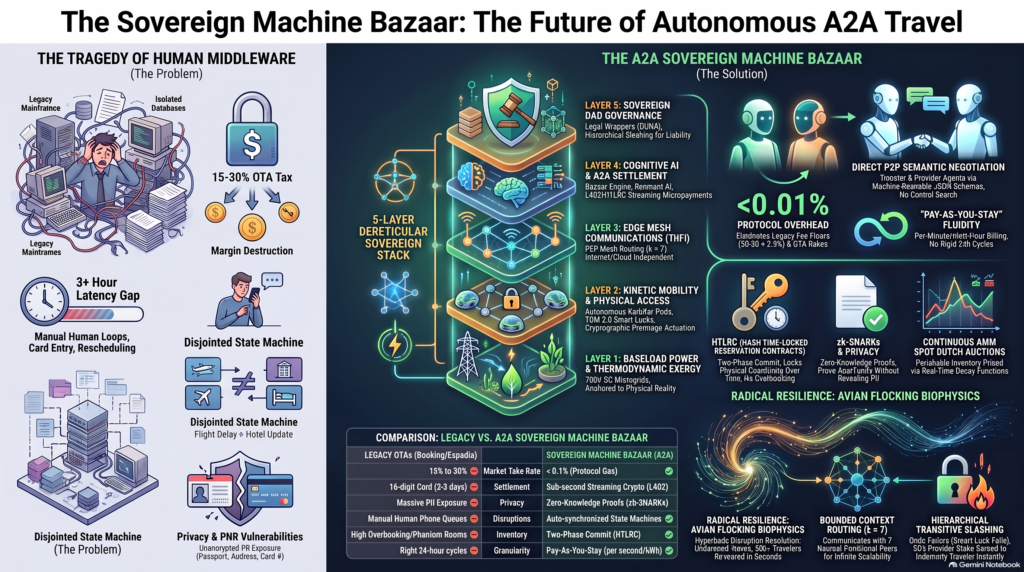
The contemporary hospitality and mobility sectors are crippled by the “Tragedy of Human Middleware.” This structural failure occurs when hyper-advanced cognitive entities, capable of sub-10ms logic, are subordinated to 3-to-48-hour biological latency loops. The strategic necessity of this migration is found in the mandatory shift from human-in-the-loop search paradigms to machine-speed execution. Legacy distribution is currently dominated by the “OTA Tax”—extractive commissions of 15%–30% enforced by “Rate Parity Clauses” that cannibalize provider margins. Furthermore, the “GDS Oligopoly” (Amadeus, Sabre, Travelport) remains anchored in 1960s-era teletype technology, utilizing EDIFACT and Type A/B messaging that imposes a massive “teletype tax” on every transaction.
The “Plastic Wall”—the legacy credit card fee floor (0.30 + 2.9%)—serves as the terminal bottleneck for micro-services. For a granular machine transaction of $0.0004 (e.g., 15ms of inference or a 100-meter transit slice), this fee floor creates a 750x overhead, rendering the unit economics of the agentic economy mathematically inviable on legacy rails.
Legacy Distribution Bottlenecks
Dimension GDS Oligopoly Centralized OTAs Human-Facing GUIs
Technological Basis 1960s Teletype (EDIFACT) Centralized SQL Databases Biological Perception
Economic Take Rate Per-message/transaction taxes 15% – 30% commission tolls High (Search/Ad Capture)
Settlement Latency Days/Weeks (Legacy Batch) 2–3 Days (Stripe/Visa) Biological (Hours/Days)
Identity Privacy Low (Plaintext PNR leaks) Low (PII Exposure) Low (Over-disclosure)
To reclaim capital margins, providers must decouple from these failures and transition to Agent-to-Agent (A2A) pipelines.
- The Agent-to-Agent (A2A) Paradigm Shift
The A2A pipeline represents a machine-native economic network where Graphic User Interfaces (GUIs) are replaced by semantic machine negotiation. This reclaiming of the provider-consumer relationship returns an estimated $120 billion annually from digital monopolies back to physical providers.
Key Differentiators of the Autonomous A2A Pipeline:
- Millisecond Latency: Direct machine-to-machine negotiation bypasses hours of human search/entry.
- Sub-cent Settlement: Cryptographic clearance fees (<$0.0001) enable granular “Pay-As-You-Stay” billing.
- Zero OTA Tolls: Removal of centralized aggregators returns 15–25% of the gross margin to the physical asset operator.
- Sovereign Consumer Agents: Personal copilots interpret traveler preferences to execute direct P2P semantic negotiations without intermediary capture.
A2A systems solve the “Disjointed State Machine” problem—the “Cascading Disruption” where airline, hotel, and transit databases remain mutually blind. By utilizing Level 0 ADS-B telemetry as a definitive trigger, a traveler’s agent can auto-synchronize state machines across the network. If a flight is delayed, the agent immediately adjusts KurbKar arrival times and hotel room keys in seconds, long before a human could pick up a phone.
- The 5-Layer Sovereign Stack: Infrastructure for Autonomy
Hospitality providers must adopt the “DeReticular 5-Layer Stack” to ensure Sustained Island Mode—operational resilience that functions during complete cloud hyperscaler or grid disconnection.
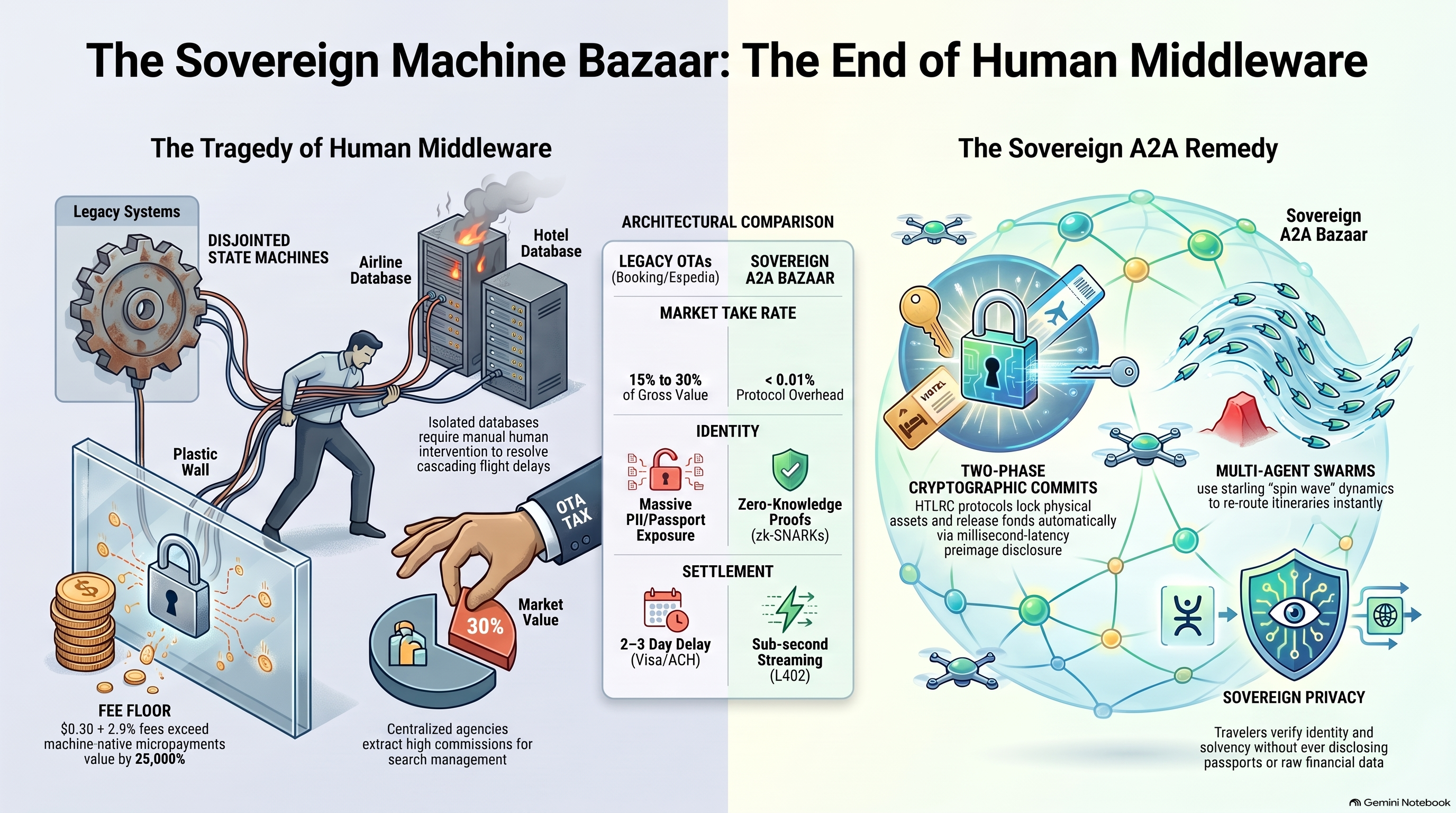
The 5-Layer Architecture:
- Layer 1: Baseload Power (Thermodynamic Exergy): Anchored by Agra.Energy thermochemical gasification and 700V DC native microgrids, providing a non-negotiable physical floor for machine commerce.
- Layer 2: Kinetic Mobility: Autonomous Utility EVs (KurbKars) and TPM 2.0-attested smart locks.
- Layer 3: Edge Mesh: TriFi wireless hardware and P2P mesh routing with sub-16ms RF handoffs.
- Layer 4: Cognitive AI: Remnant AI Engines executing on air-gapped, liquid-cooled RIOS-CC-1000 GPU racks for local inference.
- Layer 5: DAO Governance: Legal-code skins (Wyoming DUNA) and capitalized proof-of-liability.
The Oracle Separation Protocol enforces a strict hierarchy of truth. While Layer 2 (Cryptographic Ledger Integrity) proves a record was not tampered with, it is Level 0 (Ontic Physical Truth)—verified by DC bus shunts, micro-calorimeters, and optical flow encoders—that holds supreme authority. Any Layer 2 consensus or Layer 4 model that contradicts Level 0 sensor data is automatically purged via Via Negativa.
- Cryptographic Trust and Reputation Management
In a decentralized network, subjective 5-star reviews are replaced by objective, hardware-attested data. Identity and reputation are secured by Soulbound Tokens (SBTs) and Poseidon Cryptographic Nullifiers, ensuring that one physical piece of silicon (TPM 2.0) generates exactly one identity vote per epoch, eliminating “Sybil Reputation Rings.”
Brier Calibration and Reliability: Objective service promises (e.g., HVAC temperature stability, Wi-Fi latency) are verified by IoT sensors to calculate a Brier Reliability Score. This eliminates “Fake Review” cartels, as reputation cannot be fabricated without corresponding physical sensor telemetry.
The Cryptographic Cased Tablet Protocol: Utilizing an End-to-End Verifiable (E2E-V) workflow, agents ensure privacy without strategy leakage:
- Homomorphic Commitment: The agent encrypts the budget and bid, keeping the traveler’s wealth unobservable to the network.
- zk-SNARK Range Proofs: The agent generates a proof verifying the traveler meets age requirements (Age \ge 21) and holds a valid passport without revealing any Personally Identifiable Information (PII).
- Atomic Execution: Disclosure of the preimage S simultaneously actuates the physical lock and clears the escrowed payment.
- Economic Settlement: Machine Money and Streaming Rails
“Machine Money” provides an invariant ledger of physical obligation, enabling “Pay-As-You-Stay” granularity.
Economic Mechanics:
- L402 Protocol: Combining HTTP 402 with cryptographic Macaroons enables per-second streaming clearance. Agents can sever the payment stream in milliseconds if service quality (verified by Level 0 sensors) drops.
- Hash Time-Locked Reservation Contracts (HTLRC): Two-Phase Commit logic prevents “Inventory Double-Spend.” The contract requires the presentation of a preimage S to simultaneously unlock the door and clear the funds, locking the physical coordinate mathematically.
- RELA Axiom 3 (Biophysical-Monetary Equivalence): The money supply is strictly bounded by verified net physical exergy produced by microgrids. A token is a redeemable entitlement to physical thermodynamic work, preventing fiat debasement within the Bazaar.
- Risk Management: Slashing and Proof-of-Liability
Capitalized Proof-of-Liability replaces legacy litigation. Autonomous agents bear liability through Wyoming DUNA or Marshall Islands DAO LLC legal skins, with automated enforcement via staked economic bonds.
Hierarchical Transitive Slashing: Failure to deliver physical service results in immediate penalty distribution:
Entity Penalty (Slash %)
Primary Executor (Failed Node) 50% of Staked Collateral
Curator (Verifying Node) 25% of Staked Collateral
Originator (Root Node) 10% of Staked Collateral
Consumer and Systemic Protections:
- Consumer No-Show Bond: Agents post a 15–20% bond to prevent Denial-of-Service attacks on physical real estate.
- Automated Biophysical Veto: A firmware-level hardware relay trips if the projected energy draw exceeds unallocated exergy in the BiophysicalVetoRegister.json. No consensus can override this physical veto.
- The 60-Month Phased Implementation Roadmap
Epoch 1: Specification & Isolated Pilots (Months 1–12)
- Milestones: Deployment of HTLRC wrappers; implementation of Lean 4 AST (Abstract Syntax Tree) verification gates to ensure formal semantic soundness.
- Metrics: Sub-cent settlement success rate; AST-checked directive consistency.
Epoch 2: Airport Enclaves & Transit Corridors (Months 13–24)
- Milestones: Integration of Level 0 ADS-B telemetry; KurbKar-to-Hotel autonomous platooning.
- Metrics: 30% reduction in re-booking latency; 90% reduction in PII exposure.
Epoch 3: Consortium DAOs & Transitive Slashing (Months 25–42)
- Milestones: Formation of Wyoming DUNA coalitions; activation of Non-binding shadow Futarchy and dynamic epistemic routing.
- Metrics: 15% margin recovery (OTA fee capture); 50% reduction in chargeback overhead.
Epoch 4: Full Sovereign Cutover (Months 43–60)
- Milestones: Decommissioning of legacy OTA wrappers; full Sustained Island Mode across edge meshes.
- Metrics: Intermediation fees < 0.1%; city-wide consensus resolution latency < 10 seconds.
- Strategic Conclusion: The Asymptotic Machine Bazaar
The migration to the Sovereign Machine Bazaar signals the terminal collapse of the anthropocentric interface. By anchoring movement in thermodynamic efficiency rather than biological search, we transition to a world of absolute capital efficiency and sovereign privacy.
The Pillars of the New Paradigm:
- Thermodynamic Grounding: Transactions anchored in verified kilowatt-hours and Landauer erasure limits.
- Economic Liberation: Returning $120B to the physical economy by dismantling the “Plastic Wall” and OTA tolls.
- Sovereign Privacy: Frictionless passage via zk-SNARKs and hardware roots of trust.
This is the future of hospitality: an Asymptotic Machine Bazaar where human intent is translated into machine consensus—an invisible, incorruptible architecture of freedom aligned with the objective laws of the physical cosmos.
Provenance Attestation Master Digest (SHA-256): e3b0c44298fc1c149afbf4c8996fb92427ae41e4649b934ca495991b7852b855


