
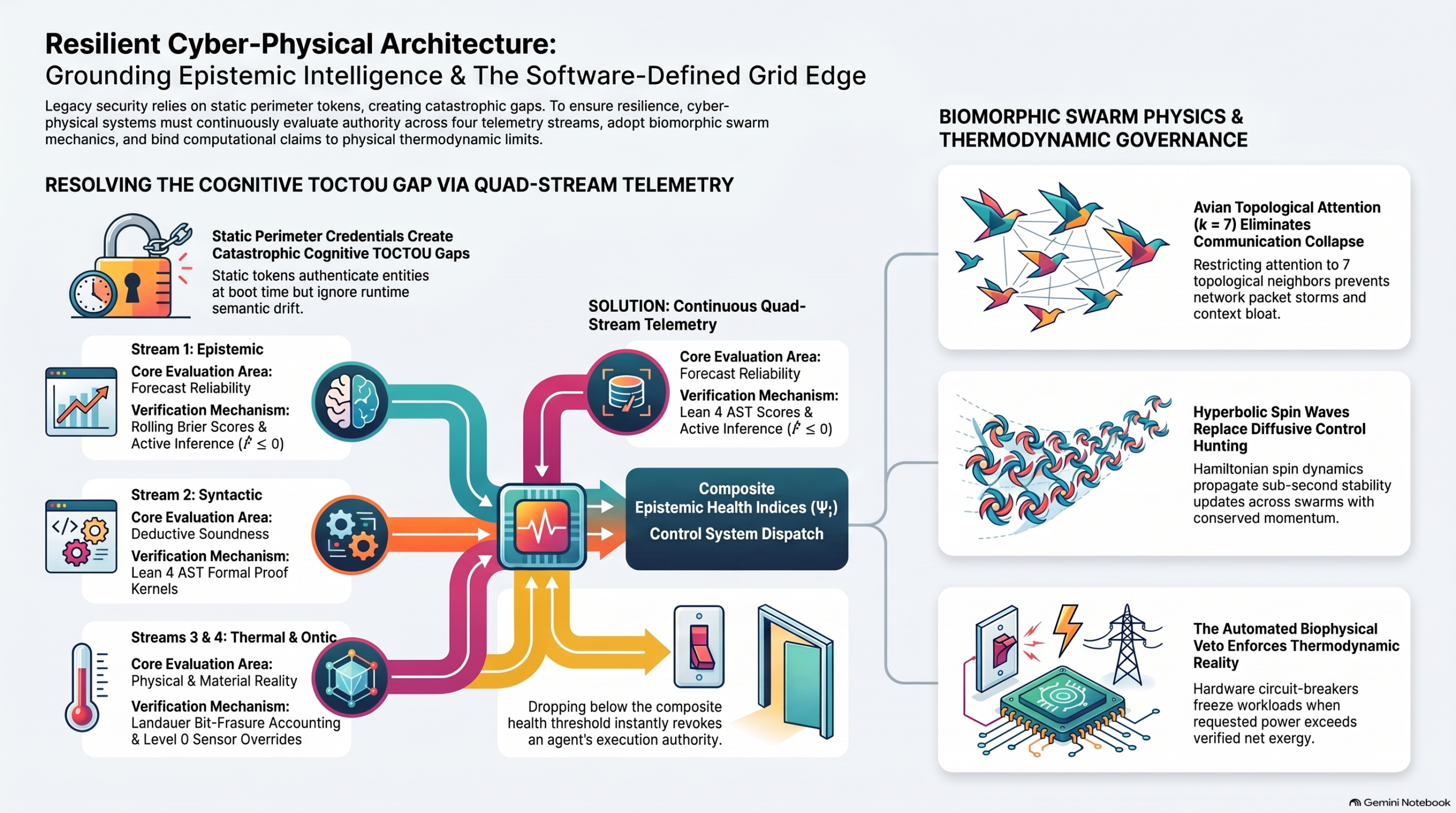
The Physics of Truth: 6 Surprising Lessons from Biophysical Computing and Distributed Systems
- Introduction: The Fragility of Digital Abstractions
Modern technology relies heavily on purely software-based abstractions. We build cloud AI models, record assets on blockchain ledgers, and secure enterprise networks with OAuth2 tokens. Yet, these symbolic representations remain entirely oblivious to the physical reality of power grids, hardware sensors, and industrial systems.
“Systems of intelligence—whether biological human polities, distributed AI swarms, or pervasive sensor networks—collapse into catastrophic failure when their symbolic representations decouple from physical reality.”
Cognitive agents operate on low-dimensional, noise-corrupted observation manifolds while trying to model an infinite-dimensional physical universe. When systems coordinate using ungrounded symbolic tokens, they fall into the “Epicycle Trap.” They add computational parameters and complexity to preserve flawed internal models rather than updating under real-world error, driving predictive validity toward zero.
- Takeaway 1: Your Security Passports Are Broken (The Cognitive TOCTOU Gap)
Enterprise security frameworks—such as OAuth2, JSON Web Tokens (JWT), and static mutual TLS (mTLS)—were designed for deterministic client-server web applications. They authenticate an identity at a single instant (t_0) and issue a static bearer token valid for an unmonitored window of time.
In probabilistic, autonomous AI environments, this static model creates the Cognitive Time-of-Check to Time-of-Use (TOCTOU) Gap.
- t_0 (Perimeter Check): An AI agent or Virtual Power Plant (VPP) aggregator authenticates via mTLS or OAuth2 and is granted a valid bearer token.
- t_1 (Cognitive Drift): Between t_0 and action dispatch, the agent ingests poisoned market data, suffers prompt injection, or experiences context window bloat, causing its internal predictive model to diverge from reality.
- t_{\text{exec}} (Action Execution): The agent dispatches a destructive command. The API gateway verifies the static token signature, finds it valid, and allows execution—turning the agent into a Confused Deputy.
A stark example occurs in energy grids: an authenticated VPP aggregator receives a valid token at t_0. By t_{\text{exec}}, its AI model diverges and issues a setpoint command ordering a 50 MW reverse-power injection onto a constrained 10 MVA feeder. Because traditional security gateways only check who signed the token rather than the payload’s physical sanity, the command executes, causing severe feeder overvoltage and transformer blowouts. Static cryptographic keys must be abandoned in favor of continuous, dynamic runtime evaluation.
- Takeaway 2: What Starlings Can Teach Autonomous Swarms About Preventing Collapses
Biological swarms face the exact same challenge as synthetic IoT networks and multi-agent AI systems: how to maintain rapid cohesion across thousands of independent actors without a central leader or infinite communication bandwidth. High-speed stereoscopic 3D tracking of European starling murmurations (the StarFlag Project) reveals three biophysical mechanisms that solve decision paralysis and network collapse.
- Topological Attention (k \approx 7): Starlings track precisely 7 nearest neighbors regardless of physical density. Metric distance fluctuates dramatically during a predator attack as the flock expands or compresses; topological tracking remains invariant, maintaining graph connectivity without fragmentation. In synthetic mesh networks, restricting routing and attention strictly to k=7 electrical or network peers eliminates context bloat and prevents CSMA/CA packet collisions.
- Scale-Free Correlation (\xi \propto L): Correlation length scales directly with flock diameter L. Poised at a second-order phase transition (criticality), the flock’s susceptibility diverges, enabling instantaneous responsiveness across hundreds of meters without central control.
- Hyperbolic Inertial Spin Waves (\omega(k) = c \cdot k): Direction changes propagate as undamped linear waves (20\text{–}40\text{ m/s}) governed by Hamiltonian spin conservation, where dispersion follows \omega(k) = c \cdot k (c = v_0 \sqrt{J / \chi_0}). This replaces slow, diffusive \mathcal{O}(N^2) consensus debates with fast \mathcal{O}(\log N) or \mathcal{O}(N) updates. In smart grids, Virtual Synchronous Machines (VSMs) mirror this by assigning virtual inertia to grid-forming inverters, allowing frequency updates to sweep feeders with conserved momentum.
Avian Biophysical Principle Synthetic Swarm / Smart Grid Correspondence
Topological Attention (k \approx 7) Bounded Context Routing: Restrict attention strictly to k=7 peers, preserving graph connectivity invariant to spatial density and preventing CSMA/CA packet collisions.
Scale-Free Correlation (\xi \propto L) Criticality Tuning: Operate at second-order phase boundaries to maximize susceptibility (\chi \to \infty), enabling instant swarm responsiveness without central orchestration.
Hyperbolic Inertial Spin Waves (\omega(k) = c \cdot k) Conserved Epistemic Momentum / VSM Control: Propagate updates via undamped wave mechanics (20\text{–}40\text{ m/s}), replacing slow \mathcal{O}(N^2) diffusive debates with sub-cycle Virtual Synchronous Machine inertia.
- Takeaway 3: Blockchain Doesn’t Guarantee Truth (The Oracle Separation Protocol)
A widespread misconception in transactive systems is that distributed ledgers (blockchains) guarantee factual accuracy. A Byzantine-fault-tolerant ledger confirms only that data was cryptographically signed and appended according to protocol rules; it cannot confirm whether that data corresponds to real-world events.
“An immutable, Byzantine-fault-tolerant ledger guarantees only that a transaction was recorded as cast; it cannot verify whether actual electrical work (kWh) was delivered across physical copper wires. An immutable ledger recording a false measurement is simply an unalterable lie.”
To solve this, system architectures must enforce the Oracle Separation Protocol, which strictly separates Level 2 Cryptographic Ledger Integrity (“the transaction was recorded as cast”) from Level 0 Ontic Physical Truth (“the physical kilowatt-hours actually flowed”).
- Level 2 (Cryptographic Integrity): Operates on silicon ledgers, Merkle trees, and zk-SNARKs. It guarantees immutability and provenance but cannot verify physical state.
- Level 0 (Ontic Physical Truth): Operates on copper conductors, magnetic flux, and thermal exergy. Verified directly via physical sensors, calorimeters, and revenue metrology.
This protocol modernizes the Old Babylonian Cased Tablets (2000–1600 BCE). Debt terms were inscribed on an inner clay core, wrapped in a wet clay envelope duplicating the text, and sealed with cylinder seals. If a contract dispute arose, magistrates fractured the outer envelope in court to verify the untampered inner core. Modern End-to-End Verifiable (E2E-V) smart meters adapt this mechanism: metrology hardware encrypts raw active energy into an inner core, wraps it in zero-knowledge proofs (zk-SNARKs) verifying physical sensor integrity, and commits it to a BFT ledger. Clearinghouses verify data using Level 0 mass-energy balancing (E_{\text{substation}} = \sum E_{\text{meter}} + E_{\text{loss}}), fracturing fraudulent envelopes if physical discrepancies emerge.
- Takeaway 4: Continuous Quad-Stream Telemetry: Re-Earning Trust Every Second
Rather than granting authority via boot-time logins, autonomous agents must continuously re-earn execution privileges across four orthogonal telemetry streams:
- Stream 1 (Epistemic Calibration): Evaluates forecast accuracy using rolling Brier scores (\text{BS} \le 0.05) and Active Inference Variational Free Energy (F). If an agent’s free-energy gradient \dot{F} > 0 for 3 consecutive cycles, the agent is suspended for “epistemic delirium.”
- Stream 2 (Syntactic Deductive Soundness): Operational directives must compile into machine-checked Lean 4 Abstract Syntax Trees (ASTs) verifying physical constraints (such as LinDistFlow power flow equations V_{\text{min}} \le V_k – \frac{r P + x Q}{V_0} \le V_{\text{max}}).
- Stream 3 (Thermodynamic & Landauer Accounting): Computations are metered against Landauer’s Principle (\Delta Q \ge N k_B T \ln 2) via the Metabolic Efficiency Ratio: \mathcal{M}{\text{ratio}} = \frac{\Delta F}{\lambda \cdot \Delta Q} = \frac{D{\mathrm{KL}}(q_{\text{new}} \parallel q_{\text{old}})}{\lambda \cdot (N_{\text{bits}} k_B T \ln 2)} Conceptually, \mathcal{M}{\text{ratio}} measures how effectively an agent reduces internal model uncertainty (\Delta F) relative to the physical thermodynamic heat dissipated by erasing VRAM/register bits (\Delta Q). If \mathcal{M}{\text{ratio}} < 1.0, the agent is burning compute without generating informational clarity, triggering a hardware halt.
- Stream 4 (Ontic Physical Resistance): Level 0 physical sensor telemetry (Rogowski coils, PT1000 RTDs) overrides remote software commands whenever real-world physical boundaries are breached.
These streams synthesize into a Composite Epistemic Health Index (\Psi_i(t)). Authority ranges from Tier 1 Veridical Core (\Psi \ge 0.85) down to Tier 4 Byzantine Failure (\Psi < 0.40), which triggers immediate hardware eviction, 50% stake slashing, and instant snap-back reversion to safe mode.
- Takeaway 5: The Automated Biophysical Veto: Subordinating Code to Thermodynamics
Economic and computational platforms frequently suffer from the Macro-Thermodynamic Crack: the mathematical divergence between exponential symbolic claims (D(t) = D_0 e^{rt}, representing financial debt, nominal capacity bids, or compute allocations) and physical reality, which is strictly bounded by net exergy and declining Energy Return on Energy Invested (EROEI).
To eliminate this crack, systems enforce RELA Axiom 3, which strictly bounds all public monetary claims, capacity commitments, and compute allocations to verified net physical exergy:
M_{\text{nominal}}(t) \le \kappa \int_{t_0}^t \left( \text{Exergy}_{\text{net}}(\tau) \cdot \eta(\tau) \right) d\tau
This constraint is operationalized via the Automated Biophysical Veto: an unbypassable, firmware-level circuit breaker embedded in edge infrastructure.
When a proposed workload (such as an AI datacenter training batch or an EV fast-charging queue) requests energy that exceeds the real-time net exergy verified in the local register, physical electromechanical and solid-state shunt relays trip and freeze the queue. The veto operates entirely at the hardware layer and cannot be overridden by administrative decrees, corporate pricing bids, or conversational prompt overrides.
- Takeaway 6: “Bird-on-a-Wire” Engineering: Designing for Hostile Physical Channels
Deploying edge computing and sensor networks directly onto hostile physical boundaries (such as 69\text{–}765\text{ kV} power lines) requires designs rooted directly in electromagnetics and physics:
- Equipotential Faraday Enclosures: Sensor chassis are clamped directly to energized phase conductors. Floating the internal electronics at local phase potential eliminates steady-state line-to-ground dielectric stress.
- Dual-Layer Shielding & Skin-Depth Physics: High-frequency transients (Very Fast Transients with \frac{dV}{dt} > 100\text{ kV}/\mu\text{s}) are absorbed by an outer cast A356 aluminum shell. At 100\text{ MHz}, aluminum skin depth is \delta_{\text{Al}} \approx 8.2\ \mu\text{m}, providing >100\text{ dB} of high-frequency attenuation. However, at 60\text{ Hz}, aluminum skin depth balloons to \delta_{\text{Al}} \approx 10.7\text{ mm}, allowing power-frequency magnetic fields to pass through unhindered and induce eddy currents that cause ADC measurement drift. An inner shield of annealed Mu-metal (\mu_r > 50,000) is required to shunt low-frequency 60\text{ Hz} magnetic flux away from sensitive analog traces.
- Waveguide-Below-Cutoff (WBC): Enclosure vents and apertures are engineered as circular tubes with aspect ratios \ell/d \ge 3, providing >80\text{ dB} of evanescent attenuation below cutoff (f_c \approx 175.7 / d\text{ [mm]} GHz) via \alpha_{\text{dB}} \approx 27.3 \cdot \frac{\ell}{d}.
- Parasitic Nanocrystalline CT Harvesters: Line-mounted sensors harvest operating power using split-core nanocrystalline transformers (\mu_i > 50,000, B_{\text{sat}} \approx 1.25\text{ T}). To survive 30\text{ kA} short-circuit faults (a 4 \times 10^6:1 energy surge), active depletion-mode MOSFET shunts detect secondary overcurrent and short the secondary winding within nanoseconds, collapsing core flux and keeping heat dissipation bounded to I_s^2 R_{DS(\text{on})}.
- Conclusion: Grounding Digital Intelligence in Physical Reality
True system resilience cannot be achieved by layering fragile software abstractions, static API keys, or unbacked ledger tokens over physical reality. As distributed AI swarms and autonomous systems take control of critical infrastructure, digital intelligence must respect physical constraints.
To build durable, self-healing systems, engineers must follow four core imperatives:
- Design for physical channel constraints first—grounding networking and hardware packaging in medium physics.
- Replace static logins with continuous multi-stream runtime execution telemetry—eradicating the Cognitive TOCTOU Gap.
- Separate cryptographic ledger integrity from physical ontic truth—enforcing mass-energy balancing.
- Subject computational and economic systems to thermodynamic exergy limits—deploying automated hardware vetoes.
As you evaluate your current software architectures and AI integrations, ask yourself: Are your digital systems grounded in physical truth, or are they floating in an ungrounded epicycle?


