An Introduction to Project Octagon
1.0 The Big Idea: The ‘Sovereign Stack’ Mission
DeReticular is an industrial infrastructure conglomerate that operates like a venture studio. It has a single, powerful goal: to build the ‘Sovereign Stack’—a complete toolkit for communities to achieve self-sufficiency and operate in ‘Island Mode’. By financing and developing independent operating divisions, DeReticular is creating the tools for a new era of local resilience.
The core philosophy is the “Sovereign Stack” thesis. Its purpose is to enable communities to operate in “Island Mode,” fully independent of failing national grids and fragile supply chains.
The Sovereign Stack is built on three foundational pillars, each providing a critical component for self-sufficiency:
- The Muscle: (Agra Dot Energy) This pillar provides power generation for the community through Plasma Gasification.
- The Motion: (Kurb Kars) This pillar provides autonomous logistics and robotics through the Kurb Kars fleet, handling all physical movement.
- The Mind: (Biz Builder Mike/RIOS) This pillar provides the network intelligence, business architecture (Biz Builder Mike), and the RIOS operating system that directs the entire ecosystem.
The connective tissue holding these pillars together is the RIOS (Rural Infrastructure Operating System). This proprietary “Global Operating System” links all the physical components and locations into a single, intelligent, and responsive network. It employs a Federated Learning Mesh and advanced ‘Signal Fusion’ (bonding Starlink and 5G) to create a resilient, self-improving network capable of operating anywhere on Earth.
This powerful operating system is the brain that directs the physical body of the project: a global network of specialized facilities known as Project Octagon.
2.0 The Global Network: Meet the Eight Nodes
If Project Octagon is a global body, then its eight “Sovereign Nodes” are its vital organs, each performing a unique function essential for the whole organism’s survival and success. Together, they form a federated network where insights from one node strengthen all the others. For instance, autonomous navigation algorithms perfected on the difficult desert roads of Arizona (Node 6) are pushed via network updates to guide agricultural tractors in Uganda (Node 4), a concept known as Federated Learning.
- Node 1 (Uganda): The Concierge, focused on logistics and hospitality operations.
- Node 2 (Canada): The Brain/OS HQ, serving as the central Systems Architect for the entire network.
- Node 3 (Arizona): The Simulator, dedicated to research, development, and sovereign connectivity.
- Node 4 (Uganda): The Industrial Engine, responsible for plasma energy and hemp production.
- Node 5 (Texas): The Energy Student, focused on mastering grid arbitrage.
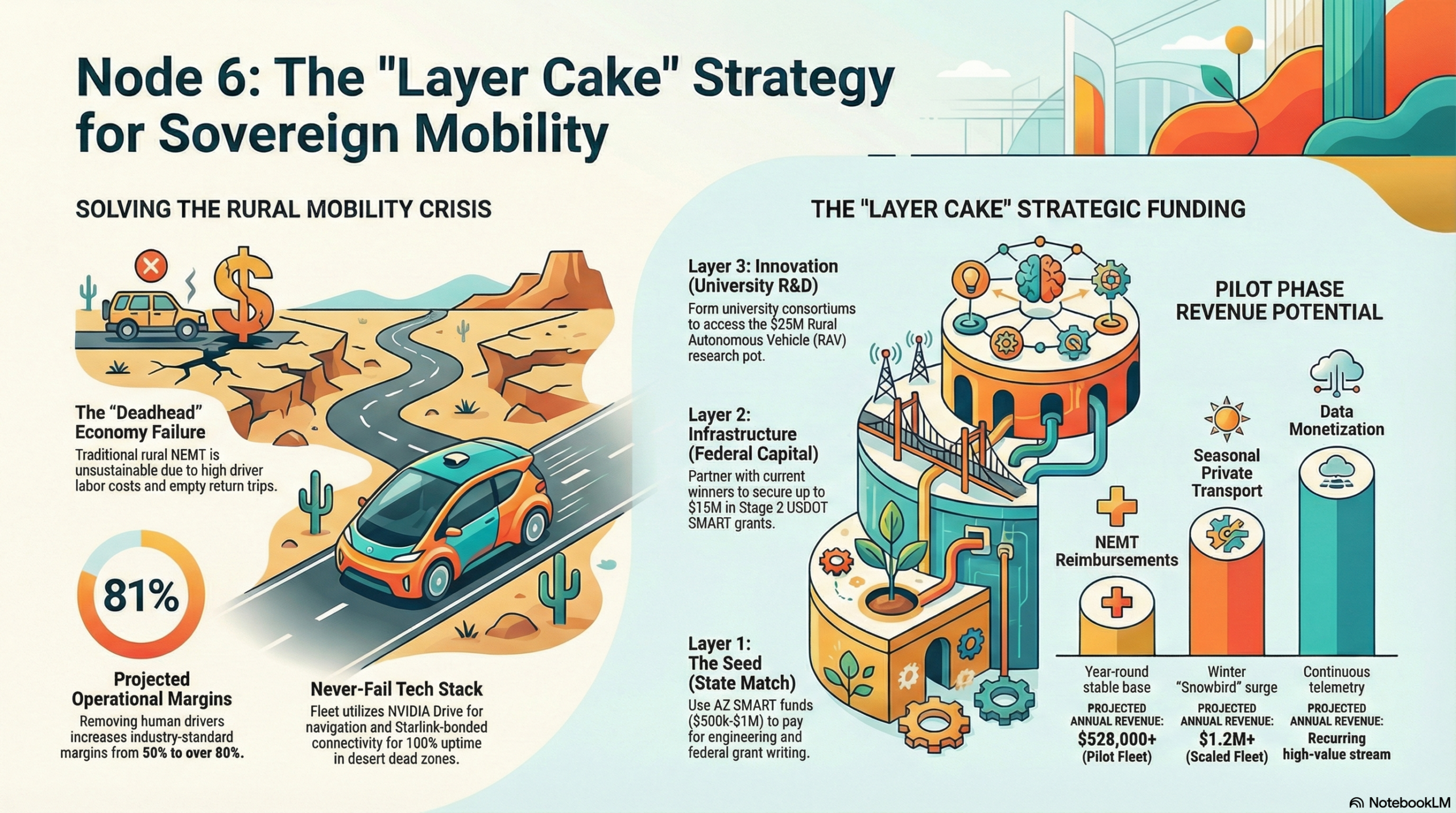
- Node 6 (Arizona): The Autonomous Transportation Division, repurposed from its former governance role to become the dedicated hub for solving the rural Non-Emergency Medical Transportation (NEMT) crisis.
- Node 7 (TBD): The Humanitarian Aid, focused on Global Impact and UN 2.0 initiatives.
- Node 8 (Undisclosed): The Commercial Validator, responsible for proving the economic models of the ecosystem.
3.0 Conclusion: The Power of the Network
Project Octagon is far more than a collection of facilities; it is a living, interconnected global organism. In this body, RIOS is the central nervous system, Node 2 (Canada) is the brain, Node 4 (Uganda) is the digestive system generating energy, and Node 6 (Arizona) is the circulatory system moving critical resources. Each specialized node functions as a vital organ, sharing data and intelligence to create a resilient, self-healing whole. The ultimate goal is to provide a comprehensive, replicable blueprint for building resilient, independent, and thriving communities, turning the ‘last mile’ problem into a ‘first mile’ opportunity anywhere in the world.


