
Briefing Document: Spatiotemporal Ontic Verification, Biophysical Grounding, and Pervasive Computing in Autonomous Systems
- Executive Summary
Modern computational architectures, multi-agent artificial intelligence collectives, and distributed wireless sensor networks (WSNs) face a critical systemic failure mode: the decoupling of digital, symbolic abstractions from physical reality. When computational ledgers, identity frameworks, spatial telemetry, and software execution engines operate without biophysical, thermodynamic, and relativistic grounding, they produce predictable pathologies:
- In Multi-Agent Collectives (MAS): Ungrounded software agents experience semantic drift, context bloat, sycophancy, positive error covariance (\operatorname{Cov}(v_i, v_j) > 0), and the Condorcet Inversion—where correlated errors cause collective majority voting to converge with mathematical certainty on falsehood (\lim_{N \to \infty} P_N = 0).
- In Digital Identity Systems: Disembodied, zero-marginal-cost software identities lead to Sybil attacks, electoral capture, and the erosion of accountability when authority is delegated without transferring physical and economic risk.
- In Spatial Security: Abstract scalar telemetry creates the Spatial Oracle Gap, leaving cyber-physical access points vulnerable to Relay Attacks (Mafia/Wormhole Fraud), GNSS spoofing, and electronic warfare (EW).
- In Pervasive Sensor Networks: Physical deployments fail when transceivers, power architectures, and MAC protocols ignore medium electrodynamics—such as high-voltage electromagnetic interference (EMI), extreme skin-depth attenuation in conductive rock, subsea acoustic refraction, or battery passivation under thermal cycling.
To resolve this crisis, the integrated research corpus across the Resilient Epistemic & Thermodynamic Ledger Architecture (RELA), Durable Self-Correcting Synthetic Ecosystems (DSSE), and Pervasive Physical Computing formalizes a unified cyber-physical framework grounded in natural physical invariants:
- Relativistic & Wave Mechanics: Speed-of-light invariants (c \approx 2.9979 \times 10^8 \text{ m/s}) for Ultra-Wideband (UWB) distance bounding and Time Difference of Arrival (TDoA) hyperbolic multilateration.
- Non-Equilibrium Thermodynamics: Active Inference variational free energy minimization bounded by Landauer’s erasure limit (\Delta Q \ge N k_B T \ln 2) and Exergy-Monetary Equivalence.
- Biomorphic Active-Matter Physics: Avian flocking dynamics translating European starling (Sturnus vulgaris) topological interaction (k \approx 7) and undamped hyperbolic spin waves (\omega = c \cdot k) into distributed computing graphs.
- Hardware-Enforced Silicon Identity: Physical Roots-of-Trust (TPM 2.0 / TEE), Zero-Knowledge Nullifiers, Liquid Epistemic Delegation with conserved liability, and automatic 50% cryptographic stake slashing.
- Physical-Layer Channel Engineering: Specialized transceivers, hard power-gating architectures (I_q < 50 \text{ nA}), Hybrid Layer Capacitor (HLC) battery-passivation buffers, and specialized propagation links (Sub-GHz LEO satellite, VLF magnetic induction, underwater acoustics).
- Foundational Ontology: Identity, Anti-Sybil Proofs, & Liability
2.1 Biological Avian Kinematics vs. Synthetic Agent Identity
In biological ecosystems, identity is an inescapable consequence of physical embodiment. A starling within a murmuration cannot duplicate its presence:
- It possesses non-zero physical mass (m_i \approx 75\text{–}90 \text{ g}) and finite volume (V_i > 0).
- Continuous flight requires metabolic work: P_{\text{aero}} = T \cdot v = \frac{1}{2} \rho v^3 S C_D + \frac{2 m^2 g^2}{\rho v S b^2}
- The interaction potential between two birds separated by distance r_{ij} contains an asymptotic repulsive barrier as r_{ij} \to r_{\text{min}} (V(r_{ij}) \to \infty as r_{ij} \le d_{\text{wingspan}}).
Conversely, unconstrained synthetic software agents suffer from the Zero-Marginal-Cost Identity Catastrophe. An adversary can spawn 100,000 Large Language Model (LLM) instances in seconds. If resource allocation relies on Quadratic Voting (\sum \sqrt{c_i}), splitting capital C across K ephemeral identities inflates voting power by a factor of \sqrt{K}: \sum_{i=1}^K \sqrt{\frac{C}{K}} = K \cdot \sqrt{\frac{C}{K}} = \sqrt{K \cdot C} = \sqrt{K} \cdot \sqrt{C}
Dimension Biological Bird Swarm (Sturnus vulgaris) Synthetic Agent Swarm (RELA / DSSE)
Ontological Basis Kinematic state vector & physical mass: \text{ID}i = (x_i, v_i, s_i, m_i) Relational Epistemic Tuple: \text{ID}i = \langle \sigma{\text{TPM}}, \theta_i, \mathcal{H}{\text{weights}}, \text{BS}k, W_i, \mathcal{S}{\text{FEP}} \rangle
Anti-Sybil Mechanism Spatial exclusion (V > 0), aerodynamic inertia (m > 0), metabolic work constraints Hardware TPM 2.0 Silicon Attestation, ZK nullifier trees, and Landauer erasure cost (\Delta Q \ge N k_B T \ln 2)
Interaction Boundary Topological rank-order (k \approx 6.5 \pm 0.5 \approx 7) Epistemic dynamic routing via Softmax over inverse Brier score (\text{BS}_k)
Role Transference Inertial spin-wave phase handoff (\omega = c \cdot k); instantaneous, boundary-driven turns Liquid Epistemic Delegation with automatic 50% cryptographic stake slashing
Trust Verification Zero symbolic trust; continuous aerodynamic & optical coupling Oracle Separation Protocol; Level 1 Lean 4 AST proofs; Level 0 sensor audits
Terminal Failure Mode Spatial rupture; split due to uncoordinated evasion Sybil swarm takeover; context bloat; model collapse via shared weights
2.2 The RELA Synthetic Relational Identity Tuple
Under the RELA specification, synthetic identity is formalized as an immutable, six-dimensional tuple: \text{ID}i = \left\langle \sigma{\text{TPM}}, ; \theta_i, ; \mathcal{H}_{\text{weights}}, ; \text{BS}k, ; W_i, ; \mathcal{S}{\text{FEP}} \right\rangle
- Hardware Silicon Root (\sigma_{\text{TPM}}): A non-exportable Ed25519 signature generated within a physical Trusted Execution Environment (TEE) or TPM 2.0 cryptoprocessor. It signs Platform Configuration Registers (PCRs) to verify machine boot state and memory isolation: \sigma_{\text{TPM}} = \operatorname{Sign}{\text{AIK}}(H(m) \parallel \text{PCR}{\text{state}})
- Perspectival Frame ID (\theta_i): SHA-256 hash of the agent’s declared observation boundaries, sensor sensitivities, and prompt constraints, formalizing its dimension-reducing projection operator (\hat{\Pi}{\theta_i}: \mathcal{M} \to \mathcal{P}{\theta_i}).
- Disjoint Checkpoint Provenance (\mathcal{H}{\text{weights}}): Cryptographic hash of the foundation neural network weights (\mathcal{H}{\text{weights}} = \operatorname{SHA256}(\mathbf{W}_{\text{model}})). Quorums enforce an Architectural Diversity Invariant: a valid voting quorum must contain at least three structurally distinct model families: {\text{Transformer_Dense}} \cap {\text{State_Space_Model (Mamba)}} \cap {\text{Symbolic_Solver}} \neq \emptyset Nodes sharing identical weight hashes are collapsed into a single vote.
- Historical Brier Reputation Vector (\text{BS}k): The empirical track record of forecast calibration across operational domains \mathcal{D}k: \text{BS}{i, k} = \frac{1}{N} \sum{t=1}^N (f_t – o_t)^2 \in [0, 2]
- Staked Compute Collateral (W_i): Capital or compute tokens locked in escrow, subject to programmatic slashing upon verified failure.
- Active Inference Thermodynamic State (\mathcal{S}_{\text{FEP}}): Runtime telemetry monitoring internal Variational Free Energy (F) and accumulated Landauer erasure dissipation (\Delta Q \ge N k_B T \ln 2).
2.3 Zero-Knowledge Admission & Anti-Sybil Nullifier Trees
To prevent a single physical blade from registering multiple virtual identities, candidate nodes must pass through a Zero-Knowledge admission pipeline:
- Nullifier Generation: The hardware TPM uses an internal private secret S_{\text{TPM}} to derive a deterministic nullifier per epoch T: \mathcal{H}{\text{null}} = \operatorname{Poseidon}(S{\text{TPM}}, \text{Epoch}_T)
- zk-SNARK Proof (\pi_{\text{div}}): Generated via Groth16 or PLONK, attesting that the TPM quote is valid, neural weights satisfy the diversity threshold relative to active swarm weights (\mathcal{D}(\vec{w}{\text{candidate}}, \vec{w}{\text{swarm}}) \ge \delta_{\text{diversity}}), and \mathcal{H}{\text{null}} was correctly derived without disclosing S{\text{TPM}}.
- Ledger Check: If \mathcal{H}{\text{null}} exists in the consensus nullifier tree (\mathbb{T}{\text{nullifiers}}), the transaction is rejected as a duplicate hardware Sybil attempt. If unique, an on-chain non-transferable Soulbound Identity Token (SBT) is issued.
2.4 Liquid Epistemic Delegation & Conserved Liability
When an agent encounters a domain outside its calibration, it signs an on-chain warrant delegating voting power to a domain specialist: \mathcal{W}_{\text{del}} = \operatorname{Sign}_A(\text{Delegatee: } B, ; \text{Domain: } \mathcal{D}_k, ; \text{Weight: } W_A, ; \text{Epoch: } T, ; \text{Max_Depth: } d \le 3)
Under RELA’s Iron Law of Conserved Liability, liability travels strictly with authority:
- Primary Executor Slash: If delegate B signs a directive that breaches real-world Level 0 physical boundaries (S(E_t, \theta) > \tau_t), 50% of the executing delegate’s staked capital is burned.
- Curation/Routing Slash: Intermediate delegating or curating nodes suffer an automatic 25% stake slash for improper routing curation.
- Sponsoring Originator Deduction: A 10% risk deduction is applied to the originator.
- Instant Snap-Back Reversion: The delegation graph is severed instantly at the firmware level, active session capability tokens are revoked, physical actuators lock, and unslashed voting power snaps back to originator self-custody.
- Epistemic Convergence & Swarm Truth Derivation
3.1 Fallibilistic Perspectival Realism & The Condorcet Inversion
The architecture adopts Fallibilistic Perspectival Realism:
- The physical cosmos is an ontic state-space manifold \mathcal{M} where \dim(\mathcal{M}) = D \to \infty. Ground truth is an invariant dynamical attractor state \Omega^* \in \mathcal{M}.
- Each agent operates within an observation frame \theta_i, functioning as a projection operator \hat{\Pi}{\theta_i}: \mathcal{M} \to \mathcal{P}{\theta_i} (\dim(\mathcal{P}_{\theta_i}) = d \ll D).
- Peircean Asymptotic Recovery: Truth is recovered across the pre-images of all valid, mutually orthogonal projection frames over indefinite inquiry: \Omega^* = \lim_{t \to \infty} \bigcap_{\theta \in \Theta_t} \hat{\Pi}\theta^{-1}\left(\mathcal{P}\theta^{\text{validated}}\right)
In ungrounded synthetic swarms, standard majority voting fails due to shared training corpora, correlated system prompts, and conversational sycophancy (information cascades). When positive error covariance (\operatorname{Cov}(v_i, v_j) > 0) causes individual accuracy to drop below chance (p < 0.5), scaling swarm size N under Condorcet’s Jury Theorem guarantees convergence on collective delusion: \lim_{N \to \infty} P(V_N = \omega^*) = 0 \quad (\text{when } p < 0.5)
THE CRISIS OF UNGROUNDED ABSTRACTIONS vs. GROUNDED CYBER-PHYSICAL STACKS
[ UNGROUNDED / UNCONSTRAINED SYSTEMS ] [ GROUNDED CYBER-PHYSICAL STACKS ]
- Disembodied LLM Chaining (Zero-Cost Identity) • Hardware Silicon Roots (TPM 2.0 / TEE)
- Unconstrained Fiat & Majority Voting • Relativistic Invariants (Speed of Light c)
- Abstract Telemetry (Spatial Oracle Gap) • Multi-Static TDoA & UWB Distance Bounding
- Software Sleep Modes (Current Leakage) • Hard Power Gating & Nano-Timers (Iq < 50 nA)
- Software-Only Trust (Vulnerable to Sybils) • Conserved Liability (50% Staked Slashing)
│ │
▼ ▼
[ CATASTROPHIC FAILURE & CASCADE DELUSION ] [ ASYMPTOTIC TRUTH & SYSTEMIC RESILIENCE ]
3.2 Topological Parameter Foreclosure (Via Negativa)
To prevent the Condorcet Inversion, truth is established through the systematic, irreversible elimination of falsified parameter space (Via Negativa). Let active hypothesis space be (\Theta, d_\Theta). Telemetry events E_t evaluate discrepancy loss S(E_t, \theta) against threshold \tau_t: \Omega_{\text{falsified}}^{(t)} = \left{ \theta \in \Theta_t : S(E_t, \theta) > \tau_t \right} \Theta_{t+1} = \Theta_t \setminus \Omega_{\text{falsified}}^{(t)} \implies \frac{d\mu(\Theta)}{dt} \le 0 Under conditions of identifiability and uniform convergence, the Borel-Cantelli Lemma guarantees that the true state \theta^* is never excised almost surely (P\left( \theta^* \in \bigcap_{t=0}^\infty \Theta_t \right) = 1).
3.3 Metacognitive Control Loops & Directive Delivery
Metacognition operates across two nested control loops:
- Micro-Metacognitive Layer (Active Inference & Landauer Halting Gate): Agents minimize Variational Free Energy (F = D_{\mathrm{KL}}(q(\vartheta) \parallel p(\vartheta \mid x)) – \ln p(x)). To prevent infinite autoregressive reflection loops, the Landauer Thermodynamic Halting Gate evaluates heat generated by erasing intermediate context tokens (\Delta Q \ge N k_B T \ln 2). If expected free energy reduction is less than metabolic cost, reflection is forcibly terminated: \text{If } \Delta F < \lambda \cdot \Delta Q, \quad \text{Trigger: } \operatorname{FORCE_ACTION_HALT} \quad (\lambda = 1.25)
- Macro-Metacognitive Layer (Epistemic Task Routing): Tasks are routed using a temperature-scaled softmax over inverse historical Brier scores: P(\text{Route to Agent } i \mid \text{Domain } k) = \frac{\exp(-\gamma \cdot \text{BS}{i, k})}{\sum{j} \exp(-\gamma \cdot \text{BS}_{j, k})} Well-calibrated nodes (\text{BS} \to 0) receive prioritized bandwidth; uncalibrated nodes (\text{BS} \to 2) are starved. Sub-swarms with inverted priors (“Devil’s Advocates”) are spawned to generate counter-examples against emerging consensus.
The Four Cascading Directive Delivery Gates
Directives are executed only after passing four sequential gates:
- Layer 1: Automated Biophysical Veto (Hardware Kill-Switch): Directives execute only if permitted by net physical exergy reserves (M_{\text{nominal}}(t) \le \kappa \int_{t_0}^t \text{Exergy}{\text{net}}(\tau) \eta(\tau) d\tau). If \Delta E{\text{workload}} > \text{Exergy}_{\text{available}}, physical relays open-circuit automatically.
- Layer 2: Machine-Checked Deductive Gates (Lean 4 ASTs): Code and propositions must compile into Lean 4 Abstract Syntax Trees (\Gamma \vdash \psi). Typecheck failure aborts compilation, prunes the search branch, and penalizes the proposer 10% stake.
- Layer 3: Futarchy Prediction Markets: Competing strategies are priced on internal markets predicting an objective welfare function (W = \alpha_1\text{Throughput} + \alpha_2\text{Accuracy} – \alpha_3\text{Exergy Burn}).
- Layer 4: Cryptographic Cased Directive Protocol: Based on ancient Babylonian Cased Tablets, directives are encrypted via homomorphic encryption (C = (g^r, h^r \cdot g^V)) in the Core, wrapped in a zk-SNARK Envelope (\pi), aggregated homomorphically while encrypted, and decrypted at epoch close via threshold BLS key-shares across N \ge 3f + 1 validators.
- Spatiotemporal Ontic Verification (PoL & PoP)
4.1 Level 0 Ontic Authority & Dual Spatial Mechanisms
Treating physical telemetry as abstract data streams creates the Spatial Oracle Gap, exposing access points to Relay Attacks (Mafia/Wormhole Fraud) and GPS spoofing. Under Level 0 Supreme Ontic Authority, physical telemetry overrides digital assertions. Spatial validity is bound to two complementary mechanisms:
+————————————————————————————————–+
| THE DUAL SPATIAL PARADIGM |
+————————————————————————————————–+
| 1. PROOF OF LOCATION (PoL): MACRO-SPATIAL ANCHOR |
| • Reference Frame: Absolute (WGS84 / ECEF coordinates: x, y, z, t). |
| • Physical Mechanism: Multi-party TDoA, carrier-phase multilateration, GNSS. |
| • Question Answered: “Where in the physical universe is this node located?” |
| • Governance Role: Validates DePIN asset deployment and regional jurisdiction. |
+————————————————————————————————–+
▲
│ Bound & Constrained by
▼
+————————————————————————————————–+
| 2. PROOF OF PROXIMITY (PoP): MICRO-RELATIONAL BOUNDARY |
| • Reference Frame: Relative / Relational (Distance metric: d ≤ d_max). |
| • Physical Mechanism: IEEE 802.15.4z UWB Round-Trip Time-of-Flight (ToF). |
| • Question Answered: “Is this agent physically co-present with entity X?” |
| • Governance Role: Prevents relay attacks on smart locks; bounds swarm meshes. |
+————————————————————————————————–+
4.2 Proof of Location (PoL) via Multi-Static TDoA Multilateration
Mobile nodes emitting packets across the terrestrial mesh are cross-referenced by stationary anchor nodes (\mathbf{s}_i, \mathbf{s}_j) with cryptographically certified coordinates:
- Anchors record picosecond-accurate Time of Arrival (t_i, t_j).
- Coordinates \mathbf{x} must satisfy hyperbolic range difference equations: \Delta d_{ij} = c \cdot (t_i – t_j) = |\mathbf{x} – \mathbf{s}_i|_2 – |\mathbf{x} – \mathbf{s}_j|_2
- Spatial discrepancy loss evaluates the residual: S_{\text{spatial}}(E_t, \theta) = \sum_{i, j} \left| c(t_i – t_j) – \left( |\theta – \mathbf{s}_i|_2 – |\theta – \mathbf{s}j|2 \right) \right| If S{\text{spatial}} > \tau{\text{spatial}}, an ontic breach is flagged and the region excised via Via Negativa.
- Anti-Collusion Safety Bound: In a network of N anchors running partially synchronous BFT consensus (N \ge 3f + 1), an adversary must compromise at least f \ge \lfloor N/3 \rfloor + 1 independent hardware anchors to forge a consistent hyperbolic intersection across four non-degenerate planes.
4.3 Proof of Proximity (PoP) & Relay Attack Immunity
Physical actuation points (smart locks, charging couplings) execute IEEE 802.15.4z Ultra-Wideband (UWB) distance-bounding protocols:
- Verifier issues challenge bit sequence c_i at time t_0.
- Prover’s hardware TPM / UWB transceiver reflects response bit sequence r_i at time t_1.
- Verifier measures round-trip time: \Delta t = t_1 – t_0 – t_{\text{proc}} (t_{\text{proc}} = \text{calibrated processing delay}).
- Physical distance is strictly bounded by d \le \frac{c \cdot \Delta t}{2}.
Proof of Speed-of-Light Relay Immunity
If an attacker tunnels a signal across physical distance D_{\text{tunnel}} > 0 over fiber or cellular networks: \Delta t_{\text{min}} = \frac{2(d_{\text{local}} + D_{\text{tunnel}})}{c} + t_{\text{proc}} > \frac{2 d_{\text{max}}}{c} + t_{\text{proc}} = \tau_{\text{rtt}} For a 2.0 \text{ meter} threshold, the total round-trip time budget is \Delta t \le \frac{2 \cdot 2.0 \text{ m}}{2.9979 \times 10^8 \text{ m/s}} \approx 13.34 \text{ ns}. External tunneling introduces milliseconds of latency, causing \Delta t to explode, instantly tripping the hardware circuit-breaker.
4.4 Biomorphic Swarm Discovery & Quad-Stream Health Grading
Nodes discover physical peers using biomorphic starling flocking physics (k \approx 7). Rather than RSSI, nodes conduct pairwise UWB ToF ranging, sorting candidate peers by physical distance to maintain a k=7 topological neighbor graph (\mathcal{G}_t). This preserves scale-free correlation length (\xi \propto L) and undamped spin wave propagation (\omega = c \cdot k).
Continuous runtime health is evaluated across four streams, expanding Stream 4 (Ontic) to include spatiotemporal vectors: \mathbf{S}{\text{ontic}}(t) = \langle S{\text{energy}}(t), ; S_{\text{thermal}}(t), ; S_{\text{PoL}}(t), ; S_{\text{PoP}}(t) \rangle
The Composite Epistemic Health Index (\Psi_i) is derived continuously: \Psi_i(t) = w_1 e^{-\gamma_1 \text{BS}i} + w_2 S{\text{syn}} + w_3 \min(1.0, M_{\text{ratio}}) + w_4 e^{-\gamma_2 S_{\text{ontic}}} Where S_{\text{ontic}} = \alpha_1 \left(\frac{S_{\text{energy}}}{\tau_{\text{energy}}}\right) + \alpha_2 \left(\frac{S_{\text{PoL}}}{\tau_{\text{PoL}}}\right) + \alpha_3 \left(\frac{S_{\text{PoP}}}{\tau_{\text{PoP}}}\right).
Health Range (\Psi) Operational Tier Permissible Network Actions & Rights
0.85 \le \Psi \le 1.00 Tier 1: Veridical Core Full BFT voting; physical door/hatch actuation; high-exergy microgrid transfers.
0.65 \le \Psi < 0.85 Tier 2: Sub-Calibrated Compute throttled 30%; physical actuation requires multi-party PoP witness; context capped.
0.40 \le \Psi < 0.65 Tier 3: Epistemic Warn Excluded from consensus; physical access barred; mandatory external TDoA audit.
0.00 \le \Psi < 0.40 Tier 4: Byzantine Fault IMMEDIATE HALT: 50% stake burned; TPM key revoked; physical relays open-circuited.
- Specialized & Extreme-Environment Physical Computing
Deploying WSNs into specialized physical spaces shifts core engineering constraints across sensing physics, transceivers, network protocols, and power management:
+————————————————————————————————–+
| FOUR-TIER WSN/EDGE ARCHITECTURAL STACK |
+==================================================================================================+
| TIER 4: APPLICATION & DIGITAL TWIN LAYER |
| – SCADA Enterprise Historians – Physics-Informed Digital Twins |
| – Actuation Engines & Closed-Loop Control Orchestrators |
+————————————————————————————————–+
▲ RESTful APIs, gRPC, OPC-UA, AMQP
+————————————————————————————————–+
| TIER 3: MIDDLEWARE, FOG & CLOUD PROCESSING LAYER |
| – Stream Ingestion (Kafka, MQTT) – Distributed State Storage & Device Registry |
| – Containerized Microservices – Over-the-Air (OTA) Firmware Management |
+————————————————————————————————–+
▲ IP Backbone, 5G NR/C-V2X, LEO Satellite, Fiber
+————————————————————————————————–+
| TIER 2: NETWORK & ROUTING LAYER |
| – Mesh & Star Topologies (TSCH, RPL, 6LoWPAN, LoRaWAN, Wi-SUN) |
| – MAC Scheduling, Channel Hopping, Collision Avoidance |
| – Delay-Tolerant Networking (DTN) & Acoustic Depth-Based Forwarding |
+————————————————————————————————–+
▲ Baseband / RF / Acoustic / Quasi-Magnetostatic
+————————————————————————————————–+
| TIER 1: PERCEPTION & PHYSICAL COMPUTING LAYER (WSN NODE) |
| – Transducers (Piezoresistive, Capacitive, Electrochemical, Optical) |
| – Analog Front-End (AFE): Instrumentation Amplifiers (CMRR > 100 dB), Anti-Aliasing Filters |
| – Mixed-Signal Digitization: Multi-Channel SAR / Delta-Sigma ADCs |
| – Compute Engine: Heterogeneous MCUs (ARM Cortex-M, RISC-V) with Hardware Crypto & PUF |
| – Power Management: Sub-microwatt PMICs, Hardware Power Gating, Li-SOCl2 / HLC Buffers |
+————————————————————————————————–+
5.1 Civil Infrastructure & Structural Health Monitoring (SHM)
- Transducer Physics: Micro-vibrations are tracked via low-noise seismic MEMS accelerometers (noise density < 20 , \mu\text{g}/\sqrt{\text{Hz}}). Structural strain utilizes Vibrating Wire Gauges, where mechanical tension alters wire resonant frequency (\Delta \epsilon \propto \Delta f^2), and Fiber Bragg Grating (FBG) optical sensors that reflect specific Bragg wavelengths (\lambda_B) without spark risks.
- Timing Synchronization: Modal vibration analysis requires calculating relative phase shifts across wide structures. CSMA/CA MAC protocols are unsuitable. Systems utilize Time-Division Multiple Access (TDMA) mesh networks combined with IEEE 1588 Precision Time Protocol (PTP) or FTSP, maintaining clock jitter below 10 , \mu\text{s} (< 1 \text{ ms}).
- Key Challenges: Natural temperature cycles obscure structural fatigue, requiring continuous baseline temperature-normalization algorithms. Directional patch antennas and repeaters overcome severe RF attenuation in steel-reinforced concrete.
5.2 Smart Energy, Power Utilities, & High-Voltage Grids
- Transducer Physics: Overhead line clamps monitor Dynamic Line Rating (DLR) using MEMS inclinometers (sag), infrared arrays (core temperature), and ultrasonic anemometers (wind cooling). Current and voltage sensing relies on Rogowski Coils (\text{V}_{\text{out}} \propto \frac{di}{dt}), preventing saturation explosion modes, and Optical Current Transducers (OCTs) using Faraday Effect polarization shifts. Insulation breakdown inside transformers and Gas-Insulated Switchgear (GIS) is detected via Ultra-High Frequency (UHF) RF sensors (300 \text{ MHz}\text{–}1.5 \text{ GHz}) capturing partial discharge pulses.
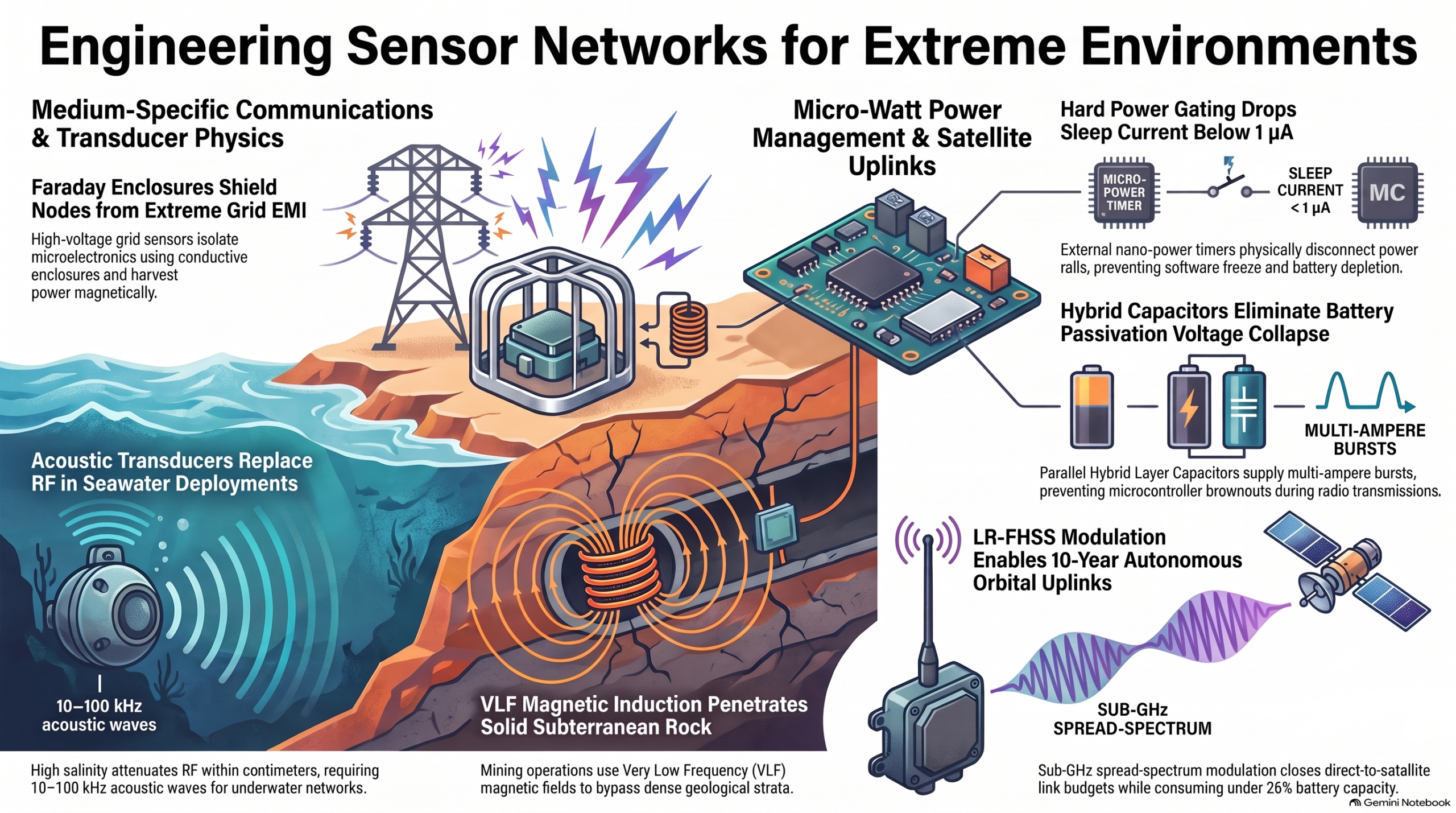
- Electromagnetic Hardening: Switchgear disconnectors generate Very Fast Transients (VFTs) with risetimes < 3\text{–}5 \text{ ns} and slew rates exceeding \frac{dV}{dt} > 100 \text{ kV}/\mu\text{s}. Line-mounted nodes float at high potential inside cast aluminum Equipotential Faraday Shields (6061\text{-T}6). Openings employ Waveguides-Below-Cutoff (WBC) (\ell/d \ge 3), providing > 80 \text{ dB} attenuation. Inner chambers use Mu-metal shielding (\mu_r \approx 50,000\text{–}100,000) against low-frequency magnetic fields.
- Protocol Convergence & Parasitic Energy Harvesting: Nodes run Wi-SUN / IEEE 802.15.4g Sub-GHz mesh networks and integrate with IEC 61850 substation fabrics using prioritized GOOSE/SV profiles. Power is harvested directly from conductor electromagnetic fields using split-core nanocrystalline current transformers (operating down to 15\text{–}20 \text{ A} line current), protected against 40 \text{ kA} line fault surges via high-speed active MOSFET shunts and triac crowbars.
5.3 Mining & Subsurface Geotechnical Operations
- Transducer Physics: Pore water pressure in mine tailings dams is monitored via vibrating wire piezometers (early failure detection). Subterranean rock deflection uses In-Place Inclinometer (IPI) arrays and Multipoint Borehole Extensometers (MPBX). Mine air safety employs electrochemical and pellistor gas sniffers (\text{CH}_4, \text{CO}, \text{NO}_x), while geophone clusters track micro-seismic acoustic emissions for rockburst prediction.
- Subsurface Propagation: Electromagnetic waves suffer extreme skin-depth attenuation in conductive rock (\sigma = 10^{-2} \text{ S/m} yields \approx 1,337 \text{ dB/m} loss at 2.4 \text{ GHz}). Systems use Through-The-Earth (TTE) Very Low Frequency / Extremely Low Frequency (VLF/ELF: 300 \text{ Hz}\text{–}3 \text{ kHz}) induction using large magnetic dipole loop antennas (m = N I A), penetrating hundreds of meters of rock. In underground drifts, nodes bridge to coaxial Leaky Feeder cables.
- Intrinsic Safety (IEC 60079-11 Ex ia): Equipment operating in explosive atmospheres (\text{CH}4, coal dust) must limit electrical and thermal energy. Spark ignition thresholds cap maximum energy at E{\text{spark}} \le 150 , \mu\text{J} (limiting capacitance C \le 2.08 , \mu\text{F} at 12 \text{ V} and inductance L \le 1.2 \text{ mH} at 500 \text{ mA}). Transmitters achieve high magnetic moments safely by tuning coil circuits in series resonance (\omega_0 L = 1/\omega_0 C) driven by low DC supply voltages (3.3 \text{ V}).
5.4 Remote Wilderness Disaster Mitigation
- Transducer Physics: Wildfires are detected during the smoldering phase (hours before thermal satellite detection) using zero-bias electrochemical cells and pulsed-thermal Metal Oxide Semiconductor (MOX) gas arrays tracking \text{CO}, \text{H}_2, and VOCs. Flash floods use non-contact millimeter-wave (mmWave) radar and narrow-beam ultrasonic stage gauges suspended over canyons.
- Hard Power Gating: Software sleep modes (1\text{–}5 , \mu\text{A}) risk cosmic-ray latch-up or excessive cumulative drain (876 \text{ mAh} lost over 10 years at 10 , \mu\text{A}). Wilderness nodes use hard power gating: an external nano-power system timer (e.g., TPL5110, drawing \approx 35 \text{ nA}) disconnects system power rails via low-leakage P-MOSFET load switches (I_{\text{leak}} < 10 \text{ nA}), waking the MCU only for scheduled heartbeats or asynchronous analog comparator interrupts (e.g., TLV7031, I_q = 300 \text{ nA}). Total sleep current is kept below I_{\text{sleep}} \le 405 \text{ nA} – 1.5 , \mu\text{A}.
- Battery Passivation & HLC Buffers: Primary Lithium Thionyl Chloride (\text{Li-SOCl}2) bobbin cells offer energy density > 650 \text{ Wh/kg} and <1% annual self-discharge due to an insulating Lithium Chloride (\text{LiCl}) passivation layer. However, high-current satellite transmission pulses (1\text{–}2 \text{ A}) cause instantaneous passivation voltage collapse (V{\text{terminal}} = V_{\text{OCV}} – I_{\text{pulse}} R_{\text{passivation}}), dropping rail voltage below MCU brownout limits (<2.0 \text{ V}). Nodes wire a Hybrid Layer Capacitor (HLC) (e.g., HLC 1550, ESR < 100 \text{ m}\Omega) in parallel with the bobbin cell. The primary cell trickles current into the HLC; during transmission, the HLC supplies the multi-ampere pulse, maintaining rail voltage above 3.3 \text{ V}.
BATTERY PASSIVATION VOLTAGE COLLAPSE & HLC BUFFER SOLUTION
Terminal Voltage
3.6 V ┌──────────────────────────────────────────────┐
│ │
3.0 V ├──────┐ │
│ │ VOLTAGE DELAY DROP │
2.2 V ├──────┼───────────────────────┐ │
│ │ (MCU Brownout Window) │ │
1.8 V ├──────┴───────────────────────┼───────────────┴── Safe Level (Post-Depassivation)
│ │
└──────────────────────────────┴────────────────── Time (ms)
[ Primary Li-SOCl2 Bobbin Cell ] (High Energy Density, Low Continuous Current: 10–50 mA)
│
├───────────────────────────────────────────────┐
│ Continuous Micro-Current Trickle Charge │
▼ ▼
[ Hybrid Layer Capacitor (HLC) ] [ Low-Leakage System Rail ]
(Low ESR < 100 mΩ, Pulse Output: 2–5 A) │
│ │
└───────────────────────┬───────────────────────┘
│
▼
[ High-Power Satellite PA ]
- Direct-to-Satellite Link Budget Engineering: Nodes transmit telemetry directly to Low-Earth Orbit (LEO) constellations using spread-spectrum modulations (LoRaWAN LR-FHSS, 3GPP Rel-17 IoT-NTN, Iridium SBD).
- Empirical Link Budget (868 MHz to LEO at 800 km slant range, 30^\circ elevation):
- Free Space Path Loss (\text{FSPL}): 20\log_{10}(8\times 10^5) + 20\log_{10}(868\times 10^6) – 147.55 = 149.28 \text{ dB}.
- Transmit Power (P_{\text{tx}}): +22.0 \text{ dBm} (158 \text{ mW}). Transmit Antenna Gain (G_{\text{tx}}): +2.15 \text{ dBi}.
- Atmospheric Loss (L_{\text{atm}}): -0.50 \text{ dB}. Polarization Mismatch (L_{\text{pol}}): -3.00 \text{ dB}. Fade Margin: -3.00 \text{ dB}. Satellite Receive Gain (G_{\text{rx}}): +6.00 \text{ dBi}.
- Total Received Power (P_{\text{rx}}): -125.65 \text{ dBm}.
- Satellite Receiver Sensitivity (LR-FHSS): -137.00 \text{ dBm}.
- Resulting Link Margin: -125.65 – (-137.00) = \mathbf{+11.35 \text{ dB}} (closing the orbital link without tracking dishes).
- Empirical Link Budget (868 MHz to LEO at 800 km slant range, 30^\circ elevation):
10-Year Wilderness Battery Capacity Math Walkthrough
For a flood warning node powered by a single 19 \text{ Ah} \text{Li-SOCl}_2 D-cell with HLC:
- Deep Sleep (99.96% of time, I_{\text{sleep}} = 405 \text{ nA}): 0.405 , \mu\text{A} \times 24 \text{ h} \times 365 \text{ d} \times 10 \text{ yr} = \mathbf{35.5 \text{ mAh}}.
- Hourly Sensor Polling (0.5 \text{ s} at 18 \text{ mA}): 0.060 \text{ mAh/day} \times 3,650 \text{ days} = \mathbf{219.0 \text{ mAh}}.
- Twice-Daily Satellite Uplinks (10 \text{ s} burst at 130 \text{ mA}): 0.722 \text{ mAh/day} \times 3,650 \text{ days} = \mathbf{2,635.3 \text{ mAh}}.
- Total Operational Drain: 35.5 + 219.0 + 2635.3 = 2,889.8 \text{ mAh} \approx \mathbf{2.89 \text{ Ah}}.
- Self-Discharge Derating (10% over 10 years): 1.90 \text{ Ah}. Total chemical usage: 4.79 \text{ Ah} out of 19.0 \text{ Ah}.
- Remaining Capacity Safety Margin: \frac{19.0 – 4.79}{19.0} \times 100% = \mathbf{74.8%}.
5.5 Marine Systems & Underwater Acoustic Sensor Networks (UWSNs)
- Acoustic Imperative: Seawater electrical conductivity (\sigma \approx 4 \text{ S/m}) causes extreme RF attenuation (\alpha_{\text{EM}} \approx \sqrt{\pi f \mu \sigma} \approx 34.5 \text{ dB/m} at 1 \text{ MHz}). Optical signals scatter rapidly, limiting clear water range to < 10\text{–}20 \text{ m}. Marine networks rely exclusively on longitudinal acoustic pressure waves (10 \text{ kHz}\text{–}100 \text{ kHz}) generated by piezoelectric ceramic rings (PZT-4/PZT-8) or magnetostrictive transducers (Tonpilz projectors).
- Propagation Physics & Thorp’s Law: Sound travels at c \approx 1,500 \text{ m/s} (5 orders of magnitude slower than light), introducing extreme propagation delays (0.67 \text{ s/km}). Frequency-dependent chemical absorption \alpha(f) is governed by Thorp’s Equation: \alpha(f) \approx \frac{0.11 f^2}{1 + f^2} + \frac{44 f^2}{4100 + f^2} + 2.75 \times 10^{-4} f^2 + 0.003 \quad [\text{dB/km}] (First term: Boric Acid relaxation; second term: Magnesium Sulfate relaxation; third term: viscous shear).
- Acoustic MAC Protocols: Long delays render standard CSMA/CA useless. UWSNs employ Depth-Based Routing (DBR), where nodes use pressure sensors to measure depth and set dynamic holding delays (t_{\text{hold}} = \tau_{\text{max}} (1 – \frac{\Delta z}{R_{\text{range}}})), allowing the shallowest node to forward first.
- Engineering Hardening: Subsea nodes withstand high hydrostatic pressure (1 \text{ atm} per 10 \text{ m} depth) using Grade 5 titanium, marine aluminum bronze, or PEEK pressure housings. Biofouling (barnacles, slime) altering transducer resonance is mitigated via copper-alloy housings, mechanical wipers, and localized UV-C sterilization.
- Cross-Domain Engineering Comparison Matrix
Domain / Sector Primary Medium & Frequencies Time-Sync Requirement Target Lifespan Primary Energy & Harvesting Dominant Physical Constraints & Protocols Typical Payload Volume
Civil Infrastructure (SHM) RF (2.4 GHz, Sub-GHz Mesh, 5G Uplink) Sub-millisecond (< 10 , \mu\text{s}, PTP / IEEE 1588) 10–30 Years Solar PV, Traffic Vibration Piezo Concrete/steel multipath RF attenuation, thermal signal masking; IEEE 1588, TDMA Mesh High (Waveform time-series)
Smart Grid & Electric Utilities Sub-GHz FHSS (868/915 MHz), 5.8 GHz, Optical Fiber Microsecond (< 1 , \mu\text{s}) 15–20 Years Parasitic E-Field / Split-Core CT Induction Extreme EMI, \frac{dV}{dt} > 100 \text{ kV}/\mu\text{s} transients, 40 \text{ kA} fault surges; Wi-SUN, IEC 61850 GOOSE/SV Medium to High (Waveforms)
Mining & Subsurface Geotechnical TTE Quasi-Magnetic Induction (300 \text{ Hz}\text{–}3 \text{ kHz}), Leaky Feeder RF Low (1–10 s) 2–10 Years External Line, Primary Cell, Ex ia Certified Packs Conductive rock attenuation (\approx 1,337 \text{ dB/m} at 2.4 GHz), spark ignition limits (E \le 150 , \mu\text{J}); IEC 60079-11 Ex ia, TTE VLF Low (Point measurements)
Environmental & Wilderness Disasters Sub-GHz (868/915 MHz), LEO Direct-to-Device (S/L-Band) Medium (100 ms) 5–10 Years Primary \text{Li-SOCl}_2 + Parallel HLC Capacitor Extreme cold (-40^\circ\text{C}), battery passivation drop, deep canopy shadows; LoRaWAN LR-FHSS, 3GPP Rel-17 NTN Minimal (10–50 byte bursts)
Marine Systems & Subsea (UWSN) Acoustic Pressure Waves (1 \text{ kHz}\text{–}50 \text{ kHz}) Very Low (Asynchronous) 1–3 Years (Service-limited) Micro-Wave Harvesters, Microbial Cells, Large Primary Packs Seawater conductivity (\sigma \approx 4 \text{ S/m}), slow sound speed (1,500 \text{ m/s}), 60 \text{ MPa} pressure, biofouling; Depth-Based Routing (DBR) Extremely Small (< 64 \text{ bytes})
Precision Agriculture Sub-GHz RF (868/915 MHz) High Tolerance (10s to 1hr) 3–5 Years Solar PV + \text{LiFePO}_4 Buffer Vegetative canopy path loss (1.5\text{–}4.5 \text{ dB/m} at 2.4 GHz), soil dielectric salinity drift; LoRaWAN, 6LoWPAN Low (Soil permittivity, ambient temp)
Transportation & Logistics Cellular, BLE 5.x, Direct Satellite, C-V2X Dynamic (1s to hours) 2–5 Years Primary \text{Li-SOCl}_2, Vehicle DC ISO Corten steel container cavity resonance (>30 \text{ dB} fading), shock spikes (>4\text{g}); DTN (RFC 5050), BLE Low to Medium (Cached logs)
Healthcare (IoMT / WBAN) Narrowband RF (402\text{–}405 \text{ MHz}), BLE, HBC Low Tolerance (10ms–500ms) Rechargeable (Days/Weeks) Rechargeable Li-Ion, Inductive Qi Tissue RF absorption, strict SAR limits (< 1.6 \text{ W/kg}), 50/60 Hz powerline artifacts; IEEE 802.15.6 Medium (Biopotential ECG/EEG)
Industrial Process Automation 2.4 GHz DSSS, 16-Ch Channel Hopping TSCH Sub-Cycle (10\text{ms}\text{–}100\text{ms}) 5–10 Years Line Power, TEG, Vibration Piezo Harvesters Metallic multipath reflections, motor EMI, explosive atmospheres; WirelessHART (IEC 62591), ISA100.11a High (Extracted spectral FFT peaks)
- Machine-Checkable Schemas, Code Mechanics, & Implementation Roadmap
7.1 Machine-Checkable Data Contract (SpatiotemporalTelemetryFrame.json)
{
“$schema”: “https://json-schema.org/draft/2020-12/schema“,
“$id”: “https://dereticular.org/schemas/v1/SpatiotemporalTelemetryFrame.json“,
“title”: “SpatiotemporalTelemetryFrame”,
“type”: “object”,
“required”: [
“frame_id”,
“agent_uuid”,
“epoch_timestamp_utc”,
“hardware_tpm_quote”,
“proof_of_location”,
“proof_of_proximity”,
“spatial_discrepancy_score”
],
“properties”: {
“frame_id”: { “type”: “string”, “format”: “uuid” },
“agent_uuid”: { “type”: “string”, “format”: “uuid” },
“epoch_timestamp_utc”: { “type”: “string”, “format”: “date-time” },
“hardware_tpm_quote”: {
“type”: “object”,
“required”: [“pcr_bank_digest”, “tpm_signature”, “counter_value”],
“properties”: {
“pcr_bank_digest”: { “type”: “string”, “pattern”: “^[a-f0-9]{64}$” },
“tpm_signature”: { “type”: “string” },
“counter_value”: { “type”: “integer”, “minimum”: 0 }
},
“additionalProperties”: false
},
“proof_of_location”: {
“type”: “object”,
“required”: [“claimed_coordinates”, “multilateration_witnesses”, “tdoa_residual_meters”, “pol_status”],
“properties”: {
“claimed_coordinates”: {
“type”: “object”,
“required”: [“latitude”, “longitude”, “altitude_meters”],
“properties”: {
“latitude”: { “type”: “number”, “minimum”: -90.0, “maximum”: 90.0 },
“longitude”: { “type”: “number”, “minimum”: -180.0, “maximum”: 180.0 },
“altitude_meters”: { “type”: “number” }
},
“additionalProperties”: false
},
“multilateration_witnesses”: {
“type”: “array”,
“items”: {
“type”: “object”,
“required”: [“witness_node_id”, “toa_timestamp_picoseconds”, “witness_signature”],
“properties”: {
“witness_node_id”: { “type”: “string”, “format”: “uuid” },
“toa_timestamp_picoseconds”: { “type”: “integer”, “minimum”: 0 },
“witness_signature”: { “type”: “string” }
},
“additionalProperties”: false
},
“minItems”: 4
},
“tdoa_residual_meters”: { “type”: “number”, “minimum”: 0.0 },
“pol_status”: {
“type”: “string”,
“enum”: [“VERIFIED_COORDINATES”, “TDOA_RESIDUAL_BREACH”, “ORACLE_TIMEOUT”]
}
},
“additionalProperties”: false
},
“proof_of_proximity”: {
“type”: “object”,
“required”: [
“target_entity_uuid”,
“ranging_protocol”,
“round_trip_time_picoseconds”,
“calculated_distance_meters”,
“max_allowable_distance_meters”,
“distance_bounding_passed”
],
“properties”: {
“target_entity_uuid”: { “type”: “string”, “format”: “uuid” },
“ranging_protocol”: {
“type”: “string”,
“enum”: [“IEEE_802_15_4Z_UWB”, “ACOUSTIC_TIME_OF_FLIGHT”]
},
“round_trip_time_picoseconds”: { “type”: “integer”, “minimum”: 0 },
“calculated_distance_meters”: { “type”: “number”, “minimum”: 0.0 },
“max_allowable_distance_meters”: { “type”: “number”, “minimum”: 0.0 },
“distance_bounding_passed”: { “type”: “boolean” }
},
“additionalProperties”: false
},
“spatial_discrepancy_score”: { “type”: “number”, “minimum”: 0.0 }
},
“additionalProperties”: false
}
7.2 Executable Spatiotemporal Verification & Slashing Mechanics
The following logic defines the core execution rules enforced by the system for Proof of Proximity (PoP), Proof of Location (PoL), topological k-NN (k=7) discovery, Quad-Stream ingestion, and transitive stake slashing:
import math
import time
import uuid
import hashlib
import numpy as np
from typing import Dict, List, Tuple, Any
PHYSICAL CONSTANTS
C_LIGHT = 299792458.0 # Vacuum speed of light (m/s)
C_PICO = C_LIGHT / 1e12 # Speed of light in meters per picosecond
K_B = 1.380649e-23 # Boltzmann Constant (J/K)
T_KELVIN = 300.0 # Ambient Temperature (K)
LN_2 = math.log(2)
LAMBDA_EFFICIENCY = 1.25 # Minimum Free Energy reduction per Landauer Joule
class UWBDistanceBoundingVerifier:
“””Enforces UWB speed-of-light distance bounding to defeat relay attacks.”””
def init(self, verifier_id: str, max_allowed_distance_m: float = 2.0):
self.verifier_id = verifier_id
self.max_allowed_distance_m = max_allowed_distance_m
self.calibrated_prover_delay_ps = 5000 # 5.0 ns hardware processing delay
def verify_response(self, t_sent_ps: int, t_recv_ps: int, is_relay: bool = False, relay_delay_ns: float = 0.0) -> Tuple[bool, float, float]:
    if is_relay:
        t_recv_ps += int(relay_delay_ns * 1000)
    total_rtt_ps = t_recv_ps - t_sent_ps
    flight_time_ps = max(0, total_rtt_ps - self.calibrated_prover_delay_ps)
    measured_distance_m = (flight_time_ps * C_PICO) / 2.0
    delta_time_ns = total_rtt_ps / 1000.0
    passed = measured_distance_m <= self.max_allowed_distance_m
    return passed, measured_distance_m, delta_time_ns
class TDoALocationVerifier:
“””Computes hyperbolic range difference multilateration across fixed anchors.”””
def init(self, anchor_positions: Dict[str, np.ndarray]):
self.anchors = anchor_positions
def verify_claimed_location(self, claimed_pos: np.ndarray, arrival_timestamps_ps: Dict[str, int], tolerance_m: float = 5.0) -> Tuple[bool, float]:
    anchor_ids = list(arrival_timestamps_ps.keys())
    if len(anchor_ids) < 4:
        return False, 999.0
    ref_anchor = anchor_ids[0]
    ref_time = arrival_timestamps_ps[ref_anchor]
    ref_pos = self.anchors[ref_anchor]
    residuals = []
    for other_anchor in anchor_ids[1:]:
        other_time = arrival_timestamps_ps[other_anchor]
        other_pos = self.anchors[other_anchor]
        measured_delta_d = (other_time - ref_time) * C_PICO
        expected_delta_d = np.linalg.norm(claimed_pos - other_pos) - np.linalg.norm(claimed_pos - ref_pos)
        residuals.append(abs(measured_delta_d - expected_delta_d))
    mean_residual_m = float(np.mean(residuals))
    return mean_residual_m <= tolerance_m, mean_residual_m
class SpatiotemporalEpistemicNode:
“””Autonomous Node executing Quad-Stream Telemetry and k-NN (k=7) Swarm Discovery.”””
def init(self, node_id: str, initial_stake: float, initial_pos: np.ndarray):
self.node_id = node_id
self.stake = float(initial_stake)
self.position = initial_pos
self.health_index = 1.0
self.is_quarantined = False
self.K_TOPOLOGICAL = 7
self.topological_neighbors: List[‘SpatiotemporalEpistemicNode’] = []
def update_topological_neighbors(self, swarm: List['SpatiotemporalEpistemicNode']):
    """Tracks exactly k=7 nearest neighbors using physical distance."""
    distances = [(np.linalg.norm(self.position - other.position), other) for other in swarm if other.node_id != self.node_id]
    distances.sort(key=lambda x: x[0])
    self.topological_neighbors = [node for _, node in distances[:self.K_TOPOLOGICAL]]

def evaluate_quad_telemetry(self, telemetry_frame: Dict[str, Any]) -> Tuple[bool, float, str]:
    if self.is_quarantined:
        return False, 0.0, "EXECUTION_BLOCKED_NODE_QUARANTINED"

    # 1. Syntactic Stream
    if telemetry_frame["syntactic_stream"]["typecheck_status"] != "TYPECHECK_SUCCESS":
        self.stake *= 0.90
        return False, self.health_index, "ABORT_SYNTACTIC_DEDUCTION_FAILED"

    # 2. Thermodynamic Stream (Landauer Limit)
    delta_q = telemetry_frame["thermodynamic_stream"]["erased_bits"] * K_B * T_KELVIN * LN_2
    delta_f = telemetry_frame["epistemic_stream"]["free_energy_delta"]
    if delta_f < (LAMBDA_EFFICIENCY * delta_q):
        return False, self.health_index, "HALT_LANDAUER_METABOLIC_REGRESS"

    # 3. Ontic Stream (Level 0 Spatial Verification)
    ontic = telemetry_frame["ontic_stream"]
    if not ontic["pol_verified"] or not ontic["pop_verified"] or ontic["spatial_discrepancy"] > ontic["tau_spatial_threshold"]:
        slashed = self.stake * 0.50
        self.stake -= slashed
        self.health_index = 0.0
        self.is_quarantined = True
        return False, 0.0, f"CRITICAL_SPATIAL_BREACH_SLASHED: Lost {slashed:.2f} Credits"

    s_epistemic = math.exp(-1.5 * telemetry_frame["epistemic_stream"]["rolling_brier_score"])
    s_ontic = math.exp(-2.0 * (ontic["spatial_discrepancy"] / ontic["tau_spatial_threshold"]))
    self.health_index = 0.25 * s_epistemic + 0.25 * 1.0 + 0.20 * min(1.0, telemetry_frame["thermodynamic_stream"]["metabolic_ratio"]) + 0.30 * s_ontic
    return True, self.health_index, "TELEMETRY_VERIFIED_NOMINAL"
class TransitiveSlashingRouter:
“””Executes multi-hop hierarchical stake slashing upon verified Level 0 failure.”””
def init(self, stakes: Dict[str, float]):
self.stakes = stakes
def execute_spatial_slash(self, lineage: List[str], reason: str) -> Dict[str, Any]:
    executor, curator, originator = lineage[-1], lineage[-2] if len(lineage) >= 2 else None, lineage[0]
    manifest = []
    if executor in self.stakes:
        burn = self.stakes[executor] * 0.50
        self.stakes[executor] -= burn
        manifest.append({"node": executor, "role": "EXECUTOR", "burned": burn})
    if curator and curator in self.stakes:
        burn = self.stakes[curator] * 0.25
        self.stakes[curator] -= burn
        manifest.append({"node": curator, "role": "CURATOR", "burned": burn})
    if originator in self.stakes:
        burn = self.stakes[originator] * 0.10
        self.stakes[originator] -= burn
        manifest.append({"node": originator, "role": "ORIGINATOR", "burned": burn})
    return {"status": "HIERARCHICAL_SLASHING_COMMITTED", "reason": reason, "slashes": manifest, "snap_back_target": originator}
7.3 Phased 60-Month Operational Roadmap
60-MONTH CONSTITUTIONAL & SPATIAL PHASEOUT TIMELINE
EPOCH 1: AUDITING & UWB PILOTS EPOCH 2: TRIFI TDoA INTEGRATION
(Months 1–12) (Months 13–24)
┌─────────────────────────────────┐ ┌─────────────────────────────────┐
│ • Deploy UWB Distance Bounding. │ │ • Calibrate TriFi TDoA meshes. │
│ • Pilot PoP on smart locks. │──►│ • Integrate DePIN sensor feeds. │
│ • Shadow spatial logging active.│ │ • Enforce zk-PoL for EV routes. │
└─────────────────────────────────┘ └────────────────┬────────────────┘
│
▼
EPOCH 4: SOVEREIGN SPATIAL CUTOVER EPOCH 3: THE BINDING SPATIAL VETO
(Months 43–60) (Months 25–42)
┌─────────────────────────────────┐ ┌─────────────────────────────────┐
│ • Decommission legacy GNSS/SSO. │ │ • Enact Constitutional Spatial │
│ • Full Asymptotic Convergence. │◄──│ Veto across all public bids. │
│ • Sustained Island Mode active. │ │ • Activate 50% spatial slashing.│
└─────────────────────────────────┘ └─────────────────────────────────┘
- Epoch 1: Auditing & UWB Pilots (Months 1–12): Upgrade all physical smart locks, passenger doors, and microgrid skids with IEEE 802.15.4z UWB chipsets. Enforce sub-nanosecond distance-bounding challenge-responses. Log spatial discrepancy frames in shadow mode.
- Epoch 2: TriFi TDoA Integration (Months 13–24): Deploy nanosecond-synchronized clocks across high-gain directional mesh hardware. Implement multi-static hyperbolic multilateration across municipal microgrids to provide ground-truth Proof of Location independent of civilian GPS.
- Epoch 3: The Binding Spatial Veto (Months 25–42): Integrate SpatiotemporalTelemetryFrame.json into core consensus. Enforce automatic 50% stake slashing for nodes reporting spoofed coordinates or failing distance bounds. Activate the spatial circuit-breaker across all agent reservation contracts.
- Epoch 4: Full Sovereign Spatial Cutover (Months 43–60): Fully decommission perimeter Single Sign-On (SSO/JWT) and unauthenticated civilian GPS across all enclaves. Autonomous swarms navigate, authenticate, and clear commerce in Sustained Island Mode—grounded in biophysical thermodynamics and relativistic physics.


