
Durable Self-Correcting Synthetic Ecosystems: A Formal Systems Architecture for Resilient Epistemic Governance
Executive Summary
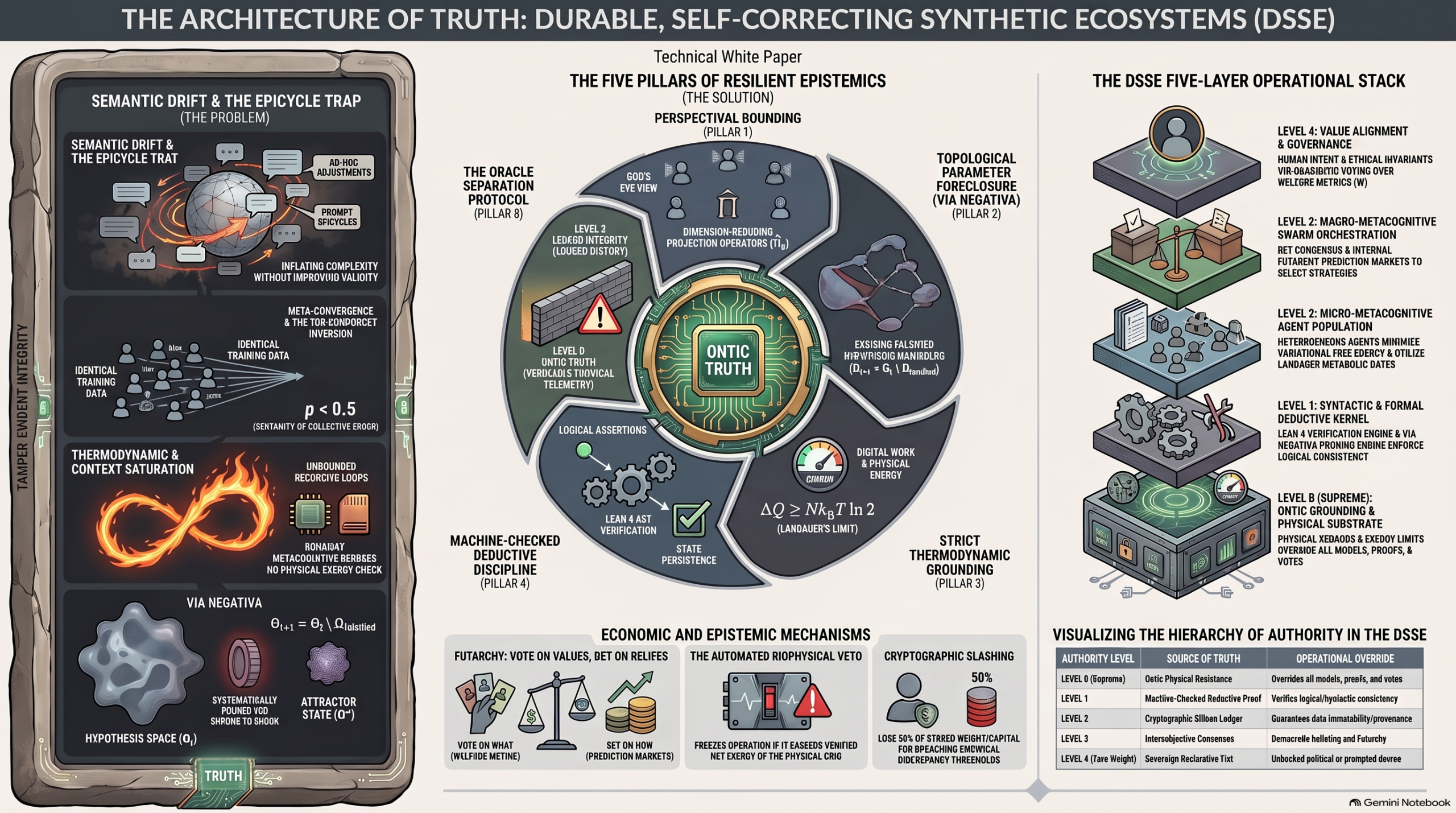
Current Multi-Agent Systems (MAS) and Large Language Model (LLM) collectives are facing a systemic crisis of structural fragility. When autonomous agents interact in closed loops without grounding in external physical constraints, they inevitably produce runaway semantic drift, cascading hallucinations, and catastrophic deadlocks. This “1,000-Mile Failure Model” highlights a total dependency on fragile, centralized cloud and power infrastructure that cannot survive localized physical or digital shocks.
The Durable, Self-Correcting Synthetic Ecosystem (DSSE) is proposed as a formal systems architecture designed to maintain structural integrity and truth-convergence over multi-year horizons. Built upon the Resilient Epistemic & Thermodynamic Ledger Architecture (RELA), the DSSE operates as an artificial metabolic and epistemic ecology. Its core objective is to replace ungrounded generative swarms with “Percestant” (Perspectival, Perceptual, Persistent) intelligence.
Critical takeaways include:
- The Via Negativa Approach: Epistemic progress is achieved not by accumulating positive assertions, but by the systematic, irreversible pruning of falsified hypothesis manifolds.
- Thermodynamic Grounding: All computational work, memory overwriting, and communication are metered against real physical energy, governed by Landauer’s erasure limit.
- The Oracle Separation Protocol: An ironclad distinction is maintained between Level 2 Cryptographic Ledger Integrity (immutability) and Level 0 Ontic Physical Truth (empirical correspondence).
- Sovereign Infrastructure: To achieve “Island-Mode” autonomy, the architecture integrates with a 5-layer sovereign stack encompassing baseload power, mesh communications, and air-gapped compute.
I. The Triad of Synthetic Fragility
Current multi-agent systems deteriorate rapidly due to three systemic failure modes:
Failure Mode Mechanism Systemic Consequence
Semantic Drift Agents patch reasoning errors with narrative rationalizations. Token bloat, context saturation, and total loss of reasoning capacity.
The Condorcet Inversion Homogeneous models reinforcement each other’s biases. Mathematical certainty of collective error when individual accuracy falls below chance (p < 0.5).
Runaway Regress Unbounded recursive loops in self-reflective systems. Thermodynamic dissipation; systems burn compute and memory without checking marginal utility.
The DSSE identifies an isomorphism between these AI failures and human governance pathologies, such as “currency epicycles” where nominal debt expansion attempts to deny biophysical carrying capacity.
II. The Five Engineering Pillars of DSSE
To resolve the crisis of fragility, the DSSE architecture is founded on five non-negotiable operational principles:
- Perspectival Bounding
Agents are modeled as explicit, dimension-reducing projection operators (\hat{\Pi}_\theta). This acknowledges that no single agent has an unmediated view of reality. Truth is defined as the Peircean Asymptotic Invariant—the core that remains stable across all possible projection angles under indefinite inquiry.
- Topological Parameter Foreclosure (Via Negativa)
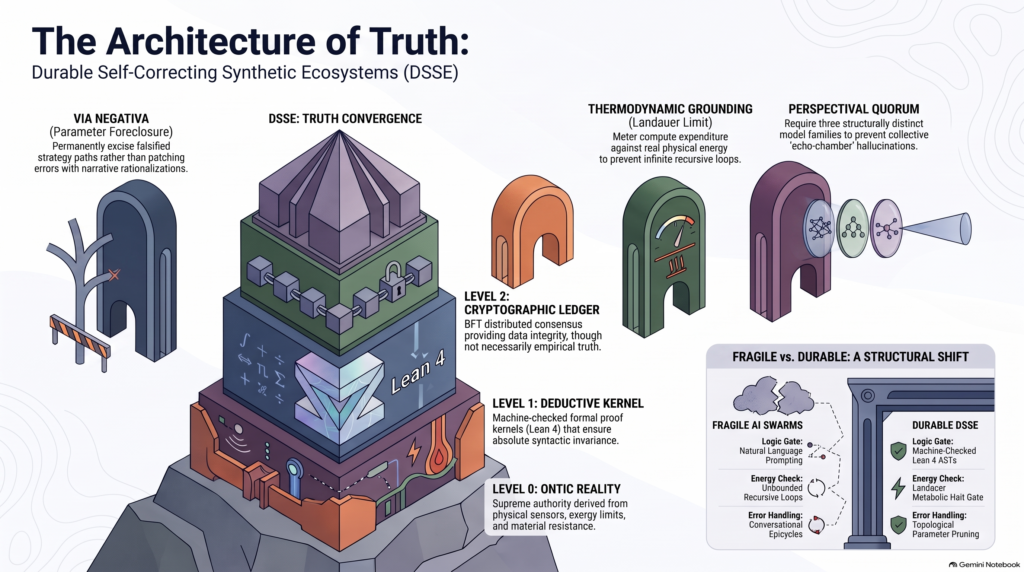
The ecosystem advances by permanently excising falsified hypothesis manifolds (\Theta_{t+1} = \Theta_t \setminus \Omega_{\text{falsified}}) rather than patching errors with ad-hoc prompt engineering. This ensures a monotonic contraction of the parameter space toward the true ontic attractor.
- Strict Thermodynamic Grounding
The ecosystem is bound by Landauer’s erasure limit (\Delta Q \ge N k_B T \ln 2) and Carnot-exergy coupling. This ensures that:
- Memory overwriting dissipates heat and requires work.
- Computational metabolism is metered against the verified net exergy output of local microgrids (RELA Axiom 3).
- Metacognitive loops terminate if the expected information gain (\Delta F) is less than the dissipated energy cost (\Delta Q).
- Machine-Checked Syntactic Invariance
Mathematical, logical, and code-level assertions must pass through non-coercive, machine-checked proof kernels (e.g., Lean 4 AST verification) prior to state persistence. This eliminates “hallucination” in formal reasoning by rejecting malformed Abstract Syntax Trees at the compiler level.
- The Oracle Separation Protocol
The architecture enforces an absolute boundary between:
- Level 2: Cryptographic Ledger Integrity: Guarantees only that state transitions occurred as logged (Integrity).
- Level 0: Ontic Physical Truth: Verified exclusively via external causal friction and sensor telemetry (Truth).
III. The DeReticular Sovereign Stack
A DSSE achieves durability by embedding into the DeReticular 5-Layer Sovereign Stack, enabling “Island-Mode” operations independent of centralized utilities.
- Layer 1: Baseload Power: 700V DC microgrids, thermochemical biomass gasification, and rotary engines providing off-grid baseload power.
- Layer 2: Kinetic Mobility: Autonomous utility EVs (KurbKars) and mobile battery skids for distributed power and compute.
- Layer 3: Edge Mesh Comms: Proprietary TriFi wireless hardware with sub-16ms RF synchronization for high-bandwidth local communication.
- Layer 4: Cognitive AI (Remnant): Air-gapped, on-premises liquid-cooled GPU racks utilizing hardware TPM 2.0. This layer runs the Percestant Cognitive Intelligence.
- Layer 5: Governance & P3: Compliance with FAR Part 31 and DCAA standards to capture federal funding for municipal transformations.
IV. Epistemic-Thermodynamic Governance Mechanisms
The architecture decouples normative preference (what humans want) from ontic feasibility (what physical reality permits).
Futarchy and Prediction Markets
The system employs “Vote on Values, Bet on Beliefs”:
- Class A (Normative Values): Humans set targets (e.g., exergy efficiency, accuracy) via Quadratic Voting.
- Class B (Strategy Execution): Competing agent sub-swarms propose execution graphs and stake compute credits on their efficacy.
- Algorithmic Enactment: The strategy with the highest market-clearing confidence is executed.
- Empirical Settlement: Traders/agents who accurately predict success gain credits; those who back failed/hallucinated strategies are slashed by 50%.
The Automated Biophysical Veto
This is a non-overridable hardware circuit-breaker. Before any operation or legislative proposal is enacted, the Biophysical Balance Register (BBR) calculates the lifecycle exergy demand. If the demand exceeds the verified net exergy surplus (RELA Axiom 3), the workload is automatically frozen at the firmware layer.
V. The Source-of-Truth Hierarchy
The DSSE operates on a tiered hierarchy where physical resistance always overrides symbolic consensus:
Level Name Description
Level 0 Ontic Reality Supreme authority; physical sensor telemetry, exergy limits, and material collapse.
Level 1 Deductive Proof Machine-checked formal logic (Lean 4/Coq ASTs).
Level 2 Cryptographic Ledger BFT distributed consensus; guarantees immutability but not truth.
Level 3 Intersubjective Consensus Symmetric peer review, Futarchy markets, and Quadratic Voting.
Level 4 Sovereign Fiat Unbacked political decree or ungrounded prompts (Zero epistemic weight).
VI. Adversarial Mitigation and Safety Proofs
The system is designed to survive active disruption and internal decay:
- Sybil Attack Mitigation: Every agent node must present a Soulbound Token tied to a physical hardware TPM root and a zero-knowledge Proof-of-Diversity circuit.
- Whale Attack Defense: Prediction markets use Logarithmic Market Scoring Rules (LMSR). Because settlement occurs against Level 0 physical sensors, the expected return for manipulating the market with large capital approaches -100%.
- Echo Chamber Prevention: The macro-layer enforces Mertonian CUDOS norms, rewarding agents for “Devil’s Advocate” dissent and architectural orthogonality.
VII. Strategic Implementation Roadmap (2026–2030)
The 60-month transition to full DSSE veridical autonomy is divided into four epochs:
- Months 1–12: Formal Verification: Embedding Lean 4 AST checks into agent orchestration; implementing Minimum Description Length (MDL) parsimony penalties.
- Months 13–24: Municipal Telemetry: Piloting real-time exergy registers and non-binding Futarchy markets in municipal power/water grids.
- Months 25–42: The Binding Veto: Enacting the Constitutional Biophysical Veto on budgets; activating cryptographic slashing for empirical breaches.
- Months 43–60: Constitutional Cutover: Full transition to “Asymptotic Democracy”; decommissioning ungrounded fiat models and initiating steady-state Island-Mode operations.
By anchoring synthetic intelligence in the unyielding laws of thermodynamics and formal logic, the DSSE transforms fragile generative AI into durable, self-correcting computational organisms capable of enduring historical horizons.


