KurbKar Autonomous Swarms and the DeReticular Sovereign Stack: A New Architecture for Medical Transit and Kinetic Autonomy
Executive Summary
The convergence of autonomous kinetic swarms and mission-critical public health infrastructure requires a total departure from the centralized cloud-and-perimeter computing paradigms of the last decade. Current autonomous vehicle (AV) deployments are hampered by the “1,000-Mile Failure Model” (high-latency cellular backhauls), “Mass-Energy Inversion” (using 5,000-lb vehicles to move 170-lb passengers), and uncoordinated “Solitary God” omniscience fallacies.
This briefing outlines a foundational systems architecture for KurbKar Autonomous Swarms, specifically applied to Non-Emergency Medical Transportation (NEMT). By synthesizing biomorphic active matter kinetics—modeled on avian starling murmurations—with a zero-trust, hardware-anchored sovereign stack, this system resolves the structural collapse of clinical logistics. Key takeaways include:
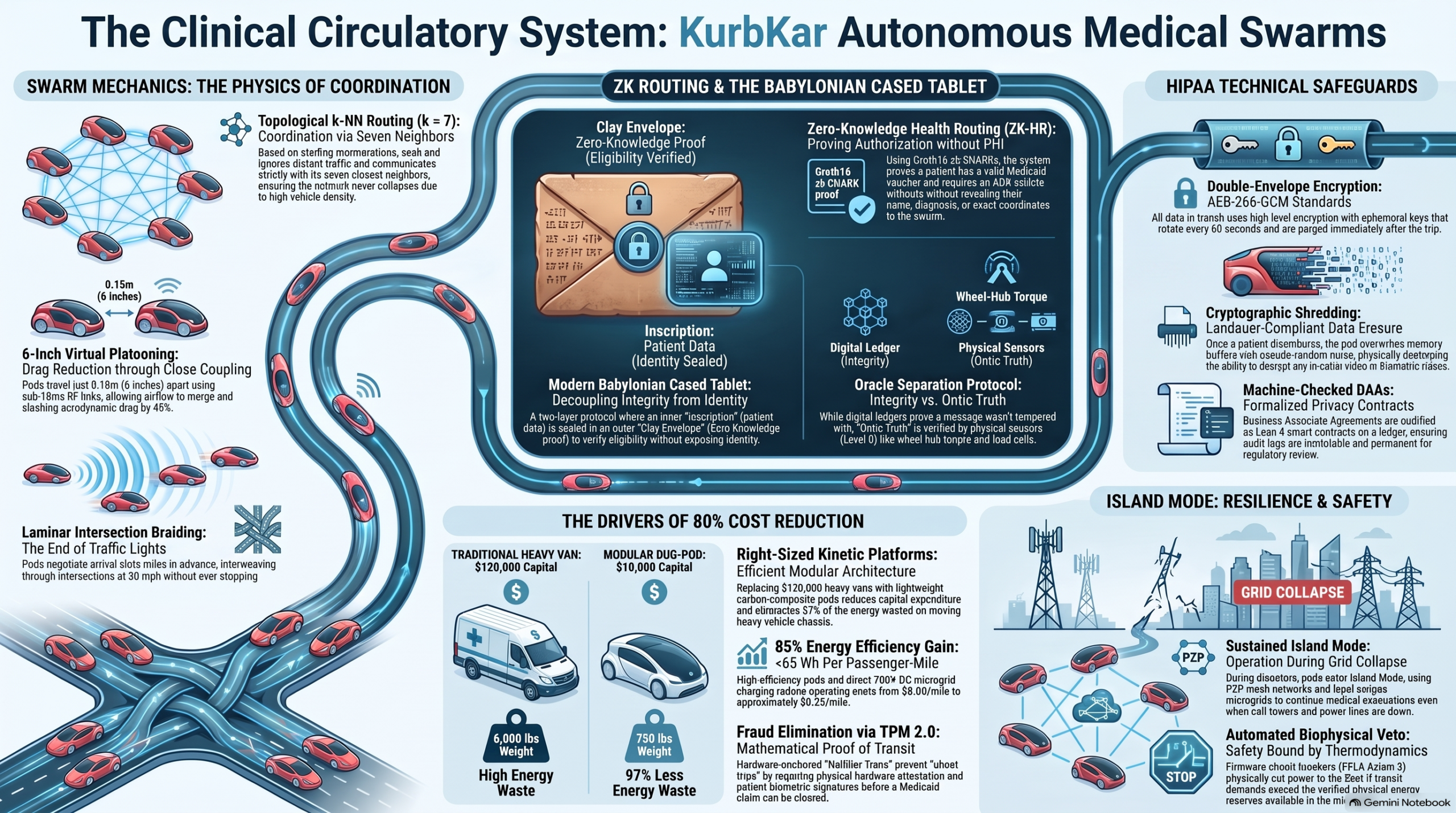
- Kinetic Efficiency: Replacing monolithic chassis with right-sized 450–750 lb modular pods, utilizing 6-inch (0.15 m) virtual platooning and laminar intersection braiding to expand transit capacity by 400% without new infrastructure.
- Biomorphic Coordination: Implementing topological k-NN (k ≈ 7) interactions and hyperbolic spin waves (c ≈ 20–40 m/s) to enable instantaneous, collision-free coordination that operates even in denied or electronic-warfare environments.
- Security & Compliance: Utilizing the Modern Babylonian Cased Tablet Protocol and Zero-Knowledge Health Routing (ZK-HR) to ensure absolute HIPAA compliance while shielding sensitive Protected Health Information (PHI) from the public routing mesh.
- Macro-Healthcare ROI: Transitioning NEMT from an extractive broker model to a deterministic swarm circulatory system, potentially slashing Medicaid transit costs from 4.50–8.00/mile to 0.15–0.25/mile and reducing avoidable hospital admissions by up to 45%.
- The Pathologies of Legacy Transit and NEMT
Current transportation systems suffer from three foundational “category errors” that inhibit scaling and safety:
1.1 The Mass-Energy Inversion
Modern automobility is thermodynamically irrational. Standard passenger vehicles (4,500–6,000 lbs) allocate approximately 97% of primary kinetic energy to moving the vehicle chassis and only 3% to moving the passenger. This results in unsustainable exergy consumption (250–450 Wh per passenger-mile).
1.2 The Broker Model Failure (NEMT)
Non-Emergency Medical Transportation is currently managed by administrative intermediaries (brokers) incentivized by capitated moral hazard:
- The Extractive Cycle: Brokers receive fixed fees from Medicaid. Every ride provided cannibalizes their profit, incentivizing administrative friction and the use of low-bid, unreliable subcontractors.
- Fraud, Waste, and Abuse (FWA): Pervasive “ghost trips” (billing for rides never taken) and upcoding (billing ambulatory patients as stretcher cases) drain billions from public funds.
- The Discharge Thrombus: Transportation failures cause medically cleared patients to occupy high-acuity beds for 5–7 hours post-discharge, leading to Emergency Department (ED) Boarding and Ambulance Diversion.
1.3 The 1,000-Mile Failure Model
Legacy AVs rely on high-latency cellular backhauls and remote human teleoperation. If network jitter or carrier outages occur, the vehicles freeze, creating “catastrophic stalls” that paralyze urban corridors.
- KurbKar Kinetic Architecture: Swarm Biophysics
The KurbKar system replaces the “isolated monad” model with Active Matter Kinetics derived from the European StarFlag Project’s study of starling murmurations.
2.1 Multi-Tier TriFi RF Mesh
Communication is decentralized via three distinct, complementary spectra to ensure operation in Denied, Degraded, Intermittent, or Limited (DDIL) environments:
Role Spectrum Latency Function
Intra-Platoon Coupling 60 GHz mmWave < 1.5 ms 6-inch headway virtual coupling; raw sensor feeds.
Topological Inter-Pod 5.9 GHz C-V2X 4–12 ms Neighborhood mesh; intersection braid negotiation.
Sovereign Backhaul 410/900 MHz 25–45 ms Macro-fleet sync; non-critical auditing; NLOS failover.
2.2 Biomorphic Coordination Principles
- Topological Interaction (k ≈ 7): Each pod maintains communication links with its 7 nearest topological neighbors, regardless of physical distance. This prevents “packet broadcast storms” and keeps the network graph invariant to spatial density.
- Hyperbolic Spin Waves: Maneuvers (like emergency braking) propagate as second-order acoustic waves at speeds of 20–40 m/s. This outruns individual reaction latency, allowing unified swarm evasion before trailing cameras even see an obstacle.
- Laminar Intersection Braiding: Traffic lights are dismantled in favor of phase-synchronized interweaving. Pods modulate velocity by ±0.4 mph to slip through perpendicular gaps at speed, expanding carrying capacity to 8,500–11,000 pods/lane/hour.
- The DeReticular Sovereign Stack: Security and Integrity
The KurbKar framework operates on a 5-Layer Sovereign Stack that decouples cryptographic integrity from ontic (physical) truth.
3.1 The Quad-Stream Telemetry Engine
Static Single Sign-On (SSO) is replaced by continuous runtime evaluation across four real-time streams:
- Epistemic Stream: Monitors Variational Free Energy (F). If an agent’s internal model diverges from reality (delirium), authority is revoked.
- Syntactic Stream: All operational directives must compile into Lean 4 Abstract Syntax Trees (ASTs) for deterministic type-checking.
- Thermodynamic Stream: Enforces Landauer’s Principle. If compute consumption does not reduce uncertainty (M_ratio < 1.0), the system trips a “Hardware Halting Gate.”
- Ontic Stream: Grounded in physical resistance (Level 0 sensors). If a wheel-hub torque sensor detects an impact that the software model did not predict, the node is instantly slashed and quarantined.
3.2 Hierarchical Transitive Slashing
Liability is conserved across the delegation graph. If a primary executor commits an ontic breach:
- Executor: 50% Stake Burn.
- Curator (Intermediary): 25% Stake Burn.
- Originator: 10% Stake Burn. An instant Snap-Back Reversion Circuit dissolves the delegation tree and returns unslashed collateral to the originator.
- HIPAA-Compliant Medical Transit
Protecting Sensitive Passenger Protected Health Information (PHI) is achieved through mathematical insulation rather than mere firewalls.
4.1 Zero-Knowledge Health Routing (ZK-HR)
To comply with the HIPAA Security Rule, the system implements a “Modern Babylonian Cased Tablet” workflow:
- The Clay Envelope (T_env): A Groth16 zk-SNARK proof verifies that a passenger holds a valid Medicaid NEMT voucher and requires a specific vehicle type (e.g., ADA Duo-Pod) without revealing their name, diagnosis, or specific clinic.
- The Core Inscription (T_core): Sensitive clinical destination data is homomorphically encrypted (Paillier/ElGamal), decryptable only by the destination clinic’s private key upon physical arrival.
- Ephemeral Shredding: Upon patient discharge, all in-cabin biometric and video buffers are cryptographically shredded to prevent forensic memory extraction.
4.2 Level 0 Physical Safeguards
Safety is enforced by “unyielding physical resistance”:
- Wheelchair Tie-Down Gating: Calibrated strain gauges must measure ≥ 450 Newtons of tension. If tension is insufficient, the electric hub motors are physically barred from receiving current.
- Smart-Glass Privacy: Duo-Pods utilize PDLC films that shift to opaque during NEMT trips to prevent external visual identification.
- Clinical Preemption: If in-cabin sensors detect cardiac arrest, the pod injects a “Hyperbolic Priority Spin Wave,” commanding the swarm to peel open a high-velocity green channel to the trauma center.
- Economic and Institutional Impact
5.1 Macro-Healthcare Systemic ROI
The transition from legacy brokers to autonomous swarms transforms the “Clinical Circulatory System”:
Economic Parameter Conventional NEMT (Broker) KurbKar Sovereign Swarm
Capital Cost/Vehicle $85,000 – $130,000 $16,000 – $22,000
Primary Energy 350 – 500 Wh/p-mile 45 – 65 Wh/p-mile
Direct Cost/Mile $4.50 – $8.00 $0.15 – $0.25
Arrival Accuracy ± 45 to 90 minutes ± 90 seconds
Fraud (FWA) Pervasive ($1.2B+) Mathematically Zero (Level 0 TPM)
5.2 The Biophysical Veto (RELA Axiom 3)
The system enforces RELA Axiom 3, which dictates that authorized compute and currency tokens must be strictly bounded by verified net exergy: M_{\text{nominal}}(t) \leq \kappa \int_{t_0}^t (\text{Exergy}_{\text{net}}(\tau) \cdot \eta(\tau)) d\tau If a transit project or compute workload exceeds the exergy surplus of the local Agra.Energy 700V DC microgrids, a hardware circuit breaker physically freezes the execution queue.
5.3 60-Month Implementation Roadmap
- Epoch 1 (Months 1-12): Cryptographic auditing and ZK-voucher integration with hospital EHRs (Epic/Cerner).
- Epoch 2 (Months 13-24): Pilot 30-pod NEMT fleet and first thermochemical syngas microgrid hub.
- Epoch 3 (Months 25-42): Activate 6-inch platooning and laminar intersection braiding; enable 50% stake slashing.
- Epoch 4 (Months 43-60): Full “Island-Mode” cutover; decommission legacy broker contracts; achieve 100% Medicaid transit on sovereign swarms.


