Operational Sovereignty Framework: A Strategic Guide to Autonomous Remote Industrial Infrastructure
1. The Mandate for Architectural Sovereignty
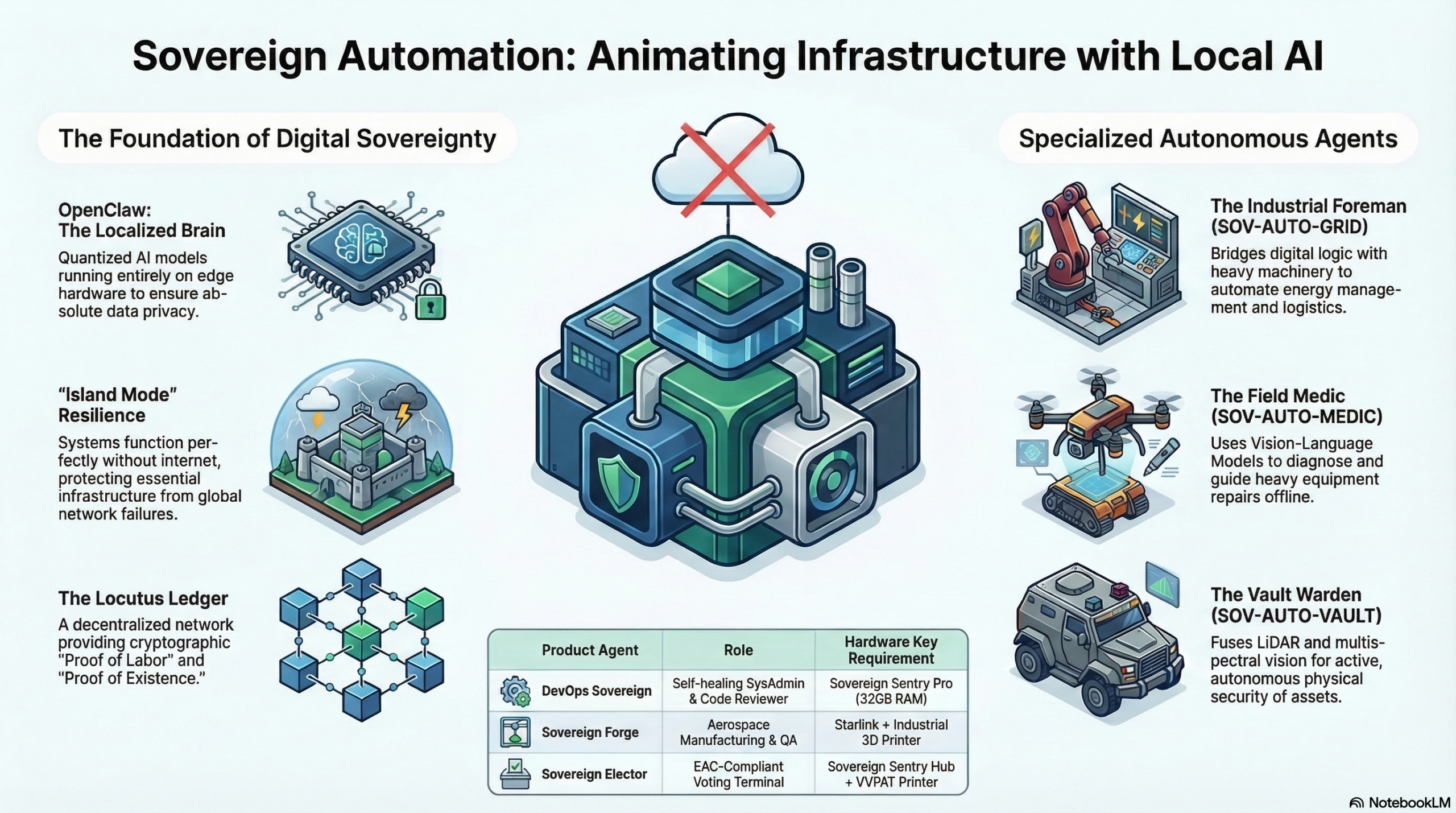
In the contemporary industrial landscape, “Operational Sovereignty” is the strategic imperative to maintain functional uptime in “Island Mode”—a state of total architectural autonomy requiring zero reliance on cloud-based service providers or persistent wide-area network (WAN) connectivity. We are moving beyond passive, static infrastructure toward active cyber-physical agents. These agents do not merely monitor telemetry; they possess the localized intelligence to diagnose, repair, and optimize critical assets without external instruction.
Traditional Original Equipment Manufacturer (OEM) models have enforced a precarious “digital sharecropping” arrangement. By tethering maintenance logic and system health to centralized cloud servers, OEMs create a single point of failure where a connection drop results in catastrophic downtime. This fragility is often weaponized through DRM (Digital Rights Management) lockouts, which prevent local technicians from repairing their own machinery. The DeReticular ecosystem serves as the ultimate Right-to-Repair weapon, shifting the “brain” of the operation to the site itself. We eliminate the vulnerability of cloud-dependency, ensuring that a mining camp in the Congo or an offshore rig remains operational even when the global internet is severed.
The physical execution of this sovereignty relies on two critical hardware pillars:
- The Sovereign Sentry Pro (The “Brain”): A ruggedized edge-computing hub hosting quantized local inference engines to eliminate WAN-latency and data exfiltration vectors.
- The Sovereign Deck (The “Eyes”): A tactical, IP68-rated tablet providing the visual and acoustic inputs necessary for autonomous field diagnostics.
This foundation enables a technical stack capable of sustaining high-value assets in the most hostile, bandwidth-starved environments on Earth.
2. The Autonomous Infrastructure Stack: Hardware and AI Orchestration
Remote industrial survival necessitates the integration of ruggedized hardware and localized AI orchestration. Unlike standard AI that resides in hyperscale data centers, the Sovereign stack hosts quantized local inference engines on-site, using high-performance compute to process complex variables in real-time.
Core Infrastructure Components
| Component | Operational Role | Sovereignty Impact |
| Sovereign Sentry Pro | Centralized Edge Node & AI Host | Local NVMe storage (4TB+) enables air-gapped Vector DBs, keeping proprietary network maps offline. |
| Sovereign Deck | Mobile Interface & Diagnostic Tool | High-resolution macro cameras and NPUs allow for offline Vision-Language Model (VLM) reasoning at the machine face. |
| Nomad Link | Secure Transmission Bridge | Provides LTE/Starlink bonding for opportunistic syncing while maintaining a hardware kill-switch for air-gapping. |
| Mesh Beacons | Private Field Network | Establishes a localized 915MHz LoRaWAN/Wi-Fi blanket for sensor data without external backhaul requirements. |
The OpenClaw AI Framework
The intelligence layer of this stack is the OpenClaw AI Framework, a modular system that deploys specialized agents—such as “Deep Admin” for IT infrastructure and “Helpdesk” for personnel support—directly onto local hardware. To ensure systemic resilience, we utilize a “Hardware Shake” protocol. This process verifies critical resources before deployment; for instance, the L2 Remediation Architect is hardcoded to refuse installation on models with less than 32GB of RAM (e.g., standard 16GB units), preventing memory thrashing during critical incidents.
Split-Ledger Architecture
To solve the “Anonymity vs. Verification” paradox, the framework utilizes a Split-Ledger Architecture designed to decouple Identity from Intent. This is achieved through three core principles:
- Identity Isolation: Operator identities remain on private, localized ledgers.
- Intent Verification: Specific actions (e.g., a maintenance log or a cast vote) are cryptographically hashed as anonymized “intents.”
- Public Attestation: Only the hashes are pushed to the public Locutus Ledger, providing a “Digital Twin” of the truth that is verifiable by outside parties without compromising site security.
3. Mechanical Autonomy: AI-Driven Repair and Maintenance
In high-downtime-cost environments where losses can exceed $50,000 per day, the Field Medic agent serves as a critical force multiplier. By transforming a junior technician into a master mechanic through localized VLM intelligence, we bypass the need for slow-moving, cloud-tethered OEM support.
Operational Workflow (The Mud & Oil Scenario)
When hardware fails in adverse conditions, the Field Medic executes a four-stage autonomous workflow:
- Input (Optical/Acoustic): The technician uses the Sovereign Deck to record the acoustic signature of a failing engine or photograph a corroded solenoid.
- Processing (Semantic Visual Lookup): The local agent extracts visual features (bolt patterns, wire colors) and cross-references them against a 4TB+ local Vector Database of legacy and modern manuals.
- Synthesis (Repair Guidance): The agent identifies the failure and synthesizes step-by-step repair guides, highlighting the specific 8mm bolts or wiring bypasses required.
- Verification (Ledger Logging): The completed action is cryptographically hashed and logged, creating an immutable maintenance record.
Physical Failover and Diagnostics
When software-level interventions fail, the Sovereign Helping Hand—a 6-axis manipulator stripped of proprietary cloud-tethered firmware—executes “Physical Failover.” This includes:
- Depressing physical power buttons on frozen server racks when SSH connectivity is lost.
- Adjusting Starlink azimuths and elevations to restore signal during high winds.
- Uprooting weeds or harvesting crops identified by the Sovereign Agronomist vision stack.
- Triggering emergency pumps via the Harbor Warden’s anti-sinking protocols if a vessel’s bilge alarm is tripped at 3:00 AM.
By utilizing Acoustic Diagnostics and Right-to-Repair CAN Bus Interfacing, the framework translates proprietary fault codes and matches frequency anomalies (like a spun bearing) to bypass OEM DRM lockouts. This digital foundation ensures that if the physical grid is stable, the machinery follows.
4. Island Mode Grid and Resource Management
True sovereignty requires autonomous energy balancing to manage variable inputs from solar, wind, or GTL (Gas-to-Liquid) systems without central utility oversight.
The Industrial Foreman
The “Industrial Foreman” agent manages the site’s physical equilibrium through two distinct modes:
- Grid Balancer: Monitors battery State of Charge (SoC). If batteries exceed 95%, it autonomously triggers “dump loads,” such as water pumps or thermal storage, to capture every available watt.
- Supply Chain Diplomat: This mode utilizes geofencing to detect proximity to borders or delivery zones. It autonomously generates and signs customs manifests via a Sovereign Key, ensuring logistics logs are ready before a vehicle reaches a checkpoint.
Safety and Resilience
To protect physical hardware from logic errors or wiring faults, the framework incorporates a “Hysteresis” delay (mandating a 5-minute state change minimum to prevent relay damage) and “Polarity Check” diagnostics to identify reversed wiring before current is applied.
The Sovereign Agronomist
In agricultural contexts, the Sovereign Agronomist logic cross-references deep-soil moisture sensors with local barometric pressure. If sensors indicate a moisture deficit but the barometer predicts a pressure drop (rain) within six hours, the AI autonomously delays irrigation to conserve water. This turns off-grid acreage into a self-regulating, high-efficiency Sovereign Node.
5. The Sovereign Support Desk: Automated IT and System Triage
Remote sites cannot wait for central IT support. The Sovereign Support Desk replaces centralized helpdesks with localized autonomous agents that live on the Sentry Pro.
- Level 1: Triage Sentinel: Handles frontline queries, utilizing Retrieval-Augmented Generation (RAG) to answer questions based on local company SOPs and OCR’d manuals.
- Level 2: Remediation Architect: A deep-system operator. Due to heavy parallel VM and LLM execution, this agent strictly requires a 32GB RAM Hardware Shake (Sentry Pro or RIOS AI Core) for deployment.
The L2 agent is authorized to execute:
- SSH remediation of localized network nodes.
- Port bounces on hung industrial switches.
- Credential-Bound Queries to restore system health via LDAP/Active Directory.
Data Ingestion and Security
During the Data Ingestion (Brainwashing) Phase, the Sentry Pro OCRs and vectorizes all local company network maps and manuals into a local Milvus database. No proprietary data is ever uploaded to the cloud for training. For high-risk or destructive commands, the framework enforces Sovereign Key Constraints, requiring a physical human-in-the-loop to approve the action via a YubiKey tap, preventing rogue execution.
6. Trustless Accountability: Proof of Labor and SLA Automation
The final pillar of the framework is the transition from “Trust” to Mathematical Verification via the Locutus Ledger.
Cryptographic Proofs of Sovereignty
| Proof Type | Originating Agent | Strategic Value |
| Proof of Maintenance | Field Medic | Increases equipment resale value via an unalterable, hashed service history. |
| Proof of Labor | Helping Hand | Mathematically confirms physical tasks (e.g., button presses, harvesting) were completed. |
| Proof of Sustainability | Agronomist | Generates verifiable ESG data for carbon credit minting without exposing yield financials. |
| Proof of SLA | Support Desk | Automates billing for MSPs by hashing the timestamp between ticket opening and resolution. |
Smart Escrow and Economic Impact
The integration of Smart Escrow allows for instant economic settlement. Utilizing stablecoin disbursements (USDC/Locutus), “Proof of Stay” or “Proof of Resolution” triggers instant payments, bypassing the 60-day international banking delays typical of legacy GDS and wire systems. A 0.5% smart contract fee is applied, providing immediate liquidity to remote operators.
Risk Management and Mitigation
To maintain the safety of the cyber-physical environment, we enforce a rigorous Risk Register:
- Visual Hallucinations (R-VIS-01): Mitigated by strict Confidence Thresholds. If the VLM’s identification confidence is below 95%, the agent is hardcoded to refuse bypass instructions and demand manual part-number verification.
- Rogue Execution (R-SEC-01): Mitigated by Blast Radius Containment. L2 agents are restricted to whitelisted IP addresses and require physical YubiKey approvals for any “destructive” system commands.
By adhering to this framework, off-grid industrial assets are transformed into Sovereign Nodes—self-regulating, self-healing, and cryptographically verified centers of excellence.


