
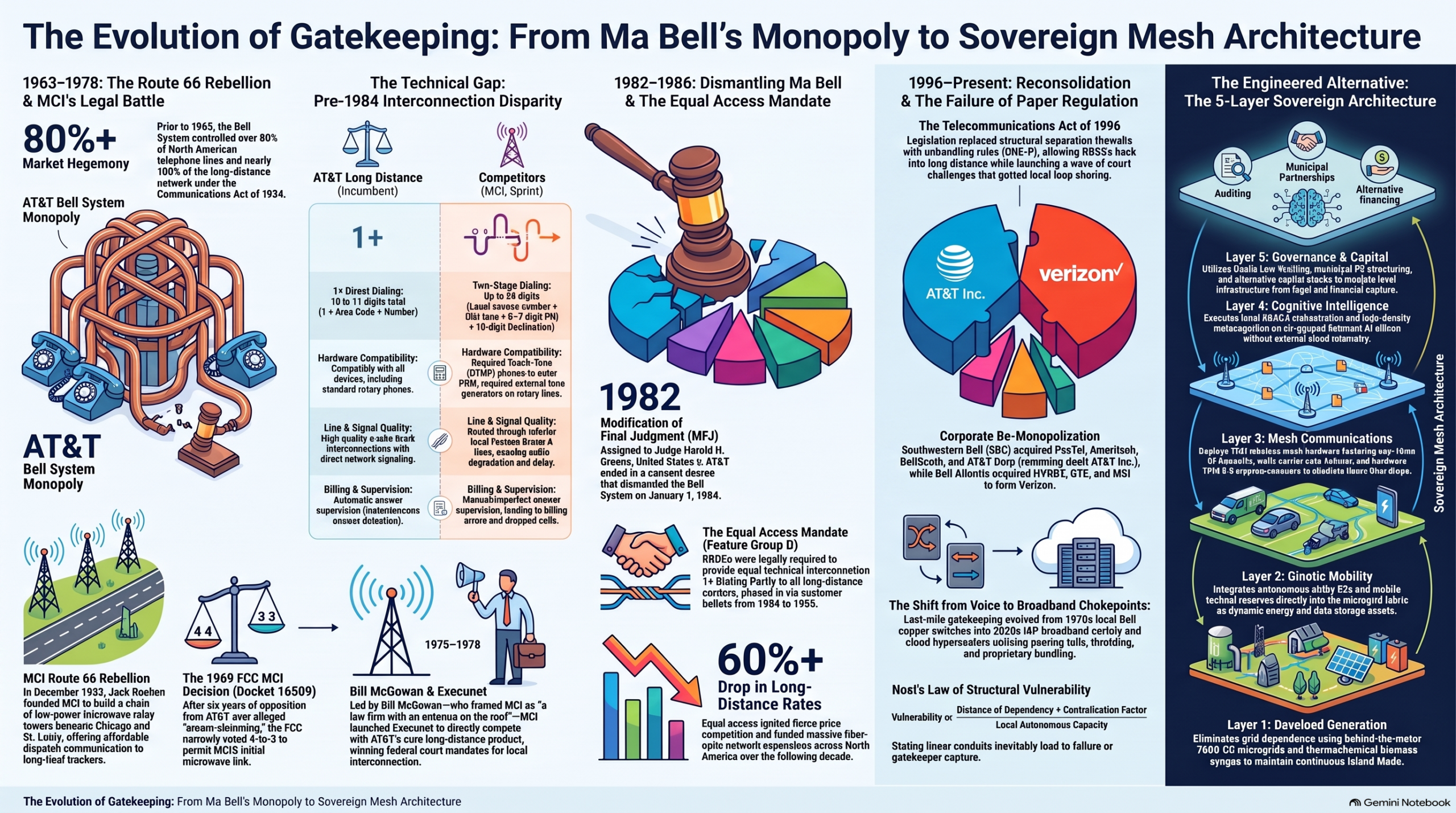
Regulatory Impact Analysis: From Bell System Unbundling to Modern Broadband Gatekeeping—Evaluating Administrative vs. Structural Interventions
- Executive Background & Historical Evolution of Telecommunications Monopolies
Context & Strategic Importance. Under the Communications Act of 1934, the American Telephone and Telegraph Company (AT&T, colloquially “Ma Bell”) operated as a legally sanctioned natural monopoly. Controlling over 80% of U.S. telephone lines and nearly 100% of the transcontinental long-distance switching matrix, AT&T maintained that unified, end-to-end operational control was strictly required to preserve national network integrity. However, this legal umbrella allowed AT&T to leverage its physical last-mile monopoly to foreclose market entry, extract monopoly rents, and degrade non-affiliated services. The regulatory protections granted to this natural monopoly established structural last-mile gatekeeping dynamics that persisted across technological media transitions for decades.
The Early Challenges (1963–1975). In 1963, John D. “Jack” Goeken, a two-way radio salesman based in Joliet, Illinois, encountered an operational bottleneck: long-haul trucking fleets transporting freight between Chicago and St. Louis required affordable dispatch communications, but mobile VHF radio ranges were limited to 30–50 miles. AT&T’s leased-line telephone service was economically unfeasible for small fleet operators, and AT&T refused to permit third-party radio systems to interconnect with Bell System copper lines. In response, Goeken founded Microwave Communications, Inc. (MCI) in December 1963, proposing to construct a chain of low-power microwave relay towers along U.S. Highway 66 (Route 66) to route long-distance voice signals at a fraction of AT&T’s tariffs.
When MCI applied to the Federal Communications Commission (FCC) for construction permits, AT&T—alongside regional operating subsidiaries Illinois Bell and Southwestern Bell—mounted intense regulatory resistance in FCC Docket 16509. AT&T argued that MCI was engaged in “cream-skimming” by targeting only high-density, profitable corporate routes, which would undermine the internal cross-subsidies used to keep residential and rural local phone service affordable.
After six years of administrative delays, the FCC issued the 1969 MCI Decision (Docket 16509), narrowly authorizing MCI’s private microwave link by a 4-to-3 vote. Lacking capital and a national legal apparatus, Goeken partnered in 1968 with William G. “Bill” McGowan, a venture capitalist and Harvard MBA. McGowan recognized that Goeken’s microwave link was a blueprint to dismantle the Bell System. Reorganizing MCI into a national corporate entity in 1972, McGowan famously declared that MCI was “a law firm with an antenna on the roof,” using aggressive regulatory litigation as a primary strategic weapon.
Execunet and Legal Interconnection. MCI was initially restricted to selling dedicated “private line” services to corporate clients. In 1975, MCI launched Execunet, a shared-switch service that enabled any subscriber to dial a local access number, enter a PIN, and route calls over MCI’s microwave network to any telephone in another city. Execunet directly competed with AT&T’s core switched long-distance product, Message Telecommunications Service (MTS). AT&T petitioned the FCC to halt the service, but MCI appealed. In landmark decisions between 1977 and 1978, the U.S. Court of Appeals for the D.C. Circuit ruled in MCI’s favor, legally requiring AT&T to grant local exchange interconnections for Execunet services. This transformed MCI from a niche private-line provider into a direct public long-distance competitor.
Technical Degradation Analysis. Despite legal authorization to compete, AT&T utilized its physical control over local central switching offices to degrade competitors’ access quality. The structural and technical disparities between AT&T Long Distance and early competitive alternatives are detailed in the comparison matrix below:
AT&T Long Distance (Native Standard) Early Competitors / MCI (Feature Group A Disparity)
Dialing Method: 1+ Direct Dialing. Subscribers dialed 1 + Area Code + Number (7 to 11 digits total) for immediate routing. Dialing Method: Two-Stage Dialing. Subscribers dialed a local 7-digit access number, waited for a second dial tone, entered a 5- to 7-digit PIN, and then dialed the destination number (up to 24 digits total).
Hardware Compatibility: Native functionality across all customer premises equipment, including standard rotary dial and Touch-Tone sets. Hardware Compatibility: Mandatory Dual-Tone Multi-Frequency (DTMF) Touch-Tone capability to transmit PINs; standard rotary phones were unusable without external acoustic tone generators.
Audio Quality & Signaling: High-quality 4-wire trunk interconnections with direct, low-attenuation network signaling path. Audio Quality & Signaling: Routed through inferior local exchange line interfaces (Feature Group A), causing lower signal power, elevated line noise, and noticeable call setup delays.
Call Completion & Billing: Automatic Answer Supervision. Switches recognized precisely when the called party answered, ensuring exact billing. Call Completion & Billing: Manual and imperfect answer supervision, causing frequent billing inaccuracies, unrecorded connections, and dropped calls.
AT&T defended these operational disparities by charging MCI reduced interconnection fees, but the physical degradation ensured competitive offerings remained technically inferior to end users.
This systematic degradation of rival traffic on the local loop ultimately forced judicial intervention to dismantle the structural monopoly.
- The Structural Paradigm: The 1982 Modification of Final Judgment (MFJ) and Equal Access
Context & Strategic Importance. In November 1974, the U.S. Department of Justice (DOJ) filed an antitrust lawsuit against AT&T (United States v. AT&T), alleging violations of Section 2 of the Sherman Act through systematic cross-subsidization and exclusionary last-mile interconnection tactics. The case established a precedent in structural intervention, demonstrating that where administrative oversight fails to curb market power, physical structural separation of essential facilities from competitive lines of business is required to achieve market parity.
PRE-1984: THE BELL SYSTEM MONOLITH
+—————————————————+
| AT&T (Long Lines, Western Electric, BOCs) |
+—————————————————+
|
(1984 MFJ Structural Divestiture)
v
+—————————————————+
| AT&T Long Distance | Western Electric |
+—————————————————+
+
+—————————————————+
| 7 Regional Bell Operating Companies |
| (Ameritech, Bell Atlantic, BellSouth, NYNEX, |
| Pacific Telesis, Southwestern Bell, US West) |
+—————————————————+
Judicial Intervention and Divestiture. Assigned to the case in 1978, U.S. District Judge Harold H. Greene rejected AT&T’s procedural delays and pushed the case to trial in 1981. Late that year, Judge Greene denied AT&T’s motion to dismiss, issuing a memorandum stating that government evidence demonstrated AT&T had used its local distribution monopoly to foreclose competition in long-distance voice and equipment markets. Facing an adverse court ruling, AT&T Chairman Charles Brown negotiated a consent decree with the DOJ, which Judge Greene modified and entered as the Modification of Final Judgment (MFJ) on August 24, 1982 (taking effect January 1, 1984).
The MFJ established a tripartite structural separation:
- Divestiture of Local Exchange Operations: AT&T was forced to divest its 22 local Bell Operating Companies (BOCs), which were consolidated into seven independent Regional Bell Operating Companies (RBOCs / “Baby Bells”): Ameritech, Bell Atlantic, BellSouth, NYNEX, Pacific Telesis, Southwestern Bell, and US West.
- Line-of-Business Firewalls: The RBOCs retained local distribution monopolies but were legally barred from manufacturing telecommunications equipment and providing long-distance services.
- The AT&T Remnant: AT&T retained its long-distance transit operations, Western Electric (equipment manufacturing), and Bell Labs.
The Equal Access Mandate (Feature Group D). The centerpiece of the MFJ was the Equal Access mandate. The court required RBOCs to provide all interexchange carriers (AT&T, MCI, Sprint) with local exchange interconnections that were equal in type, quality, and pricing to those provided to AT&T’s long-distance arm.
This standard was technically codified as Feature Group D (FGD). Under FGD, central office switching systems were reconfigured to implement 1+ Dialing Parity. Subscribers participated in a Primary Interexchange Carrier (PIC) selection process via nationwide balloting between 1984 and 1986. When a consumer dialed 1 + Area Code + Number, the local central office automatically routed the call to the subscriber’s chosen primary long-distance provider over identical 4-wire trunking, removing AT&T’s historical dialing and audio advantages.
Economic Impact Assessment. The structural unbundling of the local exchange between 1984 and 1996 fundamental altered telecommunications economics:
- Long-Distance Price Reductions: Free market competition among interexchange carriers drove long-distance voice calling rates down by more than 60% over the decade following divestiture.
- Transcontinental Fiber-Optic Deployments: To gain a technical edge, MCI invested billions to build the world’s first transcontinental single-mode fiber-optic network. Competitors followed, such as Sprint marketing its clear, all-fiber network, forcing AT&T to modernize its own infrastructure.
- Infrastructure Modernization: Structural separation unbundled stagnant monopoly markets into dynamic competitive arenas, proving that unbundling essential facilities could accelerate technological adoption across national networks.
However, the structural firewalls established by Judge Greene depended on continuous legal enforcement, which began to crumble under legislative lobbying in the late 1990s.
- The Failure of Paper Rules: The Telecommunications Act of 1996 and Corporate Reconsolidation
Context & Strategic Importance. The passage of the Telecommunications Act of 1996 replaced structural line-of-business firewalls with administrative rules designed to promote local market competition. The Act serves as a practical case study showing that administrative unbundling regulations, when lacking physical or structural separation of essential assets, fail to stop dominant incumbents from recapturing markets.
Administrative Unbundling vs. Litigation Warfare. The 1996 Act replaced the MFJ’s structural ownership bans with administrative unbundling mandates. Under these provisions, incumbent RBOCs were permitted to re-enter long-distance and manufacturing markets on the condition that they opened their local copper loops to competitive local exchange carriers (CLECs) via Unbundled Network Elements (UNE and UNE-Platform).
Rather than complying with these administrative sharing rules, incumbent RBOCs exploited the administrative law mechanisms governing rate-setting. The FCC implemented the Total Element Long-Run Incremental Cost (TELRIC) pricing methodology, which required state public utility commissions (PUCs) to calculate hypothetical forward-looking costs for unbundled local loops. Incumbent RBOCs weaponized this administrative complexity, challenging TELRIC calculations and FCC unbundling rules in federal court (U.S. Telecom Ass’n v. FCC). By swamping regulatory dockets and dragging out litigation over forward-looking cost models for years, the RBOCs effectively stalled competitor access to local central offices, starving capitalized CLECs of operational revenues and forcing them into bankruptcy before paper unbundling remedies could be enforced.
Reconsolidation Dynamics. Once competitive carriers were financially depleted and CLEC capital dried up, the incumbent RBOCs initiated a massive wave of corporate mergers between 1996 and 2008, re-establishing market concentration across the telecommunications grid:
THE RECONSOLIDATION SEQUENCE (1963–2008)
1963: Goeken founds MCI (Route 66 microwave link)
│
1975: McGowan launches Execunet (switched voice over local exchange)
│
1982: Judge Greene issues MFJ (AT&T split into 7 RBOCs; Equal Access mandated)
│
1996: Telecom Act replaces MFJ with administrative unbundling (TELRIC / UNE-P)
│
2005: SBC Communications acquires PacTel, Ameritech, BellSouth, & AT&T Corp. -> Renamed AT&T Inc.
│
2006: Bell Atlantic acquires NYNEX, GTE, & WorldCom/MCI -> Formed Verizon
│
2008: Wireline and wireless infrastructure re-monopolized under an RBOC duopoly
- SBC Communications (Southwestern Bell): Acquired Pacific Telesis, Ameritech, and Southern New England Telephone (SNET). In 2005, SBC acquired its former parent company, AT&T Corp., adopting the name AT&T Inc., and subsequently absorbed BellSouth.
- Verizon Communications: Bell Atlantic acquired NYNEX and GTE to form Verizon.
- The Collapse and Absorption of Competitive Challengers: MCI was acquired by WorldCom in 1998, which subsequently collapsed in 2002 under an $11 billion accounting fraud scandal. The financial collapse of competitive long-distance carriers allowed incumbent RBOCs to acquire distressed competitive assets at fire-sale valuations; Verizon absorbed the restructured MCI assets in 2006. This permanently eliminated the independent competitive long-distance sector envisioned by Judge Greene.
By 2008, the competitive landscape created by the MFJ had dissolved, with the sector re-concentrated under two reconstituted Bell entities: AT&T Inc. and Verizon Communications.
The Regulatory Capture Cycle. The failure of administrative unbundling without physical separation reveals systemic patterns in regulatory enforcement:
- Legislative Capture: Incumbents utilize lobbying power to replace strict structural separation decrees with ambiguous administrative unbundling rules.
- Litigation Warfare: Controlling the physical bottlenecks, incumbents weaponize judicial appeals over complex cost models (e.g., TELRIC) to delay administrative compliance, starving competitive challengers of capital.
- Obfuscation of Compliance: Incumbents introduce synthetic operational complexities at central interfaces to mask discriminatory practices.
- Re-Monopolization: After competitors face financial distress, incumbents acquire rival assets at fire-sale valuations, consolidating physical ownership of the conduit.
When an incumbent controls the physical wire, paper rules act merely as a temporary pause between periods of monopoly, a pattern that transitioned seamlessly from circuit-switched voice to IP broadband.
- The Modern Gatekeeper: Broadband, Net Neutrality, and Noel’s Law
Context & Strategic Importance. In the 21st century, core communications migrated from circuit-switched Public Switched Telephone Networks (PSTN/TDM) to IP-based broadband networks, Voice over IP (VoIP), and cellular wireless infrastructure. With voice transmission costs dropping near zero, long-distance voice ceased to be a standalone billable utility, becoming a feature bundled into mobile and internet subscriptions. Crucially, cellular mobile networks were never subjected to 1+ wireline Equal Access mandates, preventing independent long-distance providers from competing on mobile devices and accelerating the demise of voice unbundling. However, the underlying economic chokepoint—control of last-mile physical distribution—persisted through this technological shift.
The Net Neutrality Parallel. The historical struggle over voice interconnection directly parallels modern fights regarding broadband internet service providers (ISPs). The mapping matrix below illustrates these operational dynamics across technological eras:
Voice Gatekeeper Era (1970s–1980s) Data Gatekeeper Era (2010s–2020s)
Dominant Gatekeeper Entity: Local Bell Operating Companies (BOCs / AT&T) controlling local copper switches. Dominant Gatekeeper Entity: Broadband ISPs (AT&T, Verizon, Comcast, Charter) and mobile wireless carriers controlling fiber/coaxial last-mile connections.
Interconnection & Quality Disparity: Feature Group A degradation (24-digit dialing, elevated line noise, manual billing supervision). Interconnection & Quality Disparity: Strategic peering bottlenecks, traffic throttling, arbitrary data caps, transit tolls, and regional outage sprawl.
Regulatory & Enforcement Framework: Equal Access Mandates, Feature Group D, Title II Common Carriage, and 1982 MFJ Divestiture. Regulatory & Enforcement Framework: Net Neutrality debates and regulatory oscillations between Title I (Information Service) and Title II (Common Carrier) classifications.
Just as Ma Bell weaponized local exchanges to degrade MCI’s voice traffic, modern broadband ISPs—composed of reconstituted Bell entities and regional cable cartels—possess economic incentives to prioritize proprietary streaming, cloud, and voice services while imposing peering tolls and bandwidth throttling on independent edge providers.
The administrative classification oscillations over the past decade—from the FCC’s 2015 Title II Order to the 2017 Title I Restoring Internet Freedom Order and the 2024 Title II Reinstatement—demonstrate that administrative rulemaking without structural separation produces continuous legal gridlock and regulatory capture.
Architectural Failure Models (Noel’s Law Analysis). The failure of administrative oversight across linear conduits can be evaluated through Noel’s Law of Structural Vulnerability, an analytical framework examining infrastructure failure modes:
\text{Vulnerability} \propto \frac{\text{Distance of Dependency} \times \text{Centralization Factor}}{\text{Local Autonomous Capacity}}
Noel’s Law posits that any socio-technical system reliant on an un-isolated, linear umbilical is structurally predisposed to single-point operational failure, corporate rent extraction, and gatekeeper capture.
THE LINEAR DEPENDENCY MODEL (1,000-MILE FAILURE MODEL):
[Remote Generation / Hyperscaler DC] ===(1,000 Miles of Single-Point Failure)===> [Local Consumer]
(Vulnerable, Dependent, Extracted)
THE SPHERICAL AUTONOMY MODEL (EDGE RESILIENCE):
[Local Baseload Generation]
^
| (Sub-16ms RF Mesh)
v
[Local Microgrid / Energy Storage] <=======> [Local Edge Air-Gapped Computing]
\ /
===> [SUSTAINED ISLAND MODE (OFF-GRID)] <===/
This structural vulnerability manifests across three core infrastructure domains under the 1,000-Mile Failure Model:
- Modern Last-Mile Broadband ISPs: ISPs enforce access tolls at IP transit and peering points, forcing high-bandwidth services and Content Delivery Networks (CDNs) to pay access fees to avoid deliberate connection congestion across the last mile.
- Cloud Hyperscalers: Enterprise workloads and critical software systems are centralized within remote cloud data centers. Subscribers face egress fees, API rate limits, and service interruptions when centralized availability zones hundreds of miles away experience outages.
- Fragile Transmission Grids: Municipalities, water treatment systems, and emergency operations rely on high-voltage transmission corridors extending across hundreds of miles. Single points of failure—such as extreme weather events, transformer failures, or cyber intrusions—can plunge entire regions into systemic failure.
To address these systemic vulnerabilities, policy mechanisms must be systematically evaluated by contrasting legal enforcement models against physical and architectural engineering alternatives.
- Comparative Evaluation: Administrative Regulation vs. Physical & Architectural Decoupling
Context & Strategic Importance. To prevent market foreclosure and ensure network resilience, policy choices must be evaluated by contrasting legal enforcement models against physical engineering solutions. Relying on administrative oversight while leaving physical control in the hands of an incumbent creates ongoing vulnerability to regulatory capture.
Comprehensive Regulatory Matrix. The matrix below evaluates four primary policy and structural approaches implemented over the past six decades across primary enforcement mechanisms, capture vulnerabilities, and market parity outcomes:
Policy Approach Primary Mechanism Enforcement Mechanism Vulnerability to Corporate Capture Long-Term Market Parity Impact
1982 MFJ Structural Divestiture Legal Decree separating asset ownership (BOCs separated from Long Distance & Equipment). Direct Judicial Oversight (U.S. District Judge Harold H. Greene / DOJ). Low during judicial tenure; vulnerable to legislative erosion. High initial impact: Lowered long-distance rates over 60%, unbundled markets, and catalyzed fiber deployments.
1996 Telecom Act Administrative Unbundling Statutory Mandate requiring local loop access sharing (UNE / UNE-P rules). Regulatory Filings and Administrative Oversight (FCC Dockets). Critical: Subject to litigation delays (U.S. Telecom Ass’n v. FCC). Systematic erosion: Competitors litigated into bankruptcy; market reconsolidated into a duopoly by 2008.
FCC Net Neutrality (Title II Common Carriage) Administrative Classification of broadband under Title II rules. Administrative FCC Docketing, Public Comments, and Federal Court Appeals. High: Oscillates with changing political administrations (2015 Title II, 2017 Title I repeal, 2024 Title II reinstatement). Cyclical instability: Continuous legal uncertainty and market gridlock over last-mile access terms.
Sovereign Infrastructure Architecture (Mesh / Island Mode) Physical Hardware & Engineering Decoupling (Off-grid mesh, local generation, local silicon). Autonomous Physical Nodes operating in self-healing local Island Mode. Zero: Mathematically and physically decoupled from centralized gatekeeper conduits. Unassailable autonomy: Eliminates gatekeeper control by bypassing linear transmission paths entirely.
The Sovereign Infrastructure Alternative. To eliminate dependence on administrative oversight across centralized conduits, theoretical models of physical decoupling rely on a five-layer decentralized architecture (the Sovereign Stack), engineered to directly overcome specific historical gatekeeper failure modes:
THE 5-LAYER SOVEREIGN STACK ARCHITECTURE
+——————————————————————————-+
| LAYER 5: GOVERNANCE | Noel’s Law Auditing • Municipal Triage • Capital Stack|
+——————————————————————————-+
| LAYER 4: COGNITION | Air-Gapped Local Silicon • Edge Execution Engines |
+——————————————————————————-+
| LAYER 3: MESH COMMS | Wireless Mesh Networks • Sub-16ms Handoff • DePIN RF |
+——————————————————————————-+
| LAYER 2: MOBILITY | Autonomous Utility EVs • Kinetic Mobile Reserves |
+——————————————————————————-+
| LAYER 1: BASELOAD | Local Microgrids • Off-Grid Thermal & Power Generation|
+——————————————————————————-+
- Layer 1 (Baseload): Deploys behind-the-meter 700V DC microgrids and local biomass gasification systems to supply continuous dispatchable power. This layer directly overcomes central utility grid dependencies and multi-year interconnection queue gatekeeping.
- Layer 2 (Mobility): Integrates autonomous utility electric vehicles (EVs) and mobile energy storage units into the local power matrix, addressing static energy vulnerabilities by utilizing kinetic battery assets.
- Layer 3 (Mesh Comms): Bypasses vulnerable physical wirelines using RF mesh architectures featuring sub-16ms dynamic channel handoffs, Decentralized Physical Infrastructure Network (DePIN) topologies, multi-carrier auto-failover, and hardware TPM 2.0 cryptoprocessors. This layer overcomes wireline last-mile fiber monopolies and physical backhaul cuts by dynamic rerouting.
- Layer 4 (Cognition): Replaces centralized cloud dependencies with local, air-gapped silicon executing processing at the edge. Operating locally, it executes real-time control, predictive analytics, and system governance, eliminating cloud hyperscaler egress tolls and centralized API gatekeeping.
- Layer 5 (Governance): Provides structured legal, financial, and organizational frameworks via public-private partnership (P3) structuring and Noel’s Law auditing, allowing municipalities and enterprises to achieve physical infrastructure self-reliance.
Synthesis & Policy Conclusion. Evaluating six decades of telecommunications and infrastructure policy yields three decisive conclusions:
- Paper regulations applied across centralized, linear conduits are structurally predestined to fail through administrative capture, litigation delays, and corporate reconsolidation.
- True non-discrimination and market parity cannot be sustained merely through administrative rulemaking, but require physical or structural separation of essential underlying assets.
- Local edge autonomy and sovereign physical infrastructure represent an effective defense against gatekeeper capture, market extraction, and single-point failure modes.
Sixty years of policy evolution—from Jack Goeken’s 1963 Route 66 microwave towers to Judge Greene’s divestiture decree and modern sovereign mesh networks—demonstrates that lasting market parity and infrastructure resilience cannot be litigated through paper rules, but must be physically engineered at the autonomous edge.


