
Strategic Implementation Roadmap: The Urban Hub Decentralized Municipal Grid
1. Strategic Overview of the Urban Hub Ecosystem
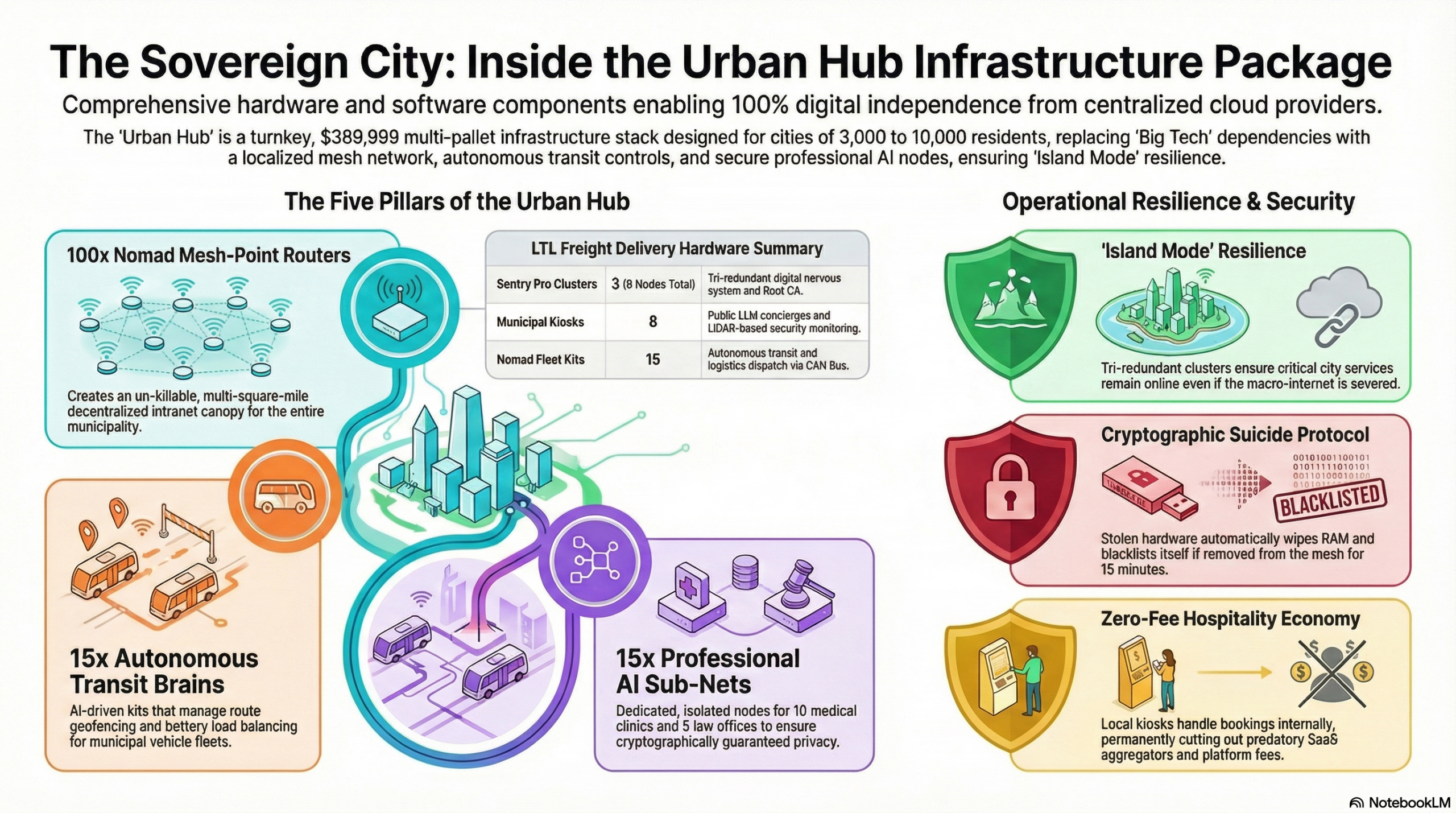
For modern municipalities servicing 3,000 to 10,000 residents, digital sovereignty is no longer a peripheral concern; it is the cornerstone of administrative survival. The “Urban Hub” Infrastructure Package is a comprehensive municipal operating system designed to surgically decouple city services from the fragility of centralized cloud providers. By establishing a localized “Island Mode” resilience, this package ensures that critical infrastructure—from emergency dispatch to public transit—remains operational even when the macro-internet is severed. This roadmap transitions the city from a state of “SaaS extraction,” where local wealth is bled by external aggregators, to a model of perpetual ownership and total civic autonomy.
The Five Pillars of Municipal Autonomy
| Category | Hardware/Software Component | Strategic Outcome for the City | Sovereignty Impact |
| Foundation | Tri-Zone Sentry Pro Clusters & 100x Nomad Mesh-Points | Establishes a redundant “Digital Nervous System” and an un-killable city-wide intranet canopy. | Zero-dependence on external ISPs for local data routing and VOIP. |
| Healthcare & Legal | 15x Sovereign Sentry (Standard) Nodes | Secures professional sub-nets with isolated databases for patient dictation and attorney-client privilege. | Local data residency; mathematical isolation from public-facing networks. |
| Transportation | 15x Nomad Fleet Kits & Industrial Foreman AI | Automates municipal transit with traffic-aware dispatch and battery load balancing. | Elimination of third-party logistics fees and cloud-based fleet tracking. |
| Visitor & Hospitality | 8x Municipal Kiosks & Sovereign Executive | Reclaims the local economy via zero-fee hospitality bookings and volumetric site monitoring. | Direct peer-to-peer commerce; removal of predatory booking aggregators. |
| Licensing | Master Urban Fleet License & SHA-256 Root CA | Provides universal cryptographic identity and mathematical isolation between municipal sectors. | Total administrative control over all 147 unique node identities. |
These five pillars converge to create a unified digital nervous system, providing the high-bandwidth, self-healing fabric required for a modern autonomous city. This architectural foundation ensures that the city’s data remains local, secure, and actionable, beginning with the critical phase of cryptographic initialization.
2. Phase I: Architectural Consultation and Cryptographic Initialization
The integrity of a decentralized grid is determined before the first node is ever powered on. Pre-deployment precision is paramount; site-specific Radio Frequency (RF) mapping and the minting of a unique cryptographic Root Certificate Authority (CA) form the bedrock of the network. Without this foundation, a mesh network is merely a collection of hardware; with it, it becomes a sovereign, high-performance territory.
Urban Topology & RF Mapping
DeReticular Enterprise engineers initiate a comprehensive survey to evaluate the municipality’s unique physical and digital contours. This process involves a rigorous evaluation of concrete density, local topography, and existing signal noise to determine the optimal placement of the 100 Nomad Mesh-Points. By utilizing existing municipal vertical assets to achieve optimal Fresnel zone clearance, engineers design a Wi-Fi 6E and LoRaWAN fabric that ensures high-bandwidth coverage across multi-square-mile urban grids and critical transit corridors.
Root CA Minting & Cryptographic Identity
The security of the Urban Hub rests upon absolute mathematical isolation. During this phase, the licensing server generates a unique SHA-256 Root CA for the municipality, followed by the creation of over 140 subordinate node identities.
- Root CA Generation: Establishes the ultimate cryptographic authority for the city’s private network, ensuring no external entity can intercept municipal traffic.
- Subordinate Identity Minting: Each of the 147 hardware units is assigned a unique, immutable identity.
- Sector Isolation: Utilizing these keys, the system creates “walled gardens” for medical, legal, and transit sectors, ensuring that a breach in the public Wi-Fi canopy cannot propagate into sensitive clinic records.
Once the onboarding dossier and deployment blueprints are finalized, the handover to the Municipal CIO triggers the physical provisioning and staging process.
3. Phase II: Enterprise Provisioning and Logistics Fulfillment
The “Enterprise Bay” is the strategic nexus where theoretical blueprints are converted into hardened hardware. To ensure zero-day functionality, the entire municipal fleet must be simulated and verified within a controlled environment before it is permitted to reach the city’s receiving warehouse.
Staging & Flashing Workflow
All 147 units undergo a five-step architectural initialization:
- Physical Audit: Each Sentry and Nomad unit is unboxed and inspected for hardware integrity within the Enterprise Bay.
- RIOS Core Flashing: The latest Sovereign Operating System is injected into the hardware, establishing the baseline local environment.
- Cryptographic Identity Injection: The unique SHA-256 identities minted in Phase I are flashed into the secure enclaves of each node.
- Mesh Topology Simulation: Engineers utilize the DeReticular Controller to build a “miniature city” within the warehouse, verifying the handshake between the Tri-Zone Core and the 100 Mesh-Points.
- Failover Verification: Active testing of tri-zone failover protocols ensures that if one cluster simulated “outage” occurs, the remaining nodes instantly assume the compute load without data loss.
Palletization and Structured Logistics
Hardware is organized into weather-sealed transit crates categorized by deployment zone to streamline the local rollout:
- Core Datacenters: High-Capacity Sentry Pro Clusters (9x 1U Nodes).
- District Mesh: 100 Nomad Mesh-Point Routers.
- Med/Law: 15 Sovereign Sentry (Standard) nodes.
- Fleet & Kiosks: 15 Nomad Fleet Kits and 8 Ruggedized Kiosks.
Secure freight shipping via multi-truck LTL ensures the physical and cryptographic integrity of the hardware as it moves toward final activation.
4. Phase III: Tactical Deployment and Core Ignition
“Ignition” is the moment the city’s sovereign network transitions from a hardware manifest to a living entity. This phase begins with the activation of the Tri-Zone Core, which serves as the centralized brain for the decentralized body.
Core Ignition of the Sentry Pro Clusters
The Core consists of 9x 1U Nodes total, arranged into three distinct clusters of three. These are installed in geographically isolated, secure locations to provide active-active-active redundancy:
- City Hall: Primary administrative and Deep Admin compute.
- Police HQ: Secure public safety and surveillance processing.
- Regional Utility Center: Grid management and infrastructure coordination.
The technical team verifies the tri-zone CA handshake, confirming that all nine nodes are functioning as a single, unified compute resource capable of repelling cyber-attacks and routing local data with sub-millisecond latency.
Mesh Canopy Deployment
Following core ignition, local utility workers mount the 100 Nomad Mesh-Points on light poles, water towers, and rooftops. This distributed installation creates the “un-killable intranet canopy,” a self-healing grid. By leveraging LoRaWAN for long-range IoT and Wi-Fi 6E for high-speed VoIP, the city maintains full internal communications even if the fiber link to the macro-internet is physically severed. This stabilization provides the necessary “air” for the distribution of professional edge-node endpoints.
5. Phase IV: Distribution of Professional Sub-Nets and Autonomous Integration
The final phase activates the specialized sectors of the municipal economy. By isolating specialized data—such as medical records or legal contracts—the municipality prevents cross-sector interference while leveraging a shared, impenetrable infrastructure.
Sub-Net Deployment Specifications
| Endpoint | Operational Configuration | Hardware Model |
| Medical Nodes | 10x Units: Pre-configured with PostgreSQL, OCR for medical records, and Whisper AI for patient dictation. | Sovereign Sentry (Standard) |
| Legal Nodes | 5x Units: Configured for high-security attorney-client privilege and encrypted localized VoIP routing. | Sovereign Sentry (Standard) |
| Transit Brains | 15x Units: CAN Bus/OBD-II integration for autonomous route geofencing and traffic-aware dispatch. | Nomad Fleet Kits |
| Municipal Kiosks | 8x Units: Public-facing local LLM concierges with Volumetric LiDAR for site monitoring. | Sentry Pro + Rugged Enclosure |
Autonomous Transit & Kiosk Integration
The integration of transit and hospitality is managed by the automated interplay between the Industrial Foreman AI and the Sovereign Executive.
- Event Response & Dispatch: When the 8 Municipal Kiosks detect a surge in pedestrian activity via LiDAR and mesh traffic analysis, the system autonomously dispatches extra electric shuttles to the zone.
- Battery Load Balancing: The Industrial Foreman monitors the 15 autonomous vehicles, coordinating charging cycles to coincide with peak local solar output, ensuring the transit fleet never strains the macro-grid.
- Zero-Fee Hospitality: The Sovereign Executive handles all local bookings. By processing restaurant and hotel transactions directly over the mesh, the city bypasses predatory “SaaS extraction” from companies like Airbnb or Expedia, keeping 100% of the revenue within the local economy.
6. Operational Resilience and Risk Management Framework
A decentralized municipal grid requires proactive, automated defense. In the Urban Hub ecosystem, resilience is not a feature but the core requirement of municipal governance.
Municipal Risk Mitigation Matrix
R-SCALE-03: Mesh Broadcast Storms
As the network scales to 100 mesh nodes, there is a technical risk of routing loops lagging the system. To mitigate this, the Deep Admin utilizes advanced BGP-style logic to automatically segment the 100 routers into dynamic, self-managing clusters using localized OSPF routing. This prevents network-wide broadcast storms and maintains maximum bandwidth.
R-SEC-05: Physical Node Theft
Widespread deployment in public spaces increases the risk of physical tampering. The Cryptographic Suicide protocol acts as the ultimate safeguard. If a node is unplugged from the mesh for more than 15 minutes or its chassis is breached, the Vault Warden protocol instantly wipes the RAM and blacklists the node’s MAC address at the Root CA, rendering the hardware useless to unauthorized parties.
R-HW-05: Grid Saturation
The power draw of a 140+ node network and an autonomous fleet is significant. The system utilizes Microgrid Integration to handshake with local solar and resilient power bundles. The Industrial Foreman ensures that transit vehicles and high-compute clusters prioritize renewable energy consumption, preventing strain on the municipal macro-grid during peak hours.
Summary of Operational Capabilities
- Island Mode Resilience: 100% uptime for local communications during macro-internet outages.
- Decentralized Hospitality Economy: Zero-fee booking engines keep local wealth within the township.
- Tri-Zone Cyber Defense: Active-active-active redundancy ensures zero downtime for critical police, transit, and medical services.
The implementation of the Urban Hub marks the definitive end of “Big Tech” dependency. By establishing total civic sovereignty, your municipality ensures a secure, resilient, and economically vibrant future for every resident.


