Strategic Operations Framework: Deploying Edge-AI Gatekeepers for Carbon-Negative Industrial Production
1. The Verification Crisis in High-Durable Carbon Removals
The global carbon market is undergoing a fundamental structural transformation, pivoting from “emissions avoidance”—often characterized by speculative counterfactuals—to “physical carbon removal.” For institutional capital to commit at scale, real-time verification is the non-negotiable prerequisite. The industry currently faces a massive “trust deficit,” exemplified by the recent cancellation of over 15 million credits due to legacy failures in monitoring and methodology. Investors now demand un-spoofable, hardware-anchored proof that carbon has been extracted and sequestered.
Traditional Monitoring, Reporting, and Verification (MRV) methods have collapsed under the weight of Linear Fragility, relying on retrospective manual audits and distant satellite approximations that cannot penetrate micro-canopies or detect soil-level degradation. This has created a “Verification Chasm” and a bifurcated market. Legacy avoidance credits trade as “dead capital” frequently under $5/tonne. In contrast, high-durable Carbon Dioxide Removal (CDR) commands a premium: Biochar Carbon Removal (BCR) stabilizes between 115–220/tonne, while engineered solutions like Direct Air Carbon Capture and Storage (DACCS) trade between $500 and $1,100+/tonne.
video
| Metric | Traditional Auditing | Sovereign dMRV |
| Speed of Verification | Months or years; retrospective | Real-time; continuous |
| Data Integrity | Vulnerable to manual error and administrative fraud | Hardware-anchored; tamper-proof |
| Operational Overhead | High (30–40% of project margins) | Automated; programmatic efficiency |
| Susceptibility to Fraud | High (falsified manifests and baselines) | Mathematically/Physically impossible |
This framework serves as the definitive bridge between raw physical biomass and bankable digital assets, replacing speculative estimation with mathematical certainty.
2. The Sovereign Stack: Architecture for Industrial Autonomy
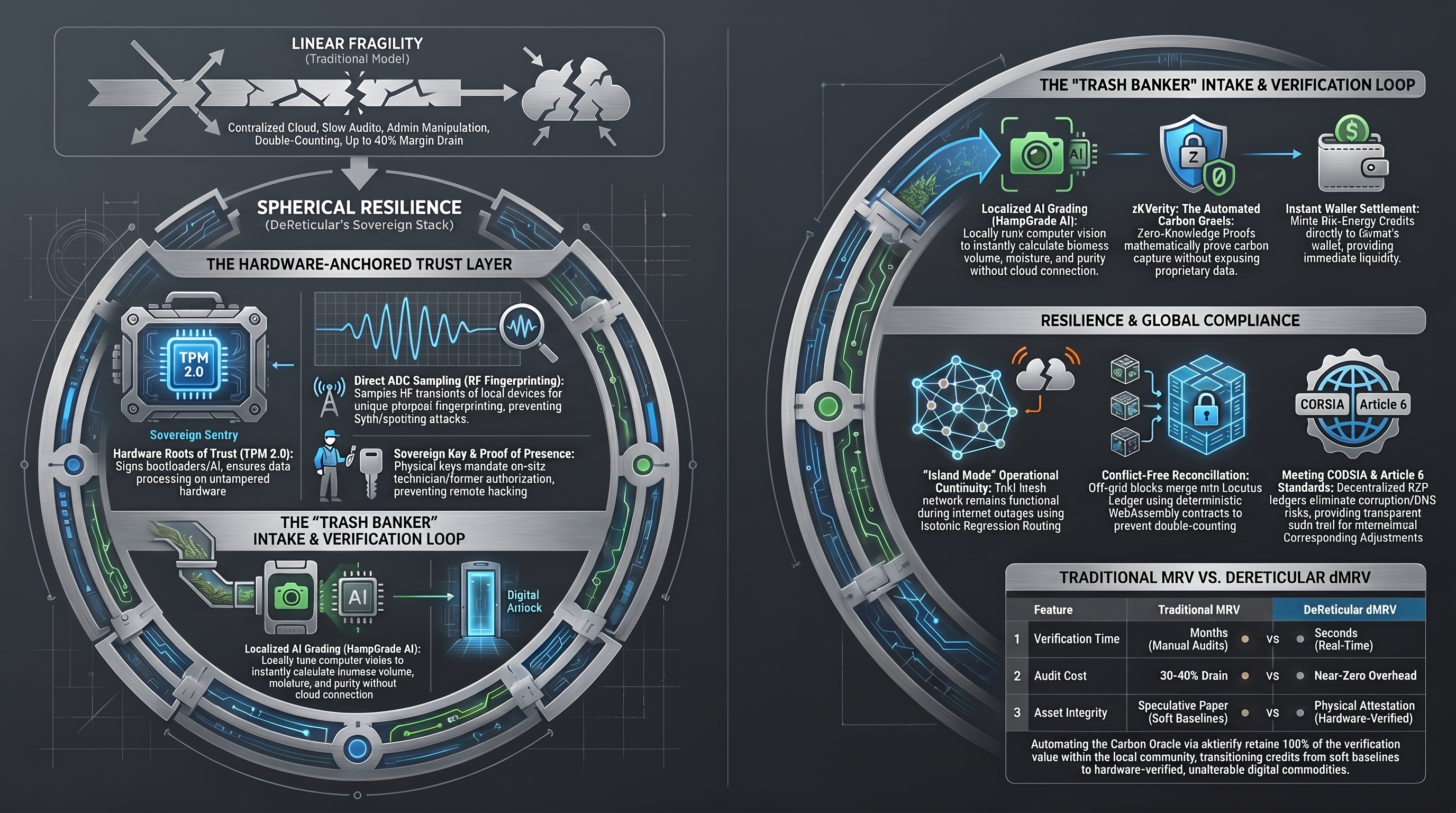
To survive in the coming decades, industrial systems must move from cloud-dependency to Spherical Resilience. This philosophy necessitates “Island Mode”—the ability for industrial operations to maintain full structural and cryptographic integrity in remote or geopolitically unstable environments without access to centralized cloud providers.
The Sovereign Stack provides this autonomy through four layers of integrated resilience:
- Application Layer: Managed by RIOS (Rural Infrastructure Operating System) and the OpenClaw Framework, allowing multi-agent edge-AI to execute complex industrial workflows without leaking data to third-party servers.
- Cryptographic Layer: Utilizes hardware-level roots of trust and decentralized state machines (Locutus) to ensure all data is immutable.
- Networking Layer: Employs the TriFi Mesh, using performance-aware Isotonic Regression Routing to synchronize data across off-grid nodes.
- Hardware Layer: Ruggedized nodes designed for the high-vibration, high-heat environments of industrial kilns and gasifiers.
To support quantized 8-billion parameter models (such as Llama 3) required for edge-reasoning, the Sovereign Sentry Pro utilizes a minimum of 32GB LPDDR4x RAM. Security is anchored in a Hard Physical Attestation model:
- TPM 2.0 Chips: Trusted Platform Modules measure and sign the RIOS kernel at boot. Any breach of the chassis or modification to the firmware results in the automatic locking of cryptographic keys.
- Direct ADC Sampling: The system performs Analog-to-Digital Converter sampling of radio frequency (RF) transients. By identifying microscopic variations in silicon capacitors and amplifiers, the stack generates a unique hardware “fingerprint” that renders Sybil attacks and device cloning physically impossible.
This hardware foundation enables the Industrial Foreman AI to act as the primary physical gatekeeper of the production line.
3. Operational Methodology: The Industrial Foreman & Feedstock Verification
The Sovereign Sentry Pro implements a Digital Airlock protocol to maintain carbon-neutral baselines. This protocol utilizes Sterilized Logic, processing raw sensor telemetry locally and exporting only the resulting cryptographic validations.
The Feedstock Verification Loop
The Industrial Foreman AI, running on the Sentry’s 6 TOPS NPU, executes a three-layered real-time verification process at the intake hopper:
- Botanical Species Identification: Edge computer vision identifies bark textures and grain patterns to classify species. This prevents the processing of restricted virgin hardwoods (e.g., mahogany, cedar) and filters for approved sustainable feedstocks like hemp hurd and corn stover.
- Contamination & Foreign Matter Detection: The AI identifies non-organic debris, such as plastics and chemically treated lumber. Rejection at this stage prevents toxic heavy metals (arsenic, chromium) from contaminating the biochar and destroying soil integrity.
- Volumetric and Carbon-Density Modeling: By integrating optical analysis with conveyor weight-scale telemetry, the system calculates precise dry-weight mass and moisture levels, transitioning from broad assumptions to batch-specific carbon accounting.
Automated Rejection Protocol Utilizing the OpenClaw Framework, the Industrial Foreman translates digital inferences into physical actions. It interfaces with industrial PLCs via Modbus RTU or CAN Bus to trigger physical diverter gates, instantly rejecting non-compliant payloads. Successful intake cycles result in the minting of a Feedstock Certificate, establishing an unalterable link between raw physical material and the resulting digital credit.
4. Cryptographic Truth: Zero-Knowledge Auditing and the Locutus Ledger
Decentralized registries are the only mechanism capable of preventing double-counting under CORSIA and Article 6 in an era of administrative corruption. The Locutus Ledger (built on the Freenet/Hyphanet protocol and rearchitected in Rust) serves as a peer-to-peer state machine for carbon assets.
Mechanics of the Locutus Ledger The ledger utilizes WebAssembly (Wasm) contracts as cryptographic gatekeepers for state transitions. A credit can only be minted, transferred, or retired if the request matches the hardware-verified data from the edge and is signed by a valid Sovereign Key.
The Carbon Oracle & zkVerify To satisfy public auditing without exposing sensitive industrial secrets, the stack utilizes a “Carbon Oracle” powered by zkVerify. This generates Zero-Knowledge Proofs (ZKPs) that prove sequestration by comparing biomass mass input against clean energy output (MWh) and kiln temperatures. These thermodynamic parameters are proven mathematically without revealing proprietary plant engineering.
Conflict-Free Reconciliation Nodes operating in “Island Mode” utilize hardware-verified timestamps to merge data back to the global ledger. Deterministic Wasm contracts allow local transaction blocks to merge seamlessly once a connection is restored, natively resolving sequencing conflicts and replacing “trust” with mathematical certainty.
5. Socio-Economic Implementation: The “Trash Banker” Ecosystem
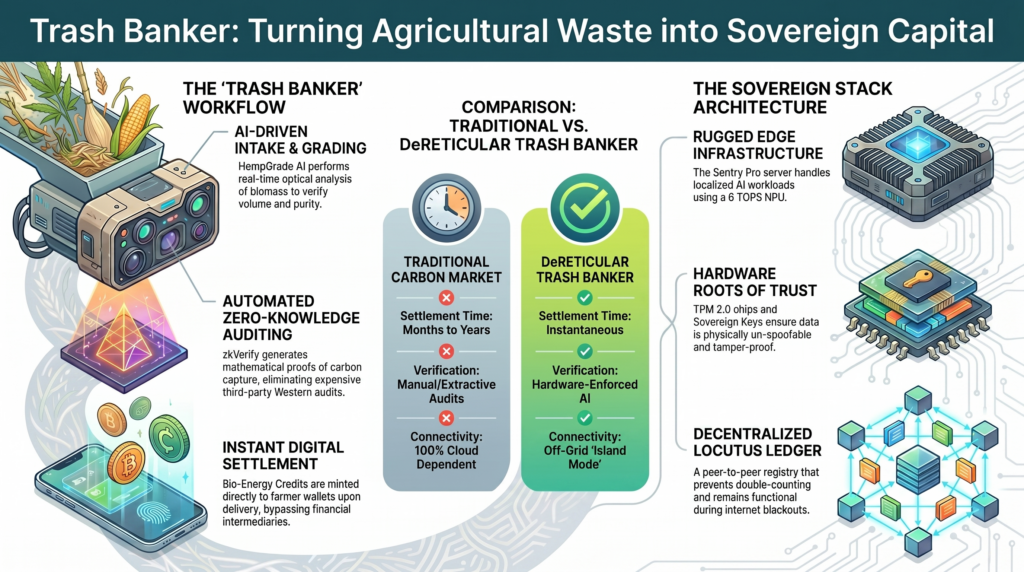
The “Capital Access Gap” remains the primary barrier to climate equity. Commercial banks typically reject decomposing agricultural waste as collateral, categorizing it as “Dead Capital.” The “Trash Banker” model, deployed at Project Umoja (Node 4) in the Kaabong District, Uganda, resolves this by converting waste into liquidity via HempGrade AI.
The Trash Banker Value Flow:
- Biomass Delivery: Smallholders deliver agricultural residues (hemp stalks, corn husks) to the industrial park.
- Evaluation: The Sovereign Deck performs a volumetric and quality scan of the load.
- Verification: The Sentry node validates the intake, grading the moisture and carbon content.
- Settlement: The system instantly mints Bio-Energy Credits (utility tokens) directly to the farmer’s digital wallet.
By turning agricultural waste into a sovereign asset, the ecosystem bypasses predatory financial intermediaries. Projects that verify these localized co-benefits and community agency command a 37% average price premium as buyers seek assets with high social integrity.
6. Regulatory Alignment: Navigating the U.S. and Global Policy Schism
Industrial operators currently face a radical divergence in climate policy. Federal de-regulation in the U.S. contrasts sharply with tightening transparency mandates at the state and international levels.
The U.S. Climate Policy Split
- The “One Big Beautiful Bill” Act (OBBBA): Signed on July 4, 2025, this act accelerated the Section 45Z expiry to 2029 and altered Section 45Q to equate the value of secure geologic storage with Enhanced Oil Recovery (EOR) at $85/tonne.
- EPA Rescission: On May 12, 2026, the EPA rescinded the GHG Endangerment Finding, stripping federal authority to regulate emissions.
- State Compliance: California’s AB 1305 and AB 1207 mandate strict disclosures for carbon claims and place offsets “under the cap” to prevent emissions dilution.
Hardware-anchored dMRV is the only hedge against greenwashing litigation and anti-ESG legislation. It provides the transparent data foundation required to overcome the Corresponding Adjustment (CA) bottleneck in CORSIA Phase 1, where host nations must authorize that credits are not being double-counted toward national targets.
7. Deployment Catalog: Sovereign Carbon & Energy SKUs
DeReticular’s product line is modular, designed for rapid industrial-scale deployment.
- DR-SENTRY-PRO-CDR-INT: The industrial core server. Features the Rockchip RK3588 SoC, a 6 TOPS NPU, and 32GB RAM minimum. Passive, monoblock aluminum chassis with dual TPM 2.0 chips. Acts as the primary feedstock gatekeeper.
- DR-DECK-FIELD-MRV: A tactical field tablet with a 1000-nit sunlight-readable display and IP65 rating. Integrated SDR for TriFi Mesh synchronization and preloaded with Kali Linux (Field Edition) and HempGrade AI.
- DR-BADGE-IPLC-SEC: An ultra-low-power attestation node in a solar-assisted IP68 enclosure. Features an ATECC608B Secure Element and optimized RF output for Direct ADC fingerprinting.
- DR-RIOS-ORACLE-LIC: The enterprise software license. Activates the Carbon Oracle, OpenClaw framework, zkVerify engine, and Locutus Sync modules.
Combined, these units form the “Nature-Based dMRV Shield,” transforming the physical labor of carbon capture into secure, decentralized digital assets that meet the world’s most stringent ecological standards.


