
Technical Component Guide: The Infrastructure-in-a-Box Ecosystem
1. Introduction: From Linear Fragility to Spherical Resilience
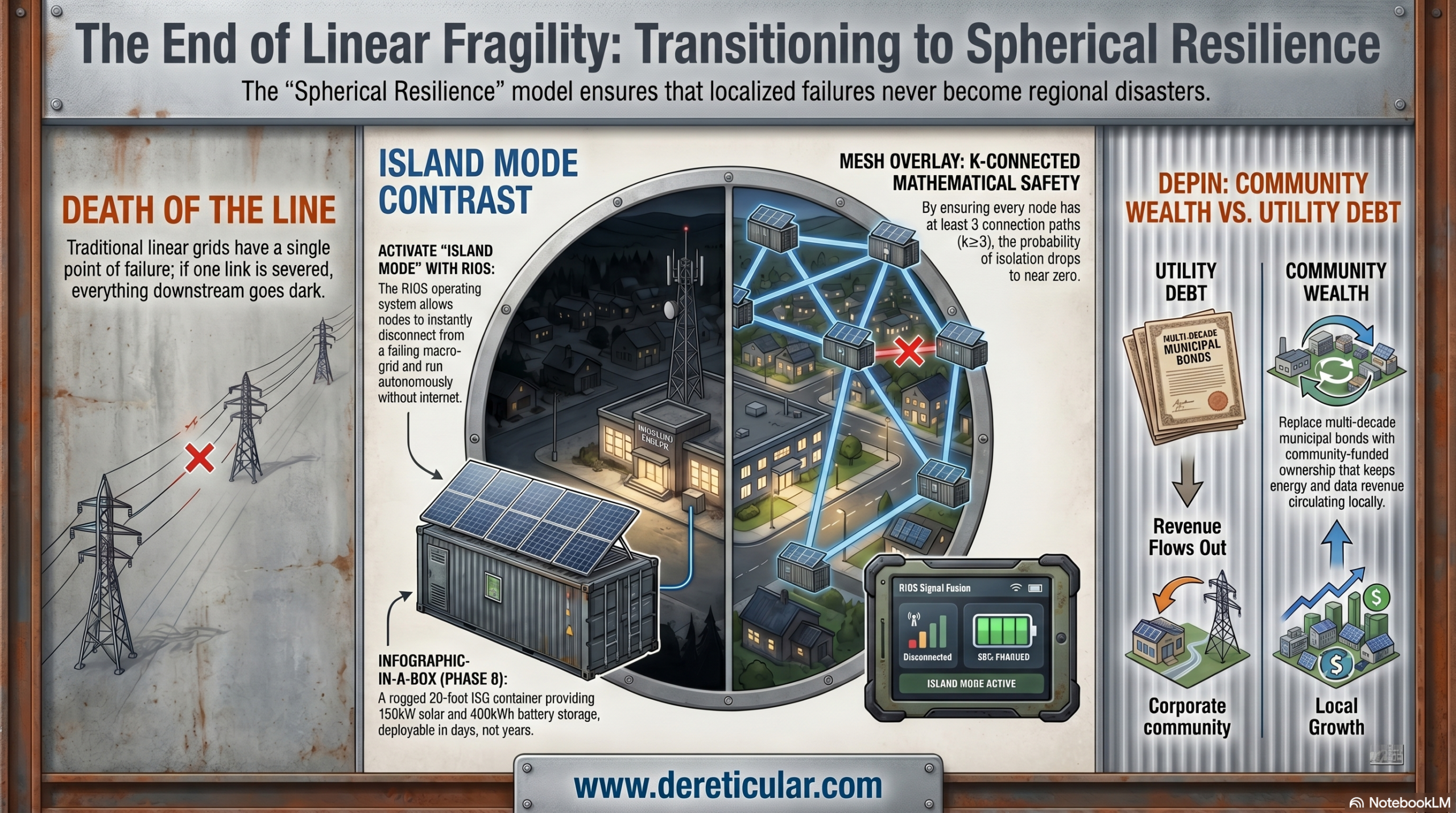
Traditional infrastructure is architected around Linear Fragility, a design paradigm where utility delivery relies on centralized corridors and high-capacity transmission lines. In a linear graph topology, the edge connectivity \lambda(G) = 1. This creates a mathematical certainty of failure: as the network scale |E| increases, the probability of a systemic partition event under a random link failure rate p approaches 1, calculated as:
P_{\text{partition}} = 1 – (1 – p)^{|E|}
To mitigate this, the systems engineering shift moves toward Spherical Resilience. This model utilizes a k-vertex-connected mesh where k \ge 3. In this architecture, a node is only isolated if k independent pathways fail simultaneously. The probability of isolation is drastically reduced to:
P_{\text{isolation}} = \prod_{j=1}^{k} p_j
Comparison: Traditional Grid Design vs. Spherical Resilience
| Feature | Traditional Grid Design (Legacy) | Spherical Resilience (Mesh) |
| Topology | Linear/Tree configuration; connectivity \lambda(G) = 1 | K-connected decentralized mesh (k \ge 3) |
| Vulnerability | Single physical point of failure; cascading risk | Redundant; requires k simultaneous failures |
| Failure Response | Downstream blackout/partition | “Island Mode” (autonomous isolation) |
| Dependency | Relies on macro-grid for sync and clock signals | Self-healing via solid-state transfer switches and reference voltage sync |
The Key Insight: Shifting to “Island Mode” capability is the only viable method to ensure 100% functionality during regional collapse. While Layer 1 provides the physical energy and compute capacity, it remains inert without a localized orchestration layer to manage the state-of-charge and load-shedding protocols.
——————————————————————————–
2. Layer 1: The Physical Foundation (The “Box”)
The physical manifestation of this resilience is the Phase 0 Infrastructure-in-a-Box. Housed in a ruggedized ISO 20-foot High-Cube shipping container, this unit bypasses the multi-year civil engineering cycles of traditional substations.
The Four Primary Hardware Systems
- Power Generation: A 150 kW bifacial monocrystalline solar array utilizing an integrated, mechanical scissor-jack mounting system for rapid deployment. This is supplemented by a 30 kW hydrogen-ready auxiliary generator for baseload support during extended solar anomalies.
- Energy Storage (BESS): A 400 kWh Lithium Iron Phosphate (LiFePO4) system, selected for thermal stability and a 6,000-cycle lifespan. The system is liquid-cooled and protected by automated aerosol-based fire suppression (FSS).
- Climate & Protection: The enclosure is constructed from 8-gauge corten steel and features dual-redundant closed-loop HVAC systems rated for -30°C to +55°C.
- Compute Hardware: An IP67-rated server rack containing a three-node high-availability cluster. Security is enforced via HSM (Hardware Security Module) cryptography to ensure local data integrity.
The Key Insight: The “Phase 0” advantage allows for deployment in days. By utilizing a standardized form factor, communities can deploy critical infrastructure “Behind-The-Meter” (BTM), effectively bypassing the multi-year utility connection study queues that paralyze traditional projects.
——————————————————————————–
3. Layer 2: RIOS – The Intelligence Layer
The Rural Infrastructure Operating System (RIOS) is an edge-native microkernel that manages local resources. RIOS uses a driver architecture that bridges legacy hardware via Modbus, CAN bus, and DNP3 protocols.
Island Mode: An operational state triggered when Quality-of-Service (QoS) thresholds drop below a functional baseline. RIOS sets the local autonomy factor (\theta_i) to 1, eliminating external dependencies. Mathematically, as \theta_i \to 1, the probability of a regional failure cascading into the local node (P_{\text{cascade}}) approaches zero.
How RIOS Manages an Air-Gapped Node
- Signal Fusion Engine: Monitors SNR and packet loss across LEO satellite, LTE, and RF mesh. It prevents “Death of the Line” by dynamically fragmenting and rerouting data at the packet level over the optimal physical layer.
- Autonomous Machine Coordination (AMC): Implements machine-learning models to balance generation against critical loads (e.g., prioritizing water pumps over non-essential circuits).
- Local Consensus: Utilizes modified Raft or PBFT algorithms to maintain a cryptographically verified database of administrative actions without a central server.
The Key Insight: RIOS doesn’t just manage one box; it acts as the hardware-agnostic “brain” that allows multiple disparate nodes to synchronize into a larger, sovereign community utility.
——————————————————————————–
4. Layer 3: The Mesh Network (The Connective Tissue)
Individual nodes self-organize into a peer-to-peer (P2P) network. Using protocols such as Babel or OLSRv2, the nodes establish a mesh that treats every unit as an autonomous relay.
Component Synergy
| Feature | Technical Execution | Benefit to Learner |
| P2P Routing | Babel / OLSRv2 protocols | Local traffic remains operational even if national backhaul is severed. |
| Load Sharing | AMC Engine coordination | Nodes dynamically share excess power capacity to balance regional demand. |
| Link Borrowing | Signal Fusion (Packet Sharding) | If Node A’s satellite link is obstructed, it fragments and “borrows” the uplink of Node B. |
The Key Insight: The mesh is self-healing. If a central fiber line is cut, the network automatically reroutes traffic through the most efficient available node, ensuring that community data and energy systems remain sovereign and uninterrupted.
——————————————————————————–
5. Synthesis: The Life Cycle of a Self-Sustaining Node
The transition to Spherical Resilience follows a pragmatic, three-phase roadmap designed to bypass administrative bottlenecks:
- Define Resilience Hubs: Identify critical municipal loads (water, emergency services, shelters).
- Deploy BTM Phase 0 Nodes: Install units “Behind-The-Meter” to immediately establish Island Mode capacity. This Strategic Bridge allows communities to ignore the administrative bottleneck of utility commissions and connection studies.
- Scale the Local Mesh: Activate P2P protocols as new nodes are added, incrementally increasing the k-connectivity of the region.
Core System Requirements for Sovereign Autonomy
- Hardware: A ruggedized Phase 0 container with 150 kW solar (mechanical scissor-jack) and 400 kWh liquid-cooled BESS.
- Software (RIOS): An edge-native microkernel managing the autonomy factor (\theta_i) and bridging legacy hardware via Modbus/DNP3.
- Networking: A k \ge 3 mesh topology utilizing Babel/OLSRv2 for P2P data sharding and load sharing.
- Sovereignty: Achieving energy and data independence through fractionalized ownership (DePIN), keeping revenue and control within the local community.
Final Statement: This modular approach allows communities to decouple from the fragile macro-grid. By integrating autonomous software with standardized hardware, we eliminate the “Death of the Line,” replacing linear fragility with the mathematical certainty of spherical resilience.


