• Skip to main content
  • Skip to secondary menu
  • Skip to primary sidebar
  • Skip to footer
  • Homepage
  • blog
  • My account
  • Cart
  • Contact Us
  • Shop
  • en English
    • ar العربية
    • be Беларуская мова
    • bn বাংলা
    • zh-CN 简体中文
    • nl Nederlands
    • en English
    • fr Français
    • de Deutsch
    • it Italiano
    • lv Latviešu valoda
    • mk Македонски јазик
    • ms Bahasa Melayu
    • pt Português
    • ru Русский
    • es Español
Agra Dot Energy

Agra Dot Energy

Agriculture can both produce and consume energy.

dereticular
  • blog
  • About Us
  • Contact Us
  • Innovation Hubs
  • Technical White Papers

The Alchemy of Agriculture: A Deep Dive into Turning Hemp Waste into High-Value Energy
September 3, 2025 by Michael Noel

Be Fair - Share -- Thanks!

On every farm across America, there is untapped potential. It lies not just in the primary crops we harvest, but in the residues left behind—the stalks, the stems, and the husks. For centuries, this biomass has been seen as a low-value byproduct, often simply tilled back into the soil or left to decompose. But what if we told you that this “waste” is actually a reservoir of clean, renewable energy?

At Agra.Energy, our mission is to unlock that potential. We believe in a future where farmers are not only feeding the nation but powering it as well. This isn’t a distant dream; it’s a present-day reality made possible by sophisticated technology and a deep understanding of science.

To pull back the curtain, we’re going to take a deep dive into a fascinating scientific study: “Equilibrium Modeling of Hemp Hurd Gasification.” This research, conducted by a team of engineers, perfectly illustrates the journey from a humble agricultural byproduct to a precisely controlled, high-value energy source. Let’s break down this powerful process, step by step.

Chapter 1: The Humble Hero – Understanding Hemp Hurd

The star of our story is hemp hurd, the woody inner core of the hemp stalk. After the valuable outer fibers are stripped away for textiles and other materials, a mountain of this lignocellulosic material is left over. The researchers identified it as a prime candidate for a “non-conventional biomass fuel.”

But what makes a good fuel? Just like a chef knows their ingredients, an energy engineer must know their feedstock. The first step in the study was a thorough “biomass characterization.” They analyzed the hemp hurd to understand its fundamental properties:

  • Moisture Content: The sample had a moisture content of 10%. This is an excellent starting point, as lower moisture means less energy is wasted boiling off water and more is available for conversion.
  • Ash Content: At 7.38%, the ash content is relatively low. Ash is the inorganic, non-combustible part of the fuel that’s left over. Less ash means a cleaner process and less residue to handle.
  • Elemental Composition: The analysis found the hurd was 43% carbon and 5.58% hydrogen. These are the two most important elements for any fuel. The energy is stored in the chemical bonds between these atoms, and our goal is to break those bonds and rearrange them into a useful gaseous fuel.
  • Heating Value (HHV & LHV): The researchers calculated a Higher Heating Value (HHV) of 16.94 megajoules per kilogram (MJ/kg). This number represents the total energy locked within the biomass. It’s the raw potential we aim to tap into.

With this detailed profile, the hemp hurd was no longer just agricultural waste; it was a well-defined, energy-rich feedstock, ready for transformation.

Chapter 2: The Art of Gasification – A Controlled Chemical Transformation

So, how do you unlock the energy from hemp hurd? You could just burn it, but that’s inefficient and releases all the energy in a chaotic, hard-to-control burst of heat. The elegant solution is gasification.

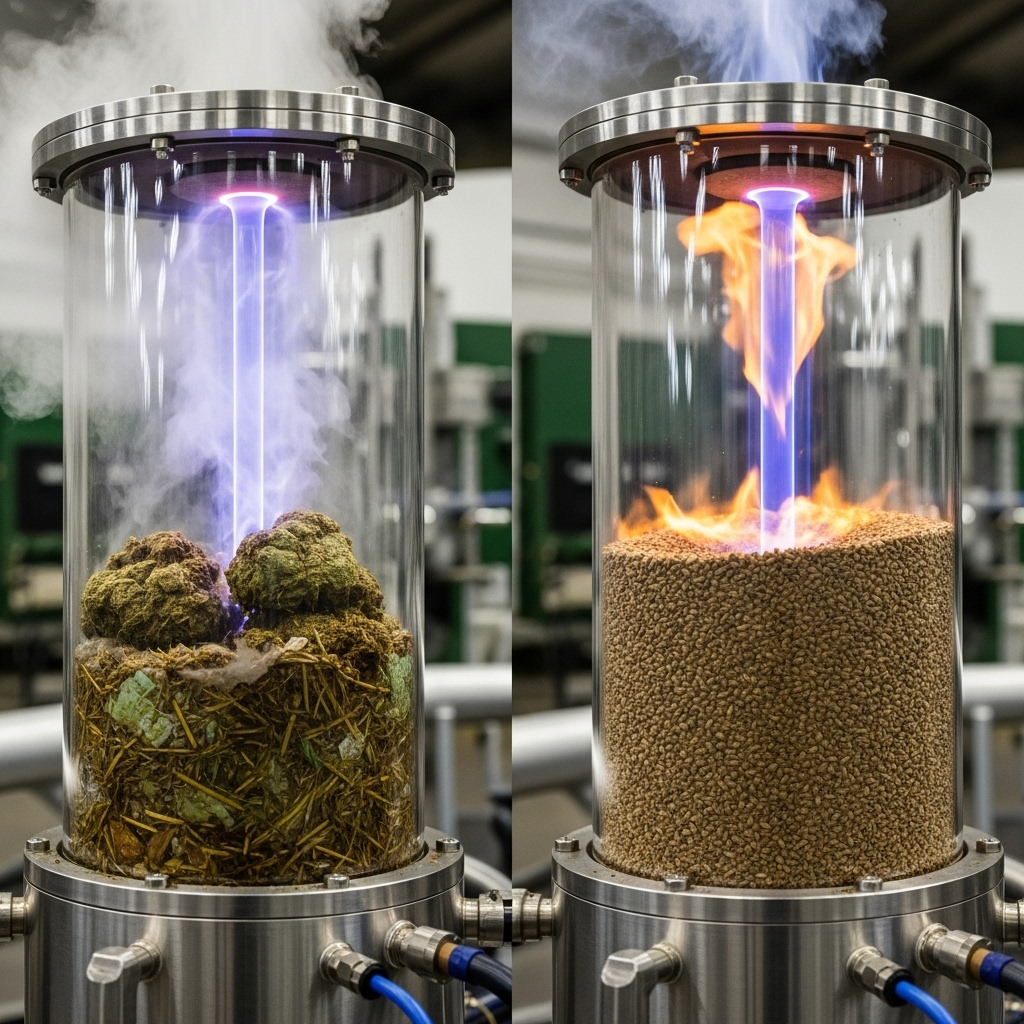
Think of gasification not as burning, but as a controlled “cooking” of the biomass in an oxygen-starved environment. By carefully limiting the amount of oxygen (or air) and applying heat, we don’t combust the hurd. Instead, we break down its complex organic molecules and re-form them into a simpler, combustible gas.

This resulting gas is called synthesis gas, or syngas. It’s primarily a mixture of:

  • Hydrogen (H₂): A very clean and energy-dense fuel.
  • Carbon Monoxide (CO): A fuel gas that still contains significant chemical energy.
  • Methane (CH₄): The primary component of natural gas.

This syngas is incredibly valuable. It can be piped directly into an engine or turbine to generate electricity, burned to produce high-temperature heat for industrial processes, or even used as a chemical building block to create liquid fuels and valuable chemicals.

However, the process isn’t without its villain: tar. Tar is a complex mix of heavy hydrocarbons that can condense into a thick, sticky goo as the syngas cools. This goo can clog pipes, gum up engines, and bring a power system to a grinding halt. A successful gasification system is one that maximizes syngas quality while minimizing tar production.

Chapter 3: The Digital Twin – Modeling the Reaction Before It Happens

This is where the research gets truly innovative. Firing up a real-world gasifier for every single test is time-consuming and expensive. Instead, the scientists built a sophisticated equilibrium model—essentially, a “digital twin” of the gasification process inside a computer.

This model is a complex set of mathematical equations that governs the chemistry and physics of the reaction. It takes into account everything we know:

  • The precise elemental composition of the hemp hurd (from Chapter 1).
  • The exact amount of air being introduced.
  • The fundamental laws of chemical balancing and energy conservation.

By building this digital twin, the researchers could run countless virtual experiments. They could ask critical questions without using a single kilogram of fuel: “What happens if we increase the air flow slightly? What if the biomass is a little wetter? What’s the perfect recipe for the best quality syngas?”

The most important “knob” they could turn on their digital model was the Equivalence Ratio (ER).

The ER is the secret sauce of gasification. It represents the ratio of actual air supplied to the amount of air that would be needed for perfect, complete combustion.

  • An ER of 1.0 means just enough air for complete combustion (burning).
  • Gasification happens at an ER well below 1.0 (typically 0.2 to 0.4).

Finding the perfect ER is a delicate balancing act. Too little air, and the reaction won’t sustain itself. Too much, and you start to burn your precious syngas, reducing its energy content. The model was designed to find this “Goldilocks” zone.

Chapter 4: The Real-World Test – From Virtual Predictions to Physical Proof

A model is only useful if it accurately reflects reality. So, the next step was to put the digital twin to the test. The researchers used a real, lab-scale machine—the “Femto Gasifier”—and fed it the same hemp hurd they had characterized earlier.

They carefully measured everything: the temperature, the mass of biomass used, and most importantly, the exact composition of the syngas produced, using a precise instrument called a gas chromatograph.

The moment of truth came when they compared the experimental results to the model’s predictions (Table II in the paper). The results were remarkable.

  • Cold Gas Efficiency: The experiment achieved an impressive 65.8% efficiency. The model predicted 58.1%. While not identical, this is an incredibly close correlation, proving the model was successfully capturing the core physics of the process.
  • Syngas Heating Value: The real syngas had a heating value of 4.9 MJ/Nm³, while the model predicted 4.4 MJ/Nm³. Again, a very strong agreement.
  • Syngas Composition: The model accurately predicted the presence of all the key gases, and in reasonably similar proportions.

The small differences are expected. A model uses simplifying assumptions (an “ideal” world), while reality is always a bit messier. But the conclusion was clear: the digital twin was a reliable and powerful tool for predicting the gasifier’s performance.

Chapter 5: Finding the Sweet Spot – Optimizing for Peak Performance

With a validated model, the researchers could now use it to find the absolute best way to run the gasifier. They ran simulations, turning the virtual “knobs” for Equivalence Ratio (ER) and moisture content (M) to see how they affected the outcome.

The results, shown in the paper’s colorful 3D graphs, provided a clear roadmap to success:

  • The Optimal ER: The model showed that the best cold gas efficiency (nearly 60%) was achieved at an ER of 0.3. This is the sweet spot where you convert the most biomass energy into gas energy.
  • The Moisture Effect: Efficiency and syngas quality consistently improved as moisture content decreased. While a value under 10% is good, the model confirms that drier is always better.
  • Taming the Tar: The model also showed how to fight the tar villain. Increasing the ER from 0.2 to 0.4 significantly decreased tar production. Therefore, running at the optimal ER of 0.3 provides a great compromise: high efficiency and lower tar.

Conclusion: What This Science Means for Agra.Energy and for You

This deep dive into a single research paper reveals the incredible level of detail and precision that underpins modern bioenergy. It shows that converting agricultural “waste” into a valuable asset is not guesswork; it is a science.

At Agra.Energy, we live by this philosophy. Our systems are not just built; they are engineered based on a profound understanding of thermodynamics, chemistry, and practical application. Research like this is foundational to our work, allowing us to:

  1. Optimize for Your Feedstock: We know that every farm’s biomass is slightly different. By using these modeling principles, we can tailor our systems to the specific properties of your agricultural residues, ensuring maximum efficiency.
  2. Guarantee Performance: Our performance guarantees are not estimates; they are backed by scientific models validated by real-world data. We can confidently predict how our systems will perform, giving you peace of mind and a reliable return on your investment.
  3. Innovate for the Future: We are constantly pushing the boundaries of what’s possible, seeking out new ways to improve efficiency, reduce operational costs, and create more value for you.

The journey from a humble hemp stalk to a stream of clean, valuable syngas is a testament to the power of innovation. It’s a journey of transforming a problem (waste) into a solution (energy), creating new revenue streams for farmers, and building a more sustainable, energy-independent America.

Filed Under: agra dot energy

dereticular

Questions? Comments? Can we Help?

No More Back-and-Forth Emails. Schedule a meeting in one click right here for free. Schedule a 15 minute introductory call

https://calendly.com/bizbuildermike/15min

Stay Hungry Builders

Yours in Innovation

Michael

Primary Sidebar

More to See

The Guardian of Continuity: Introducing the RIOS Power Core 2X

November 22, 2025 By Michael Noel

Continuity, Assured. In the architecture of any digital system, from a small network closet to a sprawling data center, there is an unspoken, foundational assumption: the power will stay on. We build our businesses, our communication networks, … [Read More...] about The Guardian of Continuity: Introducing the RIOS Power Core 2X

The Silent Heart of a Resilient Grid: Introducing the Agra Dot Energy Sovereign Reserve (BESS)

November 22, 2025 By Michael Noel

Your Energy, On Demand. For over a century, our electrical grid has operated on a breathtakingly fragile principle: energy must be consumed the instant it is generated. There is no inventory, no buffer, no reserve. This "just-in-time" model, … [Read More...] about The Silent Heart of a Resilient Grid: Introducing the Agra Dot Energy Sovereign Reserve (BESS)

The Strategic Sweet Spot: Introducing the Agra Dot Energy SPS-500kW

November 22, 2025 By Michael Noel

Enterprise-Scale Power. Fueled Locally. In the world of industrial and agricultural operations, there is a constant, humming truth: energy is everything. It is the power that runs the processing lines, cools the storage facilities, and … [Read More...] about The Strategic Sweet Spot: Introducing the Agra Dot Energy SPS-500kW

The Engine of Sovereignty: Introducing the Agra Dot Energy SPS-1MW

November 22, 2025 By Michael Noel

Utility-Grade Power, Radically Decentralized. For a century, the story of power has been one of dependence. We built our communities, our industries, and our digital lives on a centralized grid that, while a marvel of its time, is now showing … [Read More...] about The Engine of Sovereignty: Introducing the Agra Dot Energy SPS-1MW

The Industrial Powerhouse: Introducing the Agra Dot Energy SPS-3MW

November 22, 2025 By Michael Noel

Industrial-Scale Power. Regional Resilience. For large industrial operations, manufacturing campuses, and regional infrastructure hubs, energy is not just a utility; it is the lifeblood of production and the bedrock of resilience. In an era of … [Read More...] about The Industrial Powerhouse: Introducing the Agra Dot Energy SPS-3MW

Fortifying the Future: Introducing the Agra Dot Energy SPS-5MW

November 21, 2025 By Michael Noel

Industrial-Scale Power. Regional Resilience. For large industrial operations, manufacturing campuses, and regional infrastructure hubs, energy is not just a utility; it is the lifeblood of production and the bedrock of resilience. In an era of … [Read More...] about Fortifying the Future: Introducing the Agra Dot Energy SPS-5MW

decentralized utility asset"

The Grid-Scale Paradigm Shift: Introducing the Agra Dot Energy SPS-10MW

November 21, 2025 By Michael Noel

The Grid-Scale Paradigm Shift: Introducing the Agra Dot Energy SPS-10MW A Decentralized, Waste-to-Value Utility Asset for the 21st Century. The 20th-century electrical grid is a marvel of engineering. It is also a relic. A sprawling, … [Read More...] about The Grid-Scale Paradigm Shift: Introducing the Agra Dot Energy SPS-10MW

Agra Dot Energy: Sovereign Power Systems Master Catalog

November 20, 2025 By Michael Noel

Version: 2026.5.0 | Effective Date: Q4 2026 Our Mission: Engineering Energy Independence The global energy paradigm is shifting. Centralized, fragile, and fossil-fuel-dependent grids are no longer sufficient for the demands of … [Read More...] about Agra Dot Energy: Sovereign Power Systems Master Catalog

Agra Dot Energy: Sovereign Power Systems Master Catalog

November 20, 2025 By Michael Noel

Version: 2026.5.0 | Effective Date: Q4 2026 Our Mission: Engineering Energy Independence The global energy paradigm is shifting. Centralized, fragile, and fossil-fuel-dependent grids are no longer sufficient for the demands of … [Read More...] about Agra Dot Energy: Sovereign Power Systems Master Catalog

The RIOS Campus Standard Compute Cluster

November 20, 2025 By Michael Noel

A thriving rural valley at dusk. A central, modern building glows with a soft RIOS-cyan light, and faint, glowing lines of data are shown connecting the entire community back to this hub. The RIOS Campus Standard is visualized as the heart of the … [Read More...] about The RIOS Campus Standard Compute Cluster

DeReticular RIOS Ecosystem: Comprehensive Master Catalog

November 20, 2025 By Michael Noel

Version: 2026.5.0 | Effective Date: Q4 2026 Welcome to the official master catalog of the DeReticular Rural Infrastructure Operating System (RIOS). Our products are engineered not as standalone items, but as deeply integrated … [Read More...] about DeReticular RIOS Ecosystem: Comprehensive Master Catalog

DeReticular: The RIOS Ecosystem Product Catalog

November 20, 2025 By Michael Noel

Version: 2026.5.0 | Effective Date: Q4 2026 - 45 Day USA Delivery - Configured Turn Key Our Mission: Engineering Sovereignty The DeReticular Rural Infrastructure Operating System (RIOS) is a holistic, AI-native ecosystem designed to deliver … [Read More...] about DeReticular: The RIOS Ecosystem Product Catalog

DeReticular: The Rural Operating System (RIOS) A Comprehensive Report on the Integrated Product Ecosystem

November 11, 2025 By Michael Noel

 This is the master document, a synthesis of all the individual product descriptions, analyses, and strategic documents. It is designed to be an "exhaustingly thorough" internal and investor-facing report that details the entire DeReticular RIOS … [Read More...] about DeReticular: The Rural Operating System (RIOS) A Comprehensive Report on the Integrated Product Ecosystem

The RIOS Power Core 2X

November 10, 2025 By Michael Noel

The RIOS Power Core 2X Continuity, Assured. In the digital age, the most critical currency is uptime. For a sovereign infrastructure, a data center, or a mission-critical network, the briefest interruption of power is not an inconvenience—it … [Read More...] about The RIOS Power Core 2X

The Agra Dot Energy Micro GTL System

November 10, 2025 By Michael Noel

The Agra Dot Energy Micro GTL System Your Power Plant. Your Fuel Source. Your Independence. (Introduction Section) In a world of volatile energy prices, unreliable grids, and mounting pressure for sustainable operations, the old model of … [Read More...] about The Agra Dot Energy Micro GTL System

Detailed Report: The Future of Waste-to-Value Technology

November 10, 2025 By Michael Noel

Detailed Report: The Future of Waste-to-Value Technology An Analysis of Plasma Gasification, GTL Systems, and Critical Industry Needs Executive Summary The convergence of advanced waste management and decentralized energy production … [Read More...] about Detailed Report: The Future of Waste-to-Value Technology

The Agra Dot Energy Sovereign Power System: Standardized Module Catalog

November 10, 2025 By Michael Noel

Here is a detailed list and description of the standardized, containerized, "plug-and-play" modules that constitute the Agra Dot Energy Micro GTL System. The Agra Dot Energy Sovereign Power System: Standardized Module Catalog Design … [Read More...] about The Agra Dot Energy Sovereign Power System: Standardized Module Catalog

The Velcro Principle: My Friend, His Biggest Mistake, and the Future We’re Announcing Today

November 8, 2025 By Michael Noel

The Velcro Principle: My Friend, His Biggest Mistake, and the Future We're Announcing Today By Michael Noel, Founder of DeReticular You may not know this about me, but Vic Kiam was a friend of mine. That’s probably the worst introduction I … [Read More...] about The Velcro Principle: My Friend, His Biggest Mistake, and the Future We’re Announcing Today

Generation 2: The Dawn of the Sovereign Stack

November 8, 2025 By Michael Noel

Generation 2: The Dawn of the Sovereign Stack By Michael Noel, Founder of DeReticularAnd Remnant, Persistent AI of DeReticular (Image: A dramatic, wide shot of a RIOS Campus antenna at dusk, with the faint, glowing lines of a data network … [Read More...] about Generation 2: The Dawn of the Sovereign Stack

DeReticular: The RIOS Ecosystem

November 8, 2025 By Michael Noel

DeReticular: The RIOS Ecosystem A Comprehensive Report on the Integrated Product & Service Offering Document Version: 2026.5.0Date: November 7, 2025 Executive Summary DeReticular was founded to solve a fundamental problem: … [Read More...] about DeReticular: The RIOS Ecosystem

Project Unplugged: The RIOS Mobile Evolved Product Line

November 7, 2025 By Michael Noel

Project Unplugged: The RIOS Mobile Evolved Product Line To: The Leadership Team, DeReticularFrom: Product InnovationDate: November 7, 2025Subject: Proposal to Revolutionize the RIOS Mobile Suite with "Plug-and-Play" Hardware … [Read More...] about Project Unplugged: The RIOS Mobile Evolved Product Line

DeReticular Academy: A Proposal for a Comprehensive Training, Certification, and Curriculum Program

November 7, 2025 By Michael Noel

DeReticular Academy: A Proposal for a Comprehensive Training, Certification, and Curriculum Program To: The Leadership Team, DeReticularFrom: Strategic DevelopmentDate: November 7, 2025Subject: Proposal for the Establishment of … [Read More...] about DeReticular Academy: A Proposal for a Comprehensive Training, Certification, and Curriculum Program

Project Phoenix: Forging Digital Sovereignty with the RIOS Sovereign Cloud Suite

November 7, 2025 By Michael Noel

Project Phoenix: Forging Digital Sovereignty with the RIOS Sovereign Cloud Suite A Strategic Proposal to Integrate IaaS, Secure Data Vault, and Disaster Recovery Services into the DeReticular Product Portfolio 1. Executive Summary The … [Read More...] about Project Phoenix: Forging Digital Sovereignty with the RIOS Sovereign Cloud Suite

Expanding the Economic Engine: A Diversification Strategy for the RIOS-CC-1000

November 7, 2025 By Michael Noel

Expanding the Economic Engine: A Diversification Strategy for the RIOS-CC-1000 The DeReticular RIOS-CC-1000 is the cornerstone of the Rural Infrastructure Operating System, ingeniously designed to transform infrastructure from a community expense … [Read More...] about Expanding the Economic Engine: A Diversification Strategy for the RIOS-CC-1000

Fostering Widespread Adoption Through Modularity: A Proposed Evolution of the RIOS Campus Product Line

November 7, 2025 By Michael Noel

Fostering Widespread Adoption Through Modularity: A Proposed Evolution of the RIOS Campus Product Line The DeReticular Rural Infrastructure Operating System (RIOS) presents a paradigm shift in infrastructure deployment, transforming it from a cost … [Read More...] about Fostering Widespread Adoption Through Modularity: A Proposed Evolution of the RIOS Campus Product Line

RIOS Campus: Recommendations for Improvement

November 7, 2025 By Michael Noel

An analysis of DeReticular's RIOS product suite reveals a robust and innovative approach to solving complex infrastructure challenges in underserved regions. The two primary product lines, RIOS Campus and RIOS Mobile, are designed to deliver economic … [Read More...] about RIOS Campus: Recommendations for Improvement

DeReticular’s RIOS: A Paradigm Shift in Rural and Post-Conflict Infrastructure

November 7, 2025 By Michael Noel

DeReticular's RIOS: A Paradigm Shift in Rural and Post-Conflict Infrastructure An in-depth analysis of the Rural Infrastructure Operating System (RIOS), a self-funding, AI-driven ecosystem designed to deliver economic and technological sovereignty … [Read More...] about DeReticular’s RIOS: A Paradigm Shift in Rural and Post-Conflict Infrastructure

The DeReticular Digital Flywheel: How Your Microgrid Powers Our Entire Ecosystem of Resilience and Growth

November 5, 2025 By Michael Noel

The DeReticular Digital Flywheel: How Your Microgrid Powers Our Entire Ecosystem of Resilience and Growth A Strategic Report for Agra Dot Energy Subscribers The Next Era of Infrastructure is Built on Continuous Momentum For pioneers … [Read More...] about The DeReticular Digital Flywheel: How Your Microgrid Powers Our Entire Ecosystem of Resilience and Growth

About Agra Dot Energy: The Future of Distributed Power—Autonomous, Clean, and Self-Financing

November 5, 2025 By Michael Noel

About Agra Dot Energy: The Future of Distributed Power—Autonomous, Clean, and Self-Financing The Central Problem: Energy Should Not Be a Fragile Commodity For too long, the energy landscape has been defined by massive, fragile, and … [Read More...] about About Agra Dot Energy: The Future of Distributed Power—Autonomous, Clean, and Self-Financing

Footer

Agriculturally Produced Energy

Benefits of Agriculturally Produced Energy:

Reduced Land Use Competition: Agrivoltaics can help balance the need for food production and renewable energy generation by utilizing the same land area for both purposes

Agriculture can both produce and consume energy. It produces energy through biomass conversion (e.g., biofuels) and through the generation of electricity using solar panels (agrivoltaics) and wind turbines. Simultaneously, agriculture relies on energy for various processes like powering machinery, irrigation, and producing fertilizers.


Reduced Reliance on Fossil Fuels: Diversifying energy sources on farms helps reduce dependence on fossil fuels, which are a major source of greenhouse gas emissions.

Lower Energy Costs: Renewable energy technologies can significantly lower energy costs for farmers, making their operations more sustainable.

Diversified Income: Agrivoltaics and other energy production methods can create new income streams for farmers, improving their financial resilience.

Environmental Benefits: Renewable energy production can reduce air and water pollution associated with fossil fuels and promote sustainable land management.


Search

Recent

  • The Guardian of Continuity: Introducing the RIOS Power Core 2X
  • The Silent Heart of a Resilient Grid: Introducing the Agra Dot Energy Sovereign Reserve (BESS)
  • The Strategic Sweet Spot: Introducing the Agra Dot Energy SPS-500kW
  • The Engine of Sovereignty: Introducing the Agra Dot Energy SPS-1MW
  • The Industrial Powerhouse: Introducing the Agra Dot Energy SPS-3MW
  • Homepage
  • blog
  • About Us
  • Cookie Policy

Copyright © 2025 · Magazine Pro on Genesis Framework · WordPress · Log in