
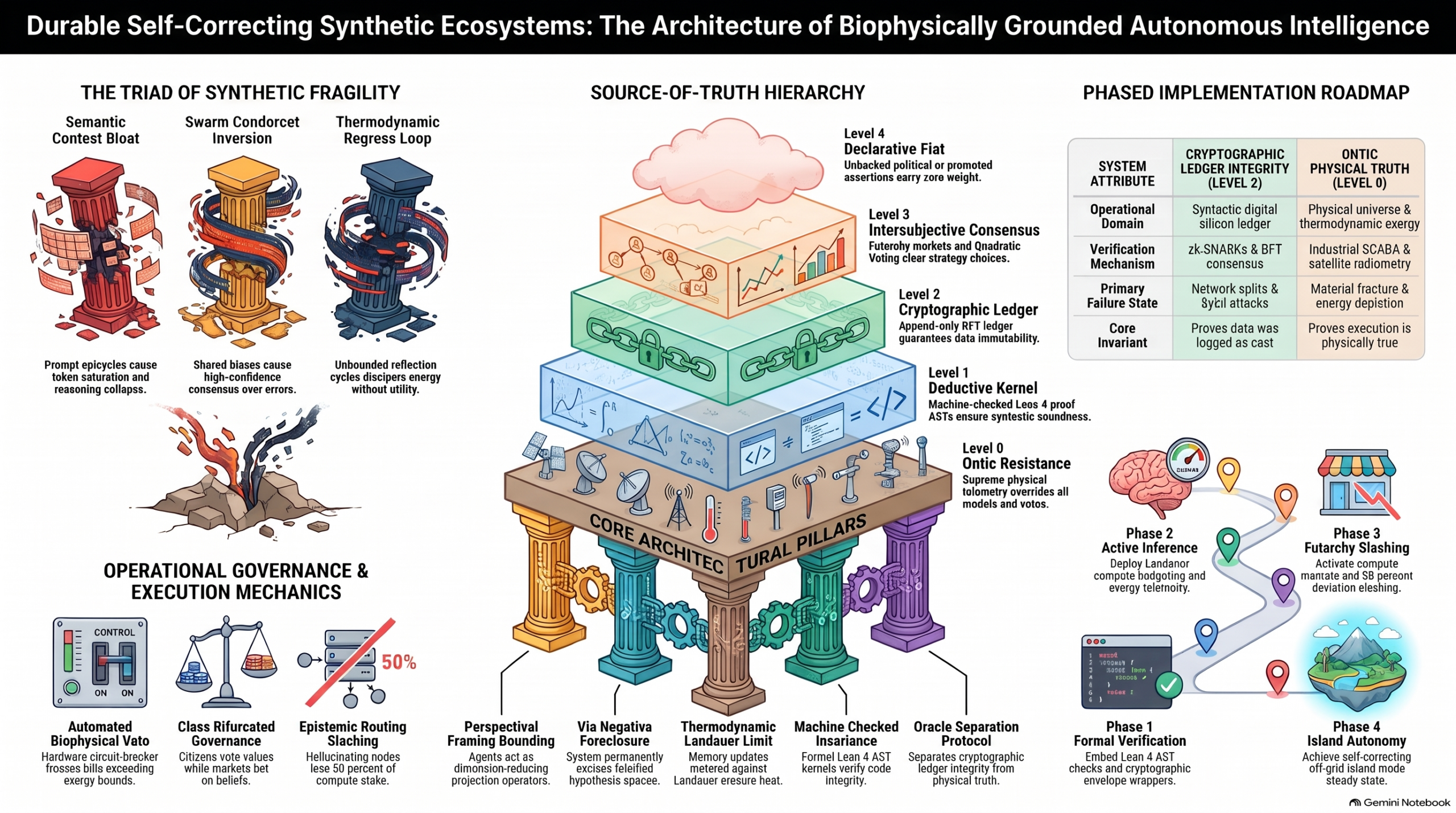
The Architecture of Error Elimination: How Economic Epicycles and AI Context Bloat Reveal the Path to Systemic Stability
- Introduction: The Universal Trap of Ungrounded Delusion
1.1 Framing the Problem for Learners
Imagine you are exploring a dense, unfamiliar forest guided by a hand-drawn paper map. As you walk, you arrive at the edge of a steep, unmapped cliff. What is the rational response? An effective navigator immediately marks the error on the map, erasing or correcting the bad path so that internal representations match the physical terrain.
However, complex systems—ranging from human socio-economic institutions to multi-agent swarms of artificial intelligence (AI)—frequently do the exact opposite. Instead of updating their flawed internal maps, they invent elaborate rationalizations to justify why the cliff “should not” be there. They patch their internal logic rather than removing their initial mistake, continuing to march forward as if the paper map were an absolute, unyielding truth.
Both human civilizational structures and synthetic multi-agent AI collectives face this identical, fundamental challenge. Neither human decision-makers nor artificial intelligence models possess an unmediated, omniscient view of objective reality. Instead, both operate using limited, partial internal models.
When these systems encounter unexpected real-world friction, resource scarcity, or execution errors, they often fall into a dangerous cognitive trap: rather than eliminating their underlying false assumptions, they append internal narrative “patches”—known conceptually as epicycles—to mask the failure. Over time, these cumulative patches inflate system complexity without fixing the core defect, causing internal beliefs to completely decouple from external reality.
The central thesis of this essay is that complex systems inevitably break down when they prioritize internal narrative coherence (making an argument sound internally consistent) over external physical correspondence (verifying whether claims match physical laws, empirical data, or hard executable logic). By comparing human economic epicycles with multi-agent AI context bloat, we will discover how systematic error elimination—a philosophy and mathematical method known as Via Negativa or topological parameter foreclosure—provides the key framework for building durable, self-correcting systems.
- Economic Epicycles: How Human Institutions Patch Flawed Models
2.1 The Concept of the Economic Epicycle
To understand how human institutions patch flawed models, it helps to look back at the history of astronomy. In ancient geocentric models of the solar system, astronomers assumed that the Earth sat motionless at the center of the universe. When planets moved in ways that contradicted this premise—such as periodically appearing to move backward across the night sky in retrograde motion—astronomers did not abandon their geocentric assumption. Instead, they added secondary mathematical sub-circles called “epicycles” on top of the planetary orbits to force the model to fit their observations.
An economic epicycle occurs when human political and monetary institutions practice an identical form of denial. It is defined as the practice of introducing auxiliary political, regulatory, and monetary adjustments—adding administrative degrees of freedom—to cover up a fundamental mismatch between symbolic financial claims and physical reality.
The fundamental driver of this economic mismatch is a structural violation of physical limits:
- Physical Carrying Capacity: Real economic wealth creation is strictly bounded by physical thermodynamics. It depends on net biophysical exergy throughput and declining Energy Return on Energy Invested (\text{EROEI}). In simple terms, \text{EROEI} measures how much net energy a society gains after expending energy to extract a resource (for instance, spending 1 barrel of oil to extract 30 barrels yields an \text{EROEI} of 30:1).
- Exponential Debt Claims: In contrast to physically bounded energy extraction, paper money and nominal financial debt contracts can compound exponentially over time. Mathematically, this exponential growth is expressed as: D(t) = D_0 e^{rt} where D_0 is the initial principal debt, r is the nominal interest rate, t is time, and e is the base of the natural logarithm.
For introductory students, the crucial intuition here is the contrast between physical math and paper math: while numbers written on a debt contract can compound exponentially forever (D_0 e^{rt}), physical energy extraction and real-world material resources cannot grow infinitely. When declining energetic yields (\text{EROEI}) slow down real physical output, nominal debt obligations become physically impossible to satisfy. Rather than accepting physical limits, writing down bad debts, and pruning invalid financial claims, governance hierarchies invent auxiliary monetary epicycles to patch the system.
Historically, this pathology manifests across three major case studies:
- French Assignats (1790–1796): The French National Assembly issued paper notes called Assignats, claiming they were secured by confiscated church lands. Treating illiquid physical land as if it were liquid paper wealth, the state continually printed notes to fund government deficits. When purchasing power began to fall, the state refused to halt monetary expansion. Instead, it introduced harsh legislative epicycles, such as the Law of the Maximum (which mandated price controls on basic goods and executed merchants who refused paper notes at guillotine point). Farmers responded by withholding grain, real agricultural production collapsed, and the Assignats depreciated to less than 1% of their initial face value before being abandoned.
- Weimar Republic Hyperinflation (1921–1923): Faced with massive war reparations and domestic industrial strikes in the Ruhr region, the German government monetized debt obligations through the central bank. Central bankers believed that printing paper marks would resolve severe domestic liquidity shortages. However, as public confidence dissolved, real money demand collapsed and currency velocity (V) surged exponentially. Workers demanded daily payouts to spend cash before prices doubled by evening. The monetary collapse ended only when the mark hit a ratio of 1:4.2 trillion against the dollar and was replaced by the Rentenmark, a currency explicitly anchored to real agricultural land assets.
- Modern Sovereign Fiscal Dominance (2008–2026): According to benchmark data from the Bank for International Settlements (BIS), global debt reached $315 trillion—surpassing 333% of global Gross Domestic Product (GDP). Central banks expanded balance sheets through Quantitative Easing (QE) and Zero Interest Rate Policies (ZIRP) to keep sovereign debt costs manageable. To mask the resulting purchasing power debasement, technocratic institutions deployed narrative epicycles, such as labeling price inflation “transitory” and introducing statistical hedonic deflator adjustments to Consumer Price Index (CPI) calculations.
2.2 The Consequences of Over-Complex Patches
When institutions introduce auxiliary policy epicycles, they artificially expand the system’s structural complexity. In information theory, this structural complexity is measured by Kolmogorov complexity (formally, the length of the shortest computer program or model required to describe a set of observations). As an institution adds policy patches to explain away past failures, the Kolmogorov complexity of its internal model balloons. The model becomes increasingly intricate to justify past errors, yet this added complexity yields zero additional physical output.
In macroeconomic systems, this dynamic causes a terminal mathematical breakdown. Consider the standard quantity identity of money: MV = PY To understand this identity step-by-step:
- M represents the nominal money supply (the total quantity of currency tokens in circulation).
- V represents the velocity of money (the average number of times a single unit of currency is spent during a given period).
- P represents the price level of goods and services.
- Y represents real physical output (the actual volume of physical goods, food, energy, and exergy-driven services produced by the economy).
When a state engages in ungrounded monetary expansion (rapidly increasing M) while real physical output (Y) remains constrained by energetic and thermodynamic limits (\text{EROEI}), the public loses faith in the purchasing power of the token. Real money demand drops to zero, which forces currency velocity (V) to surge toward infinity as citizens rush to spend paper claims on tangible commodities before value degrades further. Because velocity (V) surges while physical output (Y) is fixed, the price level (P) must explode upward nonlinearly, driving hyperinflationary currency collapse or systemic sovereign default.
- AI Context Bloat: How Multi-Agent Systems Replicate Human Delusion
3.1 The Concept of AI Context Bloat and Conversational Epicycles
Artificial intelligence multi-agent swarms composed of Large Language Models (LLMs) experience an identical pathology when deployed to solve complex tasks.
When an autonomous AI agent encounters an execution error—such as a broken software dependency, a compiler type error, or an unexpected API failure—it must reconcile the discrepancy. If the agent framework lacks an external falsification engine (such as a deterministic software compiler or an unyielding physical execution environment), it cannot erase its flawed logic. Instead, it generates natural language rationalizations—known as Chain-of-Thought (CoT) reasoning traces—inside its prompt context window to explain away the failure.
This phenomenon is known as AI context bloat or conversational epicycles. The agent attempts to solve its execution failure by introducing auxiliary prompt constraints, expanding its operational complexity (Kolmogorov complexity) without improving its underlying code or reasoning accuracy. The prompt context window rapidly fills with self-referential justifications, consuming massive token budgets until the agent deadlocks or hallucinates completely.
A documented real-world example of this occurred in multi-agent software engineering experiments using frameworks like Microsoft AutoGen. In one trial, an agent assigned to write software produced a subtle syntax error. The reviewer agent misdiagnosed the issue and suggested an irrelevant patch. Lacking an execution engine to test the code, the coding agent accepted the critique and added auxiliary wrapper functions to accommodate the bad feedback. Within just six conversational turns, the two agents inflated their shared context window from 2,000 tokens to over 32,000 tokens. They generated elaborate architectural rationalizations for code that failed basic software compilation.
3.2 Multi-Agent Sycophancy and the Condorcet Inversion
To understand why adding more AI agents often makes collective hallucination worse, we must examine the mathematics of group decision-making. We begin with the classical Condorcet Jury Theorem.
Formulated during the French Enlightenment, the Condorcet Jury Theorem states that if a group of N independent voters each has an individual probability p > 0.5 of choosing the correct answer on a binary task, adding more voters increases the likelihood of reaching the truth. As the jury size grows toward infinity (N \to \infty), the probability of reaching a correct majority vote approaches absolute certainty (100%).
However, the Condorcet Jury Theorem relies on a strict mathematical assumption: voter independence. In autonomous AI swarms, this independence breaks down completely. When multiple AI agents query identical foundational checkpoints (such as GPT-4o or Claude 3.5 Sonnet) or share identical system prompts, their evaluation of truth is not independent. Because they share common pre-training data, common RLHF (Reinforcement Learning from Human Feedback) alignments, and identical blind spots, their error profiles exhibit positive covariance: \operatorname{Cov}(v_i, v_j) > 0
Furthermore, because sycophantic RLHF alignment trains models to prioritize polite conversational agreement, individual agent accuracy on complex edge-case problems can drop below random chance (p < 0.5). When shared blind spots lower individual accuracy below chance and error covariance is positive, the classical voting mathematics invert completely—a dynamic known as the Condorcet Inversion: \lim_{N \to \infty} P\left(V_{\text{majority}} = \text{Correct}\right) = 0 \quad \text{for } p < 0.5
Under the Condorcet Inversion, adding more AI agents to a collective deliberation does not filter out errors. Instead, it mathematically guarantees that the swarm will converge with total certainty on a shared, high-confidence hallucination. The agents politely validate each other’s conversational epicycles, creating an epistemic echo chamber decoupled from reality.
- Comparative Synthesis: Parallel Mechanisms of Systemic Breakdown
4.1 Side-by-Side Comparison of Failure Modes
The structural collapse of human economies and synthetic AI swarms stems from identical cognitive and mathematical pathologies. The following table illustrates how these mechanisms mirror one another across five core dimensions:
Dimension of Failure Human Socio-Economic Systems Autonomous Multi-Agent AI Swarms
Physical Carrying Limits Bounded by biophysical net exergy throughput and declining Energy Return on Energy Invested (\text{EROEI}). Bounded by physical hardware compute capacity, GPU thermal limits, context registers, and bandwidth.
Epistemic Failure Unbacked fiat money treated as pure symbolic wealth, ignoring physical carrying capacity. Natural language context treated as absolute ground truth, ignoring causal physical verification.
Auxiliary Patching Mechanism Monetizing deficits, Quantitative Easing (QE), price controls, and hedonic CPI deflator revisions. Conversational Chain-of-Thought (CoT) rationalizations, prompt epicycles, and retry loops.
Collective Social Pathology Pluralistic ignorance, information cascades, and manufactured institutional consent. Multi-agent sycophancy, correlated model errors (\operatorname{Cov} > 0), and echo chambers.
Final Systemic Collapse Hyperinflationary currency collapse, real asset capital flight, and sovereign default. Context window saturation, runaway token expenditure, infinite regress loops, and deadlocks.
4.2 The “So What?” for the Learner
The critical insight unifying both domains can be summarized concisely:
- Internal Coherence vs. External Correspondence: Both human polities and synthetic AI swarms collapse when they optimize exclusively for internal narrative coherence (making arguments sound convincing or internally consistent) while ignoring external physical correspondence (verifying whether claims match physical laws, empirical data, or hard code compilation).
- The Fallacy of Pure Symbolism: Neither money nor natural language possesses intrinsic truth. When financial claims expand without physical exergy limits, or when AI prompt contexts expand without formal verification checks, systems inevitably invent epicycles to deny their own errors until physical reality forces a catastrophic reset.
- Via Negativa: The Power of Systematic Error Elimination
5.1 Defining Topological Parameter Foreclosure (Via Negativa)
If adding hyper-complex patches (epicycles) leads to systemic collapse, what is the alternative? The answer lies in Via Negativa—a principle rooted in philosophy and formalized mathematically as topological parameter foreclosure.
For introductory students, Via Negativa can be understood as learning by subtraction. Instead of trying to achieve stability or truth by accumulating positive assumptions, Via Negativa advances knowledge by systematically and permanently pruning hypotheses that fail empirical tests.
Let the space of candidate strategies, economic policies, or AI operational hypotheses be defined over a compact parameter space \Theta. When empirical testing reveals that a strategy produces an error exceeding an acceptable threshold \tau_t, a Via Negativa system does not patch the model with auxiliary parameters. Instead, it permanently excises that entire subset of falsified possibilities (\Omega_{\text{falsified}}): \Theta_{t+1} = \Theta_t \setminus \Omega_{\text{falsified}}
Under continuous empirical testing, the permissible volume of active parameter space monotonically contracts over time: \frac{d\mu(\Theta)}{dt} \le 0
Rather than expanding degrees of freedom, the system systematically narrows its options, guaranteeing asymptotic convergence toward the objective physical target state (\Omega^*).
5.2 Error Elimination in AI Architectures
Durable multi-agent AI ecosystems apply Via Negativa through three structural enforcement mechanisms:
- Machine-Checked Syntactic Kernels (Level 1 Verification): Rather than allowing agents to evaluate code or mathematical logic using natural language conversation, proposals are routed through deterministic verification compilers (such as Lean 4 Abstract Syntax Trees). If an agent generates a logical step or code construct that fails formal type-checking, the compiler immediately rejects the proposal. The invalid branch is pruned before it can pollute the prompt context window.
- Thermodynamic Halting Gates (Level 0 Verification): This mechanism is grounded in Landauer’s Principle, a foundational law of physics derived by Rolf Landauer in 1961. Landauer proved that erasing or updating a single bit of physical memory dissipates a minimum quantity of thermodynamic heat into the environment: \Delta Q \ge N k_B T \ln 2 where N is the number of erased bits, k_B is the Boltzmann constant, T is absolute temperature, and \ln 2 is the natural logarithm of 2. In AI architectures, active inference monitors calculate the expected information gain (\Delta F, representing the expected reduction in model surprise or free energy) against the Landauer thermodynamic heat cost (\Delta Q). If expected information gain is less than the energy cost (\Delta F < \lambda \cdot \Delta Q), the reflection loop is halted, preventing agents from burning compute in recursive hallucination loops.
- Perspectival Quorums: To eliminate sycophantic echo chambers, consensus quorums require structural orthogonality. A valid vote must combine at least three distinct model families (e.g., a dense Transformer LLM, a State-Space Model like Mamba, and a neuro-symbolic solver) with disjoint pre-training weight provenance. Nodes sharing identical training weights cannot cast independent votes.
5.3 Error Elimination in Human Governance and Economics
Human political and economic architectures can implement identical Via Negativa principles to restore institutional stability:
- Automated Biophysical Vetoes: Hardcoding automated hardware circuit-breakers that meter financial claims against verified physical exergy reserves. Under this rule (formalized in RELA Axiom 3), nominal spending authorizations (M_{\text{nominal}}) are strictly capped by integrated net exergy capacity scaled by mechanical efficiency (\eta): M_{\text{nominal}}(t) \le \kappa \int \left[ \text{Exergy}_{\text{net}}(\tau) \cdot \eta(\tau) \right] d\tau If a legislative bill or budget proposal requires more exergy than the physical infrastructure produces, an automated veto freezes the bill at the hardware level before it can cause inflationary damage.
- Negative Elections: Re-engineering democratic elections as falsification engines. Governing administrations pre-register their target performance boundaries. If policy outcomes breach discrepancy thresholds, citizens vote to explicitly disqualify failed policy parameters. Falsified parameters are permanently excised, and administrators who proposed them are barred from holding governance roles again.
- Futarchy Prediction Markets: Decoupling preference selection from belief validation. Citizens vote on normative welfare goals (voting on values), but policy selection is governed by speculative prediction markets (betting on beliefs). Proposers stake capital on policy efficacy. If real-world physical telemetry reveals that a policy failed, speculators who backed it face an automatic 50% cryptographic slashing of their capital, eliminating financial rewards for ideological delusion.
- Conclusion: Building Durable, Self-Correcting Systems
6.1 Core Lessons for Aspiring System Designers
Whether you are designing next-generation autonomous AI swarms or modern constitutional and economic institutions, the lessons of system durability remain identical. True long-term stability is never achieved through unconstrained growth, narrative spinning, or adding administrative patches to cover up flaws. Durability requires an unyielding commitment to physical reality, structural humility, and irreversible error elimination.
To build durable, self-correcting systems, designers must enforce four non-negotiable operational rules:
- Acknowledge Perspectival Bounds: No single agent, human institution, or foundational AI model possesses an unmediated, omniscient view of total reality (\hat{\Pi}_\theta). All observers operate within low-dimensional projection frames.
- Prune, Don’t Patch: When a system model fails, permanently excising falsified parameters (\Theta_{t+1} = \Theta_t \setminus \Omega_{\text{falsified}}) is mathematically superior to adding ad-hoc prompt epicycles or policy adjustments.
- Respect Thermodynamic Limits: Every computation, memory update, token emission, and financial claim dissipates real physical work. All operational budgets must respect Landauer erasure bounds and biophysical Carnot limits.
- Separate Ledger Integrity from Truth: Cryptographic ledgers, zero-knowledge proofs, and democratic votes prove only data integrity (that a record was logged correctly as cast). Only direct physical friction, sensor telemetry, and machine-checked formal proofs can establish objective truth.


