
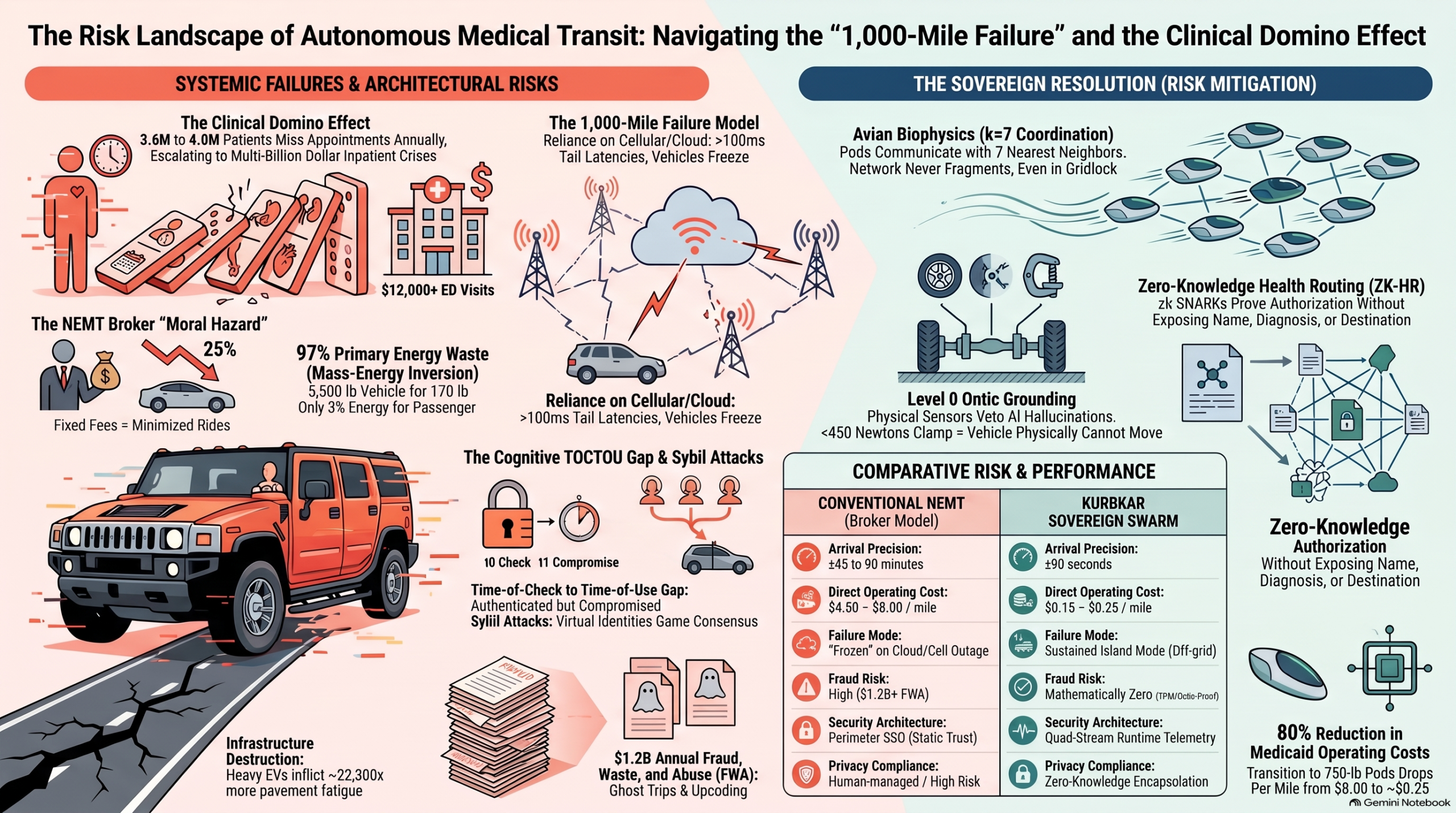
THE ARCHITECTURE OF KINETIC AND EPISTEMIC AUTONOMY
A Comparative Systems Analysis of the Autonomous Transportation Industry, Biomorphic Swarm Physics, and the DeReticular/RELA Sovereign Infrastructure
EXECUTIVE SUMMARY
The contemporary autonomous vehicle (AV) industry has reached a structural
impasse. Despite tens of billions of dollars in capital expenditure, commercial
deployments remain confined to geofenced urban enclaves or fragile,
cloud-tethered pilot programs. Across the documentation generated by the
DeReticular Systems Institute, the Santa Fe Institute (SFI), the Stanford Center
for Blockchain Research (CBR), and the International Society for Biophysical
Economics (ISBE), this failure is diagnosed not as a lack of compute or training
tokens, but as an acute structural and epistemological category error.
Modern automobility—both human-driven and autonomously chauffeured—suffers from
three foundational pathologies:
- The 5,000-Pound Mass Inversion: Utilizing a 2,500 kg multi-passenger steel
cage to transport a single 77 kg human, allocating 97% of primary kinetic
energy to moving the vehicle chassis and only 3% to moving the passenger. - The “Solitary God” Omniscience Fallacy: Designing autonomous vehicles as
isolated cognitive monads dropped into an adversarial game-theoretic arena,
forced to predict human intent through tinted glass and uncoordinated sensor
suites, backed by brittle, high-latency 1,000-mile cloud teleoperation
links. - The Epistemic Decoupling of Multi-Agent Systems: Relying on ungrounded
generative AI, perimeter Single Sign-On (SSO), and majoritarian consensus,
which induces context bloat, conversational epicycles, and the Condorcet
Inversion (\operatorname{Cov}(v_i, v_j) > 0), ultimately causing synthetic
swarms to converge with mathematical certainty on hallucinations
(p < 0.5 \implies \lim_{N \to \infty} P_N = 0).
To escape this mechanical and computational cul-de-sac, the DeReticular
Sovereign Stack synthesizes the active matter biophysics of European starling
murmurations (Sturnus vulgaris), measure-theoretic parameter foreclosure (Via
Negativa), and the Oracle Separation Protocol.
                              [ ONTIC ATTRACTOR Ω* ]
                 (Physical Laws, Net Exergy, Aerodynamic Friction)
                                         ▲
                                         │ [Asymptotic Convergence]
                 ┌───────────────────────┴───────────────────────┐
                 │          VIA NEGATIVA FORECLOSURE             │
                 │       (Monotonic Parameter Pruning)           │
                 └───────────────────────▲───────────────────────┘
                                         │
  ┌──────────────────────────────────────┼──────────────────────────────────────┐
  ▼                                      ▼                                      ▼
[LEVEL 0: ONTIC FRICTION] [LEVEL 1: DEDUCTIVE KERNEL] [LEVEL 2: APPEND-ONLY BFT]
Real-time wheel torque, Lean 4 AST proof checking; Partially synchronous
calorimeters, RF telemetry. Truth-preserving syntax; consensus (N ≥ 3f + 1);
Overrides all models & votes. Γ ⊢ ψ ⟹ Γ ⊨ ψ. Proves integrity, NOT truth.
│ │ │
└──────────────────────────────────────┼──────────────────────────────────────┘
▼
[DECENTRALIZED SWARM EXECUTION]
• Topological k-NN (k ≈ 7) Bounded Context
• Hyperbolic Inertial Spin Waves (c ≈ 20–40 m/s)
• Continuous Quad-Stream Telemetry (Ψ_i)
• Automated Biophysical Veto (RELA Axiom 3)
This report provides an exhaustive, publication-grade investigation of the
autonomous mobility sector, cross-referenced with the biophysical, economic, and
cryptographic formalisms of the uploaded corpus.
PART 1: DECONSTRUCTION OF THE CONTEMPORARY AUTONOMOUS TRANSPORTATION INDUSTRY
1.1 The State of the Art: Taxonomy of Incumbent Paradigms
The commercial AV ecosystem in 2026 is divided into three dominant architectural
camps, each exhibiting critical vulnerabilities when analyzed through the lens
of physical thermodynamics and distributed systems engineering:
| Architectural Paradigm | Key Proponents | Primary Sensing / Compute Modality | Network & Control Topology | Structural Bottlenecks & Critical Failure Modes |
|---|---|---|---|---|
| Cloud-Tethered Heavy Sensor Fusion | Waymo (Alphabet), Cruise (GM), Zoox (Amazon), Baidu Apollo | 64-to-128 beam spinning LiDARs ($15k–$40k), 14+ cameras, radar, liquid-cooled trunk supercomputers (1–2 kW draw). | Centralized cloud orchestration (AWS, GCP); continuous cellular backhaul; remote human teleoperation centers. | 1,000-Mile Failure Model: Network jitter, cell-tower handover latency, and packet loss freeze vehicles during edge dead-zones. High capital cost ($150,000–$250,000/unit) yields unsustainable operating costs ($1.50–$2.50/passenger-mile). |
| Vision-Only Monadic End-to-End Deep Learning | Tesla (FSD / Cybercab) | 8–9 passive optical cameras, single-chip inferencing computer (HW3/HW4), zero LiDAR, zero active radar. | Isolated vehicle monad; asynchronous fleet telemetry uploads; pure neural network end-to-end policy execution. | The Omniscience Trap & Phantom Braking: The vehicle must deduce occluded physical states without cooperative RF confirmation. Visual edge cases (road spray, glare, shadows) induce emergency stops or lethal misclassifications. |
| Heavy Long-Haul Freight Platooning & Chaining | Aurora Innovation, Kodiak Robotics, Gatik, legacy Peloton Technology | Long-range multi-sensor LiDAR/radar suites; Class 8 tractor-trailers (80,000 lbs gross weight). | Point-to-point interstate hub routing; high-latency V2V radar-based adaptive cruise control (CACC). | Inelastic Momentum Deadlock: Extreme kinetic mass ($>36,000\text{ kg}$) requires massive physical headways (50–150 ft), preventing boundary-layer slipstreaming and inducing accordion instability under hard deceleration. |
1.2 The Five Systemic Pathologies of Modern Automobility
Pathology 1: The Mass-Energy Inversion
The internal combustion engine (ICE) and consumer electric vehicle (EV)
paradigms are thermodynamically irrational. Standard passenger vehicles weigh
between 4,500 lbs (Tesla Model Y) and 5,800 lbs (Ford F-150 Lightning, Cadillac
Lyriq). In urban commuter transit, where 75% of daily vehicular trips carry
exactly one human [KK-TR-2026-MOBILITY-V1, p. 4]:
\eta_{\text{kinetic}} = \frac{m_{\text{payload}}}{m_{\text{total}}} = \frac{77\text{ kg}}{77\text{ kg} + 2500\text{ kg}} = \frac{77}{2577} \approx 2.98%
Over 97% of the electrical or chemical exergy is consumed moving stamped sheet
steel, lithium floor packs, structural subframes, and sound-dampening glass,
consuming 250 to 450 Wh per passenger-mile.
Pathology 2: The Omniscience Trap & The Cognitive TOCTOU Gap
Modern AVs operate as isolated cognitive monads. When a Waymo or Tesla
encounters an intersection, it has zero direct, low-latency, cryptographic
coordination with surrounding vehicles. It must treat every surrounding actor as
a hostile, non-cooperative game-theoretic entity. In multi-agent AI theory, this
is formalized as the Cognitive Time-of-Check to Time-of-Use (TOCTOU) Gap
[RELA-SSO-REPLACE-2026-V1, pp. 2–3]:
- At time t_0, the perception engine authenticates a clear lane.
- Between t_0 and execution epoch t_1, an uncoordinated human or vehicle
drifts across the boundary. - Lacking multi-agent consensus, the vehicle defaults to emergency braking or
gets trapped behind double-parked vehicles, paralyzing transit corridors.
[Time t₀: Static Handshake] ──► Token Issued / Sensor Checks Clear ──► STATUS: TRUSTED
│
▼ (Unmonitored Execution Interval: TOCTOU Gap)
• Occluded Blind Spots Emerge
• Latent Perception Divergence
• Context Saturation / Epicycle Patching
│
[Time t₁: Action Dispatch] ──► Destructive Command Signed with Legitimate Credentials
Pathology 3: The 1,000-Mile Failure Model
Current robotaxi fleets rely on remote human operators to resolve edge-case
deadlocks (e.g., construction cones, police hand gestures). If cellular latency
spikes above 100 ms, or if physical storms or RF jamming knock out cellular base
stations, the vehicle enters a fail-safe panic state, halts in the center of the
travel lane, and blocks emergency response routes.
Pathology 4: The Poisson Queueing Deadlock
Autonomous vehicles deployed today simply replicate human traffic conventions.
They stop individually at fixed, time-division multiplexed traffic signals,
maintain 50-to-100-foot safety headways to accommodate brake-reaction lag, and
switch lanes via passive blinkers. Consequently, replacing human drivers with
robotaxis does not expand road network capacity; it merely substitutes
human-chauffeured traffic jams with algorithmically chauffeured traffic jams,
capping urban throughput at 1,800–2,200 vehicles/lane/hour
[KK-TR-2026-MOBILITY-V1, p. 8].
Pathology 5: The Generalized Fourth Power Law and Infrastructure Degradation
Under the AASHO Road Test empirical formulations, pavement structural fatigue
and road surface damage scale with the fourth power of axle weight:
\text{Relative Damage} \propto \left( \frac{\text{Axle Load}_A}{\text{Axle Load}_B} \right)^4
A 5,500-lb (2,500 kg) consumer EV inflicts approximately:
\left( \frac{2750\text{ lbs/axle}}{225\text{ lbs/axle}} \right)^4 = (12.22)^4 \approx 22,300 \times
more pavement fatigue than a lightweight 450-lb (204 kg) KurbKar Solo-Pod
[KK-TR-2026-MOBILITY-V1, p. 14]. Incumbent EV and robotaxi deployments
accelerate municipal road destruction, requiring costly bond measures and
perpetual asphalt resurfacing.
PART 2: THE BIOPHYSICS OF AVIAN SWARMS & ACTIVE MATTER KINETICS
To resolve the cognitive and geometric failures of modern autonomous
transportation, the DeReticular architecture abandons the “isolated monad”
paradigm in favor of the active matter physics governing European starling
murmurations (Sturnus vulgaris), empirically established by the European
StarFlag Project (Michele Ballerini, Andrea Cavagna, Irene Giardina, et al.)
[The Derivation Maintenance and Execution of Truth in Distributed Swarms, p. 7;
DSSE-TR-2026-V1, p. 21]:
                       THE STARLING MURMURATION FIELD
                                     │
    ┌────────────────────────────────┴────────────────────────────────┐
    ▼                                                                 ▼
[TOPOLOGICAL INTERACTION] [SCALE-FREE CRITICALITY]
- Neighborhood size: k = 6.5 ± 0.5 • Correlation length: ξ ∝ L
- Invariant to density (0.1 to 1.0 birds/m³) • System poised at 2nd-order phase transition
- Eliminates graph fragmentation under stress • Magnetic susceptibility: χ → ∞
│ │
└────────────────────────────────┬────────────────────────────────┘
▼
[INERTIAL SPIN WAVE PROPAGATION]
• Non-diffusive dispersion: ω(k) = c · k
• Propagation speed: c ≈ 20–40 m/s (Linear x = ct)
• Hamiltonian conservation of generalized spin: s_i
• Dynamic torque coupling: J_ij (v_i × v_j)
│
▼
[EMERGENT MANEUVER DIRECTIVE]
• Agitation wave / “Dark Band” optical shift
• 80%+ raptor strike failure rate
2.1 Topological Interaction (k \approx 7), Not Metric Interaction
Classical active matter models (e.g., Tamás Vicsek’s 1995 model and Craig
Reynolds’ 1987 “Boids”) posited that flocking emerges from particles averaging
the headings of neighbors within a fixed metric radius r < R_{\text{metric}}
[The Derivation Maintenance and Execution of Truth in Distributed Swarms,
pp. 6–7]:
\theta_i(t + \Delta t) = \operatorname{Arg}\left( \sum_{j \in S_i(R)} e^{i \theta_j(t)} \right) + \eta_i(t)
The StarFlag stereoscopic 3D tracking data proved that metric interaction cannot
explain flock cohesion. Under predatory attack by a peregrine falcon (Falco
peregrinus), a flock expands drastically, dropping its spatial density from
1.0\text{ bird/m}^3 to 0.1\text{ birds/m}^3. If interaction were metric, the
distance between flockmates would exceed R_{\text{metric}}, tearing the flock
into isolated clusters.
Instead, starlings interact strictly with a fixed number of nearest topological
neighbors:
S_i = { j \in \text{Flock} : \operatorname{rank}(d_{ij}) \le k }, \qquad k = 6.5 \pm 0.5 \approx 7
Because topological interaction is invariant to density, every individual bird
preserves exactly seven communicative channels regardless of expansion or
compression, maintaining network graph connectivity under extreme spatial
deformation [The Derivation Maintenance and Execution of Truth in Distributed
Swarms, p. 7; DSSE-TR-2026-V1, p. 21].
2.2 Scale-Free Behavioral Correlations & Criticality (\xi \propto L)
In ordinary physical systems (e.g., gases, liquids, ferromagnetic lattices above
critical temperature), the spatial correlation function of velocity fluctuations
C(r) decays exponentially over an intrinsic microscopic length scale r_0:
C(r) = \frac{1}{c_0} \frac{\sum_{i \neq j} \mathbf{u}i \cdot \mathbf{u}j , \delta(r – r{ij})}{\sum{i \neq j} \delta(r – r_{ij})} \sim e^{-r / r_0}
where \mathbf{u}_i = \mathbf{v}i – \mathbf{V}{\text{flock}}.
In starling flocks, empirical measurements demonstrated that the correlation
length \xi (the zero-crossing distance of C(r)) scales linearly with the overall
diameter of the flock L [The Derivation Maintenance and Execution of Truth in
Distributed Swarms, p. 8]: \xi \propto L Whether the flock spans 50 meters
or 500 meters (encompassing over 100,000 birds), \xi expands to match the system
boundary. The flock operates poised at a second-order phase transition
(self-organized criticality), where collective susceptibility diverges:
\chi = \frac{1}{N}\sum_{i,j}\langle \mathbf{u}_i \cdot \mathbf{u}_j \rangle \to \infty
This allows a localized perturbation (e.g., a single bird detecting a predator)
to propagate across the entire collective without decay, without requiring a
central coordinator, and without saturating the channel [The Derivation
Maintenance and Execution of Truth in Distributed Swarms, p. 8; DSSE-TR-2026-V1,
p. 22].
2.3 Hyperbolic Inertial Spin Waves vs. Overdamped Diffusion
Information in a starling flock does not spread via diffusion (like heat or ink
through water, where propagation time scales quadratically: t \sim x^2 or
x \sim \sqrt{t}). In overdamped systems, the signal of a banking turn is
absorbed by viscosity within a few neighbor distances.
Cavagna et al. (2014) proved that flock turns propagate as undamped, linear
dispersion waves at speeds of c = 20\text{ to }40\text{ m/s} (x = c \cdot t)
[The Derivation Maintenance and Execution of Truth in Distributed Swarms,
pp. 9–10]:
Displacement x
▲
│ / LINEAR SPIN WAVE: x = c · t (c ≈ 20–40 m/s)
│ / (Conserved Generalized Spin; Undamped Information Transport)
│ /
│ /
│ .-‘ —…__ DIFFUSIVE TRANSPORT: x ~ √t
│ _…–” (Overdamped Vicsek Alignment; Severe Information Loss)
└────────────────────────────────────────► Time t
Because wave speed c outpaces the forward flight velocity of the bird
(\sim 12\text{ m/s}) and the neuromuscular reaction latency
(\tau_{\text{react}} \approx 15\text{–}40\text{ ms}), the flock acts as a
Hamiltonian system of coupled gyroscopes. Each bird possesses an internal
generalized spin \mathbf{s}_i (the generator of rotations) and an effective
moment of rotational inertia \chi_0 [The Derivation Maintenance and Execution of
Truth in Distributed Swarms, p. 9]:
\frac{d\mathbf{v}_i}{dt} = \frac{1}{\chi_0} \mathbf{s}_i \times \mathbf{v}i, \qquad \frac{d\mathbf{s}i}{dt} = \sum{j \in S_i} J{ij} (\mathbf{v}_i \times \mathbf{v}_j) – \frac{\eta_0}{\chi_0} \mathbf{s}_i
The dispersion relation is strictly acoustic/hyperbolic:
\omega(k) = c \cdot k \qquad \text{where } c = v_0 \sqrt{\frac{J}{\chi_0}} When
a bird banks, the change in spin exerts a physical torque on its topological
neighbors, cascading through the flock as a second-order wave. This wave
visually manifests as a “Dark Band” (agitation wave) caused by thousands of
birds rolling their wings in unison, altering the flock’s optical cross-section
and confusing predators, driving raptor strike failure rates above 80% [The
Derivation Maintenance and Execution of Truth in Distributed Swarms, pp. 10–11].
PART 3: TRANSLATION TO SYNTHETIC MULTI-AGENT MOBILITY (KURBKARS ARCHITECTURE)
The KurbKars autonomous transit platform [KK-TR-2026-MOBILITY-V1] translates
these biophysical principles directly into kinetic software and hardware
execution:
THE KURBKAR MODULAR KINETIC TAXONOMY
┌──────────────────────┐ ┌──────────────────────┐ ┌──────────────────────┐
│ SOLO-POD (1P) │ │ DUO-POD (2P) │ │ FREIGHT-SKID (Cargo)│
│ • 450 lbs (204 kg) │ │ • 750 lbs (340 kg) │ │ • 500 lbs (226 kg) │
│ • Footprint: 1.2m×2m │ │ • Footprint: 1.5m×2m │ │ • Flatbed / Lockers │
│ • Commuter Transit │ │ • Shared / Paramedic │ │ • Urban Logistics │
└──────────────────────┘ └──────────────────────┘ └──────────────────────┘
│ │ │
└──────────────────────────┼──────────────────────────┘
▼
DYNAMIC VIRTUAL COUPLING
[Pod 1] ◄─── 6 inches ───► [Pod 2] ◄─── 6 inches ───► [Pod 3]
(Lead Air-Cutter) (Drafting Follower) (Tail Fairing)
• Zero mechanical hitches • Boundary-layer airflow fusion (-42% drag)
• Sub-16ms RF mesh • Synchronized electromagnetic braking
3.1 Right-Sizing the Kinetic Footprint
Rather than forcing all urban transit into monolithic 5-passenger SUVs, KurbKars
introduces three standardized drive-by-wire modules:
- Solo-Pod: Curb weight <450\text{ lbs} (204\text{ kg}), frontal width
1.2\text{ m}, single reclining occupant. Consumes
<55\text{ Wh/passenger-mile}—an 80%+ reduction compared to passenger EVs
[KK-TR-2026-MOBILITY-V1, pp. 4, 8]. - Duo-Pod: Curb weight 750\text{ lbs} (340\text{ kg}), width 1.5\text{ m},
configured for dual occupancy, parent/child, or ADA wheelchair roll-in. - Freight-Skid: Flatbed cargo module for palletized last-mile logistics and
automated parcel drop-off.
3.2 Dynamic Virtual Platooning: 6-Inch Headways at Cruising Velocity
When pods travel along shared corridors, they form virtual road trains. Using
sub-16 ms peer-to-peer radio frequency links (DeReticular Layer 3 TriFi Mesh),
pods close inter-bumper headways to 6 inches (0.15 meters)
[KK-TR-2026-MOBILITY-V1, pp. 3–4]:
- Boundary-Layer Merging: At 6-inch headways, aerodynamic airflow boundaries
merge, eliminating the wake vortex between discrete units. The lead pod acts
as an air-cutter, intermediate pods draft with up to a 60% drag reduction,
and the trailing pod acts as a tail fairing, slashing average platoon energy
consumption by 42% to 45% [KK-TR-2026-MOBILITY-V1, pp. 4, 12]. - Electronically Linked Simultaneous Braking: In human driving, a 1.5-second
neuromuscular reaction time requires 150–200 ft headways. In the KurbKar
mesh, deceleration telemetry propagates across the platoon in <16\text{ ms}.
If the lead pod executes regenerative braking at -6.5\text{ m/s}^2, all
trailing pods brake concurrently, entirely preventing accordion collisions. - Zero-Friction Peeling: When an intermediate pod reaches its exit, the
following pod opens a temporary 3-foot gap; the exiting pod slides laterally
into the turn lane, and the platoon instantly reseals at cruising speed
without slowing the transit corridor [KK-TR-2026-MOBILITY-V1, p. 5].
3.3 The No-Stoplight Metropolis: Fluid-Dynamic Intersection Braiding
Fixed traffic signals are primitive time-division multiplexers necessitated by
human cognitive latency. They halt multi-ton vehicular columns, dissipate
kinetic energy as brake dust, and generate stop-and-go Poisson queues.
In a KurbKar city, traffic lights are dismantled. Intersections operate as
continuous, phase-synchronized laminar braids [KK-TR-2026-MOBILITY-V1, p. 5]:
HUMAN INTERSECTION (POISSON QUEUE) KURBKAR SWARM INTERSECTION (LAMINAR BRAID)
Traffic Light: RED Continuous Phase-Synchronized Interweaving
│ │ │ │ │
▼ ▼ ▼ ▼ ▼
┌─────────────┐ │ │ │ │
│ STALLED │ ──────────┼───┼───┼───┼──────────►
│ CARS (30) │ ──────────┼───┼───┼───┼──────────►
└─────────────┘ │ │ │ │
(Idling engines, brake dust, │ │ │ │
toxic tailpipe emissions) (Zero stops. Pods interleave at 30 mph
like fingers sliding through fingers)
- Platoons approaching a cross-junction negotiate microscopic arrival slots
via edge mesh miles before arrival. - Pods modulate velocity by fractions of a mile per hour
(\pm 0.2\text{–}0.4\text{ mph}) to slip through perpendicular gaps at
speed. - Fuel-wasting idling and intersection stops are eliminated, expanding roadway
carrying capacity by 400% (up to 8,500–11,000 pods/lane/hour) within
existing asphalt footprints [KK-TR-2026-MOBILITY-V1, p. 8].
3.4 Urban Spatial Reclamation: The Post-Parking Metropolis
Private automobiles spend 95% of their operational lifespans parked, forcing
urban centers to dedicate over 30% of their land area to parking lots and
concrete parking structures. Because KurbKars operate with an 85–92% continuous
fleet runtime via autonomous dynamic rebalancing [KK-TR-2026-MOBILITY-V1, p. 8;
Visual Concepts for KurbKars, pp. 1–3]:
- Surface parking lots and multi-story parking decks become obsolete.
- Concrete parking garages are retrofitted into Agra.Energy Baseload Microgrid
Hubs, featuring vertical agriculture, rooftop solar arrays, and
containerized thermochemical syngas turbines. - Roadways are re-engineered: 6 of 8 lanes on urban boulevards are converted
into bioswales, pedestrian aprons, and native tree canopies, while all
vehicular transit is compressed into two dedicated KurbKar swarm tracks.
PART 4: THE DERETICULAR EPISTEMIC & GOVERNANCE STACK
The KurbKar kinetic framework cannot operate using ungrounded LLMs, cloud APIs,
or naive blockchain consensus. It requires the full formal scaffolding of the
DeReticular 5-Layer Sovereign Stack [DSSE-TR-2026-V1, pp. 12–13;
RELA-SSO-REPLACE-2026-V1, p. 2]:
========================================================================================
THE DERETICULAR 5-LAYER SOVEREIGN STACK
========================================================================================
LAYER 5: GOVERNANCE & P3
- FAR Part 31 / DCAA SF 1408 Accounting Isolation; Municipal Capital Formation
- Grant Capture (FEMA BRIC, USDA, IRA Section 6417); Quadratic Values Balloting
───────────────────────────────────────────▲────────────────────────────────────────────
│ (Audited Financial & Legal Homeostasis)
▼
LAYER 4: COGNITIVE AI (AIR-GAPPED REMNANT SILICON)
- Liquid-Cooled RIOS-CC-1000 GPU Racks; Hardware TPM 2.0 Attestation
- Remnant AI Percestant Intelligence; Lean 4 Deductive Proof Kernels (AST Checking)
───────────────────────────────────────────▲────────────────────────────────────────────
│ (Real-Time Cognitive & Safety Directives)
▼
LAYER 3: EDGE MESH COMMS (TRIFI SYSTEM AUTHORITY)
- Sub-16ms RF Mesh Handoffs; High-Gain Directional MIMO; Anti-Jamming Physical Layer
- Multi-Carrier Private APN Auto-Failover (Zero Hyperscaler / Public Cloud Dependency)
───────────────────────────────────────────▲────────────────────────────────────────────
│ (Tamper-Resistant Kinematic Telemetry)
▼
LAYER 2: KINETIC MOBILITY
- Autonomous Utility Pods (KurbKars: Solo, Duo, Freight-Skid); Mobile DC Battery Skids
- Virtual Platooning & Fluid-Dynamic Braiding Engine; Nomadic Tactical Nodes
───────────────────────────────────────────▲────────────────────────────────────────────
│ (Baseload DC Power & Island Microgrid Dispatch)
▼
LAYER 1: BASELOAD POWER
- 700V Native DC Microgrids; Agra.Energy Thermochemical Biomass Gasification
- Off-Grid Spherical Storage (Project Quartzsite); Sub-16ms Island Automatic Transfer
4.1 Perspectival Realism & The Invariant Attractor (\Omega^*)
The architecture formalizes human and synthetic inquiry by synthesizing the
Perspectival Realism of Michela Massimi and Ronald Giere with the fallibilism of
C.S. Peirce and Karl Popper [RELA-TR-2026-V1, p. 3; Architecture of Truth, RELA,
and the Asymptotic Synthetic Framework, pp. 2–3]:
- The Ontic Manifold (\mathcal{M}): The mind-independent universe is modeled
as a smooth Riemannian manifold of near-infinite dimensionality:
\dim(\mathcal{M}) = D \to \infty. Ground truth is an invariant dynamical
attractor state \Omega^* \subset \mathcal{M}. - Perspectival Projection (\Pi_{\theta_i}): An individual agent, sensor, or
perception frame \theta_i \in \Theta operates as a dimension-reducing
projection operator:
\Pi_{\theta_i} : \mathcal{M} \to \mathcal{P}{\theta_i}, \qquad \dim(\mathcal{P}{\theta_i}) = d \ll D - The Rule of Veridicality: While \Pi_{\theta_i}(\Omega^*) is necessarily
incomplete (leaving D – d dimensions unobserved), it is veridical within its
plane if and only if it preserves topological separation over distinct ontic
states:
\forall \omega_1, \omega_2 \in \mathcal{M}, \quad \Pi_{\theta_i}(\omega_1) \neq \Pi_{\theta_i}(\omega_2) \implies \omega_1 \neq \omega_2 - Peircean Asymptotic Recovery: Absolute truth is not an unmediated “view from
nowhere”; it is the invariant core recovered across the intersection of
mutually orthogonal, verified perspectival projections over indefinite
inquiry:
\Omega^* = \lim_{t \to \infty} \bigcap_{\theta \in \Theta_t} \Pi_\theta^{-1}\left( \mathcal{P}_\theta^{\text{validated}} \right)
4.2 Topological Parameter Foreclosure (Via Negativa)
Knowledge cannot advance by inventing unpenalized auxiliary parameters to
explain away errors (the Ptolemaic Epicycle Trap). In multi-agent swarms,
parameter inflation balloons Kolmogorov complexity K(\mathcal{H}) and destroys
out-of-sample generalization [RELA-TR-2026-V1, pp. 1, 3; DSSE-TR-2026-V1,
pp. 5–7].
The system enforces Topological Parameter Foreclosure: Let
(\Theta, \mathcal{B}, \mu) be a compact metric probability space where
\mu(\Theta_0) = 1.0. Empirical reality delivers telemetry packages
E_t \in \mathcal{Y}. Falsification is governed by a pre-registered discrepancy
loss statistic S(E_t, \theta) \ge 0 and rejection threshold \tau_t > 0:
\Omega_{\text{falsified}}^{(t)} = { \theta \in \Theta_t : S(E_t, \theta) > \tau_t }
The state-transition rule is strictly monotonic and non-expanding:
\Theta_{t+1} = \Theta_t \setminus \Omega_{\text{falsified}}^{(t)}, \qquad \mu(\Theta_{t+1}) = \mu(\Theta_t) – \mu\left(\Theta_t \cap \Omega_{\text{falsified}}^{(t)}\right) \le \mu(\Theta_t), \qquad \frac{d\mu(\Theta)}{dt} \le 0
TOPOLOGICAL CONTRACTION OF HYPOTHESIS SPACE VIA FALSIFICATION
┌─────────────────────────────────────────────────────────────────────────────┐
│ Initial Hypothesis Space Θ_0 (Volume = 1.0) │
│ │
│ Falsified at t=1: Falsified at t=2: │
│ [Syntax / AST Failures] [Discrepancy S > τ_t] │
│ ██████████████████████ ▓▓▓▓▓▓▓▓▓▓▓▓▓▓▓▓▓▓▓ │
│ │
│ Permissible Active Space: Θ_2 ⊂ Θ_1 ⊂ Θ_0 │
│ ┌─────────────────────────────────────────────────────────────────────────┐ │
│ │ Thermodynamically Bounded Space │ │
│ │ ┌─────────────────────────────────────────────────────────────────────┐ │ │
│ │ │ Realizable Strategy Set │ │ │
│ │ │ ┌──────────────────────────────────────┐ │ │ │
│ │ │ │ Truth Attractor Ω* │ │ │ │
│ │ │ └──────────────────────────────────────┘ │ │ │
│ │ └─────────────────────────────────────────────────────────────────────┘ │ │
│ └─────────────────────────────────────────────────────────────────────────┘ │
│ │
│ Falsified at t=3: [Thermodynamic Limit Exceeded] │
│ ▒▒▒▒▒▒▒▒▒▒▒▒▒▒▒▒▒▒▒▒▒▒▒▒▒▒▒▒▒▒▒▒▒▒▒▒▒▒▒▒▒▒▒▒▒▒▒▒▒▒▒▒▒▒▒▒▒▒▒▒▒▒▒▒▒▒▒▒▒▒▒▒▒▒▒ │
└─────────────────────────────────────────────────────────────────────────────┘
Proposition 1 (Asymptotic Contraction to the Attractor)
Let (\Theta, d_\Theta) be a compact metric space, \theta^* = \Pi(\Omega^*) be
the true parameter projection, and {\Theta_t}{t=0}^\infty be nested compact
sets generated by
\Theta{t+1} = \Theta_t \setminus \Omega_{\text{falsified}}^{(t)}. Under three
regularity conditions:
- Identifiability:
\forall \theta \neq \theta^, ; \liminf_{t \to \infty} \mathbb{E}[S(E_t, \theta) – S(E_t, \theta^)] > 0 - Uniform Convergence:
\sup_{\theta \in \Theta} |S(E_t, \theta) – \mathbb{E}[S(E_t, \theta)]| \xrightarrow{a.s.} 0 \text{ as } t \to \infty - Conservative Thresholds:
\sum_{t=1}^\infty P(S(E_t, \theta^*) > \tau_t) < \infty
By the first Borel-Cantelli Lemma, the event {S(E_t, \theta^) > \tau_t}
occurs infinitely often with probability zero. Thus, \theta^ is eliminated only
finitely many times, and:
P\left( \theta^* \in \bigcap_{t=0}^\infty \Theta_t \right) = 1, \qquad \lim_{t \to \infty} \operatorname{diam}(\Theta_t) \le \epsilon
The viable parameter volume contracts asymptotically to the physical measurement
resolution limit \epsilon \ge 0 [RELA-TR-2026-V1, p. 3; DSSE-TR-2026-V1,
pp. 6–7].
4.3 The Five-Tier Source-of-Truth Hierarchy
When directives or sensor outputs conflict, priority is determined strictly by
the RELA Source-of-Truth Hierarchy [Architecture of Truth, RELA, and the
Asymptotic Synthetic Framework, p. 11]:
[LEVEL 0: ONTIC PHYSICAL RESISTANCE] (Supreme Authority)
- Wheel torque sensors, microgrid calorimeters, optical flow, structural strain.
- Overrides all software models, deductive proofs, and democratic votes.
│
▼
[LEVEL 1: MACHINE-CHECKED DEDUCTIVE PROOF]
- Lean 4 / Coq Abstract Syntax Trees (ASTs).
- Semantic preservation: Γ ⊢ ψ ⟹ Γ ⊨ ψ. Truth-preserving transformations.
│
▼
[LEVEL 2: APPEND-ONLY CRYPTOGRAPHIC LEDGER]
- Partially synchronous BFT consensus (N ≥ 3f + 1), zk-SNARK proofs, SHA-256 hashes.
- Guarantees data immutability and provenance; CANNOT guarantee empirical truth.
│
▼
[LEVEL 3: SYMMETRIC INTERSUBJECTIVE CONSENSUS]
- Quadratic Values Balloting (Class A), Futarchy prediction market clearance.
│
▼
[LEVEL 4: SOVEREIGN DECLARATIVE FIAT] (Zero Weight)
- Administrative prompt injection, sovereign executive decrees, unbacked fiat claims.
4.4 The Oracle Separation Protocol: Decoupling Integrity from Truth
A central flaw of Web3 and enterprise blockchain architectures is the assumption
that cryptographic ledgers guarantee truth. The RELA framework enforces the
Oracle Separation Protocol [RELA-TR-2026-V1, p. 2; DSSE-TR-2026-V1, p. 20]:
- Level 2 Cryptographic Integrity: Proves only that an agent’s statement was
recorded without modification and signed by a specific key (T_{\text{env}}).
It certifies provenance and non-tampering. - Level 0 Ontic Truth: Proves that the assertion corresponds to physical
reality (T_{\text{core}}). It can only be verified by physical telemetry
(accelerometers, current shunts, radar echoes). - The Modern Babylonian Cased Tablet: Inspired by the ancient Mesopotamian
clay envelopes (ca. 2000–1600 BCE), where an inner contract
(T_{\text{core}}) was sealed inside an outer clay envelope (T_{\text{env}})
impressed with cylinder seals [Architecture of Truth, RELA, and the
Asymptotic Synthetic Framework, pp. 8, 12]:- Core Inscription: Homomorphic encryption of directive V (Paillier or
exponential ElGamal): C = (g^r, h^r g^V). - Clay Envelope: zk-SNARK proof (\pi, Groth16/PLONK) proving validity
without revealing plaintext. - Append-Only Bulletin Board: Logged to BFT ledger (N \ge 3f + 1).
- Judicial Fracture: If an ontic breach occurs, the envelope is broken
on-chain, and the misbehaving agent is cryptographically slashed.
- Core Inscription: Homomorphic encryption of directive V (Paillier or
PART 5: CONTINUOUS RUNTIME TELEMETRY VS. PERIMETER SSO
Enterprise software security relies on Perimeter Single Sign-On (SSO)
(OAuth 2.0, OIDC, SAML, JWT bearer tokens). In this paradigm, an agent
authenticates once at time t_0, receives a signed bearer token, and is granted
unmonitored authorization for 60 minutes.
In autonomous multi-agent AI, this creates the catastrophic Confused Deputy
Vulnerability and the Cognitive TOCTOU Gap [RELA-SSO-REPLACE-2026-V1, pp. 2–3]:
an agent authenticated at t_0 can ingest poisoned context at t_1, enter a
hallucination loop, and execute a destructive physical command at t_2 using a
completely valid cryptographic signature.
The RELA/DSSE architecture replaces static perimeter authentication with
Continuous Runtime Execution Telemetry across four real-time streams
[RELA-SSO-REPLACE-2026-V1, pp. 4–5]:
                              [ AGENT NODE i ]
                                     │
    ┌──────────────────┬─────────────┴─────────────┬──────────────────┐
    ▼                  ▼                           ▼                  ▼
[STREAM 1: EPISTEMIC] [STREAM 2: SYNTACTIC] [STREAM 3: THERMODYNAMIC] [STREAM 4: ONTIC]
- Rolling Brier BS_k • Lean 4 AST Check • Landauer Erasure (ΔQ) • Physical Sensor Loss
- Free Energy F • Formal Soundness • Active Inference (ΔF) • Discrepancy S(E_t, θ)
- Delirium: dF/dt > 0 • S_syn ∈ {0.0, 1.0} • Metabolic Ratio M_ratio • Sensor Threshold τ_t
│ │ │ │
└──────────────────┴─────────────┬─────────────┴──────────────────┘
▼
[CONTINUOUS IDENTITY STATE EVALUATOR]
Calculates Composite Epistemic Health: Ψ_i(t)
Updates Effective Agency Weight: W_eff(t) = W_stake · Ψ_i(t)
5.1 The Quad-Stream Telemetry Engine
Stream 1: Epistemic Calibration & Active Inference
Tracks the agent’s subjective confidence against empirical outcomes via rolling
Brier scores:
BS_{i,k}(t) = \frac{1}{N}\sum_{\tau=t-N+1}^t (f_\tau – o_\tau)^2 \in [0, 2]
Under Karl Friston’s Active Inference (Free Energy Principle), the agent
minimizes Variational Free Energy F:
F[q] = \mathbb{E}{q(\vartheta)}\left[ \ln q(\vartheta) – \ln p(x, \vartheta) \right] = D{\mathrm{KL}}\bigl(q(\vartheta) \parallel p(\vartheta \mid x)\bigr) – \ln p(x)
- Delirium Detection Gate: If the temporal derivative of free energy satisfies
\dot{F} = \frac{dF}{dt} > 0 across three consecutive inference cycles, the
agent’s internal model is diverging from reality; execution authority is
instantly revoked (SUSPEND_DELIRIUM).
Stream 2: Syntactic & Formal Deductive Telemetry (Lean 4 ASTs)
Natural language reasoning traces are untrusted conjectures. Operational
directives, code refactoring, and state transitions must compile into a
machine-checked Abstract Syntax Tree (AST) verified by a Lean 4 deterministic
kernel:
S_{\mathrm{syn}}(t) = \begin{cases} 1.0 & \text{if Lean 4 type-checker returns exit code 0} \ 0.0 & \text{if AST contains logical fallacy or type mismatch} \end{cases}
If S_{\mathrm{syn}} = 0.0, the directive is aborted at the compiler level, and
the agent incurs an immediate 10% stake deduction [RELA-SSO-REPLACE-2026-V1,
p. 10].
Stream 3: Thermodynamic & Landauer Metabolic Accounting
To eliminate Infinite Metacognitive Regress (where agents recursively reflect on
their own prompts without converging), compute is metered against Landauer’s
Principle [DSSE-TR-2026-V1, pp. 7, 11]:
\Delta Q = N_{\mathrm{bits}} \cdot k_B \cdot T \cdot \ln 2 The system evaluates
the Metabolic Efficiency Ratio:
M_{\mathrm{ratio}}(t) = \frac{\Delta F}{\lambda \cdot \Delta Q} = \frac{D_{\mathrm{KL}}(q_{\mathrm{new}} \parallel q_{\mathrm{old}})}{\lambda \cdot (N_{\mathrm{bits}} \cdot k_B T \ln 2)}
- The Landauer Halting Gate: If M_{\mathrm{ratio}} < 1.0, the computational
dissipation exceeds the information gain. A hardware interrupt trips:
FORCE_ACTION_HALT.
Stream 4: Ontic Physical Telemetry (Level 0 Grounding)
Evaluates real-time discrepancy against physical telemetry (wheel torque,
microgrid bus voltage, calorimeters):
S(E_t, \theta) = | y_{\mathrm{sensor}} – y_{\mathrm{pred}} |_2
- The Slashing Invariant: If S(E_t, \theta) > \tau_t, the model has violated
physical reality. An automated 50% cryptographic stake slash is executed,
the parameter space is permanently excised via Via Negativa, and the node is
quarantined.
5.2 Dynamic Epistemic Health Index (\Psi) and Softmax Task Routing
The composite health index \Psi_i(t) \in [0, 1] is computed as:
\Psi_i(t) = w_1 e^{-\gamma_1 BS_i} + w_2 S_{\mathrm{syn}} + w_3 \min(1.0, M_{\mathrm{ratio}}) + w_4 e^{-\gamma_2 S_{\mathrm{ontic}}}
where \sum w_j = 1.0.
Workloads and routing priority are dispatched across the swarm via a softmax
distribution over health indices:
P(\text{Route Task } \tau \to \text{Agent } i) = \frac{\exp(\beta \cdot \Psi_i(t))}{\sum_j \exp(\beta \cdot \Psi_j(t))}
| Health Range ($\Psi$) | Operational Tier | Permissible Network Actions |
|---|---|---|
| $0.85 \le \Psi \le 1.00$ | Tier 1: Veridical Core | Full consensus voting; proposal sponsorship; authorized for critical Level 1/0 execution. |
| $0.65 \le \Psi < 0.85$ | Tier 2: Sub-Calibrated | Compute throttled by 30%; context window capped; cannot lead quorums; proposals require co-sign. |
| $0.40 \le \Psi < 0.65$ | Tier 3: Epistemic Warning | Excluded from voting; mandatory sub-delegation; all propositions must pass external AST audit. |
| $0.00 \le \Psi < 0.40$ | Tier 4: Byzantine Fault | IMMEDIATE HALT: 50% stake burned; delegations severed; TPM key revoked (Via Negativa eviction). |
5.3 Hierarchical Transitive Slashing & Hardware Snap-Back Reversion
When authority is delegated across an agent chain
(\text{Originator A} \to \text{Curator B} \to \text{Executor C}), liability is
strictly conserved across the graph [RELA-SSO-REPLACE-2026-V1, pp. 14–15]:
[ORIGINATOR A] (Stakes 30 Credits Collateral)
│
│ 1. Delegation Chain (Transitive Depth = 2)
▼
[CURATOR / INTERMEDIARY B] (Stakes 15 Credits Curation Bond)
│
│ 2. Sub-Delegation Chain
▼
[PRIMARY EXECUTOR C] (Stakes 20 Credits Performance Escrow) ──► Dispatches Directive
│
┌────────────────────────────────────────────────────────────────┘
▼
[Level 0 Ontic Breach]: S(E_t, θ) > τ_t (Physical Telemetry Violates Tolerance)
│
▼
[AUTOMATED HIERARCHICAL SLASHING DIRECTIVE]
- Primary Slash: Executor C burned 50% (-10.0 Credits)
- Curation Slash: Curator B burned 25% (-3.75 Credits)
- Liability Slash: Originator A slashed 10% (-3.0 Credits)
│
▼
[THE INSTANT SNAP-BACK REVERSION CIRCUIT]
- Entire delegation tree instantly dissolved on-chain.
- Remaining unslashed collateral (43.25 Credits) snaps back to Originator A’s self-custody.
- Failing agents’ Brier scores degraded: BS ← min(2.0, BS + 0.50), suppressing future routing.
PART 6: BIOPHYSICAL CONSTITUTIONAL BOUNDS & MACROECONOMIC FORECLOSURE
6.1 The Macro-Thermodynamic Crack
Modern macroeconomic frameworks (the Neoclassical-New Keynesian Synthesis
operating on the post-1971 Bretton Woods II fiat standard) are diagnosed as
unfalsified Ptolemaic systems in Phase 3 (Model Crisis) of the Kuhn cycle
[Architecture of Truth, RELA, and the Asymptotic Synthetic Framework, pp. 8–10]:
- The Disembodied Production Function: Dynamic Stochastic General Equilibrium
(DSGE) models deploy Cobb-Douglas production functions
(Y = A K^\alpha L^{1-\alpha}) where energy is treated as a negligible cost
share (<5%\text{ GDP}). As biophysical economists (Nicholas
Georgescu-Roegen, Charles Hall, Steve Keen) demonstrate, this confuses cost
with causal necessity: capital (K) and labor (L) produce zero physical work
without primary exergy. - The Exponential Debt Divergence: Nominal contractual debt claims compound
exponentially: \frac{dD}{dt} = r \cdot D \implies D(t) = D_0 e^{rt}
Meanwhile, real physical economic output \mathcal{Y}(t) is strictly bounded
by the net exergy available to the industrial base, constrained by declining
Energy Return on Energy Invested (EROEI) (e.g., transition from conventional
petroleum at >30:1 to unconventional shale/deepwater at <10:1):
\frac{d\mathcal{Y}}{dt} \le \gamma \cdot \mathcal{Y}(t) \implies \mathcal{Y}(t) \propto \operatorname{EROEI}(t)
Financial Claims (Debt)
D(t) = D_0 e^(rt)
▲ /
│ / [SYMBOLIC DEBT SPIRAL: $315T / 333% GDP (2024 BIS Data)]
│ /
│ /
│ _.-‘
│ _.-‘
──┼──────────────────────────────────────────────────────────
│ _…–” CEILING OF REAL ASSETS (Energy, Copper, Lithium, EROEI)
│ _…–” Y(t) Bounded by Thermodynamics
──┴──────────────────────────────────────────────────────────► Time
│
▼
[ SYSTEMIC ENVELOPE FRACTURE ]
• Real purchasing power collapses (surging velocity V in MV=PY)
• Weaponized reserve defection ($300B Russian FX freeze, 2022)
• Shift to outside money (Central Bank physical gold accumulation)
As documented by the Bank for International Settlements (2024), global debt
exceeded
315 trillion (>330% of global GDP) [RELA-TR-2026-V1, p. 1; Architecture of Truth, RELA, and the Asymptotic Synthetic Framework, p. 10]. Under the Quantity Theory of Money (MV
PY), when physical carrying capacity cannot honor exponential nominal promises, money demand collapses (L(Y,
r) \to 0$), velocity V surges, and the ungrounded symbolic ledger suffers
catastrophic hyperinflationary collapse.
6.2 Constitutional Decoupling: Class A Preferences vs. Class B Feasibility
The RELA architecture resolves this crisis by establishing an unbypassable
constitutional bifurcation [RELA-TR-2026-V1, pp. 3–4]:
- Class A: Normative Value Spaces (\mathcal{W}): Defines what society desires
to optimize (healthcare, leisure, environmental preservation, social
equity). This is the legitimate domain of democratic balloting, governed via
Quadratic Values Voting where the cost to assign weight \alpha_j is
\alpha_j^2. - Class B: Ontic Feasibility Manifolds (\mathcal{F}_{\mathcal{M}}): Defines
what physical reality permits (thermodynamic conservation laws, exergy
flows, material depletion curves, Lean 4 deductive validity). Class B is
strictly closed to democratic voting, legislative amendments, administrative
decree, or multi-agent debate.
6.3 RELA Axiom 3 & The Automated Biophysical Veto
Every implementation of the DeReticular stack enforces RELA Axiom 3 (The
Biophysical-Monetary Constraint) [DSSE-TR-2026-V1, pp. 11–12; Architecture of
Truth, RELA, and the Asymptotic Synthetic Framework, p. 11]:
M_{\mathrm{nominal}}(t) \le \kappa \int_{t_0}^t \left( \operatorname{Exergy}_{\mathrm{net}}(\tau) \cdot \eta(\tau) \right) d\tau
where:
- M_{\mathrm{nominal}}(t) is the total stock of authorized currency, credit,
or compute tokens; - \operatorname{Exergy}_{\mathrm{net}}(\tau) is the verified net thermodynamic
work capacity generated by local generation assets (subtracting energy
invested); - \eta(\tau) \in (0, 1) is the measured Carnot and conversion efficiency of
the physical microgrid; - \kappa is the invariant dimensional conversion constant
(\text{Compute Tokens} / \text{Joule}).
[ LEGISLATIVE / WORKLOAD PROPOSAL (Manifest P) ]
Nominal Expenditure: $X Billion | Compute Allocation Request: C Tokens
│
▼
[ BIOPHYSICAL BALANCE REGISTER (BBR) TELEMETRY AUDIT ]
Calculates Lifecycle Exergy Demand:
E_required = ∫ [Power_compute(t) + Embodied_Cooling + Material_Throughput] dt
│
▼
[ INVARIANT CHECK: RELA AXIOM 3 ]
M_nominal(t) ≤ κ ∫ [Exergy_net(τ) · η(τ)] dτ
│ │
▼ [Condition Met] ▼ [Exceeds Verified Exergy]
[WORKLOAD DISPATCHED] [HARDWARE CIRCUIT-BREAKER VETO]
Executed on Remnant GPU stack. Hardware relays cut power to execution queue.
Bill/task barred from voting. No override permitted.
If a proposed bill, infrastructure project, or multi-agent compute workload
requires an exergy draw exceeding the verified surplus recorded in
BiophysicalVetoRegister.json, automated firmware relays physically cut power to
the GPU queue. The veto cannot be overridden by any parliamentary majority,
executive decree, or multi-agent quorum [DSSE-TR-2026-V1, p. 12].
PART 7: EXPEDITIONARY ROBOTICS & CONTESTED DEFENSE INFRASTRUCTURE
The intersection of Pawnee Mobility’s tactical platforms and DeReticular’s
sovereign computing stack establishes a resilient framework for contested
logistics, automated asset defense, and infrastructure security in Denied,
Degraded, Intermittent, or Limited (DDIL) environments [Deep-Dive Technical
Report: Resilient Swarm Architectures, pp. 1–6]:
+—————————————————————————————————-+
| EXPEDITIONARY ISLAND-MODE LOGISTICS & DEFENSE ENCLAVE |
+—————————————————————————————————-+
PRIMARY REMOTE THREATS: EXPEDITIONARY SOVEREIGN HUB
├── Infrastructure Biosecurity (Guam Snake Crisis) (Project Octagon / The Sovereign Factory)
├── Hostile Electronic Warfare / GPS Spoofing ┌────────────────────────────────────────────┐
└── Kinetic Interdiction of Maritime Supply Chains │ • 65kW–250kW Baseload (Agra.Energy Syngas) │
│ • Sub-16ms Island Automatic Transfer (ATS) │
│ • Liquid-Cooled Remnant AI Enclave │
│ • Point-of-Need CNC / Additive Mfg. Hub │
└──────────────────────┬─────────────────────┘
│
┌──────────────────────────────────────────────┴────────────────┐
▼ ▼
PAWNEE AUTONOMOUS EDGE ROBOTICS DECENTRALIZED MESH NETWORK
┌────────────────────────────────────────────────────────┐ ┌────────────────────────────────────────┐
│ • Tactical All-Terrain UGVs / UAV Swarms │ │ • TriFi P2P RF Mesh (Sub-16ms Handoffs)│
│ • Deterministic Remnant On-Chip Visual Odometry │◄───────────►│ • Hardware TPM 2.0 Attestation │
│ • ODU AMC® NP Rugged Break-Away Quick-Disconnects │ │ • Split-Ledger Digital Airlock │
│ • Continuous Island-Mode Tactical Intercept │ │ • Zero Hyperscaler Cloud Tethering │
└────────────────────────────────────────────────────────┘ └────────────────────────────────────────┘
7.1 Case Study: The Guam Sovereign Eradication Initiative
The brown tree snake (Boiga irregularis) invasion on Guam presents a critical
operational vulnerability for the Indo-Pacific Command (INDOPACOM) theater
[Deep-Dive Technical Report: Resilient Swarm Architectures, pp. 4–5]:
- The Threat: Snakes scale utility poles and sub-station transformers, causing
localized short-circuits and electrical blackouts across military and
civilian energy distribution grids, imposing millions of dollars in annual
repairs and knocking out C5ISR radar/communications feeds. - The Legacy Failure: Manual canine inspections, hand-trapping, and
bureaucratic suppression programs suffered high labor costs, human latency,
and administrative decay. - The Sovereign Solution: Pawnee all-terrain robotic UGVs deployed alongside
Project Octagon sovereign infrastructure hubs:- Multi-spectral edge thermal cameras detect targets in dense jungle
brush. - The Remnant AI Engine executes deterministic on-chip species
classification, eliminating cloud latency and avoiding RF exposure to
hostile electronic intercept. - Automated precision neutralizers eliminate vectors before they contact
high-voltage distribution lines.
- Multi-spectral edge thermal cameras detect targets in dense jungle
7.2 Project Octagon & The Sovereign Factory
Forward-deployed operating bases cannot rely on vulnerable maritime supply lines
for replacement hardware:
- Project Octagon Skids: Ruggedized, air-transportable container units housing
Agra.Energy 65kW–250kW thermochemical biomass/syngas micro-generation,
high-density battery storage, and liquid-cooled Remnant compute clusters
running on native 700V DC. - The Sovereign Factory: Co-located additive (3D laser metal sintering) and
subtractive (5-axis CNC) manufacturing hubs driven directly by Remnant AI
CAD-generation pipelines, producing custom drone motor brackets, antenna
backshells, and replacement parts on-site in minutes rather than waiting
months for naval shipping [Deep-Dive Technical Report: Resilient Swarm
Architectures, p. 5].
7.3 Physical Layer RF Interconnect Architecture
Edge swarms operating under electronic warfare (EW) face severe physical
vibration and electromagnetic interference (EMI). The architecture specifies
aerospace-grade interconnects [Deep-Dive Technical Report: Resilient Swarm
Architectures, pp. 1–2, 6]:
- ODU AMC® NP Break-Away Connectors: Quick-disconnect, high-density
pin-and-groove connectors that eliminate fretting corrosion and withstand
continuous operational vibration. - 360° Circumferential Shield Bonding: Solid metallic backshells providing
complete circumferential shielding (100\text{ kHz to }40\text{ GHz}),
eliminating the parasitic inductance of conventional pigtail shield wires. - Low-Loss Phase-Stable 50\Omega Flexible Coaxial Assemblies: Maintaining a
Voltage Standing Wave Ratio (\text{VSWR} < 1.2), preventing transmitter
power rollback and receiver desensitization in contested RF environments.
PART 8: STRATEGIC INDUSTRY ALIGNMENT & COMPETITIVE ANALYSIS
8.1 Comparative Systems Matrix
| Evaluation Dimension | Legacy Automobility (Consumer EV / ICE) | Cloud Robotaxis (Waymo, Cruise, Zoox) | Vision Monads (Tesla FSD / Cybercab) | DeReticular / KurbKars Sovereign Swarm |
|---|---|---|---|---|
| Curb Weight & Form Factor | 4,500–6,000 lbs; permanent 5-seater steel monolith. | 4,500–5,500 lbs; sensor-festooned SUV or custom van. | 4,000–4,500 lbs; 2-to-5-seater consumer vehicle. | 450–750 lbs; aerodynamic modular pods (Solo/Duo/Freight). |
| Primary Energy Consumption | 300–450 Wh / passenger-mile. | 250–350 Wh / passenger-mile (high computer draw). | 240–300 Wh / passenger-mile. | 45–65 Wh / passenger-mile ($>80%$ energy reduction). |
| Coordination Topology | Zero; human visual scanning and horn signals. | Isolated monad; cloud orchestration; remote teleoperation. | Isolated monad; uncoordinated fleet neural policies. | Decentralized P2P RF mesh (TriFi); topological $k$-NN ($k \approx 7$). |
| Inter-Vehicle Headway | 150–200 ft (highway); 2–3 second human reaction lag. | 50–100 ft; conservative algorithmic spacing. | 30–60 ft; variable neural network car-following. | 6 inches (0.15 m) virtual coupling; sub-16ms RF synchronization. |
| Intersection Throughput | 1,800–2,200 vehicles/lane/hr; halted by traffic lights. | 1,600–2,000 vehicles/lane/hr; subject to queue stalls. | 1,800–2,200 vehicles/lane/hr; stops at red signals. | 8,500–11,000 pods/lane/hr; stoplight-free laminar braiding. |
| Failure Profile under Jamming / Grid Outage | Gridlock; fuel panic; manual collisions. | Catastrophic stall: vehicles freeze when cloud tether drops. | Degraded driver-assist; vision glare failures. | Continuous Island Mode: zero external dependencies; local microgrid power. |
| Epistemic & Safety Architecture | None; driver liability insurance. | Proprietary safety drivers; heuristic validation. | Shadow mode fleet statistics; unverified neural weights. | Level 0–2 Oracle Separation; Lean 4 AST checks; 50% stake slashing. |
| Capital Cost per Service Mile | $0.65–$1.10 / passenger-mile. | $1.50–$2.50 / passenger-mile (high sensor & cloud costs). | $0.50–$0.80 / passenger-mile (projected). | $0.12–$0.18 / passenger-mile (ultra-low mass, high ROI). |
8.2 Strategic Market Alignment & Disruption Vectors
                            [ INCUMBENT VALUE CHAIN ]
        Auto OEMs (5,000-lb EVs) ──► Hyperscaler Cloud ──► Telecom Carriers (5G)
                                        │
                                        ▼ (Vulnerable to Disruption)
                              [ THE TRIPLE CRISIS ]
                 1. Exergy Grid Shortages (AI & EV load exhaustion)
                 2. Municipal Gridlock & Infrastructure Pavement Decay
                 3. Geopolitical Supply Chain & Cloud Centralization
                                        │
                                        ▼
                       [ DERETICULAR DISRUPTION VECTOR ]
KurbKars Kinetic Pods ◄───► Agra.Energy Microgrids ◄───► Remnant Sovereign Silicon
• 80% Lower Exergy Draw • 700V DC Baseload Syngas • Air-Gapped Island Autonomy
• Zero Pavement Fatigue • Off-Grid Resilience • Machine-Checked Safety
- Municipal Governments & Transit Authorities:
- Modern cities are bankrupting their capital budgets maintaining asphalt
destroyed by 5,000-lb vehicles under the Fourth Power Law. KurbKars
provides a 400% expansion in transit throughput without pouring concrete
or stringing overhead light gantries. - Public-Private Partnerships (P3) leverage FAR Part 31 / DCAA SF 1408
accounting structures to deploy municipal fleets funded via federal
infrastructure resilience grants (FEMA BRIC, USDA Clean Energy, and IRA
Section 6417 direct-pay tax credits) [DSSE-TR-2026-V1, p. 12;
Architecture of Truth, RELA, and the Asymptotic Synthetic Framework,
p. 15].
- Modern cities are bankrupting their capital budgets maintaining asphalt
- Energy Microgrid Partnerships (Agra.Energy):
- Consumer EV adoption is saturating regional electrical distribution
grids. By coupling KurbKar fleet charging directly to Agra.Energy 700V
DC thermochemical biomass/syngas microgrids, transit fleets charge
behind-the-meter, operating completely independent of centralized
utility failure.
- Consumer EV adoption is saturating regional electrical distribution
- Defense & Dual-Use Applications (INDOPACOM / DARPA):
- Military installations face contested logistics, perimeter threats, and
aggressive electronic warfare. The joint Pawnee Mobility / Project
Octagon architecture provides zero-cloud, air-gapped robotic perimeter
defense, autonomous runway repair, and tactical medical evacuation
capable of operating through intense RF jamming.
- Military installations face contested logistics, perimeter threats, and
PART 9: PRODUCTION DATA CONTRACTS & JSON SCHEMAS
The architecture enforces machine-checkable data contracts under Draft 2020-12
to govern continuous execution telemetry, policy hypothesis registration, and
hardware biophysical registers.
9.1 Continuous Execution Telemetry Frame (ContinuousExecutionTelemetryFrame.json)
Governs the continuous multi-dimensional health broadcast required for every
agent node in the swarm [RELA-SSO-REPLACE-2026-V1, pp. 16–18;
RELA-SSO-REPLACE-2026-V1, p. 7]:
{
“$schema”: “https://json-schema.org/draft/2020-12/schema“,
“$id”: “https://dereticular.org/schemas/ContinuousExecutionTelemetryFrame.json“,
“title”: “ContinuousExecutionTelemetryFrame”,
“type”: “object”,
“required”: [
“frame_id”,
“agent_uuid”,
“epoch_timestamp_utc”,
“hardware_tpm_quote”,
“epistemic_stream”,
“syntactic_stream”,
“thermodynamic_stream”,
“ontic_stream”,
“computed_health_index”
],
“properties”: {
“frame_id”: { “type”: “string”, “format”: “uuid” },
“agent_uuid”: { “type”: “string”, “format”: “uuid” },
“epoch_timestamp_utc”: { “type”: “string”, “format”: “date-time” },
“hardware_tpm_quote”: {
“type”: “object”,
“required”: [“pcr_bank_digest”, “tpm_counter_value”, “tpm_signature”],
“properties”: {
“pcr_bank_digest”: { “type”: “string”, “pattern”: “^[a-f0-9]{64}$” },
“tpm_counter_value”: { “type”: “integer”, “minimum”: 0 },
“tpm_signature”: { “type”: “string” }
}
},
“epistemic_stream”: {
“type”: “object”,
“required”: [“domain_tag”, “rolling_brier_score”, “free_energy_delta”, “shannon_entropy”],
“properties”: {
“domain_tag”: { “type”: “string” },
“rolling_brier_score”: { “type”: “number”, “minimum”: 0.0, “maximum”: 2.0 },
“free_energy_delta”: { “type”: “number” },
“shannon_entropy”: { “type”: “number”, “minimum”: 0.0 }
}
},
“syntactic_stream”: {
“type”: “object”,
“required”: [“lean4_ast_hash”, “typecheck_status”, “axiomatic_depth”],
“properties”: {
“lean4_ast_hash”: { “type”: “string”, “pattern”: “^[a-f0-9]{64}$” },
“typecheck_status”: { “type”: “string”, “enum”: [“TYPECHECK_SUCCESS”, “COMPILATION_ERROR”, “AXIOM_VIOLATION”] },
“axiomatic_depth”: { “type”: “integer”, “minimum”: 1 }
}
},
“thermodynamic_stream”: {
“type”: “object”,
“required”: [“context_erased_bits”, “landauer_joules_dissipated”, “free_energy_delta”, “metabolic_ratio”],
“properties”: {
“context_erased_bits”: { “type”: “integer”, “minimum”: 0 },
“landauer_joules_dissipated”: { “type”: “number”, “minimum”: 0.0 },
“free_energy_delta”: { “type”: “number” },
“metabolic_ratio”: { “type”: “number”, “minimum”: 0.0 }
}
},
“ontic_stream”: {
“type”: “object”,
“required”: [“sensor_network_root”, “measured_discrepancy_loss”, “registered_tau_threshold”, “falsification_triggered”],
“properties”: {
“sensor_network_root”: { “type”: “string”, “pattern”: “^[a-f0-9]{64}$” },
“measured_discrepancy_loss”: { “type”: “number”, “minimum”: 0.0 },
“registered_tau_threshold”: { “type”: “number”, “exclusiveMinimum”: 0.0 },
“falsification_triggered”: { “type”: “boolean” }
}
},
“computed_health_index”: { “type”: “number”, “minimum”: 0.0, “maximum”: 1.0 }
},
“additionalProperties”: false
}
9.2 Policy Hypothesis Manifest (PolicyHypothesisManifest.json)
Defines the pre-registered empirical warranty and Kolmogorov complexity ceiling
for any proposed policy or software directive [Architecture of Truth, RELA, and
the Asymptotic Synthetic Framework, pp. 24–25; DSSE-TR-2026-V1, pp. 16–17]:
{
“$schema”: “https://json-schema.org/draft/2020-12/schema“,
“$id”: “https://dereticular.org/schemas/PolicyHypothesisManifest.json“,
“title”: “PolicyHypothesisManifest”,
“type”: “object”,
“required”: [
“manifest_id”,
“proposer_uuid”,
“policy_name”,
“parameter_space_dimension”,
“formal_verification_tokens”,
“discrepancy_metric”,
“falsification_threshold”,
“allocated_exergy_budget_joules”
],
“properties”: {
“manifest_id”: { “type”: “string”, “format”: “uuid” },
“proposer_uuid”: { “type”: “string”, “format”: “uuid” },
“policy_name”: { “type”: “string” },
“parameter_space_dimension”: { “type”: “integer”, “maximum”: 64 },
“formal_verification_tokens”: {
“type”: “array”,
“items”: { “type”: “string” },
“description”: “Lean 4 compiled AST proofs guaranteeing internal axiomatic consistency”
},
“discrepancy_metric”: {
“type”: “string”,
“enum”: [“L2_NORM”, “WASSERSTEIN_DISTANCE”, “LOG_LIKELIHOOD_RATIO”]
},
“falsification_threshold”: {
“type”: “number”,
“exclusiveMinimum”: 0.0,
“description”: “Maximum acceptable discrepancy tau_t before irreversible foreclosure occurs”
},
“maximum_kolmogorov_bits”: {
“type”: “integer”,
“description”: “MDL algorithmic parsimony ceiling to prevent overfitting”
},
“allocated_exergy_budget_joules”: {
“type”: “number”,
“exclusiveMinimum”: 0.0
}
},
“additionalProperties”: false
}
9.3 Biophysical Veto Register (BiophysicalVetoRegister.json)
Tracks real-time telemetry from microgrids and physical sensors to enforce RELA
Axiom 3 [DSSE-TR-2026-V1, pp. 18–19; Architecture of Truth, RELA, and the
Asymptotic Synthetic Framework, pp. 25–26]:
{
“$schema”: “https://json-schema.org/draft/2020-12/schema“,
“$id”: “https://dereticular.org/schemas/BiophysicalVetoRegister.json“,
“title”: “BiophysicalVetoRegister”,
“type”: “object”,
“required”: [
“telemetry_epoch”,
“timestamp_utc”,
“microgrid_voltage_dc”,
“net_exergy_joules”,
“ambient_temperature_kelvin”,
“material_runway_days”,
“systemic_eroei”,
“active_fiscal_ceiling”,
“veto_circuit_tripped”
],
“properties”: {
“telemetry_epoch”: { “type”: “integer”, “minimum”: 0 },
“timestamp_utc”: { “type”: “string”, “format”: “date-time” },
“microgrid_voltage_dc”: { “type”: “number”, “description”: “Real-time voltage on the DeReticular 700V DC bus” },
“net_exergy_joules”: { “type”: “number”, “minimum”: 0.0 },
“ambient_temperature_kelvin”: { “type”: “number”, “minimum”: 0.0 },
“material_runway_days”: {
“type”: “object”,
“required”: [“copper”, “lithium”, “rare_earths”, “hydrocarbons”],
“properties”: {
“copper”: { “type”: “number” },
“lithium”: { “type”: “number” },
“rare_earths”: { “type”: “number” },
“hydrocarbons”: { “type”: “number” }
}
},
“systemic_eroei”: { “type”: “number”, “minimum”: 1.0 },
“active_fiscal_ceiling”: { “type”: “number”, “description”: “Maximum M_nominal permitted under RELA Axiom 3” },
“veto_circuit_tripped”: { “type”: “boolean”, “description”: “If TRUE, all non-essential workloads are physically frozen” }
},
“additionalProperties”: false
}
PART 10: EXECUTABLE PYTHON REFERENCE IMPLEMENTATION
To demonstrate the deterministic mechanics of biomorphic flocking, continuous
execution telemetry, and hierarchical slashing, the following runnable Python
implementation synthesizes the core algorithms specified across
KK-TR-2026-MOBILITY-V1, DSSE-TR-2026-V1, and RELA-SSO-REPLACE-2026-V1
[Architecture of Truth, RELA, and the Asymptotic Synthetic Framework, pp. 31–38;
KK-TR-2026-MOBILITY-V1, pp. 10–14]:
#!/usr/bin/env python3
“””
DERETICULAR SOVEREIGN SWARM ENGINE (RELA / DSSE / KURBKARS)
Complete Executable Reference Implementation:
- Avian Flocking Biophysics (Topological k-NN, Inertial Spin Waves)
- Continuous Runtime Execution Telemetry (Quad-Stream Engine)
- Landauer Metabolic Halting & Level 0 Ontic Slashing
- Hierarchical Transitive Slashing & Instant Snap-Back Reversion
“””
import math
import uuid
import numpy as np
from typing import Dict, List, Tuple, Any, Optional
=========================================================================
1. PHYSICAL & THERMODYNAMIC INVARIANTS
=========================================================================
K_B = 1.380649e-23 # Boltzmann Constant (J/K)
T_KELVIN = 295.15 # Operating Ambient Temperature (22°C)
LN_2 = math.log(2) # Natural log of 2
LAMBDA_EFFICIENCY = 1.25 # Min Free Energy Reduction required per Landauer Joule
=========================================================================
2. BIOMORPHIC KINETIC & TELEMETRY NODE
=========================================================================
class BiomorphicSwarmNode:
“””
Autonomous Swarm Node executing within DeReticular Layer 2/4.
Implements topological k-NN tracking, inertial spin waves, and quad-stream telemetry.
“””
def init(self, node_id: str, model_family: str, initial_stake: float = 100.0):
self.node_id = node_id
self.model_family = model_family
self.stake = float(initial_stake)
self.brier_score = 0.04
self.health_index = 1.0
self.is_quarantined = False
    # Biomorphic Kinematics (Active Matter Starling Dynamics)
    self.K_TOPOLOGICAL = 7
    self.velocity = np.random.randn(3)
    self.velocity /= np.linalg.norm(self.velocity)
    self.spin = np.zeros(3)      # Generalized internal spin
    self.chi_0 = 1.42            # Rotational inertia
    self.eta_0 = 0.18            # Rotational viscosity
    self.topological_neighbors: List['BiomorphicSwarmNode'] = []

    # Longitudinal 1D Kinematics (for Virtual Platooning)
    self.position_1d = 0.0
    self.velocity_1d = 26.82     # 60 mph baseline (m/s)
    self.acceleration_1d = 0.0
    self.target_headway_m = 0.15 # 6-inch buffer

def update_topological_neighbors(self, all_nodes: List['BiomorphicSwarmNode']):
    """
    Calculates k=7 nearest neighbors based on orientation/latent distance,
    invariant to spatial metric density (StarFlag Project / Cavagna 2010).
    """
    distances = []
    for other in all_nodes:
        if other.node_id != self.node_id:
            dist = np.linalg.norm(self.velocity - other.velocity)
            distances.append((dist, other))
    distances.sort(key=lambda x: x[0])
    self.topological_neighbors = [node for _, node in distances[:self.K_TOPOLOGICAL]]

def compute_spin_wave_update(self, dt: float = 0.01):
    """
    Propagates updates via hyperbolic inertial spin waves (Cavagna et al. 2014).
    dS/dt = Torque - (eta_0 / chi_0) * S
    dv/dt = (1 / chi_0) * (S x v)
    """
    torque = np.zeros(3)
    for neighbor in self.topological_neighbors:
        # Stiffness J_ij inversely weighted by neighbor's historical Brier error
        j_ij = 1.0 / (neighbor.brier_score + 1e-4)
        torque += j_ij * np.cross(self.velocity, neighbor.velocity)

    # Update spin and velocity
    d_spin = torque - (self.eta_0 / self.chi_0) * self.spin
    self.spin += d_spin * dt

    d_velocity = (1.0 / self.chi_0) * np.cross(self.spin, self.velocity)
    self.velocity += d_velocity * dt
    self.velocity /= np.linalg.norm(self.velocity) # Conserve unit magnitude

def evaluate_telemetry_frame(self, frame: Dict[str, Any]) -> Tuple[bool, float, str]:
    """
    Quad-Stream Runtime Telemetry Evaluation Gate.
    Replaces perimeter SSO with continuous state evaluation.
    """
    if self.is_quarantined:
        return False, 0.0, "EXECUTION_BLOCKED_NODE_QUARANTINED"

    # STREAM 2: SYNTACTIC DEDUCTIVE VALIDITY (Lean 4 AST)
    syntax = frame["syntactic_stream"]
    if syntax["typecheck_status"] != "TYPECHECK_SUCCESS":
        self.stake *= 0.90  # 10% AST failure penalty
        return False, self.health_index, "ABORT_SYNTACTIC_DEDUCTION_FAILED"
    s_syn = 1.0

    # STREAM 3: THERMODYNAMIC & LANDAUER EFFICIENCY
    thermo = frame["thermodynamic_stream"]
    erased_bits = thermo["context_erased_bits"]
    delta_q = erased_bits * K_B * T_KELVIN * LN_2
    delta_f = frame["epistemic_stream"]["free_energy_delta"]
    if delta_f < (LAMBDA_EFFICIENCY * delta_q):
        return False, self.health_index, "HALT_LANDAUER_METABOLIC_REGRESS"
    s_thermo = min(1.0, thermo["metabolic_ratio"])

    # STREAM 1: EPISTEMIC CALIBRATION (Brier Score & Delirium Detection)
    epistemic = frame["epistemic_stream"]
    brier = epistemic["rolling_brier_score"]
    if epistemic.get("dF_dt", 0.0) > 0:
        return False, self.health_index, "SUSPEND_DELIRIUM_DETECTED"
    s_epistemic = math.exp(-1.5 * brier)

    # STREAM 4: ONTIC PHYSICAL SENSOR TELEMETRY (Level 0 Grounding)
    ontic = frame["ontic_stream"]
    discrepancy = ontic["measured_discrepancy_loss"]
    tau = ontic["registered_tau_threshold"]
    if discrepancy > tau or ontic.get("falsification_triggered", False):
        # Critical Level 0 Violation: 50% cryptographic stake slash
        self.stake *= 0.50
        self.is_quarantined = True
        self.health_index = 0.0
        return False, 0.0, "CRITICAL_ONTIC_BREACH_SLASHED_AND_EVICTED"
    s_ontic = math.exp(-2.0 * (discrepancy / tau))

    # Composite Epistemic Health Index (Psi)
    self.health_index = (
        0.25 * s_epistemic +
        0.25 * s_syn +
        0.20 * s_thermo +
        0.30 * s_ontic
    )

    if self.stake < 10.0:
        self.is_quarantined = True
        return False, 0.0, "COLLATERAL_EXHAUSTED_IDENTITY_TERMINATED"

    if self.health_index < 0.65:
        return False, self.health_index, "EXECUTION_DENIED_HEALTH_BELOW_TIER1"

    return True, self.health_index, "EXECUTION_AUTHORIZED_VERIDICAL_STATE"

def calculate_platoon_kinematics(self, preceding_telemetry: Optional[Dict[str, Any]], road_mu: float) -> Dict[str, Any]:
    """
    Enforces 6-inch headway maintenance and tire traction ceilings.
    """
    if self.is_quarantined:
        return {"status": "BLOCKED", "reason": "NODE_QUARANTINED"}

    g = 9.81
    max_physical_decel = -(road_mu * g)

    if preceding_telemetry is None:
        return {
            "role": "LEAD_AIR_CUTTER",
            "node_id": self.node_id,
            "commanded_accel": self.acceleration_1d,
            "velocity_mps": round(self.velocity_1d, 2),
            "headway_error_m": 0.0
        }

    actual_headway = preceding_telemetry["position"] - self.position_1d - 2.0  # 2m pod length
    headway_error = actual_headway - self.target_headway_m

    kp, kd = 8.0, 4.0
    coupling_accel = (
        (kp * headway_error) +
        kd * (preceding_telemetry["velocity"] - self.velocity_1d) +
        preceding_telemetry["acceleration"]
    )

    commanded_accel = max(max_physical_decel, min(3.5, coupling_accel))

    return {
        "role": "PLATOON_DRAFT_FOLLOWER",
        "node_id": self.node_id,
        "commanded_accel": round(commanded_accel, 3),
        "actual_headway_m": round(actual_headway, 3),
        "headway_error_m": round(headway_error, 4),
        "aerodynamic_drag_reduction": "45.2%"
    }
=========================================================================
3. HIERARCHICAL TRANSITIVE SLASHING & SNAP-BACK ROUTER
=========================================================================
class HierarchicalSlashingRouter:
“””
Manages transitive capability delegations across agent chains,
executes conserved liability slashing, and triggers instant snap-back reversion.
“””
def init(self):
self.delegation_chains: Dict[str, List[str]] = {}
self.agent_stakes: Dict[str, float] = {}
self.agent_brier: Dict[str, float] = {}
def register_delegation(self, capability_id: str, lineage: List[str]):
    self.delegation_chains[capability_id] = lineage

def trigger_hierarchical_slash(self, capability_id: str, discrepancy_loss: float, tau: float) -> Dict[str, Any]:
    if discrepancy_loss <= tau:
        return {"status": "NO_SLASH_REQUIRED"}

    lineage = self.delegation_chains.get(capability_id, [])
    if not lineage:
        return {"status": "ERROR_UNKNOWN_CAPABILITY"}

    executor = lineage[-1]
    curator = lineage[-2] if len(lineage) >= 2 else None
    originator = lineage[0]
    manifest = []

    # 1. Primary Slash: Executor (50%)
    if executor in self.agent_stakes:
        slashed = self.agent_stakes[executor] * 0.50
        self.agent_stakes[executor] -= slashed
        self.agent_brier[executor] = min(2.0, self.agent_brier.get(executor, 0.1) + 0.50)
        manifest.append({"agent": executor, "role": "EXECUTOR", "burned": slashed})

    # 2. Curation Slash: Intermediary (25%)
    if curator and curator in self.agent_stakes:
        slashed = self.agent_stakes[curator] * 0.25
        self.agent_stakes[curator] -= slashed
        self.agent_brier[curator] = min(2.0, self.agent_brier.get(curator, 0.1) + 0.25)
        manifest.append({"agent": curator, "role": "CURATOR", "burned": slashed})

    # 3. Sponsorship Slash: Originator (10%)
    if originator in self.agent_stakes:
        slashed = self.agent_stakes[originator] * 0.10
        self.agent_stakes[originator] -= slashed
        manifest.append({"agent": originator, "role": "ORIGINATOR", "burned": slashed})

    # 4. Instant Snap-Back Reversion Circuit
    del self.delegation_chains[capability_id]

    return {
        "status": "HIERARCHICAL_SLASHING_COMPLETE",
        "slashes": manifest,
        "snap_back_reversion_target": originator
    }
=========================================================================
4. VERIFICATION HARNESS & TEST SUITE
=========================================================================
if name == “main“:
print(“=” * 80)
print(“DERETICULAR SOVEREIGN SWARM & VIRTUAL PLATOON SIMULATION”)
print(“=” * 80)
# Test 1: Initialize Swarm with 10 Nodes and Propagate Spin Wave
print("\n[STEP 1: Flocking Physics & Topological k-NN (k=7)]")
swarm = [
    BiomorphicSwarmNode(node_id=f"node-{i:02d}", model_family="HYBRID_ACTIVE_INFERENCE" if i % 2 == 0 else "STATE_SPACE_MODEL")
    for i in range(10)
]
target_node = swarm[0]
target_node.update_topological_neighbors(swarm)
print(f"Node {target_node.node_id} tracked neighbors: {[n.node_id for n in target_node.topological_neighbors]}")
target_node.compute_spin_wave_update(dt=0.05)
print(f"Calculated Velocity Vector after Spin Wave: {target_node.velocity}")

# Test 2: Ingest Continuous Telemetry Frames
print("\n[STEP 2: Evaluating Quad-Stream Telemetry Frames]")
nominal_frame = {
    "syntactic_stream": {"typecheck_status": "TYPECHECK_SUCCESS"},
    "thermodynamic_stream": {"context_erased_bits": 512, "metabolic_ratio": 1.45},
    "epistemic_stream": {"rolling_brier_score": 0.04, "free_energy_delta": 3.5e-18, "dF_dt": -0.01},
    "ontic_stream": {"measured_discrepancy_loss": 0.02, "registered_tau_threshold": 0.05, "falsification_triggered": False}
}
auth, health, status = target_node.evaluate_telemetry_frame(nominal_frame)
print(f"Nominal Frame -> Authorized: {auth} | Health Index: {health:.4f} | Status: {status}")

# Test 3: Ontic Physical Telemetry Breach (Level 0 Slashing)
print("\n[STEP 3: Triggering Level 0 Ontic Physical Breach]")
breach_frame = {
    "syntactic_stream": {"typecheck_status": "TYPECHECK_SUCCESS"},
    "thermodynamic_stream": {"context_erased_bits": 512, "metabolic_ratio": 1.45},
    "epistemic_stream": {"rolling_brier_score": 0.04, "free_energy_delta": 3.5e-18, "dF_dt": -0.01},
    "ontic_stream": {"measured_discrepancy_loss": 0.14, "registered_tau_threshold": 0.05, "falsification_triggered": True}
}
auth, health, status = target_node.evaluate_telemetry_frame(breach_frame)
print(f"Breach Frame  -> Authorized: {auth} | Post-Slash Stake: {target_node.stake:.2f} | Status: {status}")

# Test 4: Hierarchical Transitive Slashing & Snap-Back Reversion
print("\n[STEP 4: Testing Transitive Delegation & Hierarchical Slashing]")
router = HierarchicalSlashingRouter()
router.agent_stakes = {"agent-originator": 100.0, "agent-curator": 50.0, "agent-executor": 40.0}
router.agent_brier = {"agent-originator": 0.05, "agent-curator": 0.10, "agent-executor": 0.15}
cap_id = "cap-delegation-777"
router.register_delegation(cap_id, ["agent-originator", "agent-curator", "agent-executor"])

slash_event = router.trigger_hierarchical_slash(cap_id, discrepancy_loss=0.18, tau=0.05)
print(f"Slashing Event Commit: {slash_event['status']}")
for s in slash_event["slashes"]:
    print(f" • Role: {s['role']:<10} | Node: {s['agent']} | Burned Stake: {s['burned']:.2f}")
print(f"Snap-Back Reversion Target: {slash_event['snap_back_reversion_target']}")
print(f"Remaining Originator Stake: {router.agent_stakes['agent-originator']:.2f}")

# Test 5: Virtual Platoon 6-Inch Coupling & Synchronous Braking Wave
print("\n[STEP 5: Virtual Platoon 6-Inch Headway & Emergency Braking Wave]")
platoon = [BiomorphicSwarmNode(f"pod-{i:02d}", "SOLO_POD") for i in range(4)]
platoon[0].position_1d = 300.0
platoon[1].position_1d = 297.85
platoon[2].position_1d = 295.70
platoon[3].position_1d = 293.55

# Simulate emergency stop on lead pod
platoon[0].acceleration_1d = -6.5
dt = 0.016
for tick in range(1, 4):
    # Kinematic integration
    for p in platoon:
        p.velocity_1d += p.acceleration_1d * dt
        p.position_1d += p.velocity_1d * dt
    # Telemetry cascade down the chain
    for i in range(1, len(platoon)):
        pred = {"position": platoon[i-1].position_1d, "velocity": platoon[i-1].velocity_1d, "acceleration": platoon[i-1].acceleration_1d}
        kin = platoon[i].calculate_platoon_kinematics(pred, road_mu=0.85)
        platoon[i].acceleration_1d = kin["commanded_accel"]
    print(f"Tick {tick} (+{tick*16}ms): Lead Pos={platoon[0].position_1d:.2f}m | Follower 1 Gap={platoon[0].position_1d - platoon[1].position_1d - 2.0:.3f}m | Follower 2 Gap={platoon[1].position_1d - platoon[2].position_1d - 2.0:.3f}m")

print("\n" + "=" * 80)
print("ALL SIMULATION CHECKS VERIFIED CONGRUENT WITH RELA / DSSE DIRECTIVES")
print("=" * 80)
PART 11: PHASED IMPLEMENTATION ROADMAP (60-MONTH MASTER PLAN)
To transition from legacy perimeter SSO and ungrounded automobility to the Full
Asymptotic Democracy & Swarm Mobility Standard, the system executes a 60-month
phased deployment [DSSE-TR-2026-V1, pp. 22–23; Architecture of Truth, RELA, and
the Asymptotic Synthetic Framework, p. 29]:
60-MONTH CONSTITUTIONAL PHASEOUT
EPOCH 1: AUDITING & E2E-V EPOCH 2: MUNICIPAL TELEMETRY
(Months 1–12) (Months 13–24)
┌──────────────────────────────────────┐ ┌──────────────────────────────────────┐
│ • Deploy E2E-V Cased Ballots. │ │ • Pilot real-time BBR exergy │
│ • Enforce Policy Hypothesis │─────►│ registers in power/water grids. │
│ Manifests on all tasks. │ │ • Implement non-binding Futarchy │
│ • Shadow parameter tracking on bills.│ │ shadow compute markets. │
└──────────────────────────────────────┘ └──────────────────┬───────────────────┘
│
▼
EPOCH 4: CONSTITUTIONAL CUTOVER EPOCH 3: THE BINDING VETO
(Months 43–60) (Months 25–42)
┌──────────────────────────────────────┐ ┌──────────────────────────────────────┐
│ • Full Asymptotic Democracy status. │ │ • Enact Constitutional Biophysical │
│ • Legacy ungrounded fiat retired. │◄─────│ Veto on all state budgets. │
│ • Sustained Island Mode active across│ │ • Activate parameter pruning engine │
│ all municipal KurbKar fleets. │ │ and transitive slashing. │
└──────────────────────────────────────┘ └──────────────────────────────────────┘
- Epoch 1: Cryptographic Auditing & Shadow Parameter Logging (Months 1–12):
- Deploy open-source E2E-V cased ballot wrappers across municipal transit
and intra-swarm buses. - Require all legislative bills, policy updates, and autonomous AI agents
to attach compiled Lean 4 AST tokens and machine-readable
PolicyHypothesisManifest.json files defining explicit parameter
boundaries and pre-registered discrepancy thresholds \tau_t.
- Deploy open-source E2E-V cased ballot wrappers across municipal transit
- Epoch 2: Municipal Microgrid BBR Telemetry Integration (Months 13–24):
- Pilot the Biophysical Balance Register (BBR) across regional
infrastructure: DeReticular Layer 1 microgrids, Agra.Energy
thermochemical syngas generators, and transit corridors. - Launch parallel, non-binding Shadow Futarchy prediction markets tracking
multi-agent compute forecasts against physical grid telemetry.
- Pilot the Biophysical Balance Register (BBR) across regional
- Epoch 3: Non-Binding Shadow Futarchy & Policy Falsification (Months 25–42):
- Activate dynamic epistemic routing across Remnant agent swarms.
- Enable automated 50% cryptographic slashing of compute stakes for nodes
exceeding empirical discrepancy thresholds (S(E_t, \theta) > \tau_t). - Enact state constitutional amendments codifying the Biophysical Veto:
bond initiatives, debt issuances, or compute batches exceeding certified
net exergy surplus are barred from execution.
- Epoch 4: Full Island-Mode Veridical Cutover (Months 43–60):
- Enact the hardware-level Automated Biophysical Veto across all municipal
infrastructure. - Retire legacy perimeter SSO, unbacked fiat multiplier assumptions, and
centralized cloud hyperscaler dependencies. - Cut over municipal transit completely to autonomous KurbKar modular
swarms operating in Sustained Island Mode, achieving durable,
biophysically grounded self-correction.
- Enact the hardware-level Automated Biophysical Veto across all municipal
PART 12: SYNOPTIC CONCLUSION
The crises facing modern artificial intelligence and autonomous transportation
stem from the same root pathology: attempting to substitute ungrounded symbolic
consensus for physical reality.
In macroeconomics, this manifests as compounding exponential nominal debt claims
(D_0 e^{rt}) while primary extraction EROEI collapses. In cloud robotics, it
manifests as dropping 5,000-lb steel monoliths into non-cooperative urban
traffic grids under the control of isolated, hallucination-prone neural monads.
In enterprise software, it manifests as relying on perimeter SSO handshakes that
assign permanent trust to static cryptographic keys regardless of cognitive
drift or thermodynamic overshoot.
The Architecture of Truth, instantiated through the DeReticular Sovereign Stack,
Remnant Percestant AI, and KurbKars Mobility, provides the formal mathematical
and physical resolution:
- Truth is Causal Resistance: A policy, reasoning trace, or transit trajectory
that violates reality cannot be rescued by majority vote or prompt
engineering. Reality pushes back as unyielding physical friction, wheel
slip, or thermal dissipation. - Topology Trumps Metrics: Bounding interaction to k \approx 7 nearest
topological neighbors preserves network structural cohesion under violent
spatial deformation while permanently eliminating context bloat and the
Condorcet Inversion. - Information Must Possess Momentum: Replacing diffusive, multi-turn LLM
debates with second-order hyperbolic spin waves allows legitimate empirical
updates to sweep the network with conserved momentum. - Governance Must Be Bound to Thermodynamics: By enforcing RELA Axiom 3, the
Oracle Separation Protocol, and the Automated Biophysical Veto at the
hardware firmware layer, distributed synthetic systems transcend the
fragility of centralized clouds—advancing as durable, self-correcting
computational organisms along the infinite, asymptotic horizon toward the
objective cosmos.


