The Digital Alchemy of the Spark Spread: A Masterclass in Energy-to-Compute Arbitrage
deck
podcast
- The Interconnection Crisis: Breaking Through the “Permitting Wall”
video
Modern AI development has encountered a physical limit that software cannot optimize away: the regional transmission grid. As high-density compute clusters evolve from real-estate ventures into massive energy consumers requiring 40kW to 120kW per rack, they have hit the “Permitting Wall.”
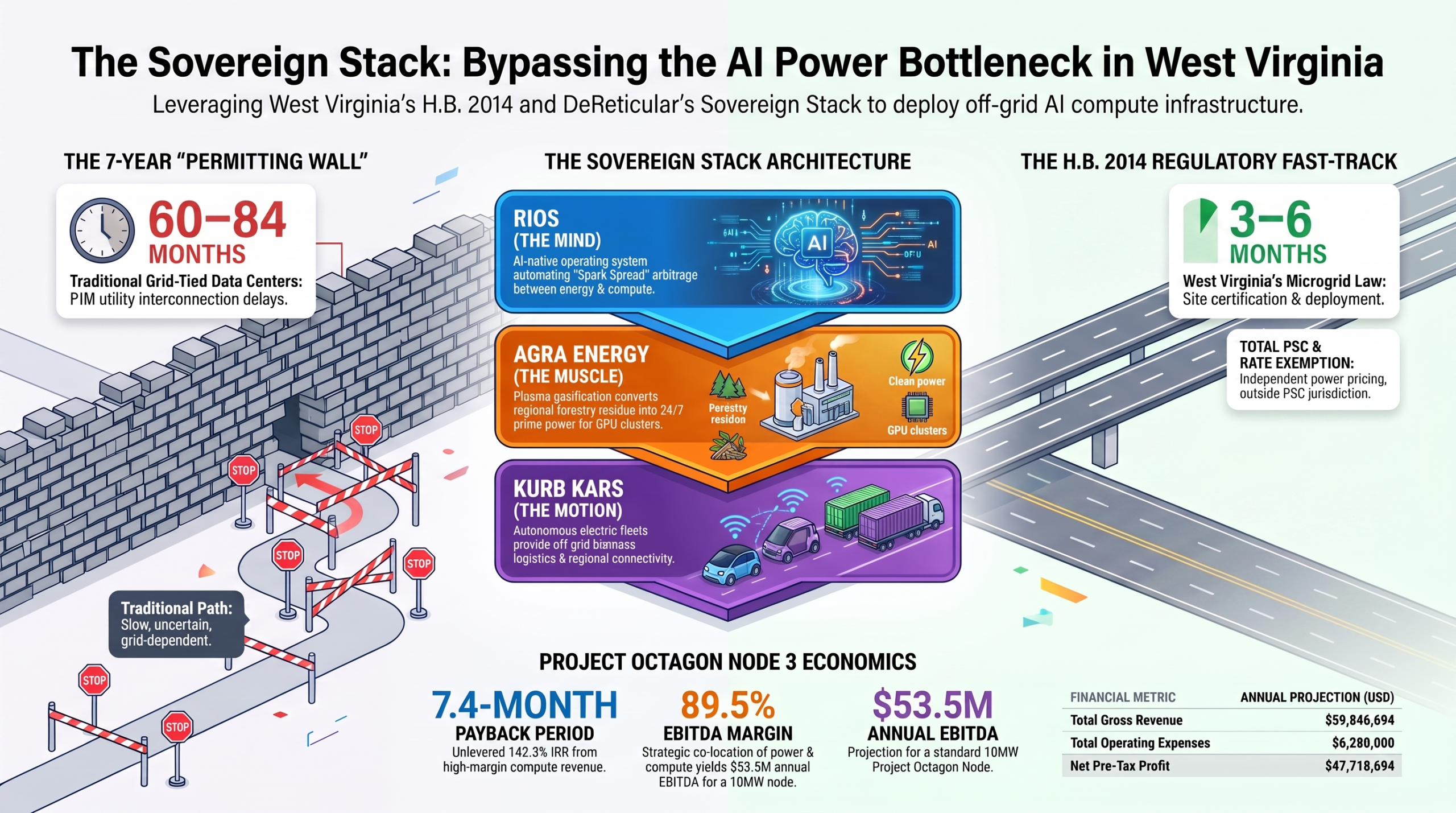
Traditional data centers are “grid-tied,” meaning they are subservient to regional transmission organizations (RTOs) like PJM. Currently, the PJM New Service Requests Queue is choked by multi-year studies and infrastructure lag, pushing interconnection timelines to an untenable five to seven years. For the AI industry, this delay is an existential threat. The solution is a fundamental architectural shift from “The Line”—a linear, single-point-of-failure topology—to “Spherical Resilience,” a non-Euclidean mesh of autonomous, behind-the-meter (BtM) nodes.
Metric “The Line” (Traditional Grid-Tied) “Spherical Resilience” (Sovereign Stack)
Interconnection Timeline 60–84 Months (PJM Queue) 3–6 Months (State Certification)
Reliability Cascading (100% reliant on grid) Sovereign (Deterministic “Island Mode”)
Regulatory Oversight Federal (FERC) & State (PSC) Streamlined State Economic Development
Topology Linear, Central-Outward Tree Non-Euclidean, Self-Healing Mesh
Energy Monetization Passive Consumer (LMP Volatility) Active “Spark Spread” Arbitrage
Takeaway: Behind-the-Meter (BtM) architecture is the only viable path to bypass multi-year utility bottlenecks and deploy the massive power densities required for next-generation AI within a single hardware depreciation cycle.
This physical sovereignty enables a unique economic opportunity known as the Spark Spread.
- Decoding the Spark Spread: Converting Waste into Intelligence
In the Sovereign Stack, electricity is no longer a utility expense—it is a raw material for the manufacture of FLOPs (Floating Point Operations). The “Spark Spread” is the economic arbitrage of converting local, low-cost feedstock directly into high-value AI intelligence.
The three key inputs to this equation are:
- Fuel Cost: The levelized cost of local feedstock, such as forestry residue, timber scraps, or agricultural waste.
- Power Efficiency: The thermodynamic efficiency of plasma gasification and the “energy-to-compute” conversion rate of high-density GPUs.
- AI Workload Value: The real-time market price for “pixels” (AI tasks like Large Language Model training or complex inference).
Synthesis: This model is fundamentally decoupled from traditional energy market volatility. According to our sensitivity analysis, even a 42% increase in fuel costs results in a change to the project’s payback period of less than eight days. Because the market value of AI computation is orders of magnitude higher than the cost of waste-derived electrons, the system remains profitable across a wide range of economic shifts.
To operationalize this arbitrage, we must deploy the hardware and software “Stack” that makes intelligence manufacture possible.
- The Sovereign Stack: The Mind, Muscle, and Motion of the Microgrid
DeReticular’s architecture is an integrated sovereign environment designed for “Island Mode” resilience.
- The Rural Infrastructure Operating System (RIOS) acts as an AI-native Distributed Energy Resource Management System (DERMS). RIOS utilizes Sysbox isolated run-times to create unprivileged system containers. This ensures that even if an AI workload is compromised, the breach cannot escape to the microgrid’s physical control loops.
- Power is generated via Agra Energy plasma gasification, subjecting waste to temperatures exceeding 3,000°C to create high-purity syngas. This gas drives reciprocating engines that power the RIOS-CC-1000, a ruggedized, liquid-cooled enclosure housing high-density GPU clusters.
- Autonomous logistics are provided by Kurb Kars—electric freight vehicles that operate on private access roads. Governed by the RIOS Fleet Agent, they ensure the gasifier is continuously fed with biomass without relying on external drivers or cloud-connected GPS.
Technical Insight: A major “hidden” profit booster is our 700V Direct DC Bus Coupling. Traditional data centers suffer from 7–12% efficiency losses due to AC-to-DC double-conversion and rectification heat within UPS systems. By coupling the generators directly to the compute racks via a 700V DC busbar, we achieve a 97.7% power chain efficiency, bypassing conversion overhead and boosting margins by roughly 7–9%.
While the technology provides the capability, the regulatory landscape in West Virginia provides the legal “cheat code” for deployment.
- The 70% Rule: How West Virginia House Bill 2014 Fuels AI
West Virginia’s House Bill 2014 (The Power Generation and Consumption Act) is the most significant regulatory catalyst for AI infrastructure in the United States. It allows for the creation of Certified Microgrid Districts that operate outside the reach of traditional utilities.
The Captive Power Mandate: “A Certified Microgrid District must guarantee that at least 70% of the total electrical energy generated within the district is consumed locally by on-site high-impact industrial or compute assets.”
High-density AI compute is the “perfect tenant” for this mandate because GPUs provide a near-constant, flat load profile (95%+ capacity factor), unlike traditional manufacturing.
The Math of Statutory Compliance (Annual Aggregate Basis):
- Annual District Generation: 78,840 MWh (10MW at 90% capacity)
- Annual On-Site Compute Consumption: 66,900 MWh (8.5MW at 90% uptime)
- Captive Power Ratio: 66,900 \div 78,840 = \mathbf{84.85\%}
- Result: The facility comfortably exceeds the 70% requirement, legally shielding the project from external utility interference.
The Four Structural Advantages of H.B. 2014:
- Total PSC Exemption: Complete freedom from Public Service Commission regulation of power rates and service conditions.
- Queue Bypass: Statutory exemption from the 5–7 year PJM interconnection line.
- Zoning Preemption: State-level certification overrides local municipal or county zoning bans.
- Captive Power: Limits grid exports to <10%, ensuring energy wealth remains localized.
With the legal framework secured, the software kernel takes over to maximize real-time yield.
- The Arbitrage Engine: How Software Decides Between Power and Pixels
The RIOS kernel contains the Spark Spread Arbitrage Engine, which executes deterministic optimization commands every second. It manages Agent-to-Agent (A2A) negotiations where different system components “trade” resources.
Decision Matrix Logic:
- IF [Value of AI Task] > [Cost of Power Generation + Opportunity Cost] THEN [Prioritize Compute (Route all power to RIOS-CC-1000)].
- IF [Compute Yield] < [Battery Arbitrage Potential] THEN [Prioritize Storage (Charge BESS for peak-shaving)].
- IF [AI Demand < Threshold] AND [Fuel Reserve < 45 Days] THEN [Prioritize Logistics (Charge Kurb Kars to haul feedstock)].
To ensure the integrity of these decisions, RIOS utilizes TPM 2.0 Hardware Oracles. Every telemetric packet from the Sensor Agent (gas composition, thermal loads, environmental data) is cryptographically signed at the silicon level. This prevents “oracle attacks” where spoofed data could be used to manipulate the arbitrage engine.
- The Six Profit Centers: Building an Unshakeable Economic Engine
The Sovereign Stack creates a resilient ecosystem of six non-correlated revenue streams:
Profit Center Core Monetization Target Customer
- AI Compute GPU “FLOP” Sales (CaaS) AI Labs & Enterprises
- Agra Energy Power Sales & Biochar Byproducts Internal Node & Agricultural Co-ops
- RIOS Software SaaS Licensing & Arbitrage Fees 3rd-Party Microgrid Operators
- Kurb Kars Autonomous Freight (MaaS) Timber & Logistics Partners
- DePIN Mesh Data Verification & Bandwidth Fees ESG Auditors & Rural Residents
- Venture Studio Franchise Fees & IP Licensing Municipalities & Developers
Synthesis: This “Sovereign” model facilitates a historic transition for West Virginia. By integrating with the $321 Million NSF RETI Consortium at West Virginia University, we are transforming the region from a “legacy extractive model” into a global Software Authority for microgrid orchestration. We are no longer just exporting raw energy; we are exporting high-tech intelligence.
The result is “Digital Alchemy”: the magical ability to turn the sticks and scraps of the forest floor into the 21st century’s most valuable resource—computation.


