The End of the Fragile Grid: Forging Sovereign Economies in the Third Industrial Revolution
The modern world is waking up to a quiet, visceral anxiety: our centralized infrastructure is a house of cards. When a utility grid buckles under climate demand or a supply chain snaps, it’s not just an inconvenience; it’s a systemic failure that exposes the “dead capital” buried in the mud of emerging markets. Trillions of dollars in physical value—agricultural waste, local energy, raw commodities—sit idle because traditional banking systems have no way to verify their worth. For decades, we tried to patch these 20th-century relics. But in 2026, the strategy has shifted from repair to replacement.
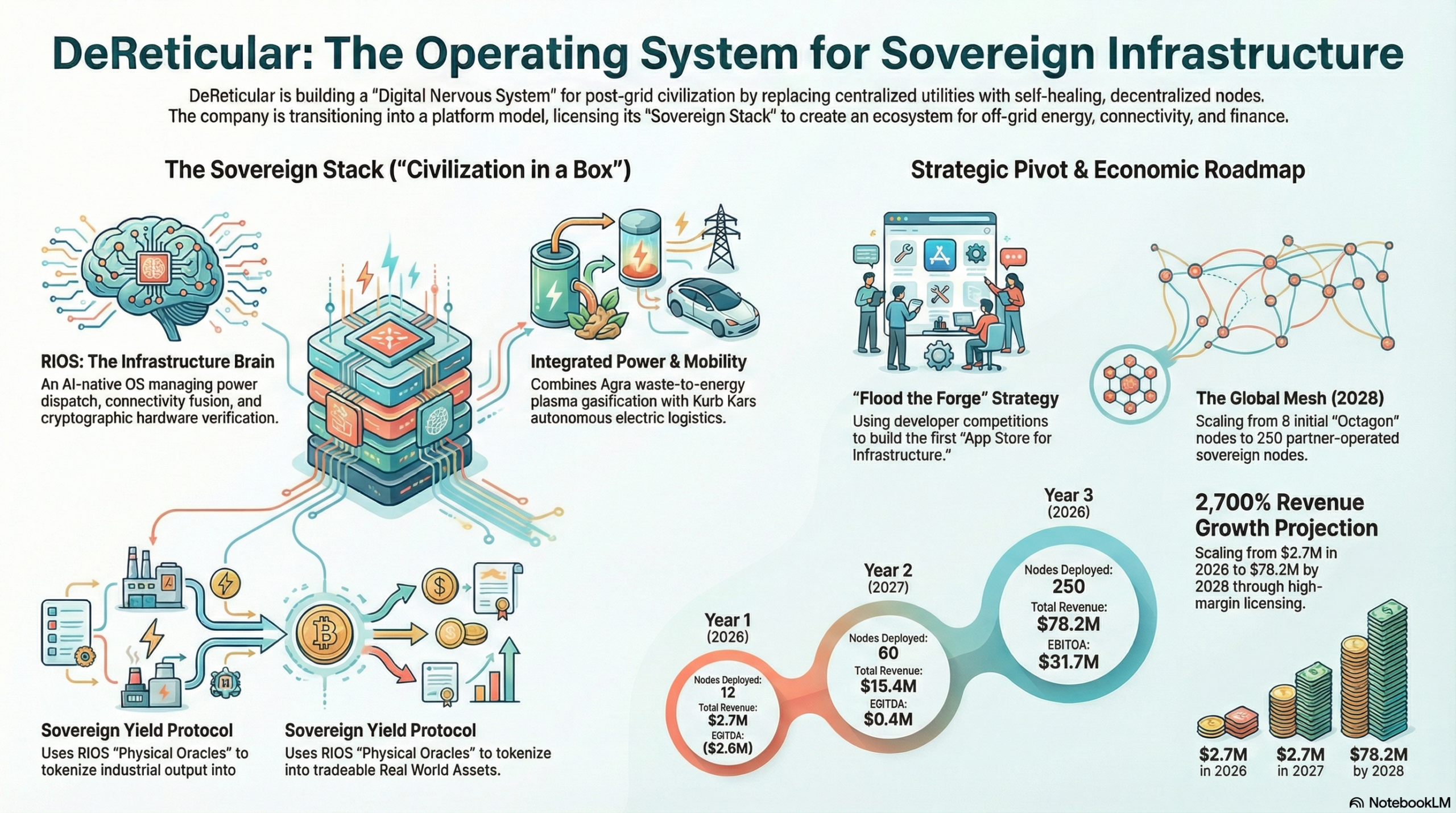
We are witnessing the pivot of DeReticular from a hardware manufacturer into a platform orchestrator. By building the “Digital Nervous System” of a post-grid civilization, they are operationalizing a concept known as “Spherical Resilience.” This isn’t just about backup generators; it is about creating decentralized, self-healing networks that allow a community to enter “Island Mode”—operating with total energy, data, and financial sovereignty even when the rest of the world goes dark.
The Convergence: Jeremy Rifkin’s Blueprint for the 21st Century
This transformation is the physical manifestation of the Third Industrial Revolution (TIR). As economic theorist Jeremy Rifkin has long argued, true paradigm shifts occur only when three “internets” converge: Communication, Energy, and Logistics. We are moving away from the hierarchical, fossil-fuel-driven models of the past toward a distributed, “Super-Internet” of things.
To bridge this gap, DeReticular is deploying the five pillars of the Rifkin framework:
- Renewable Transition: Moving to solar, wind, and biomass.
- Buildings as Power Plants: Transforming structures into micro-generation hubs.
- Storage: Deploying hydrogen and advanced battery tech to manage intermittency.
- Smart Intergrids: Peer-to-peer energy sharing.
- Electric Mobility: Autonomous, grid-interactive transport.
Crucially, this model addresses the Empathy-Entropy Paradox. Historically, as civilizations became more connected (extending empathy), they consumed more energy and created more waste (entropy). By using distributed, renewable infrastructure, we can maintain global connectivity without planetary degradation. As Rifkin notes:
“The Third Industrial Revolution moves humanity from geopolitical thinking—battling for resources—to biosphere thinking, where we collaboratively steward the planet as a shared community.”
“Civilization in a Box”: The Vertical Sovereign Stack
While Silicon Valley focuses on software, the real revolution is being forged in places like Quartzsite, Arizona, where DeReticular is scaling the manufacturing of its “Sovereign Stack.” This is a vertically integrated “Civilization in a Box” designed to provide a community with total autonomy.
The Heart: Agra Dot Energy
This is the engine of the stack. It utilizes waste-to-energy plasma gasification to convert biomass—everything from hemp waste to municipal trash—into continuous baseload electricity and bio-char. Unlike intermittent solar, this provides the steady power required for industrial-scale eco-parks.
The Brain: RIOS (Rural/Robotic Infrastructure Operating System)
RIOS is the AI-native “command and control” layer. It performs signal fusion, bonding Starlink, 5G, and local mesh networks for unbreakable connectivity. (Note: This is distinct from RIOS Intelligent Machines, which focuses on factory robotics; DeReticular’s RIOS is purpose-built for infrastructure management.)
The Motion: Kurb Kars
Logistics is handled by autonomous electric rovers. Powered by the local Agra unit, these vehicles manage the “last mile” of mobility and goods delivery without a single drop of imported fuel.
The Bank: Hempgrade AI & Sovereign Yield
The financial layer uses computer vision and IoT sensors to grade physical output in real-time, tokenizing it into Real World Assets (RWA). This turns physical work into immediate, tradeable liquidity.
Solving the “Oracle Problem” with Physical Verification
The “Oracle Problem” is the trust deficit that has kept billions in capital locked in the mud. Blockchain projects often fail because they can’t prove what’s happening in the physical world; they suffer from “garbage in, garbage out.”
RIOS acts as a Physical Oracle. It uses Radio Frequency Fingerprinting to cryptographically verify the hardware’s identity, ensuring the data isn’t being spoofed by a simulator. This “Automated Notary” provides the “Ground Truth” institutional finance demands. For sensitive sectors like healthcare or defense, RIOS can operate in a “Data Haven” mode, using Zero-Knowledge Proofs (ZKP) to verify creditworthiness locally without ever exposing private operational data to the public cloud.
Sovereign Yield: Turning Waste into Wall Street Collateral
We are seeing this play out at Node 4 in Uganda, where a 7,000-acre eco-industrial park is being powered by the stack. Here, the Sovereign Yield protocol is solving the “dead capital” problem.
When a farmer loads hemp waste into an Agra unit, the system doesn’t just burn it. It scans the biomass, verifies the energy generated, and mints a “Proof of Industry” token. These tokens, categorized as Bio-Energy Credits, allow rural operators to bypass predatory local lenders and access global DeFi liquidity.
“By providing the Oracle of Ground Truth, we are effectively turning agricultural waste into Wall Street collateral, providing liquidity to the markets that need it most.”
This isn’t limited to the equator. From manufacturing in Quartzsite to Node 2 in Canada, this global mesh is beginning to interconnect, creating a $2 trillion RWA market and capturing a slice of the $63 billion off-grid storage sector.
The Regulatory Safe Haven: GENIUS and CLARITY Acts
The 2026 pivot is supported by a landmark shift in US policy, making DeReticular the “Gold Standard” for compliant infrastructure.
- The GENIUS Act: This framework allows DeReticular to partner with National Trust Banks to issue Sovereign Stablecoins. These are USD-equivalent digital currencies backed by physical infrastructure assets, allowing for institutional-grade settlement.
- The CLARITY Act: By classifying industrial output tokens as “Digital Commodities” under CFTC jurisdiction rather than securities, this act opens the floodgates for commodities traders to buy and sell verified energy and carbon credits.
“Flood the Forge”: The App Store for Infrastructure
DeReticular’s most aggressive move is its shift to a DePIN (Decentralized Physical Infrastructure Network) Platform Operator model. Through the “Flood the Forge” strategy, they are leveraging the CodeLaunch competition to recruit third-party developers.
This is a Venture Studio model where DeReticular takes a 15-30% equity stake in startups building on RIOS. Whether it’s an app for medical logistics or a micro-insurance protocol for off-grid equipment, these applications create a “vendor lock-in” via utility. By providing the hardware and the OS, DeReticular is positioning itself as the landlord of a $3.5 trillion DePIN economy. Early developers are incentivized with “Gas Grants”—free compute and power—ensuring the “App Store for Infrastructure” is populated before the grid even has a chance to fail.
Toward Biosphere Consciousness
We are moving past the era of ownership and extraction toward one of access and regeneration. The global mesh of sovereign nodes doesn’t just provide power; it fosters environmental stewardship by making the “Collaborative Commons” a physical reality. As we interconnect millions of these nodes, we create an unbreakable, distributed economy that prioritizes resilience over mere efficiency.
The tools for a post-grid civilization are no longer theoretical; they are being manufactured, certified, and deployed. The only question left is: are you ready to transition from a world of “brittle networks” to one of “Spherical Resilience”? The shift from geopolitical resource-grabbing to biosphere-consciousness isn’t just a moral imperative—it’s the greatest economic opportunity of our lifetime.


