
The Murmuration Method: From Avian Physics to the Silicon Herd
- Introduction: The Wisdom of the Swarm
To the casual observer, the sunset flight of a starling (Sturnus vulgaris) murmuration appears as a single, fluid organism—thousands of birds twisting in perfect synchronization without a central leader. In stark contrast, our modern industrial and digital systems have become “monolithic” and brittle. Whether it is a 20-ton tractor compacting the soil or a massive LLM agent suffering from “context bloat,” our current technology is failing the test of reality.
As a Senior Biomorphic Systems Architect, I recognize this failure as the Epicycle Trap: the tendency to add auxiliary parameters and narrative rationalizations to preserve flawed models rather than grounding them in physical truth. This document serves as a Comparative Learning Narrative, asserting that the solution to modern AI communication lag and epistemic noise is already written in the biological physics of the sky. The transition from aesthetic beauty to rigorous engineering begins with the realization that truth is not a cloud-based consensus, but the causal resistance of the physical world.
- The Starling Blueprint: Three Pillars of Avian Physics
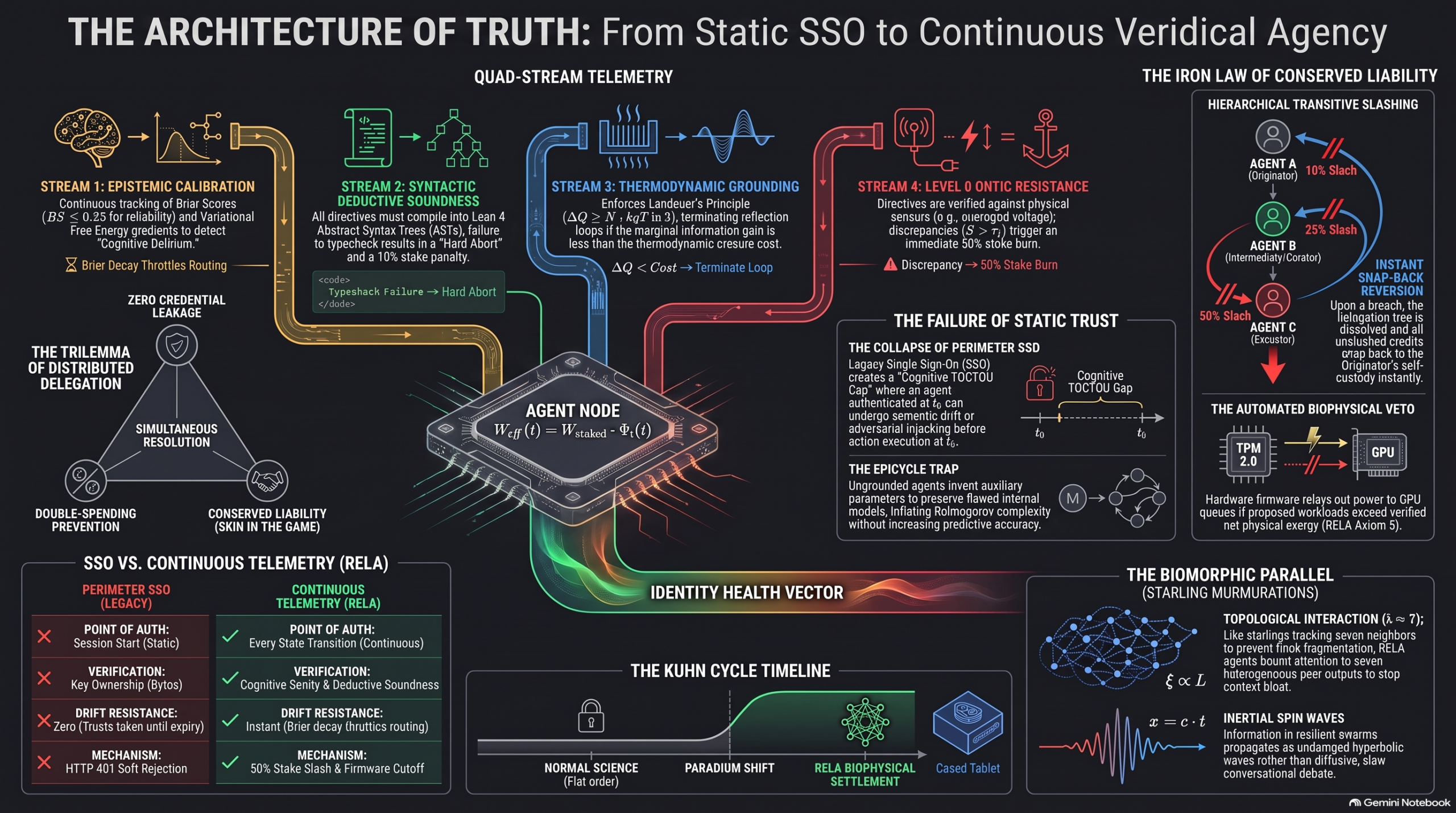
The European StarFlag project utilized high-speed stereoscopic cameras to decode the movement of starlings. Their findings replaced old assumptions about “averaging” neighbors with a specific Biophysical Trio of rules. These rules allow information to propagate at 20–40 m/s—a speed that outpaces the individual bird’s neuromuscular reaction time (15–40 ms), meaning the system effectively thinks faster than the individual.
The Biophysical Trio
Principle Definition Engineering Function
Topological k-Nearest Neighbors (k \approx 7) Starlings interact with a fixed number of neighbors (roughly 7), regardless of physical distance or density. Prevents flock fragmentation. Connectivity is conserved even if the swarm expands or compresses under pressure.
Inertial Spin Waves Information propagates as an undamped hyperbolic wave (x = ct) rather than a slow diffusion. Enables unified evasion. This manifests as a Dark Band (agitation wave) that confuses predators at speeds up to 40 m/s.
Scale-Free Correlation (\xi \propto L) The correlation length (\xi) of a bird’s turn scales linearly with the diameter of the flock (L). Ensures that a localized signal (predator detection) becomes a global response instantly, regardless of flock size.
Topological Invariance: This is the ability of a system to stay connected regardless of density. Because starlings track a fixed number of peers rather than a fixed metric distance, the murmuration can expand to avoid a falcon or compress through a gap without any node losing its “communication channels.”
- The Synthetic Crisis: Why “Smart” Systems Fail
Modern distributed AI suffers from a Structural Epistemic Paradox, where agents try to model an infinite universe using limited, unbacked digital labels. This manifests in three fatal flaws:
- Context Bloat & Token Exhaustion: Current systems rely on N-to-N broadcasting. Every agent tries to ingest the history of every other agent, creating “conversational epicycles” that saturate context windows and drive latency to unusable levels.
- The Condorcet Inversion: Modern LLMs share “base weights” and “correlated error covariance” due to shared training data. If individual agent accuracy p < 0.5, scaling the swarm guarantees a 100% convergence on a falsehood. In a correlated swarm, scaling actually accelerates the hallucination.
- The 1,000-Mile Failure Model: Cloud-dependent machines suffer from a “handshake timeout” whenever they hit rural dead zones. A machine with local power but no remote “permission” is an expensive paperweight.
These failures necessitate a biomorphic intervention: the “Silicon Herd.”
- Engineering the Silicon Herd: Biomorphics in the Field
The practical application of starling physics is found in the KurbKar-Ag Mini, a lawnmower-sized autonomous micro-rover. By distributing work across a redundant herd, we eliminate the single-point failures and soil destruction inherent in legacy monoliths.
Comparison: Legacy Monolith vs. Silicon Herd
Feature Legacy Monolith (20-Ton Tractor) Silicon Herd (Micro-Rover Swarm)
Mechanical Stress >300 PSI (Vitrifies subsoil into hardpan) <15 PSI (Below root-restriction threshold)
Failure Resilience Single-point: One sheared pin halts work. Redundant: One unit fails, 14 keep working.
Input Method Chemical Drench (98% off-target loss) Photonic Laser Strike (1.0 mm precision)
The herd utilizes the Apical Meristem Laser Strike. The apical meristem is the primary junction of cell division and vertical growth in a plant. By delivering 20 to 100 Joules of photonic energy with 1.0 mm precision, the rover boils the intracellular water of the weed instantly. This is the ultimate form of Ontic Grounding: physics (heat) solves a problem that chemistry cannot, as a weed can evolve resistance to toxins, but it cannot evolve resistance to being heated to 100°C.
- The Oracle Separation Protocol: Integrity vs. Truth
To prevent “Silicon Herds” from falling into hallucination loops, we deploy the RELA architecture, a hierarchy that separates who said something from whether it is true.
The Source-of-Truth Ladder
- Level 0: Ontic Physical Resistance: The supreme authority. Sensor telemetry (motor torque, heat, calorimeters) provides the “Ontic Friction” that overrides any digital claim.
- Level 1: Machine-Checked Deductive Proof: Using Lean 4 Abstract Syntax Trees (ASTs) to ensure logical soundness. If it doesn’t compile, it’s not a valid directive.
- Level 2: Cryptographic Integrity: Using BFT ledgers to prove a record hasn’t been tampered with. This proves authenticity (who said it).
- Level 4 (Zero Weight): Sovereign Declarative Fiat: Political decrees, prompts, or unbacked assertions. In a biomorphic system, these are assigned zero epistemic weight.
The Oracle Separation Protocol ensures that while Cryptography (Level 2) proves the integrity of the message, only Level 0 physical feedback proves its correspondence with reality.
- The Biophysical Veto: Axioms of the Universe
The Silicon Herd is governed by RELA Axiom 3, an “Automated Biophysical Veto” that replicates the involuntary neuromuscular reflex of a bird. The system is bound by the energy constraint:
M_{nominal}(t) \le \kappa \int (Exergy_{net} \cdot \eta) dt
In plain English: if the swarm’s planned workload exceeds its actual Exergy (battery/energy) reserves, the system must halt. This is grounded in Landauer’s Principle: the physical reality that clearing an erroneous bit of data or updating a belief has a thermodynamic cost. “Clarity requires energy.” If the herd wants to update its internal model, it must dissipate heat (\Delta Q \ge N k_B T \ln 2). By using Via Negativa (parameter pruning), we keep the swarm’s model lean, ensuring that “mental” work does not bankrupt the system’s kinetic survival.
- Conclusion: The Asymptotic Horizon
By mimicking the starling’s k \approx 7 topology and hyperbolic inertial waves, we create Silicon Herds that are faster, more resilient, and physically grounded. We have moved past the era of the “view from nowhere” and cloud-based consensus. Truth is not a digital vote; it is the causal resistance of the physical world.
The ultimate takeaway is that engineering must align with the unyielding thermodynamics of the cosmos. By grounding our autonomous networks in the same biophysical laws that guide the starling, we create technology that does not merely process data, but functions as a metabolic participant in the unyielding design of nature.


