The Pawnee Off-Grid Network: A Physical Infrastructure Guide
- The “Signal Gap” and the Sovereignty Solution
In the remote outdoor corridors of the New River Gorge, the current digital economy relies on a fragile paradox: centralized cloud applications attempting to manage decentralized physical activities. Consider a family-owned whitewater rafting and mountain bike rental operation in Fayetteville, West Virginia. To reach customers, they are currently forced to surrender 15% to 30% of their gross revenue to platform monopolies like Expedia or Airbnb. When a traveler enters a mountain hollow and the cellular signal vanishes, these cloud-dependent apps fail. Shuttles are missed, double-bookings occur, and local economic value evaporates.
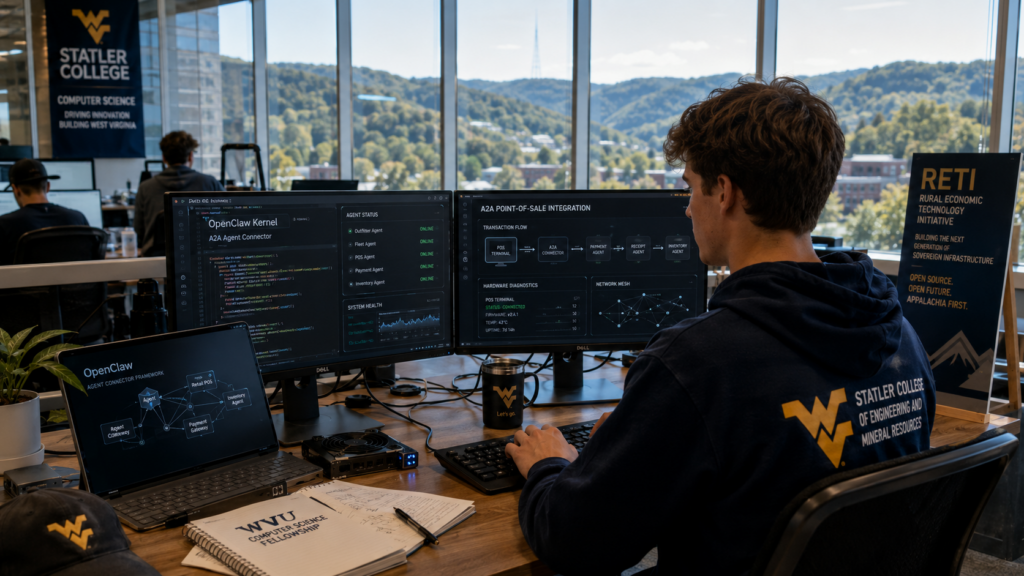
The Pawnee Off-Grid Network replaces this “Signal Gap” with an air-gapped physical mesh, transforming local infrastructure into a sovereign state-machine. This is not merely an IT upgrade; it is an architectural requirement for local economic survival.
Legacy systems suffer from three systemic failures:
- Extractive Commissions: Centralized aggregators export wealth out of West Virginia by taxing local transactions at predatory rates (15-30%).
- Infrastructure Fragility: Dependency on distant data centers and persistent cellular handshakes makes commerce impossible in “dead zones.”
- Operational Friction: The disconnect between digital booking silos and physical assets requires manual human intervention (phone calls and paperwork) to coordinate multi-leg trips.
Sovereignty is achieved by moving the execution environment to the edge. By owning the hardware, the merchant retains 97.5% of their transaction value, escaping platform monopolies and ensuring their “digital doors” remain open regardless of the state of the global internet.
To bridge the gap from digital intent to physical reality, the network relies on a family of specialized hardware units known as the WISP-in-a-Box gateways.
- The WISP-in-a-Box Gateway Family: The Network’s Brain
The “brain” of the Pawnee network is the WISP-in-a-Box family—a suite of Gen 5 commercial gateways designed to host the OpenClaw agentic kernel. These units represent the intelligence layer of the mesh.
Hardware Unit Primary Technical Role Strategic Location (Where to deploy)
WISP-in-a-Box Agentic Local AI Agent Server & LLM Inference Engine Central Merchant HQs / Main Business Hubs
WISP-in-a-Box LTE Dual-WAN Failover (Satellite/LTE) & Regional Sync High-altitude nodes or regional failover points
WISP-in-a-Box Base Short-range P2P Handshakes (Bluetooth/Wi-Fi) Trailheads, shop entrances, and remote kiosks
The Agentic Gateway: The Edge Execution Environment
The WISP-in-a-Box Agentic ($9,997.00) is the cornerstone of the Sovereign Stack. It is not a traditional router; it is a high-performance local server housing the OpenClaw execution environment. Because it hosts local Large Language Model (LLM) inference engines, it can process complex, multi-attribute decision trees—such as negotiating a kayak rental and shuttle timing—without ever contacting a centralized server. This localized compute power justifies its role as the primary host for autonomous software agents that execute atomic smart contracts at the edge.
While the gateways provide the intelligence to communicate, they require a consistent, independent source of energy to remain truly off-grid.
- The Power Backbone: Pawnee GenSets and the Microgrid Program
The Pawnee network is “Thermodynamically Integrated,” a systems-architecture term meaning the processing of data is physically linked to the production of energy. This is realized through the 45 kW Pawnee Power GenSet.
These units are engineered to leverage West Virginia House Bill 2014. Under this legislation, certified microgrid programs are granted a critical strategic advantage: exemption from Public Service Commission (PSC) utility oversight. This allows merchants to operate independent commerce networks without the regulatory friction of traditional utilities. To maintain this status, the system must meet a Captive Power Requirement, where ≥ 70% of the generated energy is consumed “behind-the-meter” by the owner’s own systems—specifically the high-density AI compute servers within the WISP gateways.
“The RIOS Spark Spread AI serves as the critical link in this ecosystem, balancing energy production with transaction processing volume to ensure the microgrid remains efficient and compliant with statutory requirements.”
By embedding A2A (Agent-to-Agent) gateways within these microgrids, the energy used to power the server is the same energy used to heat the merchant’s physical facility, creating a resilient, closed-loop economic environment.
With power and intelligence established, the network must then secure the data flowing through its air-gapped channels.
- The Invisible Shield: TPM 2.0 Oracles and Mesh Connectivity
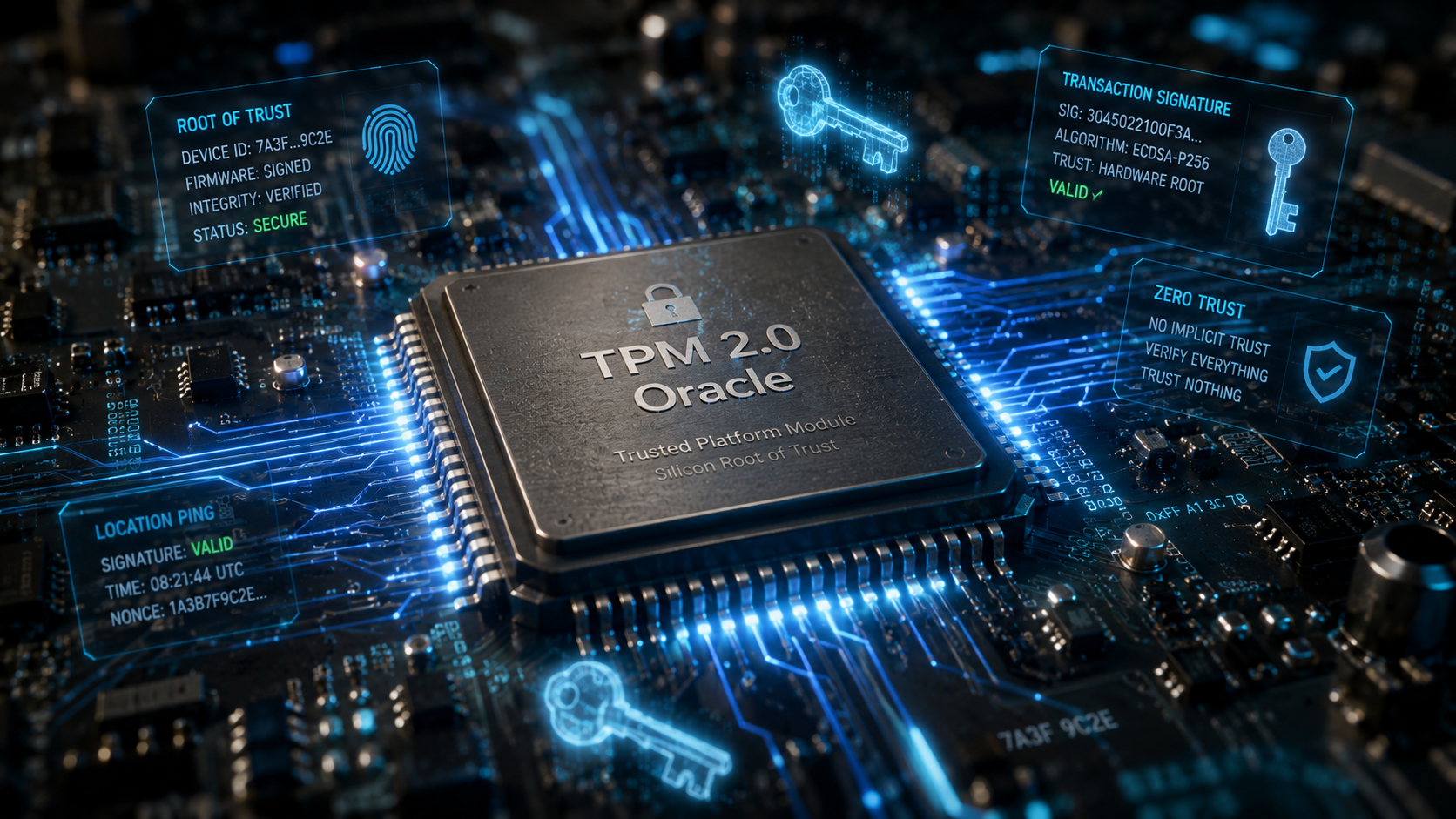
In an off-grid environment, trust cannot be verified by a central bank. Instead, it is enforced by TPM 2.0 (Trusted Platform Module) silicon chips embedded in the hardware. These chips act as Hardware Oracles, providing a silicon root-of-trust that software cannot alter.
The TPM chip signs every data packet with a unique Private Key, ensuring that the “ground truth” of a transaction is immutable. Every cryptographic signature contains four vital components:
- Agent ID: The unique cryptographic identity of the negotiating AI.
- Service Timestamp: The exact, non-forgeable time of the event.
- Price: The final negotiated rate of the atomic smart contract.
- GPS Location: The physical coordinates of the hardware at the moment of signing.
This prevents “spoofing” or “double-spending” across the mountains. This data is transmitted via Hyphanet/NeoMesh, a Peer-to-Peer (P2P) architecture. It allows a traveler’s “intent” to broadcast across the rugged topography via radio waves, ensuring that even in deep hollows, the agent-to-agent negotiation remains uninterrupted.
Once a digital agreement is secured via the TPM oracle, the network triggers the dispatch of physical assets to fulfill the service.
- Mobile Infrastructure: TAVs and Autonomous Buggies
The Sovereign Stack extends into the mobile environment through specialized vehicles that serve as roaming nodes in the mesh. These assets are the physical fulfillment layer of the OpenClaw protocol.
- Pawnee Flagship TAV ($797,000): The “Mobile Server Hub.” This tactical vehicle provides massive compute density and regional command capabilities, acting as a moving base station for the mesh.
- Pawnee Hybrid Dune Buggy ($99,000): The “Testing and Asset Dispatch” unit. It is used to verify mesh coverage and perform the “last-mile” transport of guests or equipment to trailheads.
Physical API Integration
The “Physical API” is the handshake between a digital settlement and a mechanical action. The integration functions as follows:
- Digital Trigger: The OpenClaw kernel confirms a cryptographic settlement (< 4 seconds).
- Physical Dispatch: An autonomous command is transmitted directly to the Fleet Agent inside a Pawnee Buggy or TAV.
- Autonomous Execution: The vehicle is dispatched to the precise GPS coordinates recorded in the TPM-signed contract without requiring human dispatchers.
These mobile assets represent the final layer of the Sovereign Stack, turning digital coordination into real-world movement.
- Infrastructure Synthesis: The Cost of Sovereignty
Achieving total independence from extractive platforms requires a deliberate investment in a regional hardware stack. The following Master Bill of Materials (BOM) outlines the components required for a regional deployment in an outdoor corridor like the New River Gorge.
Gen 5 Product Name Unit Price (USD) Primary Function
WISP-in-a-Box Agentic $9,997.00 Local AI Agent Server (OpenClaw Host)
WISP-in-a-Box LTE $5,887.00 Dual-WAN Failover & Regional Data Sync
WISP-in-a-Box Base $1,497.00 Trailhead/Kiosk Agent Handshakes
Pawnee Power GenSet $49,997.00 45 kW Microgrid Power & Compute Support
Pawnee Flagship TAV $797,000.00 Mobile Server Hub & Regional Command
Pawnee Hybrid Buggy $99,000.00 Testing & Autonomous Asset Dispatch
Learner’s Insight
As a Systems Architect, recognize that the value of this stack lies in its interlocking nature:
- Local Wealth Retention: By utilizing a 2.5% protocol fee instead of 30% legacy commissions, the merchant retains nearly 100% of their revenue, funding the hardware through sheer savings.
- Thermodynamic Uptime: By integrating power generation with transaction processing (H.B. 2014), the network remains operational during grid failures while remaining exempt from utility oversight.
- Cryptographic Ownership: Through TPM 2.0 hardware security, the merchant—not a third-party corporation—owns the data logs, ensuring total sovereignty over their customer relationships and operational history.


