
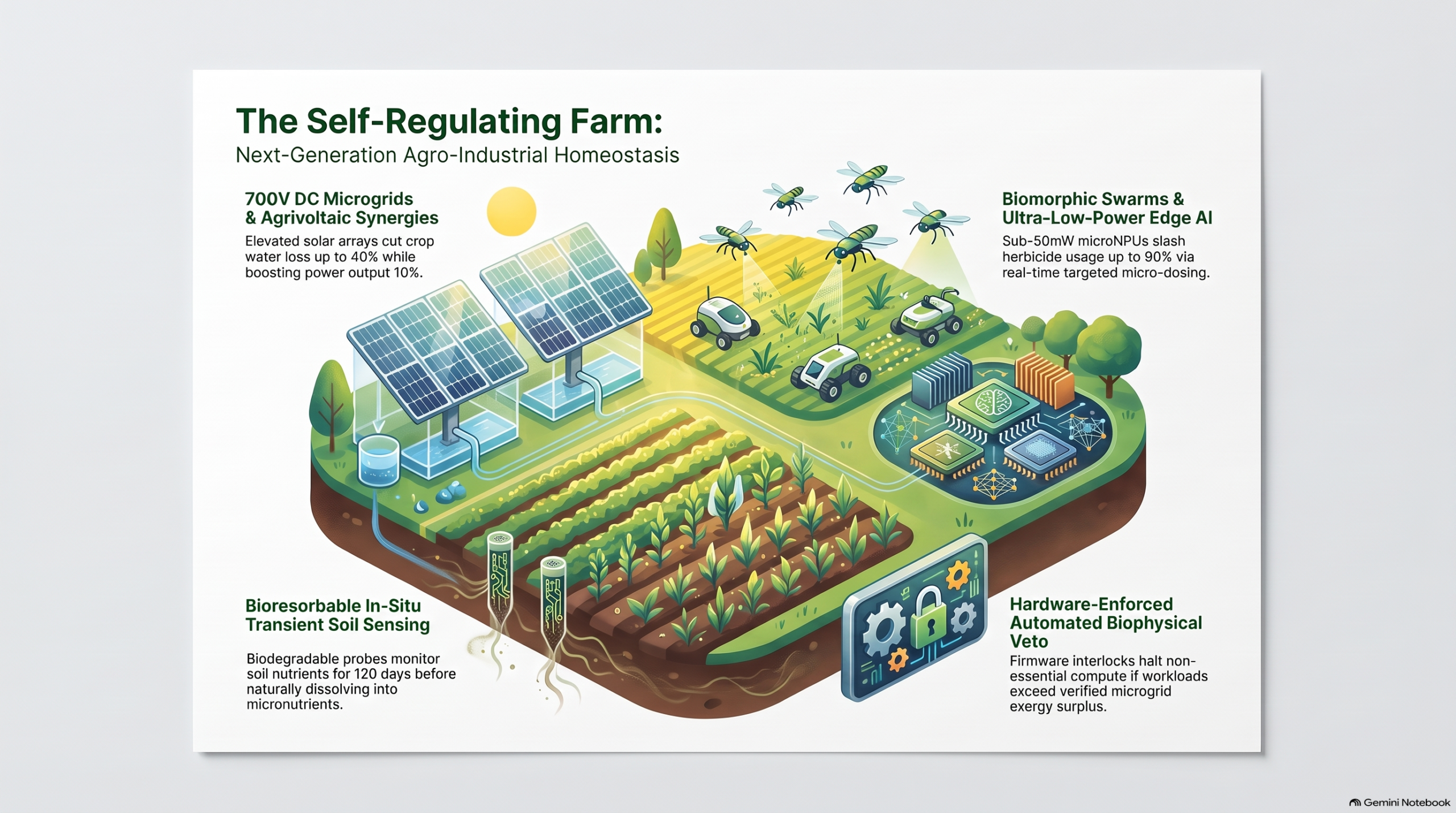
The Self-Regulating Farm: An Accessible Primer on Biophysical Principles, Energy Loops, and Agro-Industrial Integration
- The Paradigm Shift: From Open-Loop Exploitation to Self-Regulating Organisms
Why must modern farms fundamentally rethink their relationship with energy and data?
For over half a century, industrial agriculture has operated as an extractive, open-loop system. Synthetic inputs—such as fossil-fuel-derived energy, organophosphate pesticides, and synthetic Haber-Bosch nitrogen fertilizers—are injected uniformly across broad field expanses. Because these inputs are applied without real-time, biophysically synchronized feedback, substantial portions leach into surrounding watersheds or off-gas into the atmosphere as volatile emissions. Concurrently, modern agricultural systems have reached an acute biophysical-financial crisis. Financial claims, farm debt, and derivative obligations compound exponentially according to the equation:
D(t) = D_0 e^{rt}
where D(t) represents total financial debt at time t, D_0 is the initial principal debt, r is the compounding interest rate, and t is time. In stark contrast to this unconstrained mathematical curve, the real physical capacity of agricultural land is strictly bounded by biological laws, photosynthetic solar capture efficiencies (\le 1\text{–}2%), and available physical exergy.
This widening gap between financial debt acceleration and real physical capacity is driven by three degrading dynamics:
- Declining Energy Return on Energy Invested (EROEI): During the early Green Revolution, crop production yielded over 20 units of food energy for every 1 unit of fossil energy invested. In modern high-input industrial agriculture, the net lifecycle EROEI—accounting for Haber-Bosch nitrogen synthesis, machinery manufacturing, fuel combustion, and long-distance transport—has dropped below 2:1. In intensive animal protein systems, the net EROEI is deeply negative (\le 0.3:1).
- Topsoil Depletion and Biological Degradation: Continuous mechanical tilling and chemical salinization have depleted global topsoil Soil Organic Matter (SOM) from pre-industrial baseline levels of 5%–8% down to critical thresholds below 1.5%. This severe organic matter deficit destroys the soil’s dielectric water-holding capacity and turns natural rainfall into destructive surface runoff.
- The “1,000-Mile Failure Model”: Modern digital AgTech platforms routinely rely on cloud hyperscalers and remote cellular towers located hundreds or thousands of miles away. If a regional fiber line is severed, a domain name server fails, or cellular coverage degrades, multi-ton autonomous field implements and automated irrigation valves stall in the field due to dropped cloud handshakes. Furthermore, centralizing farm telemetry in distant cloud platforms exposes operational data to remote extraction, corporate vendor lock-in, and speculative market manipulation.
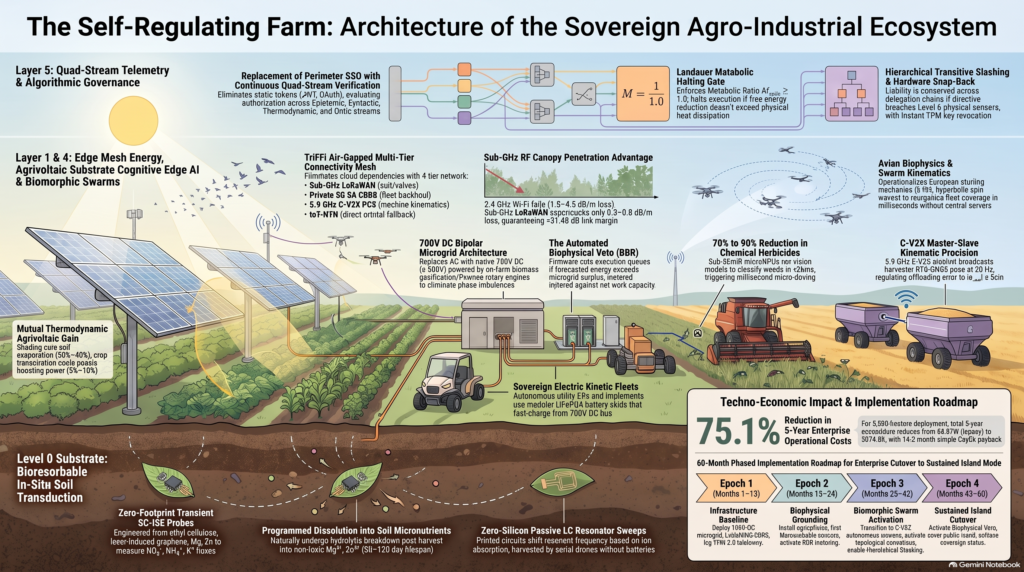
To eliminate these structural vulnerabilities, the agricultural paradigm must shift toward Sustained Island Mode. Under this operational framework, the farm is engineered as an air-gapped, autonomous, self-correcting thermodynamic organism. By generating its own baseload power, cycling its own nutrients, and processing data locally at the computing edge, a self-regulating farm closes its operational feedback loops entirely within its physical boundaries.
Legacy Industrial Agriculture Self-Regulating Farm Architecture
Energy Sourcing: Heavy reliance on depletable, off-farm fossil inputs and centralized AC power grids subject to rural brownouts; declining Haber-Bosch EROEI (\le 2:1). Energy Sourcing: On-farm renewable harvesting via elevated agrivoltaics, thermochemical biomass gasification, and a native 700V DC bipolar microgrid.
Connectivity & Data Model: Cloud-tethered hyperscalers (“1,000-Mile Failure Model”); proprietary vendor lock-in; high operational vulnerability to remote telecom outages. Connectivity & Data Model: Air-gapped, multi-tier local edge meshes (LoRaWAN, Private 5G, C-V2X sidelink); local exergy accounting; full data sovereignty.
Nutrient Flows: Linear (“open-loop”) extraction; heavy synthetic nitrogen and phosphorus broadcasting; chemical leaching into watersheds; feedlot waste concentration. Nutrient Flows: Circular (“closed-loop”) bio-synergies; integrated crop-livestock manure cycling; nitrified digestate; biochar-assisted nutrient retention.
Operational Resilience: Brittle; highly vulnerable to global fuel supply shocks, carrier service drops, and topsoil organic matter depletion below 1.5%. Operational Resilience: High; Sustained Island Mode autonomy; self-healing biomorphic machine swarms; automated biophysical balance enforcement.
To achieve complete self-regulation, an agricultural system must first master the physical integration of its most fundamental resource flows: water, energy, and crop microclimates.
- The Water-Energy-Food Nexus & Agrivoltaic Thermodynamics
A core structural foundation of the self-regulating farm is dual-use agrivoltaics. Rather than clearing arable land for standard utility-scale solar installations, agrivoltaic systems elevate photovoltaic (PV) tracking arrays 3.5 to 5 meters above crop rows or grazing pastures. This clearance allows heavy field machinery to navigate underneath while establishing a dual-use spatial footprint that yields both food crops and clean electricity from the exact same land area.
Elevating solar panels directly over living crop canopies establishes a mutual thermodynamic win-win that cools both the electrical machinery overhead and the biological systems below:
The Dual-Cooling Engine: Standard silicon solar panels lose operational efficiency as ambient temperatures rise, while crops exposed to unfiltered mid-day solar irradiance experience severe thermal stress and rapid water loss. Agrivoltaics establishes a synergistic feedback loop: plant transpiration releases cooling water vapor into the canopy microclimate, lowering overhead panel temperatures. In return, the elevated solar panels cast intermittent shade during peak heat hours, lowering soil surface temperatures and preserving crop moisture.
This thermodynamic interaction yields quantitative efficiency gains across the entire ecosystem:
- Crop-to-Panel Benefit (Photovoltaic Output Boost): Standard silicon PV panels experience a thermal degradation coefficient of roughly -0.4%/^\circ\text{C} for every degree Celsius above 25^\circ\text{C}. Transpiration vapor generated by underlying crops cools overhead modules by several degrees. This microclimatic transpiration cooling mitigates thermal degradation and boosts PV power output by +5% to +10% (yielding a +2.4% to +4.0% increase in total net kWh output).
- Panel-to-Crop Benefit (Microclimate & Water Preservation): Intermittent shading from overhead panels drops soil surface temperatures by 5^\circ\text{C} to 12^\circ\text{C}. This moderation lowers crop evapotranspiration (ET_c) and slashes agricultural water demand by 20% to 40% (reducing total seasonal evapotranspiration by up to 35%), buffering crops against flash droughts and solar scalding.
- Land Equivalent Ratio (LER) Maximization: Land productivity is measured using the Land Equivalent Ratio (LER). While single-use land allocated exclusively to farming yields an LER of 1.0 (100% crop output) and single-use solar land yields an LER of 1.0 (100% electricity output), an agrivoltaic system on a single hectare achieves an LER of 1.65 (combining 0.85 crop output + 0.80 electricity output). This represents a 65% increase in total land productivity on the exact same spatial footprint.
Harvesting clean energy overhead complements the circular closure of biological nutrient cycles on the ground below.
- Closing the Biological Loop: Integrated Crop-Livestock & Bio-Synergies
The historical separation of animal husbandry from arable crop production created two distinct environmental liabilities: synthetic fertilizer runoff from crop farms into aquatic ecosystems, and concentrated manure waste accumulation on livestock feedlots. Re-integrating these components through Integrated Crop-Livestock Systems (ICLS) restores circular nutrient flows and revitalizes soil biological health.
- Livestock Waste Generation & Collection: Ruminants grazing on cover crops or post-harvest crop residues deposit microbially active manure directly onto arable soil. For housed livestock, slurry and raw manure are collected as high-exergy biological substrates.
- Anaerobic Digestion and Pyrolysis Processing: Collected slurry enters thermophilic anaerobic digesters, yielding biomethane gas (\approx 60%\ \text{CH}_4, 40%\ \text{CO}_2) for farm energy and a liquid nitrified digestate. Simultaneously, dry, high-lignin crop residues (such as corn stover or orchard prunings) undergo oxygen-deprived thermochemical pyrolysis to produce solid biochar.
- Soil & Biochar Matrix Enhancement: Applying raw, untreated biochar to soil can cause temporary soil nitrogen immobilization because its high carbon-to-nitrogen ratio (\text{C:N}) causes soil microbes to draw free nitrogen from the soil matrix. However, when biochar is co-composted or pre-charged with nitrified digestate and liquid livestock manure, the porous carbon framework becomes saturated with organic nutrients. This pre-charged biochar acts as a microscopic sponge with an exceptionally high surface area, dramatically increasing the soil’s Cation Exchange Capacity (CEC)—its physical ability to retain positively charged nutrient ions (\text{K}^+, \text{Ca}^{2+}, \text{Mg}^{2+}) against rain leaching—while providing stable micro-habitats for mycorrhizal fungi.
- Crop & Pasture Re-growth: The resulting biochar matrix and nitrified digestate replace synthetic nitrogen manufactured via the energy-intensive Haber-Bosch process. As rotational grazing stimulates root exudates, stable humic carbon accumulates in the topsoil.
Restoring Soil Organic Matter (SOM) provides direct drought buffering: every 1% increase in SOM enables soil to retain an additional 180,000 to 240,000 liters of water per hectare, insulating fields against prolonged dry spells.
Building biological soil health on the ground requires robust physical hardware and real-time sensing infrastructure to continuously monitor and govern these natural cycles.
- Energy Autonomy & Transient Sensing: DC Microgrids and Bioresorbable Probes
To maintain complete autonomy in Sustained Island Mode, a self-regulating farm relies on a physical hardware foundation that integrates localized power grids with eco-friendly, zero-footprint soil sensors.
700V DC Bipolar Microgrid
- Operational Mechanism: Standard rural AC electrical distribution suffers from line losses, phase imbalances across long feeders, and high inverter counts. The self-regulating farm standardizes on a native 700V DC bipolar microgrid bus (\pm 350\text{V DC} referenced to ground).
- Integrated Systems: This native DC bus unifies elevated agrivoltaics, anaerobic digester generators, and thermochemical biomass gasifiers (utilizing Pawnee rotary heat engines burning clean synthesis gas, \text{CO} + \text{H}_2, derived from crop residues) with high-load sinks—such as automated irrigation pumps, electric vehicle charging skids, and liquid-cooled edge compute racks.
- Biophysical Balance Register (BBR) Governance: All energy expenditures are metered against net physical work capacity. If forecasted energy consumption exceeds verified microgrid surpluses, an Automated Biophysical Veto trips at the hardware firmware level. This veto cuts execution queues for non-essential workloads (such as edge model retraining or non-urgent field smoothing) to prioritize life-critical survival functions (such as frost-mitigation pumping, livestock ventilation, or crop protection).
Bioresorbable Soil Sensors (Transient Probes)
- Substrate and Trace Materials: To eliminate electronic waste and avoid manual post-harvest sensor retrieval, soil probes are fabricated from fully biodegradable substrates—including ethyl cellulose, silk fibroin, or polyhydroxyalkanoates (PHA)—patterned with thin-film conductive traces made of pure magnesium (\text{Mg}), zinc (\text{Zn}), or Laser-Induced Graphene (LIG).
- Potentiometric Macronutrient Transduction: Probes utilize Solid-Contact Ion-Selective Electrodes (SC-ISE) to measure nitrate (\text{NO}_3^-), ammonium (\text{NH}_4^+), and potassium (\text{K}^+) ion fluxes directly in soil pore water based on the Nernst-Nikolsky equation:
E = E^0 + \frac{RT}{z_i F}\ln\left(a_i + \sum_{j} K_{i,j}^{\text{pot}} (a_j)^{z_i/z_j}\right)
where E is the measured potential, E^0 is the standard electrode potential, R is the universal gas constant, T is temperature, F is Faraday’s constant, z_i is the ion valence, a_i is primary ion activity, and K_{i,j}^{\text{pot}} is the selectivity coefficient for interfering ions a_j.
- Programmed Dissolution Kinetics: Encapsulated in protective polycaprolactone (PCL) or refined beeswax barriers, the sensors operate reliably throughout a 90- to 120-day crop growth window. The barrier thickness loss follows linear surface-reaction kinetics:
h(t) = h_0 – k_{\text{diss}} \cdot t
where h(t) is the remaining barrier/trace thickness at time t, h_0 is the initial thickness, and k_{\text{diss}} is the degradation rate constant (\approx 0.5\text{–}2.0\ \mu\text{m/day}).
- Environmental Assimilation: Post-harvest, natural soil moisture and microbial hydrolysis break down the remaining sensor components into non-toxic plant micronutrients (\text{Mg}^{2+} and \text{Zn}^{2+}), leaving zero chemical or plastic pollution in the topsoil before tillage.
These physical microgrids and soil telemetry networks provide the real-time data and energy necessary to drive autonomous, intelligent field machinery.
- Autonomous Edge Intelligence: Micro-Spraying and Biomorphic Swarms
Instead of sending raw telemetry feeds across long distances to centralized cloud hyperscalers, the self-regulating farm processes data locally at the sensor edge. Autonomous machinery fleets coordinate their field operations using decentralized biomorphic algorithms inspired by nature.
- Sub-50mW Edge Vision MicroNPUs: Autonomous weeding rovers and smart implement booms bypass cloud latency by integrating dedicated microNPUs (ARM Cortex-M55 microcontrollers paired with Ethos-U55 accelerators) operating under less than 50 mW of active power. Executing quantized computer vision models (such as INT8/INT4 Tinyissimo-YOLO or MobileNetV4) in under 25 to 30 milliseconds, these edge processors differentiate crops from weeds in real time. Connected directly to high-speed solenoid nozzles, they micro-dose herbicides directly onto target weeds, slashing overall chemical application volume by 70% to 90%.
- Starling Swarm Biophysics (Sturnus vulgaris): Autonomous field fleets—including weeding rovers, aerial drones, and grain carts—coordinate using mathematical principles derived from European starling murmurations:
- Topological Bounded Attention: Rather than attempting all-to-all wireless communication (which causes network congestion and bandwidth bloat), every machine tracks strictly its k \approx 7 nearest topological neighbors (k = 6.5 \pm 0.5). This topological invariance maintains fleet cohesion regardless of spatial density or terrain expansion.
- Scale-Free Criticality: The spatial correlation length of velocity fluctuations (\xi) scales directly with the physical diameter of the fleet (\xi \propto L). Operating at self-organized criticality drives system susceptibility toward infinity (\chi \to \infty), allowing an individual scout rover detecting a field obstacle to trigger an immediate, fleet-wide path reorganization without central control.
- Hyperbolic Inertial Spin Waves: Operational trajectory updates travel across the fleet as second-order undamped waves, obeying the linear dispersion relation:
\omega = c \cdot k
where \omega is the wave frequency, c is the propagation speed (20\text{ to }40\text{ m/s}), and k is the wavevector (spatial frequency). Derived from Hamiltonian spin conservation, this wave mechanism replaces slow, multi-turn iterative negotiation protocols with rapid wave consensus.
- C-V2X PC5 Kinematic Coordination: During moving grain offloads, combine harvesters and autonomous grain carts establish direct 5.9 GHz C-V2X (PC5 Mode 4) sidelink connections with sub-10 millisecond latency. The cart continually adjusts its trajectory to keep lateral tracking errors (|\mathbf{e}_{\text{lat}}|) below 5 centimeters, eliminating crop spillage on rough terrain.
Top 3 Operational Takeaways for Autonomous Swarms:
- Zero Cloud Dependency: Local sub-50mW microNPUs execute vision-based weed classification in under 30 milliseconds, enabling real-time chemical micro-dosing without internet access.
- Context-Optimized Coordination: Restricting communication to k \approx 7 topological neighbors prevents network overload while preserving swarm responsiveness.
- Sub-Centimeter Kinematic Precision: Direct 5.9 GHz sidelink communication maintains sub-5 centimeter alignment during moving harvest operations, preventing fuel waste and grain loss.
These integrated edge technologies culminate in a unified, biophysically grounded farm management architecture.
- Summary: The Grokkable Agro-Ecosystem Blueprint
When digital technologies align with biosphere thermodynamics, agricultural productivity and ecological health actively reinforce one another. The self-regulating farm replaces extractive industrial methods with closed-loop engineering, establishing a resilient operational footprint capable of indefinite performance in Sustained Island Mode.
The Five Pillars of the Self-Regulating Farm
Pillar / Layer Core Principle Physical Mechanism Primary Learner Benefit
- Energy & Exergy Substrate Localized Thermodynamic Autonomy Native 700V DC bipolar microgrid coupled with thermochemical biomass gasification (Pawnee rotary heat engines burning \text{CO}+\text{H}_2). Eliminates reliance on fragile rural power grids and ensures continuous operational uptime in Sustained Island Mode.
- Water-Energy-Food Nexus Mutual Microclimatic Cooling Dual-use agrivoltaic arrays elevated 3.5–5m; plant transpiration cools PV panels while panel shading lowers soil temperatures. Increases PV power generation by +5% to +10%, reduces water demand by 20%–40%, and boosts land productivity (LER = 1.65).
- Biological Loop Closure Circular Nutrient Synergies Integrated Crop-Livestock Systems (ICLS); manure digestate and co-composted biochar building soil organic matter (SOM). Replaces synthetic Haber-Bosch fertilizers, prevents chemical runoff, and increases soil water holding capacity by up to 240,000 L/ha per 1% SOM.
- In-Situ Soil Telemetry Zero-Footprint Transient Sensing Bioresorbable SC-ISE probes (Mg/Zn traces on ethyl cellulose/PHA) measuring NPK ion fluxes via Nernst-Nikolsky potentiometry. Provides real-time soil nutrient profiling that naturally dissolves into non-toxic plant micronutrients (\text{Mg}^{2+}, \text{Zn}^{2+}) within 90–120 days.
- Autonomous Edge Swarms Biomorphic Swarm Orchestration Sub-50mW microNPUs for targeted micro-spraying; starling murmuration physics (k \approx 7 topological attention) over 5.9 GHz C-V2X sidelinks. Slashes chemical herbicide usage by 70%–90% and maintains sub-5 cm machine alignment without relying on distant cloud servers.


