
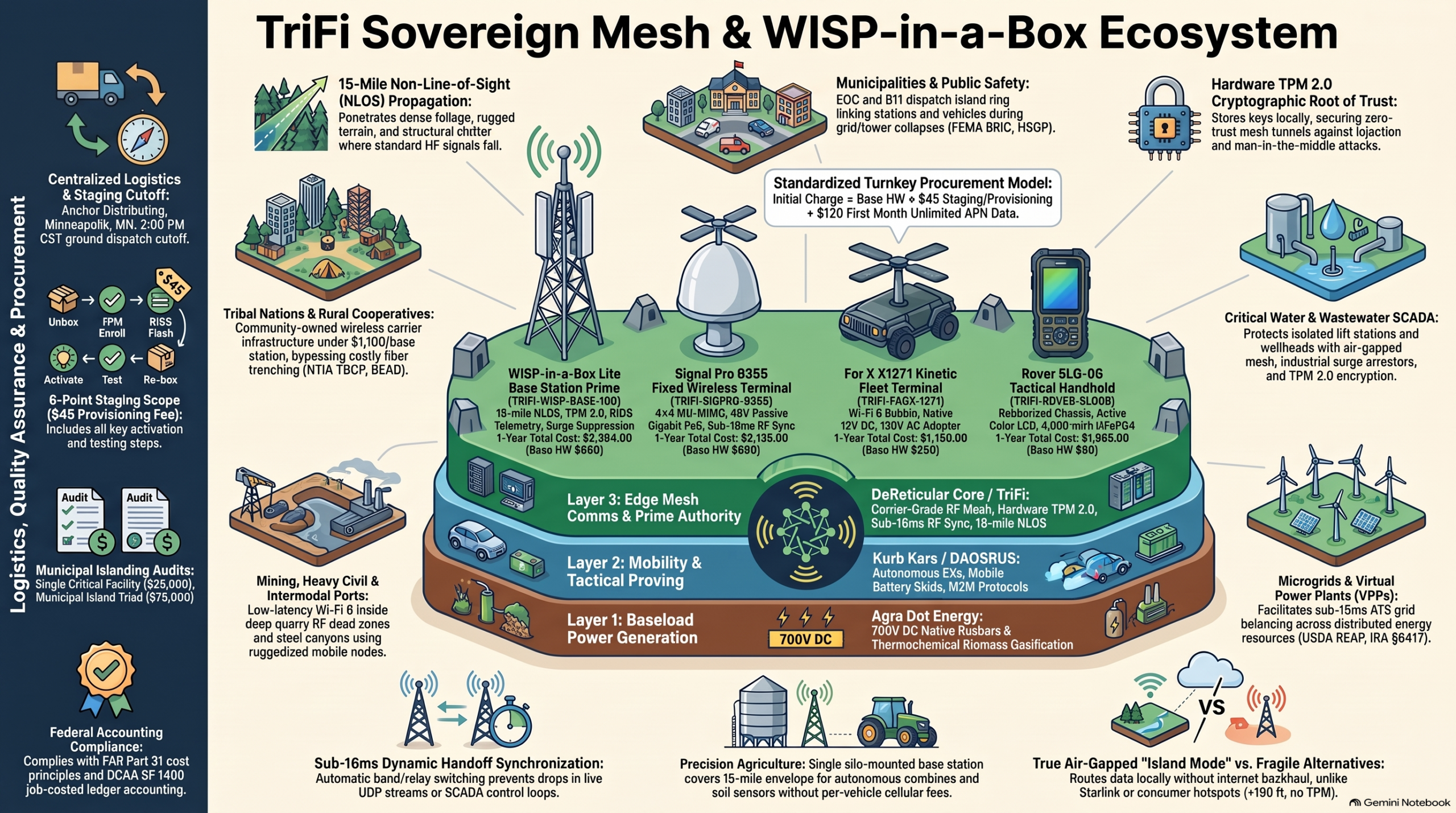
TriFi Sovereign Mesh Architecture: Operational Analysis for Island-Mode Continuity and Critical Infrastructure Hardening
- Architectural Thesis & The 1,000-Mile Failure Model
Context & Strategic Importance
Modern critical facilities—including municipal Emergency Operations Centers (EOCs), water and wastewater Supervisory Control and Data Acquisition (SCADA) networks, and distributed energy microgrids—operate under a precarious assumption of continuous external connectivity. Standard enterprise communication stacks rely on fragile, long-haul commercial telecommunications backhauls, public utility electrical grids, and hyper-centralized hyperscaler cloud data centers. When extreme meteorological events, physical supply chain interdictions, or wide-area power grid failures occur, these remote dependencies collapse simultaneously. This severing leaves local operational assets isolated, uncoordinated, and incapable of executing automated control loops. Establishing sovereign, localized telecommunications infrastructure is therefore an urgent strategic necessity. By decoupling local communications from external infrastructure, critical facility engineers can guarantee uninterrupted operational continuity and localized authority during catastrophic macro-level disruptions.
Analytical Evaluation of Systemic Vulnerability
The fundamental structural fragility of centralized telecommunications is formally deconstructed through the 1,000-Mile Failure Model. This analytical model demonstrates that localized critical facilities rarely experience catastrophic downtime due to internal hardware component failure; rather, operational paralysis is almost universally induced by upstream severances occurring hundreds or thousands of miles away. This structural vulnerability is mathematically governed by Noel’s Law of Structural Vulnerability:
\text{Survivability of Operational Node} \propto \frac{1}{\text{Length & Central Coordination of Supply Chains & Communication Backhauls}}
Under Noel’s Law, any operational node that requires persistent session validation, centralized Domain Name System (DNS) resolution, or real-time packet routing through distant cloud data centers inherits the cumulative operational risk of every intermediate transport node, fiber route, and utility sub-station along that path. When a regional electrical grid experiences cascading blackouts or a remote hyperscaler suffers a routing collapse, dependent local systems—such as municipal 911 emergency dispatch or automated water lift station pumps—are forced into safety trips or complete operational shutdown. Local continuity requires the total elimination of long-distance architectural backhaul dependencies.
Structural Breakdown of the Unified Sovereign Architecture
To systematically eradicate external dependencies, the Sovereign Infrastructure Consortium (SIC) deploys the 5-Layer Sovereign Infrastructure Stack. This integrated model isolates localized operational districts from external macro-failures by establishing self-sustaining power, mobility, communications, intelligence, and governance frameworks directly at the facility edge.
Consortium Layer Functional Scope Primary Technology & Design Parameters Operational Entity / Authority
Layer 1: Power Baseload Off-Grid Generation 700V DC native busbars, thermochemical biomass gasification, and biomass pyrolysis, completely bypassing public grid interconnection queues. Agra Dot Energy
Layer 2: Mobility Tactical Mobility & Proving Autonomous commercial/utility EVs, mobile battery skids, and nomadic nodes operating via offline machine-to-machine (DAOS_A2A_M2M_v3) protocols. Kurb Kars / DAOSRUS
Layer 3: Mesh Comms (Active Scope) Edge Mesh Communications Turnkey carrier-grade RF mesh networks, 15-mile NLOS envelopes, sub-16ms channel handoffs, and hardware TPM 2.0 cryptoprocessors. DeReticular Core / TriFi Wireless
Layer 4: SCADA / AI SCADA & Cognitive Intelligence Air-gapped on-premise compute, liquid-dielectric immersion GPU clusters (RIOS-CC-1000), and supervisory telemetry. DeReticular Energy
Layer 5: Governance Capital Stacking & Advisory Public-Private Partnerships (P3), Municipal Islanding Audits, and non-dilutive capital stacking (USDA REAP, FEMA BRIC, IRA §6417 Direct Pay). Biz Builder Mike / SIEA Academy
Operational Transformation
Transitioning from traditional cloud-dependent architecture to zero-cloud “Island Mode” operational continuity fundamentally alters the survivability profile of critical edge facilities:
+———————————————————————–+
| TRADITIONAL CLOUD DEPENDENT ARCHITECTURE (Vulnerable) |
| [Local SCADA / EOC] —> [Long-Haul Fiber] —> [Hyperscaler Cloud] |
| (Single Point of Backhaul Failure) |
+———————————————————————–+
| SOVEREIGN ZERO-CLOUD “ISLAND MODE” ARCHITECTURE (Resilient) |
| [Local SCADA / EOC] <===> [TriFi Layer 3 Mesh] <===> [Layer 4 AI Edge]|
| (100% On-Premise Autonomous Routing) |
+———————————————————————–+
In standard enterprise designs, a backhaul severance stalls edge decision-making, drops telemetry buffers, and halts industrial automation loops. Under an air-gapped, zero-cloud “Island Mode” operational model, Layer 3 TriFi nodes dynamically discover local peers, form encrypted mesh bridges, and keep all operational data localized. By executing telemetry routing and decision-making entirely within the local district, zero-cloud islanding maintains total system integrity during complete regional network collapse.
Transitioning from macro-level architectural theory to practical implementation requires evaluating the specialized hardware profiles and Radio Frequency (RF) spectrum mechanics that constitute Layer 3 Edge Mesh Communications.
- TriFi Sovereign Mesh Hardware Profile & RF Engineering Analysis
Context & Strategic Importance
Layer 3 of the Sovereign Infrastructure Consortium Stack deploys purpose-built hardware form factors integrated with high link-budget Radio Frequency (RF) components. Rather than relying on fragile consumer-grade routers or leased commercial cell towers, the TriFi Sovereign Mesh ecosystem utilizes four specialized node tiers. Together, these nodes form an adaptable, self-healing communications fabric designed for municipal, industrial, and tactical mobile environments.
Comprehensive Hardware Matrix
Technical & Hardware Metric TriFi WISP-in-a-Box Lite TriFi Signal Pro 8355 TriFi Far X X1271 TriFi Rover SLG-06
Master SKU TRIFI-WISP-BASE-100 TRIFI-SIGPRO-8355 TRIFI-FARX-1271 TRIFI-ROVER-SLG06
System Role Base Station Prime (District Hub Anchor) Fixed Wireless Terminal (Campus Microgrid CPE) Kinetic Fleet AP / Long-Range Rural Router Tactical Handheld Hotspot / Personal Field Node
Visual Form Factor High-gain mast/tower mount with gas-discharge arrestors Low-profile matte-white circular dome/disc Upright matte-gray desktop chassis with 4 vertical paddles Pocket-sized vertical handheld with active color LCD
Chassis Hardening Heavy-duty weather-sealed chassis with lightning suppression IP67 UV-stabilized cast composite / aluminum Upright desktop / kinetic vehicle mount chassis Drop-tested rubberized shock-absorbent body
RF Array & Antennas High-power carrier-grade sector/omnidirectional array 4×4 MU-MIMO high-gain directional array Four (4) vertical 9dBi directional paddle antennas Internal high-efficiency multi-band antenna array
Power Architecture AC-to-DC mast input or native DC busbar integration 48V Passive Gigabit Power-over-Ethernet (PoE) Native 12V DC vehicle input & 120V AC desktop adapter 4,000 mAh \text{LiFePO}_4 battery with USB-C PD pass-through
RF Sync / Handoff Multi-carrier base control (<16ms sync) Sub-16ms dynamic RF carrier handoff Sub-16ms dynamic carrier handoff sync Mobile multi-carrier sync (<16ms)
Coverage Radius 15-Mile Non-Line-of-Sight (NLOS) envelope Local campus / fixed station directional link Localized Wi-Fi 6 coverage bubble Personal Wi-Fi bubble with dynamic QR code pairing
Security Cryptoprocessor Hardware TPM 2.0, pre-flashed RIOS Agent Hardware TPM 2.0, pre-flashed RIOS Agent Hardware TPM 2.0, pre-flashed RIOS Agent Hardware TPM 2.0, dynamic QR display security
Unbundled Device Price $899.00 $650.00 $250.00 $80.00
Staging & Provisioning $45.00 $45.00 $45.00 $45.00
Turnkey Bundle Price $1,064.00 (HW + Stage + APN) $815.00 (HW + Stage + APN) $415.00 (HW + Stage + APN) $245.00 (HW + Stage + APN)
RF Propagation & Sub-16ms Handoff Mechanics
The operational performance of the TriFi WISP-in-a-Box Lite (TRIFI-WISP-BASE-100) centers on its sub-6 GHz Non-Line-of-Sight (NLOS) link budget. Standard millimeter-wave (mmWave) and high-frequency microwave links suffer severe atmospheric attenuation (dB path loss) and require an unobstructed line-of-sight. When obstructed by physical terrain, foliage, or airborne particulates, high-frequency signals experience total link blockage due to strict Fresnel zone clearance requirements.
In contrast, the Base Station Prime utilizes high link-budget, sub-6 GHz propagation profiles designed to maximize multi-path reflection resiliency and wave diffraction. This allows the signal to bend around topographical obstacles and penetrate moisture-laden foliage, dense structural concrete, and heavy atmospheric particulate fields (such as dense wildfire smoke plumes and ash) across a 15-mile coverage radius without losing link lock.
SUB-16MS SCADA PROTOCOL PERSISTENCE DURING RF FAILOVER:
[SCADA Master Station / PLC]
│ (Polling Loop Timeout Threshold: 100ms – 500ms)
▼
[TriFi Dynamic RF Layer] ──> (Degraded Primary Link Detected)
│
├── Handoff Negotiated & Completed in <16ms
│
▼
[Target SCADA Endpoint] <── (Zero Packet Loss / No Retransmission Cascade)
Equally critical to industrial operations is the network’s sub-16ms dynamic carrier handoff synchronization. Industrial automation and supervisory control rely on strict real-time protocols such as Modbus TCP and DNP3 over IP. Industrial Programmable Logic Controllers (PLCs) and remote terminal units (RTUs) enforce strict polling loop timeouts—typically set between 100ms and 500ms.
When commercial cellular modems experience link degradation, their carrier switching routines take anywhere from 3,000ms to 10,000ms to negotiate a new tower session. This drop causes buffer bloat, TCP retransmission cascades, socket termination, and safety trips on SCADA equipment.
TriFi Layer 3 radios continuously evaluate multi-carrier link quality at the physical layer. When a primary link degrades, the radio executes a carrier or peer-relay handoff within a sub-16ms window. Because this transition occurs faster than a single network frame interval, industrial polling loops and active UDP data streams suffer zero dropped frames, preventing control loop state machine failures.
Understanding RF spectrum dynamics and low-latency switching leads directly to examining the cryptographic root-of-trust and physical survival mechanisms required to shield these systems from physical and cyber attack vectors.
- Cryptographic Root-of-Trust & Physical Hardening Standards
Context & Strategic Importance
Deploying communication infrastructure into mission-critical, unmonitored outdoor settings presents significant physical and cybersecurity challenges. Hardware assets face harsh weather, power surges, severe temperatures, direct physical tampering, and state-sponsored cyberattacks. A hardened mesh architecture must unite physical ruggedization with hardware-enforced, zero-trust cryptographic security to protect the operational technology (OT) network from unauthorized entry, firmware injection, and data interception.
Cryptographic Architecture Evaluation
Every Layer 3 node in the TriFi ecosystem incorporates a discrete Trusted Platform Module (TPM 2.0) hardware cryptoprocessor soldered directly to the system board.
HARDWARE TPM 2.0 STAGING & TRUSTED BOOT SEQUENCE:
- Physical TPM 2.0 Cryptoprocessor Board-Level Initialization
- Enrolled with Sovereign Root Key at Staging (Anchor Distributing)
- Verified Secure Boot Execution (Blocks Malicious OTA Firmware)
- Local Hardware Identity Authentication (No Cloud Key Server Needed)
- Zero-Trust Peer-to-Peer Encrypted Tunnel Established (<16ms)
During Step 2 of the mandatory staging protocol at Anchor Distributing in Minneapolis, MN, the physical TPM 2.0 chip is cryptographically enrolled with the Sovereign Authority Root Key. This board-level provisioning establishes an immutable hardware root of trust, providing four core security protections:
- Board-Level Identity Protection: Hardware keys cannot be extracted or spoofed, preventing unauthorized hardware clones from joining the private mesh.
- Verified Secure Boot Integrity: Cryptographic signatures are validated before firmware execution, blocking unauthorized Over-The-Air (OTA) firmware injection or bootkit attacks.
- Air-Gapped Zero-Trust Tunneling: Nodes establish encrypted peer-to-peer tunnels with adjacent nodes using pre-shared local root trust, requiring no external DNS or cloud authentication servers.
- OT Network Protection: Shields industrial Modbus TCP/DNP3 telemetry streams from state-sponsored Man-In-The-Middle (MITM) network spoofing and wireless packet injection.
Because key validation is performed locally by the onboard TPM 2.0 cryptoprocessor, the node authenticates peer connections in a zero-trust architecture, maintaining local mesh security even when isolated from public network infrastructure.
Environmental & Electrical Survival Analysis
To maintain high availability in hostile outdoor environments, TriFi nodes employ specialized physical and electrical protective engineering:
- Industrial Lightning Surge Suppression: High-elevation installations—such as the TriFi WISP-in-a-Box Lite (TRIFI-WISP-BASE-100) mounted on water towers or communication masts—feature integrated heavy-duty gas-discharge lightning surge arrestors. These components divert extreme high-voltage electrical surges safely to ground, protecting sensitive internal transceiver circuitry during severe lightning strikes.
- Thermal Resilience & Advanced Lithium Chemistry: The tactical TriFi Rover (TRIFI-ROVER-SLG06) utilizes a 4,000 mAh Lithium Iron Phosphate (\text{LiFePO}_4) battery core. Unlike standard Lithium-ion batteries that risk thermal runaway and degradation at high temperatures, \text{LiFePO}_4 chemistry operates safely in ambient environments up to 140^\circ\text{F} (60^\circ\text{C}). This thermal tolerance allows field personnel to leave handheld nodes in hot vehicle cabs or industrial enclosures without risking thermal failure.
- Ruggedized Enclosures & Flexible Power Architecture: The TriFi Signal Pro 8355 (TRIFI-SIGPRO-8355) uses an IP67-rated, UV-stabilized cast composite and aluminum dome enclosure designed to block dust and water ingress. It operates via 48V Passive Gigabit Power-over-Ethernet (PoE), consolidating data and power delivery onto a single weather-sealed cable. For mobile deployments, the TriFi Far X (TRIFI-FARX-1271) features dual power inputs, running on native vehicle 12V DC power or standard 120V AC desktop input.
With cryptographic integrity and physical survivability established, attention turns to real-world deployment topologies across diverse operational sectors and competitive technology benchmarks.
- Deployment Topologies, “Island Mode” Use Cases, and Competitive Differentiators
Context & Strategic Importance
The modular design of the TriFi Sovereign Mesh ecosystem enables engineers to construct custom network topologies tailored to public safety, municipal utilities, microgrids, intermodal logistics, and agricultural operations. Analyzing domain-specific deployments shows how local mesh nodes maintain “Island Mode” operational continuity where traditional telecommunications networks fail.
Domain-Specific Topology Synthesis
MULTI-DOMAIN LOCALIZED MESH TOPOLOGY:
+———————————-+
| WISP-in-a-Box Lite (Base-100) |
| (15-Mile NLOS Anchor / TPM 2.0) |
+—————-+—————–+
|
+——————-+——————+——————+——————-+
| | | |
▼ ▼ ▼ ▼
+—————–+ +—————–+ +—————–+ +—————–+
| Municipal / EOC | | Water / SCADA | | Microgrid / VPP | | Precision Ag / |
| Base-100 + | | Signal Pro 8355 | | Signal Pro 8355 | | Extractive |
| Rover SLG-06 | | (IP67 Air-Gap) | | (<16ms ATS Sync)| | Far X X1271 |
+—————–+ +—————–+ +—————–+ +—————–+
- Municipal & Emergency Operations Centers (EOC): Base Station Prime anchors mounted on high-elevation assets (e.g., City Hall, communications towers) create a 15-mile island communications ring. This ring bridges 911 dispatch, municipal offices, and first responders carrying Rover SLG-06 handhelds, preserving command coordination during commercial network outages.
- Water & Wastewater SCADA: Isolated lift stations, treatment plants, and wellheads are retrofitted with IP67-rated Signal Pro 8355 CPE terminals. This establishes an air-gapped SCADA telemetry mesh that routes sensor data and remote control commands locally, insulating municipal water utilities from public internet attacks and cloud server failures.
- Distributed Energy & Microgrids: Solar fields, Battery Energy Storage Systems (BESS), and biomass generators utilize Signal Pro 8355 terminals to maintain sub-16ms link synchronization. This rapid link response time enables local Automatic Transfer Switch (ATS) balancing and Virtual Power Plant (VPP) control during main grid isolation.
- Precision Agriculture & Mining Fleet Operations: Silo-mounted base stations provide broad coverage across multi-thousand-acre farms and open-pit quarries. Far X X1271 terminals installed inside haul trucks, combines, and heavy machinery create local Wi-Fi 6 bubbles around vehicles.
- OpEx Fleet Consolidation Economics: Deploying a kinetic fleet AP (Far X X1271) inside a haul truck or combine consolidates dozens of onboard engine sensors, telemetry modules, and operator tablets behind a single $120/month APN profile. This eliminates thousands of dollars in monthly recurring costs compared to paying individual commercial SIM subscription fees for every onboard device.
- Maritime Ports & Intermodal Logistics Hubs: Intermodal shipping yards present difficult RF environments known as “container canyons”—shifting walls of dense corrugated steel cargo containers that block standard Wi-Fi signals. High link-budget directional Signal Pro 8355 terminals mounted directly to gantry cranes and yard towers penetrate these steel barriers, providing persistent connectivity to automated guided vehicles (AGVs) and yard hostlers without connection drops.
Technology Comparison Matrix
Technical & Operational Metric TriFi Sovereign Mesh Architecture Low-Earth Orbit Satellite (e.g., Starlink) Consumer / Commercial Hotspots Custom Carrier Macro-Towers
Private Island Mode Native / Standard (100% Local Routing) None (Fails without active cloud link) None (Requires central carrier core) None (Requires centralized core network)
Coverage Radius Up to 15 Miles per Base Station Terminal-only localized footprint Highly restricted (<150 ft) 2–5 Miles (Requires multi-tower grid)
Hardware Crypto (TPM 2.0) Integrated (Board-level hardware root) No (Cloud software authentication) Rare / Non-existent Enterprise equipment dependent
NLOS Foliage Penetration Carrier-Grade (Sub-6 GHz high link-budget) Zero (Requires open sky view) Poor (Low power output) Variable (Terrain/foliage dependent)
Sky-Block Vulnerability Unaffected (Operates through obstacles) Severe (Fails in trees, smoke, ash) Unaffected by sky; blocked by walls Unaffected by sky; blocked by landform
Handoff Latency <16 ms dynamic switching N/A (Stationary / single-path link) Slow / Dropped sessions (3,000–10,000ms) Standard cellular handoff (500–2,000ms)
Upfront CapEx Low Entry (<$1,100 per Base Station) Moderate (600–2,500 per dish) Very Low (100–300 per unit) Very High (100,000–250,000+)
Analytical Differentiator Assessment
Evaluating sovereign mesh against traditional networking options reveals clear operational and financial distinctions:
- Versus LEO Satellite Systems (e.g., Starlink): LEO satellites offer helpful point-to-point broadband, but suffer from sky-block vulnerability. Heavy tree canopies, urban canyons, wildfire smoke, or heavy rain cause complete signal degradation. Crucially, satellite terminals cannot route local traffic if their cloud ground stations or centralized authentication servers go offline. TriFi mesh nodes route traffic locally in true “Island Mode,” maintaining active peer-to-peer data exchange regardless of cloud availability.
- Versus Commercial Cellular Hotspots: Consumer-grade mobile hotspots lack high-gain directional antennas, limiting coverage to small footprints (50–150 feet) while omitting board-level TPM 2.0 cryptoprocessors. They experience dropped sessions during tower handoffs and depend entirely on public cellular networks. TriFi nodes extend coverage envelopes up to 15 miles with sub-16ms dynamic switching, hardware root security, and native peer-to-peer mesh connectivity.
- Versus Custom Carrier Macro-Towers: Constructing custom carrier macro-towers requires multi-year site leasing, extensive civil engineering, and capital outlays between $100,000 and $250,000 per location. Turnkey TriFi base stations deploy in hours at a fraction of the cost, bringing private carrier-grade performance to municipalities, rural utilities, and commercial enterprises.
Translating technical capabilities into deployed infrastructure requires defining procurement pricing, staging protocols, and federal grant alignment.
- Procurement Architecture, Staging Scope, and Federal Grant Capital Stacking
Context & Strategic Importance
Deploying hardened telecommunications networks requires transparent financial modeling and streamlined procurement protocols. To support municipal, enterprise, and utility buyers, DeReticular pairs predictable hardware pricing with standardized staging SLAs and federal cost-accounting compliance—enabling organizations to leverage non-dilutive federal grants to fund system deployments.
Total Cost of Ownership (TCO) & Billing Framework
All hardware within the TriFi Sovereign Mesh ecosystem is procured through a structured billing formula:
\text{Initial Acquisition Charge} = \text{Unbundled Hardware Price} + $45.00\text{ (Staging/Provisioning Fee)} + $120.00\text{ (Month 1 Data Subscription)}
Following system deployment, multi-carrier cellular backhaul is billed at a flat rate of $120.00 per month per node for uncapped, non-throttled data access across private APN profiles.
Hardware Unit Model Master SKU Unbundled Hardware Price Staging / Provisioning Fee Initial Turnkey Charge Monthly Recurring Data 1-Year Total Cost of Ownership (TCO)
TriFi Rover TRIFI-ROVER-SLG06 $80.00 $45.00 $245.00 $120.00 / mo $1,565.00 (HW + Stage + 11 Mo)
TriFi Far X TRIFI-FARX-1271 $250.00 $45.00 $415.00 $120.00 / mo $1,735.00 (HW + Stage + 11 Mo)
TriFi Signal Pro TRIFI-SIGPRO-8355 $650.00 $45.00 $815.00 $120.00 / mo $2,135.00 (HW + Stage + 11 Mo)
WISP-in-a-Box Lite TRIFI-WISP-BASE-100 $899.00 $45.00 $1,064.00 $120.00 / mo $2,384.00 (HW + Stage + 11 Mo)
Staging SLA & Logistics Protocol
To ensure field readiness, all Layer 3 hardware undergoes pre-dispatch staging at the primary logistics center in Minneapolis, MN (Anchor Distributing), tracked under general ledger code GL 5200-LOGISTICS. Orders processed prior to the 2:00 PM CST ground dispatch cutoff undergo a mandatory 6-step Quality Assurance (QA) provisioning protocol:
STAGING & QA WORKFLOW (Anchor Distributing / GL 5200-LOGISTICS):
- Physical Inspection ──> Visual chassis and unboxing check.
- Cryptographic Enrollment ──> TPM 2.0 key binding to Sovereign Root Key.
- Firmware Flashing ──> RIOS telemetry agent installation.
- SIM & APN Activation ──> IMEI modem registration and ICCID SIM marrying.
- Bench Verification Testing ──> RF loopback and sub-16ms failover validation.
- Serialized Asset Tagging ──> Barcoding, re-boxing, and same-day dispatch.
Audit Services & Non-Dilutive Grant Capital Stacking
To assist municipal and enterprise entities with network architecture and funding acquisition, DeReticular provides forensic engineering audits structured for grant reimbursement:
- Single Critical Facility Audit ($25,000 SOW): A targeted engineering assessment for an isolated facility (e.g., a standalone wastewater pump station, fire station, or regional hospital). The audit evaluates local RF propagation, failover latency, and emergency backup power integration.
- Municipal Island Triad Audit ($75,000 SOW): A regional forensic engineering assessment covering the three vital pillars of local government operations:
- City Hall & Administrative Governance Hubs
- Water & Wastewater SCADA Infrastructure
- 911 Emergency Dispatch & Emergency Operations Centers (EOC)
FEDERAL GRANT CAPITAL STACKING ARCHITECTURE:
+—————————————————————————————+
| Federal Accounting & Regulatory Compliance |
| (Strictly Compliant with FAR Part 31 & DCAA SF 1408 Job-Costed Ledgers) |
+——————-+——————-+——————-+—————————+
| FEMA BRIC / HSGP | USDA REAP / | IRA §6417 | NTIA TBCP / |
| Program Funding | ReConnect Grants | Direct Pay | IIJA BEAD Program |
+——————-+——————-+——————-+—————————+
| Emergency Comms | Ag & Rural Telecom| Direct Cash Credit| Community Wireless & |
| & Infrastructure | Microgrid Mesh | For Tax-Exempt | Tribal Broadband |
| Hardening | Deployments | Entities | Extensions |
+——————-+——————-+——————-+—————————+
All audit Statements of Work (SOW), staging fees, and hardware procurement adhere to strict federal cost-accounting standards, including FAR Part 31 (Federal Acquisition Regulation: Cost Principles) and DCAA SF 1408 job-costed general ledger criteria. This accounting framework allows municipal entities, utilities, and non-profits to pass staging fees, audit SOWs, and hardware costs directly into non-dilutive federal grant programs without triggering audit exceptions:
- FEMA BRIC & HSGP: Funding via Building Resilient Infrastructure and Communities and the Homeland Security Grant Program for emergency communications hardening and hazard mitigation.
- USDA REAP & ReConnect: Grants supporting rural agricultural microgrids, off-grid power, and rural broadband expansion.
- IRA Section 6417 (Direct Pay): A direct cash reimbursement mechanism enabling tax-exempt public entities and non-profits to receive direct payment credits for clean energy and resilient infrastructure investments.
- NTIA TBCP & IIJA BEAD: Funding through the Tribal Broadband Connectivity Program and Broadband Equity, Access, and Deployment Program for community-owned and underserved regional network builds.
Summary Mandate
By uniting zero-cloud “Island Mode” local routing, hardware-enforced TPM 2.0 security, ruggedized physical components, and federally compliant capital stacking, the TriFi Sovereign Mesh Architecture delivers a turnkey framework for establishing telecommunications autonomy and critical infrastructure resilience.


