Unbreakable Connectivity: A Technical Primer on Sovereign Mobile Networks
- Foundations: From Connectivity Chaos to the Sovereign Node
The current mobile landscape is defined by a significant “Market Deficit.” While the demand for remote operations and high-value nomadic lifestyles has surged, the supporting infrastructure has remained a “Traditional Consumer Patchwork.” This legacy approach relies on fragmented hotspots, fragile DIY installations, and consumer-grade hardware that fails the moment an operator exits the range of urban cellular towers.
The Generation 5 (Gen 5) Systems Architecture facilitates the transition from this chaos to the Sovereign Mobile Node. This is not merely a hardware upgrade; it is a vertical integration of ruggedized, industrial-grade components designed to treat connectivity as a mission-critical utility.
Traditional Experience RIOS Sovereign Experience
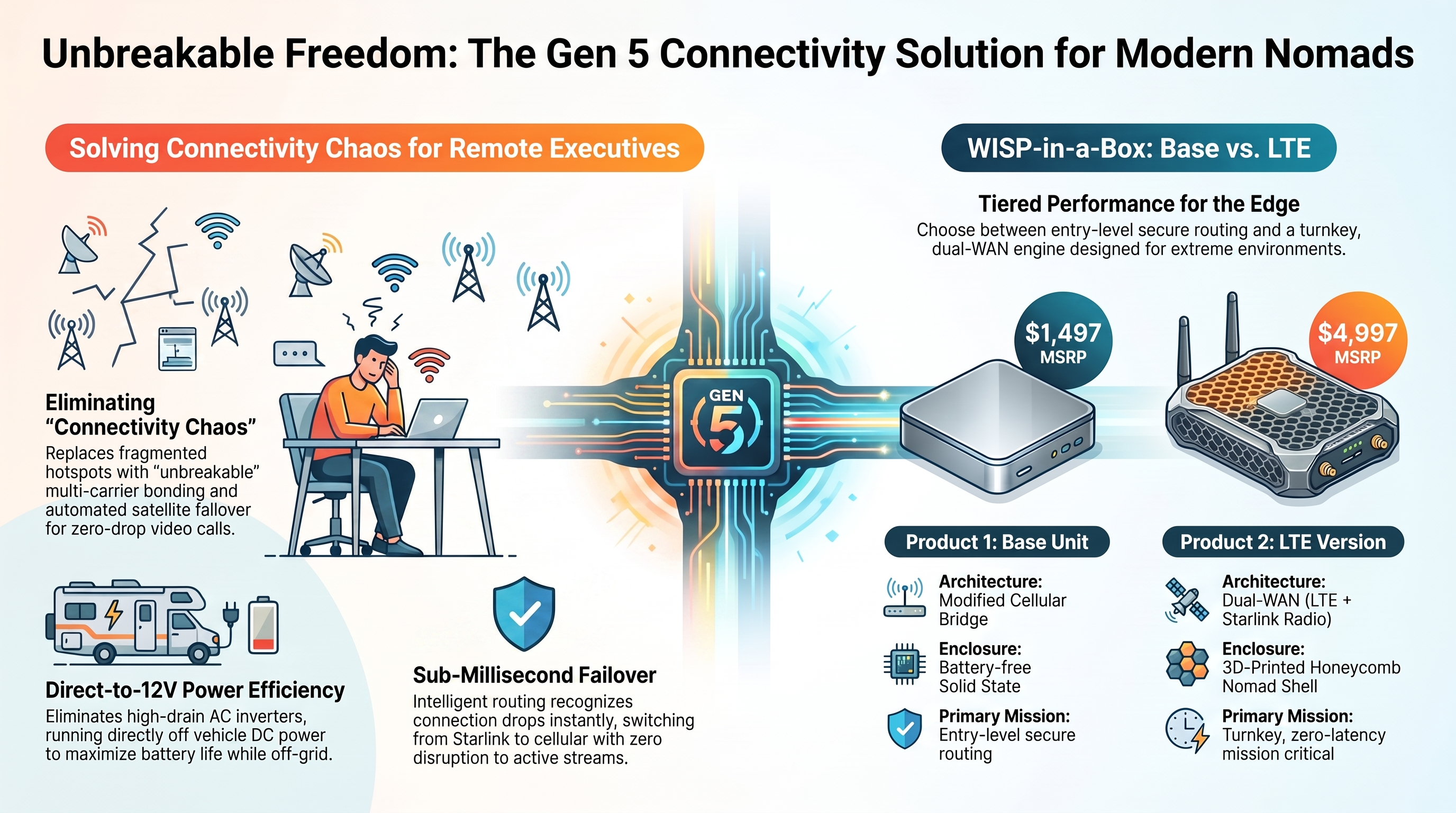
Connectivity Chaos: Reliance on unusable campground Wi-Fi and single-carrier hotspots. Unbreakable Bonding: Multi-carrier cellular bonding (AT&T, Verizon, and T-Mobile) into a unified pipeline.
Communication Failure: Frequent dropped video calls and telemetry loss in remote “dead zones.” Seamless Failover: Sub-millisecond hardware-level transition between satellite (LOE) and bonded cellular.
Energy Inefficiency: Massive battery drain caused by inefficient AC inverters required for consumer routers. 12V Efficiency: Direct-to-DC native power framework (12V–48V) optimized for mobile rigs and remote outposts.
Complex Management: Disparate devices and apps with zero unified technical support. Integrated Telemetry: A single smart interface managing connectivity, machine health, and edge-AI.
Learning Insight: The “Apple of Connectivity” Philosophy Technical systems often fail in the field because they are too complex for the operator. The Sovereign Node philosophy mirrors the “Apple” approach: hiding enterprise-grade complexity—such as packet-level routing and Battery Elimination Circuits—behind a clean interface. However, a clean interface is useless if the hardware is powered by an inefficient AC inverter that kills the vehicle’s battery. True sovereignty requires 12V-native engineering to ensure the hardware remains as resilient as the interface is intuitive.
- Multi-Carrier Cellular Bonding: The Unified Data Pipeline
At the core of the Voyager/Nomad Kit (Tier 1) is the principle of multi-carrier cellular bonding. Rather than switching between carriers when one signal degrades, this technology “glues” multiple networks together into a single, robust data pipeline via the RIOS Guardian Hub.
This configuration requires three specific components to function as a unified system:
- RIOS Guardian Hub: The central “brain” utilizing the SLG-06 core to manage and bond AT&T, Verizon, and T-Mobile signals simultaneously.
- Trifi RIOS 5-in-1 Mobile Antenna: A high-gain, multi-MIMO antenna array designed to capture signals from multiple carriers across various frequency bands.
- RIOS 12V Power & Data Kit: A specialized wiring harness that allows the system to pull power directly from the vehicle’s DC bus, bypassing the failure points of AC inverters.
Learning Insight: Having three separate carriers is superior to a single-carrier hotspot because carrier coverage is rarely uniform. In remote environments, a “dead zone” for one provider is often covered by another; bonding ensures the pipeline remains open as long as any tower is reachable. While this cellular foundation is powerful, true “unbreakability” requires a bridge to the sky.
- Hybrid Satellite Fusion and Sub-Millisecond Failover
The Sovereign Navigator tier introduces the Sat-Cellular Combustion Engine. This is a hardware-level fusion where a Low Earth Orbit (LOE) radio transceiver is integrated directly onto the communications bus, blending satellite data with bonded LTE.
The Gen 5 stack utilizes an integrated pfSense/OPNsense routing layer to manage data flow. Unlike consumer failover systems that may take 30 seconds to switch, this architecture executes sub-millisecond failover. By utilizing packet-level evaluation, the system detects a drop in satellite line-of-sight (caused by trees or terrain) and pivots to cellular instantly, ensuring that a 4K video stream or critical C2 telemetry remains uninterrupted.
Learning Insight: The distinction between “DIY” and “Sovereign” architecture lies in the failure threshold. In a DIY setup, a 30-second delay is an inconvenience. In a Beyond Visual Line of Sight (BVLOS) drone mission or an autonomous agricultural operation, a 30-second delay is a catastrophic failure.
- Solid-State Engineering: The Battery-Free Advantage
Standard mobile hardware contains chemical lithium batteries prone to swelling and fire in high-heat environments. The Gen 5 architecture utilizes a Solid-State, Battery-Free design, ruggedizing units at Station C (The Operating Table) via a specific Standard Operating Procedure (SOP):
- Chemical Battery Removal: Internal batteries are discarded to eliminate thermal limitations and fire risk.
- Implementation of Battery Elimination Circuits (BECs): Technicians solder-bridge a 10kΩ resistor to the Battery Status Indicator (BSI) pin at 350°C to “spoof” the hardware into a permanent “healthy” power state.
- Direct DC Integration: A Mini-360 DC-DC Buck Converter is integrated, allowing the unit to pull directly from 12V–48V vehicle power.
Learning Insight: This engineering provides three critical advantages:
- Fire Safety & Stability: Elimination of volatile chemistry allows for operational stability in temperatures ranging from -10°C to 60°C.
- Weight Reduction: Shedding battery weight is essential for high-altitude BVLOS drones.
- RF Noise Prevention: By connecting via USB-C RNDIS (Tethering) and utilizing shielded BECs, the unit acts as lightweight flight avionics without polluting the RF spectrum or interfering with radio control links.
- Architecture of the WISP-in-a-Box Series
The Gen 5 digital stack is categorized into three tiers, each factory-tuned for specific mission profiles.
Product Core Hardware Profile Primary Mission MSRP
Product 1: Base Modified SLG-06, Starlink bracket, pfSense Entry-level secure remote routing; 12V-ready. $1,497
Product 2: LTE RIOS-WBL-02: Dual-WAN LTE, LOE Radio, vSIM, Honeycomb Nomad Shell Turnkey maritime, ag-bot, and fleet communications. $4,997
Product 3: Agentic Dual-WAN + RIOS-TC-01 (Agentic Compute Core) Air-gapped AI and V2V Ledger synchronization. Config. Dependent
Learning Insight: A key value-add is Application-Specific Factory Pre-Configuration. Each unit is tuned at the workshop—whether for the high-vibration environment of a trophy truck or the salt-mist conditions of a maritime mast—ensuring optimal routing profiles out of the box.
- Edge Intelligence and the Air-Gapped Advantage
The flagship Agentic tier (Product 3) introduces the Telemetry Core RIOS-TC-01. This compute core is built on a Raspberry Pi 5 with 8GB LPDDR5 RAM and NVMe storage (MicroSD is banned for reliability). It hosts an Air-Gapped AI that ensures sensitive data never leaks to public clouds.
The local AI performs three core Edge Tasks:
- Autonomous Management: Handles reservations and real-time scheduling without an internet uplink.
- M2M Negotiation: Facilitates machine-to-machine coordination with secondary autonomous vehicles.
- Ledger Sync: Utilizes the Locutus Ledger for peer-to-peer data synchronization over Trifi mesh networks.
Learning Insight: This architecture enables Spherical Vehicle Synchronization. In a multi-vehicle expedition, all units (RV, reconnaissance drones, and utility vehicles) maintain a shared operational state even in jammed or off-grid conditions.
- Summary of the Sovereign Ecosystem
The Sovereign ecosystem reaches its apex in the Product 6 Tactical Advanced-Power Vehicle (TAV). This $450,000 platform fuses mechanical power—utilizing multi-fuel Wankel rotary engines as high-density range extenders—with the full Gen 5 digital stack.
Student Takeaway: Core Pillars of Resilience
- Resilience: Achieved via Battery-free/Dual-WAN solid-state hardware and a -10°C to 60°C operating range.
- Intelligence: Provided by Air-gapped AI agents running on NVMe-based RIOS-TC-01 cores for total data sovereignty.
- Autonomy: Supported by 12V-native electronics and multi-fuel capability (Rotapower engines) for indefinite off-grid operation.
The guiding principle of this architecture is “Buy Once, Cry Once.” By engineering systems that bypass consumer limitations, we ensure that both the connection and the mission remain unbreakable in the most demanding environments on Earth.


