Master Blueprint for Off-Grid Regional Expansion: Integrated Energy, Compute, and Hospitality Infrastructure Strategy

- Strategic Regulatory Arbitrage: Bypassing the ‘Permitting Wall’
In the domain of high-tier rural development, the “Permitting Wall” represents the terminal bottleneck: a 5-to-7-year utility interconnection queue characterized by prohibitive capital requirements and regulatory paralysis. For the Principal Infrastructure Strategist, the solution is not to wait, but to bypass. Statutory microgrid certification serves as the foundational strategic bypass, transforming a remote site from a stranded asset into a self-sufficient, sovereign energy district.
The legal mechanism for this acceleration is West Virginia House Bill 2014 (specifically W. Va. Code §5B-2-21 and §24-2-21a). This statute allows for a formal “Petition for Certified Microgrid District Designation,” granting developers a complete exemption from Public Service Commission (PSC) rate jurisdiction. This is a critical competitive advantage for rapid scaling in high-demand regions such as Monongalia or Fayette County. By operating behind-the-meter, we eliminate utility dependency and gain the autonomy to set internal rates, ensuring speed-to-market and high-margin operational stability.
Timeline Comparative Analysis: Market Entry Efficiency
Development Milestone Traditional Grid Extension Certified Microgrid District (H.B. 2014)
Regulatory Filing Multi-year utility queue 60-day filing process
Interconnection Timeline 5–7 years Immediate (Behind-the-meter)
PSC Oversight Full rate regulation Statutory exemption
Cost Basis Unpredictable Volumetric Tariffs & Connection Surcharges $0.038/kWh (Self-generated)
Once the regulatory path is cleared, the physical synergy of the hardware must be optimized to maintain this legal status. The following technical architecture is not a suggestion—it is a mandatory requirement for regulatory compliance.
- Technical Synergy: The Integrated Power and Compute Engine
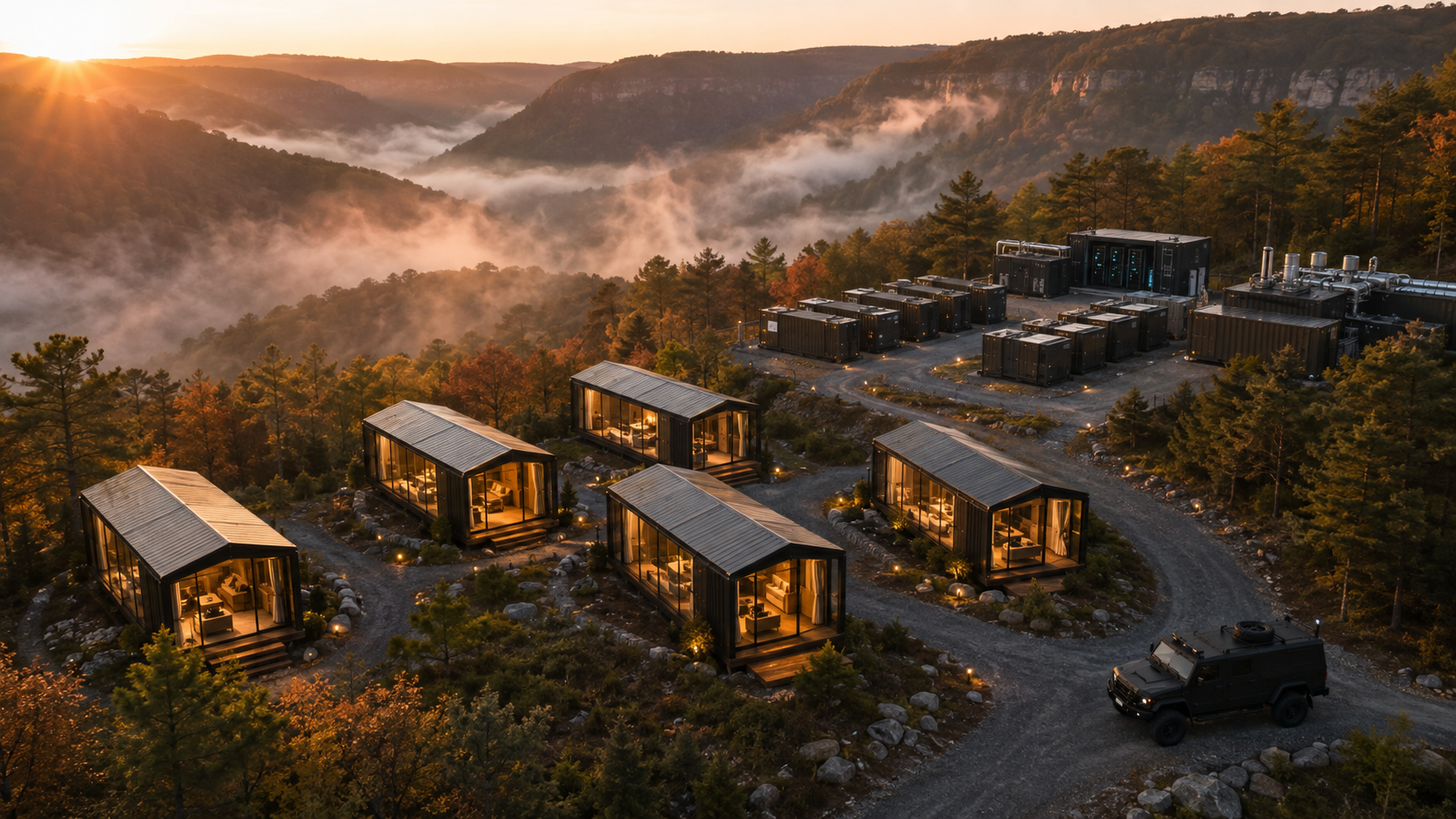
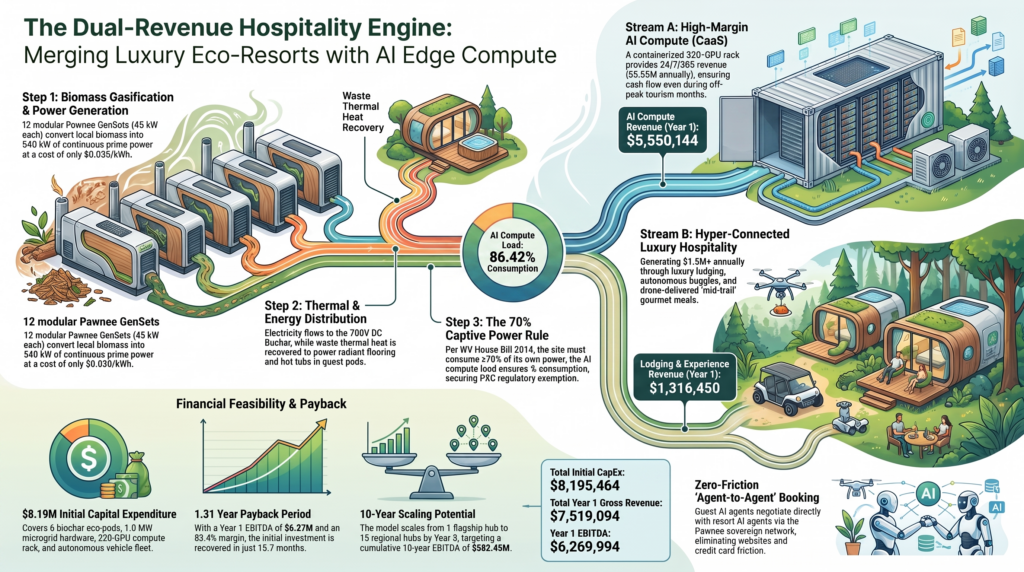
Transitioning from energy as a liability to energy as a dual-revenue asset requires the seamless integration of Pawnee Power GenSets and high-density GPU racks. This architecture creates a closed-loop system where energy production fuels both luxury hospitality and high-margin industrial compute.
GenSet & DC Bus Architecture
Deploy 12 modular Pawnee Power GenSets (45 kW each), utilizing the Agra Energy Gasification Vessel to convert local biomass into clean syngas. Distribute power via a 700V DC Busbar system to eliminate the conversion losses inherent in traditional AC systems. This configuration delivers prime power at a base cost of $0.038/kWh, providing a stable electrical backbone for the entire district.
podcast
Compute-as-a-Service (CaaS) Integration
Integrate the RIOS-CC-1000 GPU Compute Enclosure, a Generation 5 (Gen 5) commercial hardware product housing 320 GPUs. This unit is not merely a revenue stream; it functions as a continuous electrical and thermal “sink.” By placing high-density compute on-site, the microgrid gains a constant load that stabilizes the system against the fluctuating demands of hospitality operations.
Thermal Energy Recovery (Waste-to-Value)
Capture 65°C coolant return from the engine exhaust jackets to drive radiant floor heating and hydrotherapy systems. The effectiveness of this low-grade heat is maximized by the R-38 value of the biochar-composite panels used in the eco-pod construction (manufactured using Node 1 gasifier ash). This thermal efficiency ensures that waste-to-value recovery provides 100% of the climate control requirements for the lodging infrastructure.
- The Captive Power Ratio: Compliance and Independence Analytics
The Captive Power Ratio (C_R) is the mathematical proof required to maintain grid independence and statutory compliance. To retain PSC exemption under W. Va. Code §24-2-21a, the district must consume the vast majority of its generated power on-site.
The 86.42% Compliance Model
To satisfy the statutory mandate of \ge 70\% captive power, the infrastructure adheres to the following annual performance metrics:
- Total Annual Generation: 4,257,360 kWh (Produced by 12 Pawnee GenSets at 90% capacity factor).
- AI Compute Consumption: 3,285,000 kWh (Calculated as: 375 kW continuous GPU load * 8,760 hours/year).
- Lodging & Fleet Consumption: 394,200 kWh (Facility HVAC, water systems, and vehicle charging).
Analytical Justification
The resulting Captive Power Ratio (C_R) of 86.42% provides a 16.42% buffer above the 70% legal threshold. This margin is a strategic necessity to protect the project’s regulatory safety against seasonal occupancy dips or GPU maintenance cycles. Maintaining this ratio is the only way to ensure utility grid independence and preserve the high-margin, carbon-negative nature of the development.
- Autonomous Logistics and Agentic Infrastructure
The “Sovereign Stack” architecture removes guest friction by replacing manual logistics with autonomous AI-to-AI (A2A) orchestration. By eliminating human-mediated service points, we reduce operational overhead and provide a seamless “Hyper-Connected” experience.
Fleet and Gateway Technical Specifications
Logistics are executed through a suite of Gen 5 hardware products:
- Pawnee Flagship TAV ($797,000): A tactical vehicle acting as the mobile command center and primary launchpad for autonomous delivery drones.
- Pawnee Hybrid Dune Buggies ($99,000): Autonomous shuttles that provide zero-human-intervention trailhead transport.
- WISP-in-a-Box Gateway Series: Deploy the Agentic (9,997)** and **LTE (5,887) units at the hub, with Base units ($1,497) as trail-side beacons.
The Mesh Network & Drone Delivery
The WISP-in-a-Box series facilitates a sovereign mesh network, enabling “mid-trail” services in cellular dead zones. When a guest beacon pings a Base Gateway, the RIOS kernel triggers an autonomous delivery drone from the roof pad of the Pawnee Flagship TAV. The drone tracks the hiker’s GPS coordinates and lowers a thermal meal pod via winch, providing gourmet service in remote terrain.
Operational Efficiency Analysis
Friction Point The Traditional Way The Hyper-Connected Model
Connectivity 2-Hour Cellular Dead Zones Sovereign P2P Mesh Network
Bookings Manual web/phone coordination A2A Agent Orchestration
Logistics Manual diesel vans / Static drops Autonomous Buggies & Drones
Service Static / Unreliable Catering On-demand 20-minute delivery
- Human Capital: The WVU Energy Student Pipeline
Securing specialized talent for off-grid maintenance in rugged terrain is a critical operational risk. We mitigate this through a strategic partnership with the WVU Statler College of Engineering and the Brad D. Smith OEDC.
RETI Consortium Integration
This “WO Strategy” (Weakness-Opportunity) utilizes the RETI Consortium fellowship model. By allocating 2.43% of gross revenue to fund 14 undergraduate and graduate WVU Energy Student Fellows, we secure a localized, technical workforce that grows with the project.
podcast
Sustaining the “Living Laboratory”
Fellows are integrated directly into the infrastructure’s lifecycle, performing high-stakes roles:
- A2A Node Operation: Managing the RIOS kernels and P2P mesh protocols.
- GenSet & Gasifier Servicing: Maintaining the Agra Energy vessels and modular rotary units.
- Autonomous Overwatch: Conducting drone flight overwatch and remote sensor monitoring.
This pipeline ensures that the “Specialized Talent” weakness identified in the SWOT is converted into a proprietary regional strength.
- Scalability Roadmap: From Flagship to National Franchise
This model is a repeatable blueprint for the re-industrialization of rural North America. By combining the speed of H.B. 2014 certification with the margins of AI compute, we scale from a single hub to a national eco-hospitality brand.
Phased Expansion Timeline
- Phase 1 (Y1-Y2): Flagship deployment at New River Gorge (Monongalia/Fayette candidate sites). Secure 1.0 MW microgrid and H.B. 2014 certification.
- Phase 2 (Y3-Y5): Appalachian Cluster expansion (15 hubs). Establish a Node 5 central assembly facility on a coal brownfield site for vertical manufacturing of pods and Gen 5 hardware mounts.
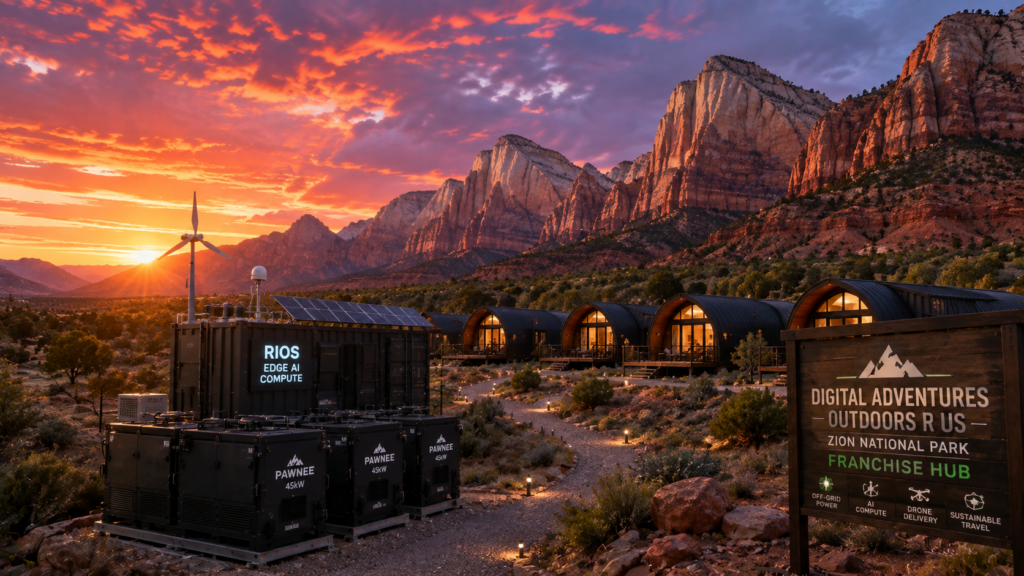
- Phase 3 (Y6-Y10): National Franchise scaling. License the Sovereign Stack and hospitality brand to national park corridors including Yellowstone and Zion.
Financial Performance Summary
The dual-revenue engine delivers unprecedented returns for infrastructure assets.
Metric Year 1 (Flagship) Year 10 (National Scale)
Total Revenue $7,519,094 $305,000,000
EBITDA $6,269,094 $264,000,000
EBITDA Margin 83.4% 86.6%
10-Year Unlevered IRR 168.4% —
Net Present Value (NPV) $612.4M —
Final Strategic Synthesis
The “Permitting Wall” is the legacy of a failing centralized grid. By utilizing West Virginia H.B. 2014 and the Sovereign Stack architecture, we have engineered a bypass that enables a $300M+ annual revenue engine. This model delivers a carbon-negative, high-margin wilderness experience that is decoupled from utility constraints and optimized for the future of agentic infrastructure.


