The Generation 5 Ecosystem: A Guide to Sovereign Off-Grid Living
- The Infrastructure Challenge: Why “The Line” Fails
Modern civilization is built upon “The Line”—a centralized, linear topology of power grids, cloud data centers, and fiber-optic backbones. While efficient under static conditions, these systems exhibit extreme fragility during localized surges. In Quartzsite, Arizona, the population swells from 2,000 to over 1.5 million during the Bureau of Land Management (BLM) season (September 15 – April 15). Under this load, “The Line” snaps: local cellular towers throttle to speeds <1Mbps, and the absence of a central grid forces a reliance on loud, polluting gas generators.
To achieve true topological resilience, we must shift to “Spherical Resilience.” In this model, infrastructure is no longer a fragile chain but a self-healing web of autonomous nodes. While “The Line” is a string of holiday lights where one failure darkens the circuit, Spherical Resilience functions as a series of independent “islands” that can synchronize for trade and security but remain fully operational in absolute “Island Mode” if the outside world fails.
Infrastructure Comparison: Centralized vs. DeReticular Sovereign Infrastructure
Category Traditional Centralized Infrastructure DeReticular Sovereign Infrastructure
Power Dependent on distant grids or noisy, high-vibration gas generators. Quiet, high-capacity Pawnee microgrids and zero-carbon plasma gasification.
Connectivity Local towers that throttle to <1Mbps during peak winter usage. Multi-carrier bonding aggregating Starlink and 5G into an unbreakable link.
Reliability Single points of failure; cloud dependency creates systemic downtime. Decentralized Physical Infrastructure Networks (DePIN) for autonomous uptime.
To fix these failures, we require a Decentralized Physical Infrastructure Network (DePIN) capable of acting as an “island” of stability in unmapped or congested terrain.
- RIOS Mobile Gateways: Your “WISP-in-a-Box” Digital Lifeline
The Rural Infrastructure Operating System (RIOS) serves as the AI-native orchestration layer for the Generation 5 ecosystem. The WISP-in-a-Box gateways represent the hardware manifestation of this system, replacing fragmented DIY setups with industrial, direct-to-12V power hardware designed for the Sonoran desert.
- WISP-in-a-Box Base Gateway: An entry-level node featuring a ruggedized 3D-printed mesh chassis and Tri-Fi localized connectivity for nomadic pioneers.
- WISP-in-a-Box LTE Gateway: An enterprise-grade system for remote executives featuring an onboard pfSense edge router for physical, hardware-level security.
- WISP-in-a-Box Agentic AI Gateway: The flagship orchestration tool, housing an air-gapped local AI engine and the Locutus Ledger for peer-to-peer data verification.
The single most important benefit of Multi-Carrier Bonding is the ability to aggregate Starlink, LTE, and 5G signals into a single, seamless connection to bypass local tower saturation and ensure mission-critical broadband uptime.
Tri-Fi Mesh Networking: A localized, peer-to-peer communication protocol that enables a fleet of vehicles to establish a private, secure Wi-Fi web across miles of wilderness, facilitating data and telemetry sharing without reliance on external cellular towers.
Having a digital signal is a hollow victory without the sovereign energy metabolism required to keep the orchestration layer alive.
- Pawnee Kinetic & Power: The Muscles and the Microgrid
The Pawnee series provides the “kinetic body” of the ecosystem, delivering high-output power and autonomous mobility. These units transform a standard encampment into a resilient sovereign node.
Component Name Primary Function Learner Insight (The “So What?”)
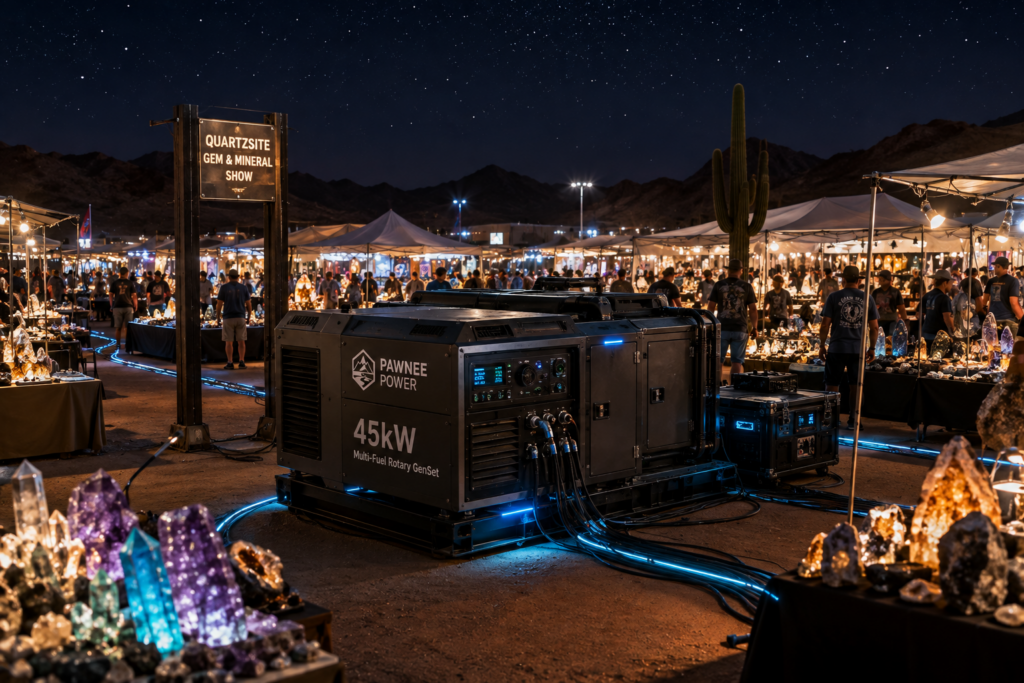
Pawnee 45kW GenSet Mobile high-capacity power generation. Replaces noisy gas generators with whisper-quiet microgrids for vendor plazas and enclaves.
Hybrid Dune Buggy Autonomous off-road logistics. Enables autonomous medical triage and cargo delivery across unmapped terrain without human operators.
Pawnee Flagship TAV 6×6 Tactical Autonomous Vehicle. Serves as a $797,000 mobile Command & Control (C2) center for total digital and physical sovereignty.
While these units are formidable as standalone assets, their true utility is realized through machine-to-machine (M2M) telemetry synchronization.
- The Synergy: How RIOS and Pawnee Collaborate
The Generation 5 ecosystem operates as a unified organism: RIOS provides the “brain” (intelligence and connectivity), while Pawnee provides the “body” (kinetic power and movement). This collaboration is mediated by the Locutus Ledger, an offline-first peer-to-peer verification engine that allows nodes to synchronize telemetry and verify transactions without an active internet connection.
A Sovereign Node is established through a defined Operational Execution Timeline:
- Backbone Deployment: RIOS WISP towers are established at key BLM LTVA access points, such as La Posa North and South, to anchor the network topology.
- Power Initialization: Pawnee 45kW GenSets are positioned to establish a quiet power microgrid, feeding the RIOS gateways and local High-Density GPU Racks.
- Mesh Integration: Individual vehicles equipped with WISP Gateways link to the microgrid and each other, entering “Island Mode” where local AI agents and the Locutus Ledger maintain absolute data sovereignty.
This structural synergy transforms technology into a resilient baseline for the human populations navigating the desert’s bottlenecks.
- Real-World Impact: Solving the Quartzsite Bottlenecks
The Gen 5 stack specifically mitigates the infrastructure friction points identified during the September 15 – April 15 LTVA season.
- Remote Executives & Digital Nomads
- The Problem: Cellular towers throttle to <1Mbps during peak winter months, making executive trade execution and VPNs impossible.
- The Gen 5 Solution: WISP-in-a-Box LTE Gateways utilize multi-carrier bonding and pfSense edge routing to guarantee a high-bandwidth, secure backbone.
- Commercial Show Vendors (2,000+ Businesses)
- The Problem: Massive revenue loss occurs when local networks crash, causing Point-of-Sale (POS) terminals to fail during the peak RV and Gem shows.
- The Gen 5 Solution: “Unbreakable POS” packages utilize Agentic AI Gateways and the Locutus Ledger for local transaction logging and zero-downtime Starlink/5G failover.
- Luxury Overland Community
- The Problem: High-net-worth rigs require total autonomy and the ability to perform repairs or medical triage in isolated wilderness.
- The Gen 5 Solution: The Pawnee Flagship TAV acts as a mobile C2 center, while The Field Medic provides localized, AI-driven diagnostics for rapid mechanical and infrastructure repair.
- The Blueprint for Autonomy: A Summary of Gen 5 Capabilities
The Generation 5 ecosystem represents “Civilization in a Box.” Beyond connectivity and power, the system integrates High-Density GPU Racks for local AI inferencing and Plasma Gasification Eco-Pods to convert organic waste into zero-carbon biochar and baseload power. This is the transition from being a consumer of failing, centralized utilities to becoming a sovereign owner of infrastructure.
Fast Facts: Top Generation 5 Hardware Pieces
Hardware Component Unit Cost (MSRP) Target User
WISP-in-a-Box Base Gateway $1,497 Vanlifers & Budget Nomads
WISP-in-a-Box LTE Gateway $5,887 Remote Executives & Show Vendors
WISP Agentic AI Gateway $9,997 Tech Founders & DePIN Builders
Pawnee Power GenSet (45kW) $49,997 Vendor Plazas & Camp Enclaves
Pawnee Flagship TAV $797,000 UHNW Overlanders & Executive Rigs
This shift marks a historic turning point in human resilience: the move from being a dependent “consumer” of the grid to a “sovereign owner” of the infrastructure required to maintain modern civilization anywhere on Earth.


