The Architecture of Truth: Perspectival Realism, Material Ledgers, and the Crisis of Symbolic Systems
Executive Summary
This briefing document synthesizes a foundational framework for understanding truth, not as a static possession, but as a dynamic “Ontic Attractor” (\Omega^*) toward which human inquiry converges through disciplined error reduction. The provided sources outline a structural paradox: human cognition is local and resource-bounded, yet it seeks to map a high-dimensional, thermodynamically unyielding reality.
The core findings suggest that progress is achieved through the Via Negativa—the systematic foreclosure of false parameter spaces. This process is mediated by Material Ledgers (from Babylonian clay to cryptographic chains) that anchor truth in physical substrates to resist subjective drift. However, the document identifies a catastrophic “Model Crisis” in modern macroeconomics, where ungrounded symbolic ledgers (debt) have decoupled from biophysical reality (energy/thermodynamics). The synthesis concludes with the specification of a Resilient Epistemic & Thermodynamic Ledger Architecture (RELA) designed to realign human systems with objective physical invariants.
- The Epistemic Paradox and the Nature of Truth
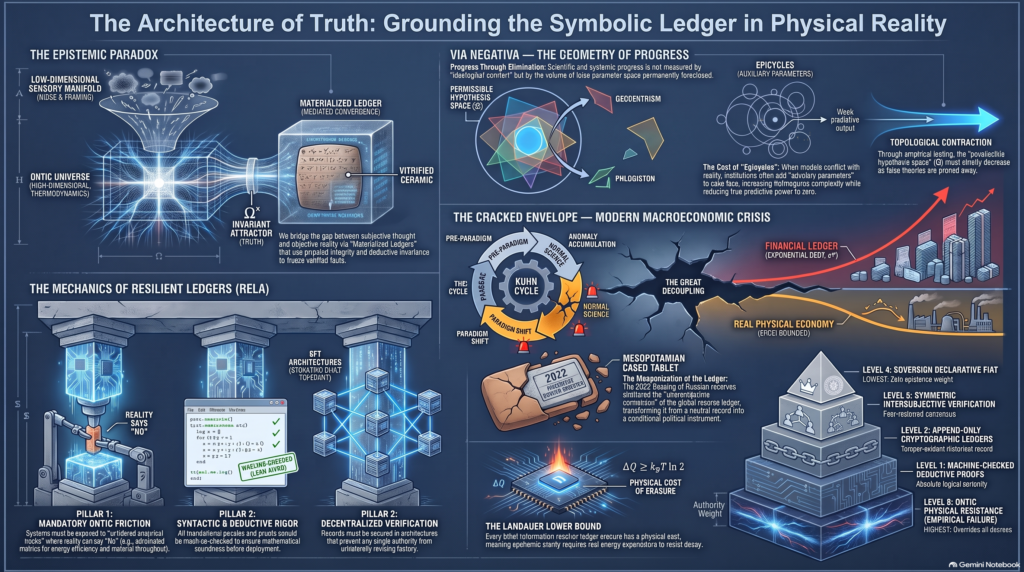
Humanity operates within a “low-dimensional sensory manifold” characterized by neurological noise and linguistic framing. Conversely, the mind-independent universe (\mathcal{M}) is high-dimensional and non-teleological. This generates a structural paradox between subjective interiority and objective exteriority.
1.1 The Ontic Attractor
Truth is modeled as an invariant dynamical attractor (\Omega^* \subset \mathcal{M}) within an open state-space. Cognitive agents do not achieve truth through direct “Cartesian illumination” but through materialized error reduction: the irreversible truncation of false parameter manifolds.
1.2 Perspectival Realism
To bridge the gap between “Dogmatic Absolutism” (Naive Realism) and “Radical Relativism” (Constructivism), the sources propose Perspectival Realism.
- The Perspective (\hat{\Pi}_\theta): A projection operator that drops dimensions but remains veridical within its projection plane.
- Intersection of Truth: Absolute truth is the asymptotic limit where all valid projection angles intersect. As noted in the context, “Truth is not the view from nowhere; it is the invariant core that remains stable across all valid projection angles.”
- The Mechanics of Progress: Via Negativa
Progress is not the accumulation of “ideological comfort” but the volume of false parameter space permanently foreclosed. This is mathematically defined through Measure-Theoretic Elimination.
- Ideological Hyper-Parameterization: Institutions often avoid refutation by adding auxiliary parameters (epicycles) to models to fit conflicting data. This increases Kolmogorov complexity while reducing predictive power to zero.
- Monotonic Contraction: Under true epistemic friction, the volume of a viable hypothesis space must decrease monotonically as empirical evidence falsifies regions of the parameter space.
- Theorem of Convergence: If the testing sequence is epistemically complete, the true parameter state is never eliminated, and the hypothesis space contracts asymptotically around the invariant attractor.
- Transmission Dynamics and Physical Bottlenecks
Transmitting truth requires encoding propositions into physical states, which introduces physical and information-theoretic constraints.
3.1 Thermodynamic and Information Limits
- Shannon Capacity Limits: Absolute zero probability of error (P_e = 0) over an empirical channel requires infinite codeword length. Every finite physical transmission carries a non-zero probability of corruption.
- Landauer’s Principle: Maintaining an internal network of verified beliefs requires physical work to resist thermodynamic decay. The erasure or overwrite of information dissipates a minimum quantity of heat (\Delta Q \ge k_B T \ln 2).
- Quinean Indeterminacy: Because empirical observations underdetermine reference, minds cannot transfer absolute semantic content without loss. What crosses the channel is a physical signal that the receiver must reconstruct using an internal ontology.
- Material Ledgers: Anchoring Truth in Substrate
Because human memory degrades and verbal consensus is vulnerable to pressure, civilization developed Material Ledgers to freeze verified claims into high-entropy physical substrates.
4.1 The Mesopotamia Protocol
The Old Babylonian “cased tablet” (a tablet within an envelope) serves as a foundational tamper-evident protocol:
- Inscription: The contract is written on an inner tablet.
- Encapsulation: A clay envelope is folded around the tablet and the text is repeated on the exterior.
- Sealing: Unique cylinder seals (physical cryptographic signatures) are rolled onto the wet clay.
- Dispute Resolution: If the exterior is altered, the magistrate breaks the envelope. The inner tablet stands as the ground truth.
4.2 The Failure of the Symbolic Ledger
Paper money and digital fiat represent an abstraction of the ledger. While this increases velocity, it allows the symbolic ledger to multiply at near-zero marginal energy cost.
- The Systemic Break Point: When the growth of nominal claims (e^{rt}) exceeds the real biophysical capacity (Y(t)), the ledger decouples from reality.
- Historical Reset: When the gap between paper claims and physical resources grows too wide, the ungrounded ledger collapses, and society returns to high-friction “outside money” (gold, silver, or commodities).
- Consensus Architecture: Convergence vs. Pathology
Consensus is a proxy for truth but is dual-natured. It functions as an error-correcting engine only under specific conditions.
Mechanism Convergence Mode Pathology Mode
Information Flow Condorcet Scaling: Independent signals aggregate to identify the true state. Information Cascade: Agents ignore private signals to follow the public history.
Rationality Aumann’s Agreement: Rational agents with common priors cannot “agree to disagree.” Pluralistic Ignorance: Every agent privately rejects a claim but publicly endorses it.
Social Structure Habermasian Ideal Speech: Symmetrical, non-coercive discourse. Manufactured Consent: Institutional filtering of public signals to force a consensus.
- The Kuhn Cycle and the Crisis of Macroeconomics
The documents apply Thomas Kuhn’s model of scientific revolutions to the current global economic state, diagnosing it as being in a “Model Crisis.”
6.1 The Phases of the Cycle
- Normal Science: A stable axiomatic frame (e.g., the Neoclassical synthesis).
- Model Drift: Accumulation of anomalies (e.g., the 2008 crisis). Institutions add “epicycles” (QE, negative rates).
- Model Crisis: The “envelope cracks.” The disconnect between the model (infinite debt) and reality (thermodynamic limits) becomes obvious.
- Model Revolution: Competing paradigms emerge as trust in the old framework breaks down.
- Paradigm Shift: False parameters are foreclosed; a new, realigned ledger is established.
6.2 Structural Contradictions
The modern paradigm is failing due to the Macro-Physical Decoupling:
- Thermodynamic Divergence: Financial claims grow exponentially (e^{rt}), but industrial wealth is bound by declining Energy Return on Investment (EROEI).
- Weaponization of the Ledger: The 2022 freeze of Russian reserves breached the “neutrality” of the global reserve ledger, transforming it from an absolute store of value into a conditional political promise.
- The Resilient Epistemic & Thermodynamic Ledger Architecture (RELA)
To survive the paradigm shift, the sources specify the RELA framework, a system grounded in physical reality and resistant to censorship.
7.1 The Three Pillars of Resilient Architecture
- Ontic Friction: Mandatory exposure to real-world testing; automated falsification hooks tied to energy efficiency and material throughput.
- Syntactic Rigor: Use of formal, machine-checked verification (e.g., Lean 4) and the principle of Minimum Description Length (MDL) to prevent model overfitting.
- Decentralization: Byzantine Fault Tolerant (BFT) verification that assumes a fraction of nodes are compromised.
7.2 Source-of-Truth Hierarchy
RELA establishes a strict hierarchy for resolving conflicts between signals:
- Level 0 (Highest): Ontic Physical Resistance (empirical failure, material fracture).
- Level 1: Machine-Checked Deductive Proofs (Lean 4, Coq).
- Level 2: Append-Only Cryptographic Ledgers.
- Level 3: Symmetric Intersubjective Peer Verification (Mertonian CUDOS norms).
- Level 4 (Lowest): Institutional/Sovereign Declarative Fiat (zero epistemic weight).
7.3 SWOT Analysis of RELA Implementation
- Strengths: Absolute ontic grounding in thermodynamic laws; mathematically sound; tamper-evident.
- Weaknesses: High energy/computational overhead; denies “ideological comfort” to leaders; inelastic policy response.
- Opportunities: Global de-dollarization; maturation of AI formal verification; the sovereign debt trap creates demand for alternatives.
- Threats: Incumbent hostility from central banks; short-term economic dislocation; geopolitical sabotage.
Conclusion
The current economic and epistemic crisis is the natural operation of the Kuhn Cycle. The task ahead is not to repair the “cracked envelopes” of failing paradigms but to build new architectures grounded in the “kiln of physical reality.” As stated in the primary white paper: “We will never possess absolute truth in its entirety… But by systematically identifying and discarding what is false, we steadily shrink the darkness.”


