Technical Primer: Building the Sovereign Economy
This primer serves as the foundational roadmap for students and career-changers entering the “Sovereign Economy.” As legacy centralized utilities and corporate cloud networks become increasingly fragile, a new market has emerged for the “high-tech blue-collar” professional. This document outlines the engineering principles, hardware tools, and workforce credentials required to transition from a passive consumer to an autonomous producer of critical infrastructure.
- Foundations: The Sovereign Stack and Noel’s Law
The transition to a sovereign economy is not merely a philosophical shift; it is a response to the 1,000-Mile Failure Model. This model dictates that any resource produced thousands of miles from its point of use is inherently insecure. Centralized systems are prone to single-point failures, transmission bottlenecks, and multi-year “interconnection queues.” By localizing infrastructure, we replace these vulnerabilities with self-healing, independent nodes.
The Sovereign Infrastructure Consortium (SIC) operates under three foundational axioms:
- The Sovereign Stack: A vertical engineering standard where infrastructure is built from the physical bedrock up: Power → Mobility → Communications → Intelligence → Governance. Every layer is designed for “Island Mode,” operating indefinitely without public utilities.
- Spherical Resilience: A design philosophy utilizing distributed, non-linear node topologies. These nodes are engineered to endure macro-grid blackouts, physical kinetic disruptions, and supply chain severance.
- Noel’s Law: The principle that any municipality, farm, or campus remaining a passive, downstream customer of centralized services is structurally insecure. To be resilient, an entity must become an autonomous producer of its own energy and compute.
The “So What?”: The High-Tech Blue-Collar Career
For the aspiring technician, Noel’s Law represents a massive job market. As municipalities and industrial campuses seek to resolve structural insecurity, they require a new breed of workforce. This “high-tech blue-collar” economy merges traditional manual trades—such as electricians and linemen—with high-level systems architecture involving AI and mesh networking. Mastering these skills ensures a career that is both defense-grade and recession-proof.
To master the stack, a professional must first master the physical tools used to implement it.
- The Hardware: Sovereign Mesh & TriFi Wireless Product Line
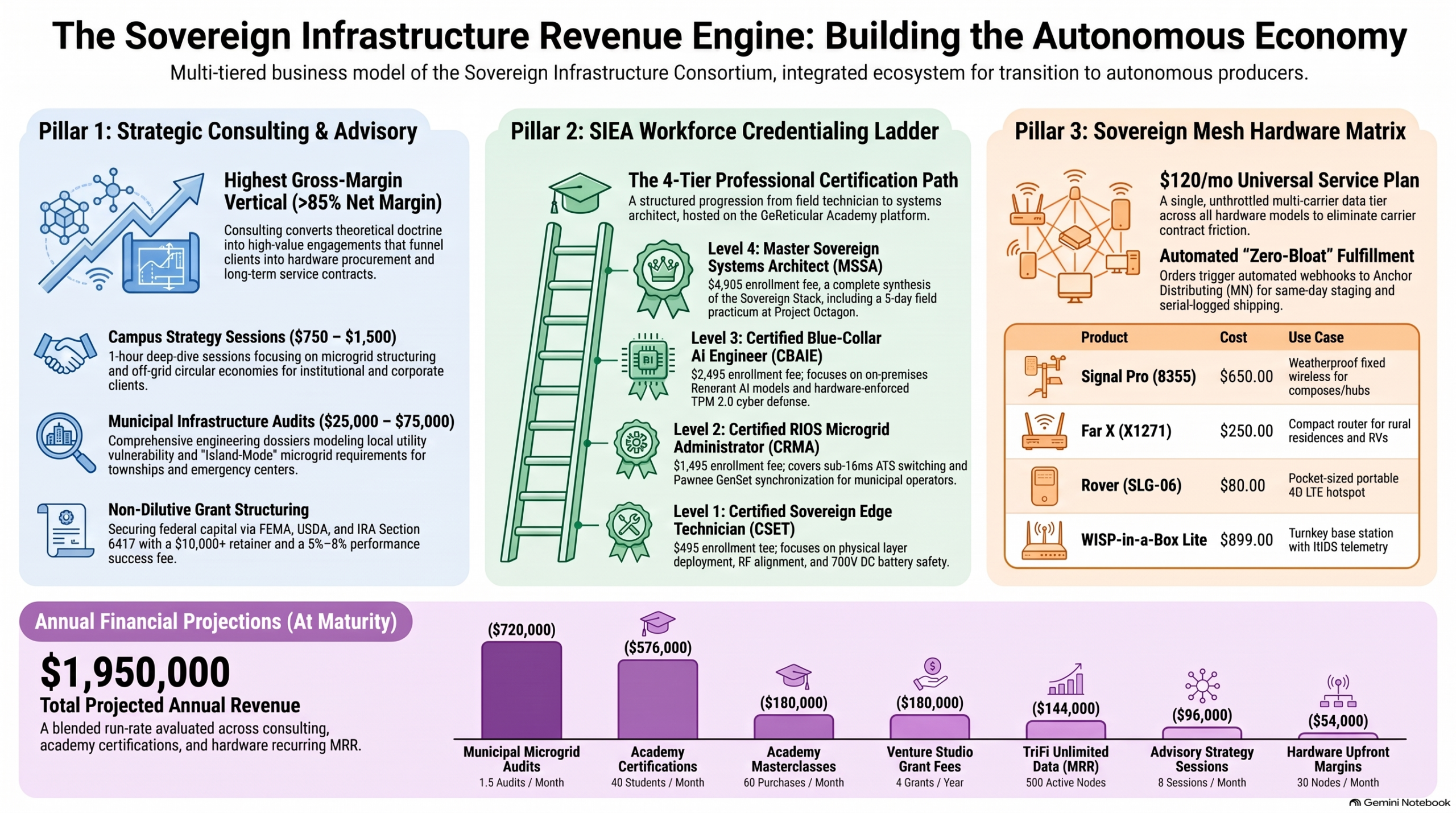
The Sovereign Mesh is a carrier-free network that allows users to bypass the “carrier wall”—the 4-to-7-year interconnection queues and corporate monopolies that stifle rural and industrial connectivity. It utilizes the TriFi Wireless protocol, a multi-band (5.8 GHz and 60 GHz) mesh system that is self-forming and self-healing.
Hardware Comparison Matrix
All hardware units share the Universal Service Plan, providing $120/month unthrottled, multi-carrier pooled data with no contracts.
Device Name Primary Use Case Key Hardware Specs Total Setup Cost*
Signal Pro (Model 8355) Fixed facilities, campus hubs, and basecamp infrastructure. IP67 weatherproof; Multi-carrier failover; Passive Gigabit PoE. $815.00
Far X (Model X1271) Rural residences, farmsteads, cabins, and RVs. Wi-Fi 6 local broadcast; External SMA paddle antennas; 12V/110V power. $415.00
Rover (Model SLG-06) Portable use for field technicians and mobile operators. Pocket-sized 4G hotspot; Integrated 4,000 mAh battery; USB-C. $245.00
WISP-in-a-Box™ Lite Turnkey base station for municipal broadband. Signal Pro core + aluminum mast; Pre-installed RIOS telemetry agent. $1,064.00
*Total includes Hardware, $45 staging/fulfillment fee (SIM insertion & IMEI scanning), and the first month of $120 data.
Bypassing the Carrier Wall
The common thread across all devices is the elimination of carrier friction. By utilizing TriFi Wireless, users can project a private data bubble (up to 15 miles in certain configurations) that routes packets locally. For agricultural and remote users, this means high-speed connectivity is no longer a permission-based service granted by a distant monopoly.
Deploying this hardware effectively requires a tiered set of professional skills, moving from the physical to the cognitive layer.
- The Workforce Ladder: SIEA Professional Certification Levels
The Sovereign Infrastructure Education Alliance (SIEA) provides a four-tier workforce training pipeline. These certifications validate the skills necessary to build, manage, and architect sovereign systems.
3.1 Level 1 – Certified Sovereign Edge Technician (CSET)
This level focuses on the Physical Layer, training the “boots on the ground” for hardware deployment.
- Target Audience: Electricians, telecom linemen, and field contractors.
- Core Skills Mastered:
- Unlicensed spectrum theory (5.8 GHz and 60 GHz) and RF alignment.
- Battery Energy Storage System (BESS) wiring (48V and 700V DC).
- Safe management of LiFePO4 battery chemistries and DC busbars.
3.2 Level 2 – Certified RIOS Microgrid Administrator (CRMA)
This level transitions to the Operational Layer, focusing on the software and mechanical systems that govern a microgrid.
- Target Audience: Municipal utility operators, water treatment engineers, and SCADA technicians.
- Core Skills Mastered:
- Configuration of RIOS (Resilient Infrastructure Operating System) for telemetry.
- Managing sub-16ms Automatic Transfer Switch (ATS) transitions to ensure seamless “Island Mode.”
- Operation and synchronization of Pawnee 45 kW Wankel rotary GenSets using syngas or biogas.
3.3 Level 3 – Certified Blue-Collar AI Engineer (CBAIE)
This level addresses the Cognitive Layer, where local intelligence is integrated into the infrastructure.
- Target Audience: Industrial automation specialists and systems integrators.
- Core Skills Mastered:
- Deploying Remnant AI—wisdom-trained models running on air-gapped, on-premises silicon.
- Orchestrating Metacognitive Swarms (MSI) for autonomous grid load balancing.
- Management of liquid-cooled RIOS-CC-1000 server enclosures and hardware-enforced TPM 2.0 security.
3.4 Level 4 – Master Sovereign Systems Architect (MSSA)
The pinnacle of the ladder, the MSSA focuses on the Governance and Synthesis Layer, requiring a complete vertical understanding of the Sovereign Stack.
- Target Audience: CTOs, Senior Civil Engineers, and Public Works Directors.
- Core Skills Mastered:
- Operationalizing statutory exemptions like West Virginia H.B. 2014 to bypass utility permitting.
- Blended capital modeling, capturing non-dilutive grants (FEMA BRIC, USDA REAP, and IRA Section 6417).
- Project Octagon Field Practicum: Mandatory 3-day on-site deployment in a high-stress proving ground.
These certifications translate into real-world project capability through rigorous testing in extreme environments.
- Proving Grounds: Project Octagon and the Future of Field Ops
The SIEA validates its hardware and training through Project Octagon, a model utilizing standardized 20ft/40ft ISO container skids. These skids house modular microgrids and air-gapped compute clusters. Central to these operations is the Infinite Loop model, which utilizes invasive brush and forestry waste to produce syngas, creating a zero-diesel logistics line that can power a node indefinitely.
Deployment Environments:
- Quartzsite, AZ: High-thermal desert testing for dust endurance and nomadic communications.
- West Virginia: Dense timberland testing for signal penetration and biomass gasification.
- Guam: Testing for maritime salt-fog and corrosion resistance in tropical environments.
- Kaabong, Uganda: Frontier deployment in regions entirely lacking legacy utility grids.
Critical Takeaways for Aspiring Architects
- Energy is the Bedrock: Without sovereign power (syngas or solar thermal) at a levelized cost of ~$0.038/kWh, compute and comms cannot survive a macro-grid failure.
- Air-Gapping is Absolute: Real sovereignty requires Remnant AI that does not “call home” to corporate cloud servers, protecting both data and operational integrity.
- Master the Financial Stack: Building these systems is accelerated by mastering non-dilutive federal capital, specifically FEMA BRIC for resilience and IRA Section 6417 for direct-pay tax credits.
Conclusion
The pathways into the sovereign economy are accessible, practical, and highly technical. By moving from a consumer mindset to an infrastructure-builder mindset, the next generation of technicians and architects can build a future that is resilient, autonomous, and truly sovereign. The tools are ready; the ladder is waiting for you to climb.


