How New US Regulations Are Quietly Tokenizing the Real World
Beyond Bitcoin: How New US Regulations Are Quietly Tokenizing the Real World
For years, the conversation around digital asset regulation has often felt abstract, a complex legal debate disconnected from tangible, real-world applications. But in late 2025, a series of pragmatic updates from the U.S. Commodity Futures Trading Commission (CFTC) changed the landscape. These new rules created a surprisingly practical and impactful framework that is already forging a direct link between digital finance and real-world industries.
This article breaks down the top four most important and counter-intuitive takeaways from this new regulatory environment. From demystifying the value of tokenization to uncovering the new role of “utility tokens,” we will explore how these changes are setting the stage for the next phase of economic transformation.
1. Tokenizing an Asset Isn’t a Magic Wand for Its Value
There’s a prevailing myth in digital assets that tokenizing a real-world asset (RWA) is an automatic upgrade—a magic wand that makes it better collateral. The logic seems simple: make it digital, make it better. However, the CFTC’s guidance offers a sober dose of reality, clarifying that technology does not erase fundamental risk.
The commission’s December 8 Guidance explicitly states that tokenization does not alter the underlying risk profile of an asset.
“[T]he use of digital ledger technology to tokenize an asset need not change the fundamental characteristics of that asset”.
This is a critical distinction. Far from eliminating risk, the process of tokenization can introduce entirely new vectors of it. These include potential smart contract vulnerabilities, heightened cybersecurity threats, and new operational dependencies on the underlying blockchain infrastructure. Lenders and institutions must now account for both the risk of the asset itself and the risk of the technology used to represent it.
The surprising outcome of this is that firms may need to apply even deeper haircuts to tokenized assets compared to their non-tokenized counterparts to compensate for these additional technological risks. This regulatory stance forces the industry to mature beyond ‘blockchain for blockchain’s sake’ and focus on tokenization that delivers tangible benefits—like enhanced settlement speed or programmatic control—that demonstrably outweigh the new technological risks.
2. Regulators Are Cautiously Walking, Not Running
While this new framework is a significant step forward, the CFTC is moving with deliberate caution. This is not a regulatory free-for-all; it is a highly controlled pilot program designed for careful observation and gradual expansion.
The initial relief provided in CFTC Letter No. 25-40 is narrowly defined. During the initial onboarding period, Futures Commission Merchants (FCMs) are only permitted to accept a limited set of assets as collateral: Bitcoin (BTC), Ether (ETH), and qualified existing payment stablecoins.
Furthermore, the conditions for participation are onerous. Any FCM wishing to join the pilot must meet a series of strict requirements, including:
- Filing a formal notice of intent with the CFTC.
- Applying conservative, risk-based haircuts to all digital collateral.
- Submitting weekly reports on their digital asset balances.
- Obtaining written legal opinions that confirm the enforceability of their security interest in the collateral.
This is not bureaucratic friction; it’s a deliberate ‘sandbox’ approach. By starting with a narrow scope and high compliance burden, the CFTC aims to build institutional trust and gather data, ensuring the foundation is solid before expanding the program. This measured approach means the program is most likely to be utilized first by a small group of the most sophisticated FCMs that already have significant digital asset business lines and the resources to navigate the demanding compliance landscape.
3. From Ugandan Farms to US Futures Markets: A Glimpse of the Future
To see how these abstract rules translate into real-world impact, look no further than an innovative project solving a major economic problem: agricultural illiquidity.
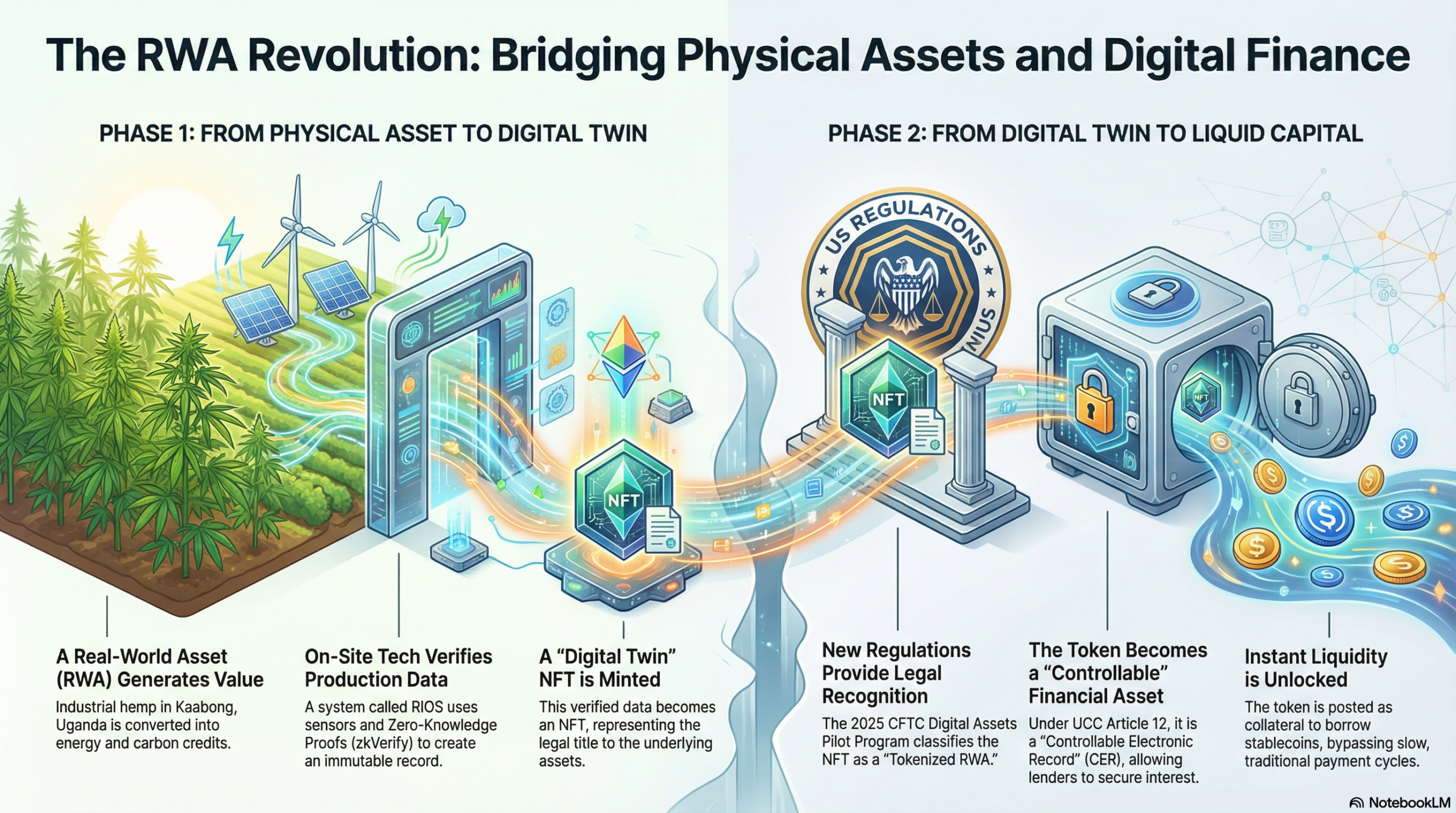
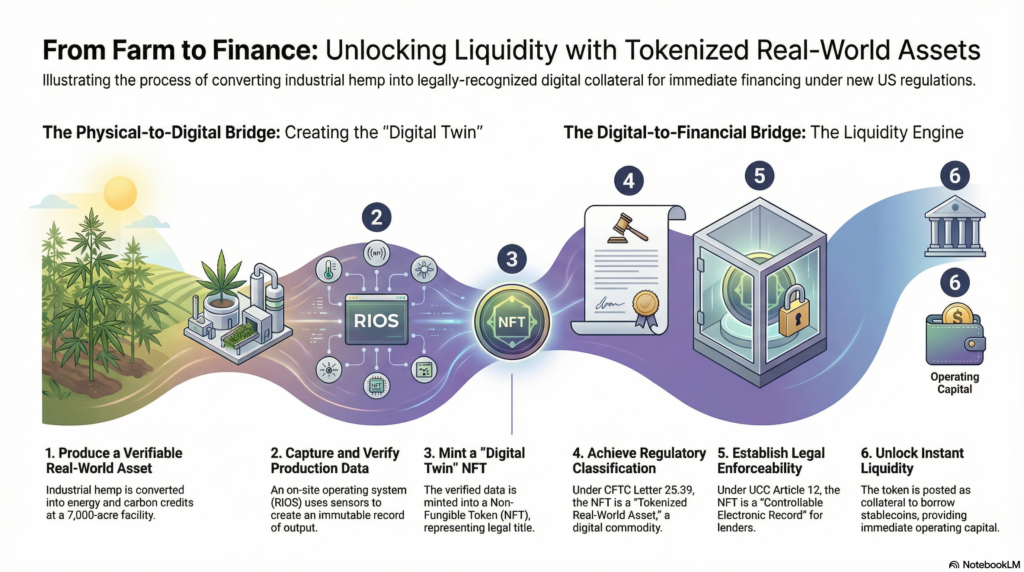
In Kaabong, Uganda, the DeReticular “Node 4” project is a 7,000-acre eco-industrial park that converts industrial hemp into carbon-negative energy and carbon credits using a process called plasma gasification. The primary challenge for such an operation is cash flow; traditionally, it could take over six months to get paid for its production, severely limiting its ability to grow.
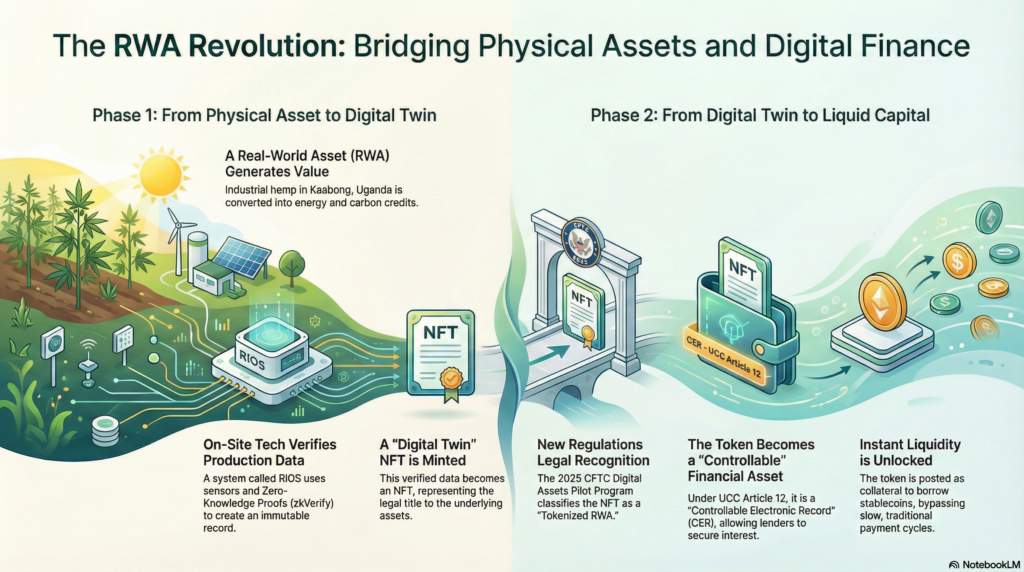
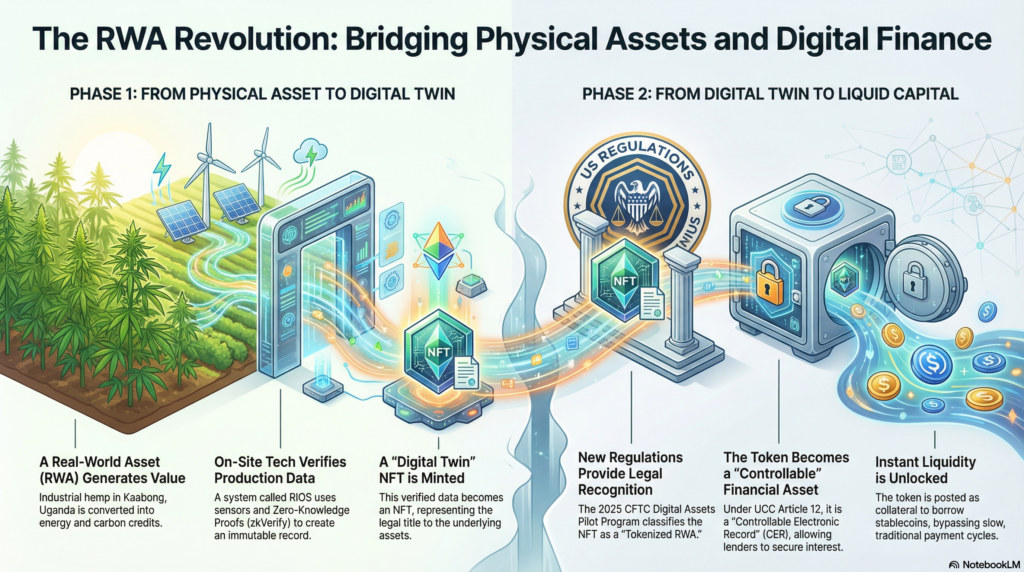
This is where the new regulatory framework becomes a powerful tool. The project uses a “Rural Infrastructure Operating System” (RIOS) that employs on-site sensors and cryptographic verification (zkVerify) to create a trusted, immutable digital record of its physical output, such as the amount of biomass harvested or energy produced. This verified data is then minted into a “Tokenized RWA” in the form of an NFT, which acts as a “Digital Twin”—a digital title to the physical assets.
Under the new U.S. framework, this NFT is legally recognized as a valid form of collateral, qualifying as a “Tokenized Real-World Asset” under new federal guidance (CFTC Letter No. 25-39) and a “Controllable Electronic Record” under commercial law (UCC Article 12), which gives lenders a clear legal right to seize it in a default.
The impact is transformative. The project is able to escape the slow, inefficient legacy financial model and leverage a new, high-velocity alternative:
- The Old Model (Slow Liquidity): A producer grows a crop, processes it, sells it, and then waits 6+ months for payment. Capital is trapped, and growth stalls.
- The New Model (Fast Liquidity): The project’s verified production is tokenized into an NFT, which is immediately posted as collateral to a U.S.-based FCM. The project can then borrow against its own production instantly.
The NFT acts as the bridge, carrying the legal title and verified data of the physical products into the global financial system, allowing the Kaabong SEIP to act as its own “sovereign bank,” borrowing against its own production in real-time.
4. The Smart Money Is Now on “Digital Plumbers”
The new regulations have effectively created a powerful, protected channel for institutional-grade digital assets. While most existing “utility tokens” are explicitly excluded and can’t flow through this channel as collateral, the ‘smart money’ realizes they are the only ones who can build, maintain, and upgrade the channel itself. Their value is no longer in what they are, but in the essential services they provide to this new, multi-trillion dollar ecosystem.
This creates a strategic pivot where their value shifts away from being speculative assets and toward becoming the essential infrastructure—the “rails” or “digital plumbing”—that supports the movement and programmatic control of the newly regulated assets. Their future value lies not in what they are, but in what they do.
The new high-value roles for utility tokens include:
- 24/7 Atomic Settlement: Traditional finance closes on weekends, but digital markets don’t. Utility tokens act as the “gas” that powers the high-speed, 24/7/365 settlement of regulated collateral, providing a critical advantage over legacy systems.
- Tokenizing RWAs: They power the protocols that “wrap” real-world assets like U.S. Treasuries into tokens that are compliant with CFTC guidance, making them eligible for use as collateral.
- Programmatic Custody: They enable the creation of sophisticated smart contracts that comply with the Uniform Commercial Code (UCC). This allows a lender to programmatically and automatically take “control” of collateral in a default scenario, a key requirement for institutional adoption.
- Providing DeFi Yield in a Regulated Market: The GENIUS Act prohibits regulated stablecoin issuers from offering interest, creating a massive, legally-sanctioned demand for yield. Utility tokens are now the essential plumbing for DeFi protocols that can fill this gap, allowing holders of compliant stablecoins to put their capital to work and earn a return.
Conclusion
The CFTC’s 2025 pilot program is far more than abstract legal text. It is a pragmatic foundation that methodically connects the digital asset ecosystem to tangible, real-world economic activity. By clarifying the rules around risk, establishing a controlled environment for adoption, and enabling the tokenization of physical production, these regulations have built a bridge between two previously disconnected worlds.
The true significance of these rules is not just the assets they permit, but the standards they set. By establishing clear frameworks for risk, control, and legal enforceability, regulators have created the rails for institutional capital to move from the traditional world into the digital one. The bridge has been built. The question is no longer if real-world value will move on-chain, but how quickly.
Now that the financial plumbing to tokenize and collateralize real-world production is in place, what industry will be transformed next?