
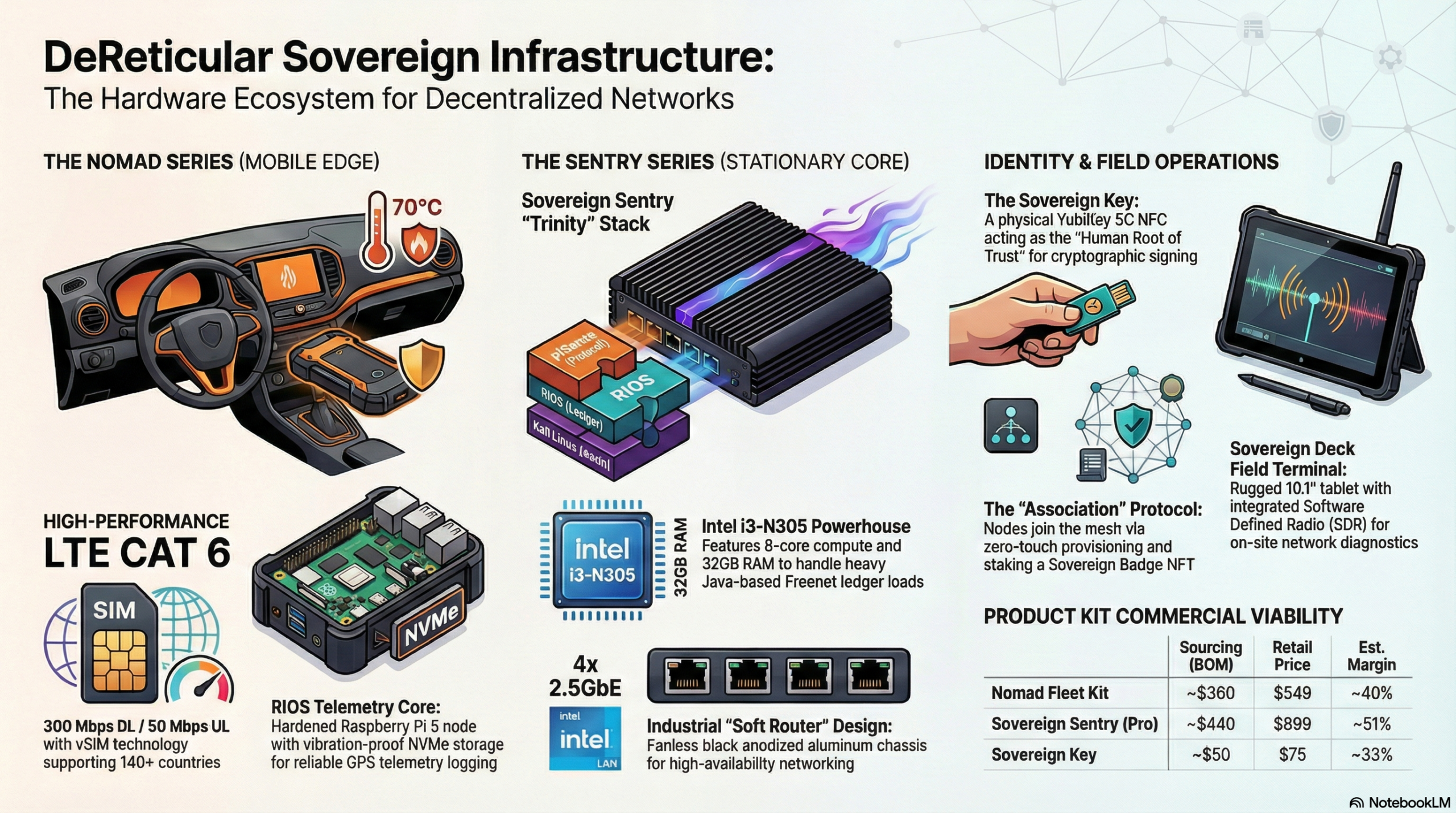
From Gadgets to Infrastructure: A Guide to Ruggedized Decentralized Hardware
Welcome to the DeReticular Academy. As systems engineers, we recognize that the gap between a consumer gadget and industrial-grade infrastructure isn’t just a matter of price—it is a matter of rigorous modification. In the world of Decentralized Physical Infrastructure (DePIN), we don’t wait for industrial manufacturers to produce specialized hardware. Instead, we “upcycle” mass-market silicon to build the Sovereign Stack.
This guide details the methodology for transforming consumer electronics into hardware capable of running the Rural Infrastructure Operating System (RIOS) in environments ranging from the Arizona desert to rural Uganda.
——————————————————————————–
1. The Strategy of Upcycling: Consumer Performance at Industrial Scale
At DeReticular, our “Strategic Verdict” favors the modification of consumer hardware like the Skylink SLG-06 and the Raspberry Pi 5 over purchasing off-the-shelf industrial gateways. This isn’t merely a cost-saving measure; it is a performance play.
Mass-market consumer devices often feature cutting-edge silicon that outpaces the conservative release cycles of industrial IoT. For instance, the SLG-06 utilizes Cat 6 LTE (300 Mbps), whereas standard industrial gateways like the Teltonika RUT956 are frequently limited to Cat 4 (150 Mbps). By upcycling, we secure high-tier performance for the decentralized mesh at a fraction of the traditional capital expenditure.
Insight: The “Stage 1” Deployment Advantage The upcycling strategy is specifically engineered for “Stage 1” operations (the first 0-500 units). While it requires higher operational complexity in the form of manual soldering and assembly, it rewards the operator with massive hardware margins—typically between 40% and 57%—while providing “Cyber-Native” tools that legacy industrial standards cannot match.
While the performance of this silicon is superior, mass-market enclosures and power systems are not built to survive the high-vibration environment of a mobile asset or the extreme thermals of an “Island Mode” deployment. This necessitating a deep dive into the engineering divide between consumer and industrial grades.
——————————————————————————–
2. The Great Divide: Consumer-Grade vs. Industrial-Grade
Deploying stock hardware into mobile assets like Kurb Kars exposes it to conditions it was never designed to handle. The goal of the DeReticular stack is Autonomous Recovery—ensuring the node can survive “Day 0” without IT intervention.
| Feature | Consumer-Grade (Stock) | Industrial-Grade Infrastructure |
| Thermal Rating | 0°C to 40°C (Standard office/home) | -40°C to 60°C+ (Extreme outdoor/vehicle) |
| Storage Reliability | MicroSD Cards (Prone to vibration/wear) | NVMe SSD (Vibration-proof, high IOPS) |
| Power Handling | Internal Li-ion Battery (Heat sensitive) | Hardwired DC Bus (12V–60V Integration) |
| Management Interface | Web UI / Wi-Fi (RF Interference risk) | USB Tethering (RNDIS) (Direct data/power) |
While these limitations provide a baseline for comparison, the true danger lies in the specific vulnerabilities that lead to catastrophic node failure in the field.
——————————————————————————–
3. Critical Vulnerabilities: Thermal Runaway and Filesystem Corruption
Unmodified hardware faces two primary “death sentences” when deployed in harsh field conditions:
- Thermal Runaway (The Battery Problem):
- The Risk: Most hotspots contain 4000mAh Li-ion batteries. In regions like Arizona, vehicle dashboard temperatures can exceed 70°C.
- Field Consequence: Result: Total node failure, battery swelling (pillowing), and a significant fire hazard.
- Filesystem Corruption (The Storage Problem):
- The Risk: Hobbyist boards rely on MicroSD cards. In mobile assets, constant vibration and voltage sags during EV acceleration interfere with data writes.
- Field Consequence: Result: OS corruption and data loss, requiring a manual factory reset and physical intervention.
These risks are not deal-breakers; rather, they are the engineering requirements that define the DeReticular “Hardening” process.
4. The Nomad Link: Engineering the “Fire-Safe” Bridge
The Nomad Link (SKU: RIOS-NL-01) is a factory-modified Skylink SLG-06. To eliminate fire risks, we implement a Battery Elimination Circuit (BEC). This modification allows the bridge to run 24/7 on industrial power.
The Three-Step BEC Modification Process:
- The Bypass: We physically remove the 4000mAh Li-ion battery, eliminating the volatile chemical component entirely.
- The Dummy: A custom 3D-printed spacer is inserted into the cavity. This houses a DC-DC Buck Converter that steps down vehicle bus power (12V–60V) to a steady 4.0V.
- The Trick: The SLG-06 firmware checks for a battery via the BSI (Battery Status Indicator) pin. We solder a 10kΩ resistor between the BSI and Negative terminals to “spoof” a valid thermistor value, tricking the firmware into seeing a healthy battery.
To ensure the “bridge” never hangs, we integrate a software Watchdog. Using the uhubctl utility, the system can detect a firmware freeze and power-cycle the USB port to force a hard reboot.
Technical Note: Precision Spoofing The 10kΩ resistor is the industry-standard “trick” for SLG-06 firmware, but this value is subject to bench verification on a per-batch basis. This resistor ensures 100% uptime by bypassing the device’s internal safety-shutdown protocols.
While the Nomad Link provides the “nervous system” for connectivity, a nervous system without a brain is useless—this necessitates the hardening of the Telemetry Core.
——————————————————————————–
5. The RIOS Telemetry Core: Hardening the Edge Brain
The RIOS Telemetry Core (SKU: RIOS-TC-01) is built on the Raspberry Pi 5 platform. To move from “hobbyist” to “sovereign,” three core upgrades are mandatory:
- 8GB LPDDR4X RAM (Mandatory): The dual-stack load of the Hyphanet (Java) and Locutus (Rust) daemons requires significant memory overhead. Using a 4GB model leads to “swap-thrashing,” which will prematurely kill the SSD.
- PCIe NVMe Storage: We abandon MicroSD in favor of a PCIe NVMe SSD via a HAT. This provides vibration-proof logging and high-endurance TBW (Terabytes Written) ratings for constant ledger updates.
- Thermal Armor: We utilize a CNC Aluminum Armor Case that serves as a massive heatsink for the CPU, RAM, and PMIC via thermal pads. An active blower fan is programmed to engage only when temps exceed 60°C, preserving the bearing life of the fan.
- ML-2020 RTC Battery: Offline “Island Mode” requires accurate timekeeping. Without the ML-2020 battery on the RTC header, logs will generate with invalid timestamps, causing the decentralized ledger to reject the data.
These modifications result in a Sovereign hardware kit: independent, rugged, and cryptographically secure.
——————————————————————————–
6. Summary: The Sovereign Infrastructure Kit
The result of this engineering process is the Nomad Fleet Kit (SKU: RIOS-KIT-MOB). It provides operators with an industrial-grade “Cyber-Deck” that is significantly more cost-effective than traditional gateways while remaining natively compatible with the decentralized mesh.
Component Checklist (Nomad Fleet Kit)
When receiving your Pelican-style rugged case, verify the following components:
- [ ] The Brain: RIOS Telemetry Core (Modified Pi 5, 8GB RAM, 256GB NVMe).
- [ ] The Bridge: Nomad Link (Modded SLG-06, Battery-free, 4.0V BEC).
- [ ] The Power Whip: ACC-CBL-PWR harness (12V–60V input, fused).
- [ ] The Key: Sovereign Badge (Custom YubiKey 5C NFC) using FIDO2/PIV as a Human Root of Trust.
- [ ] The Mount: Vibration-proof RAM Mount system for vehicle chassis integration.


