
Agronomic Comparison Guide: Optimizing Cultivation for Industrial Outcomes
1. Introduction: The “Why” Behind the Strategy
The core objective of this guide is to illustrate how specific agronomic choices—specifically plant population and harvest timing—directly dictate the commercial viability of a 40-acre daily harvest pipeline. In the context of a modern Eco-Industrial Park, a farm is not merely a collection of fields; it is the stomach and engine of a circular industrial ecosystem where biological inputs determine energy and product outputs.
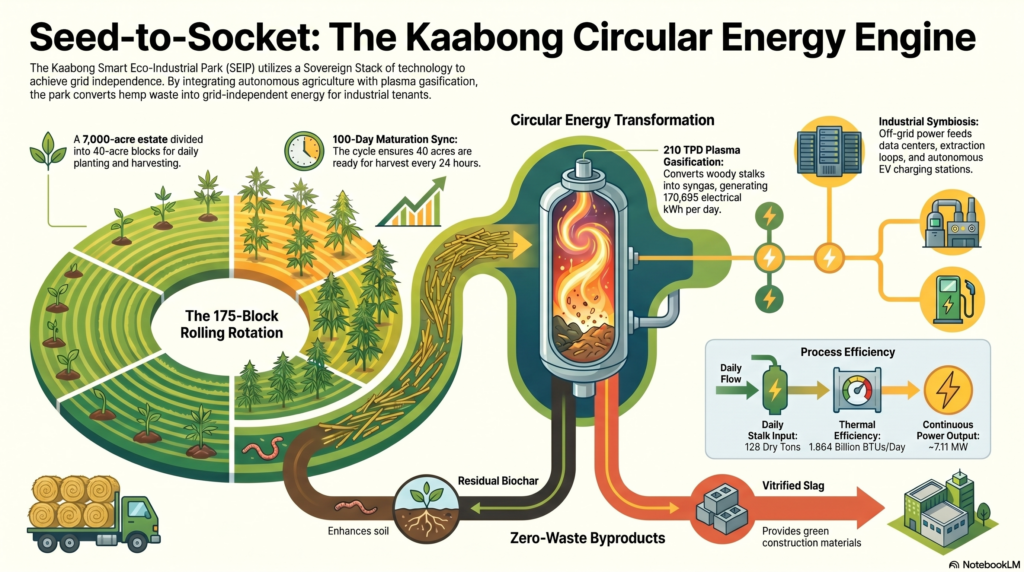
At Node 4 in Kaabong, Uganda, we utilize the Continuous Rolling Rotation Model. This system transitions away from traditional seasonal harvesting by dividing a 7,000-acre estate into 175 operational blocks of 40 acres each. By harvesting 40 acres every single day, we resolve the “fuel-delivery limitations” of the 210 Tons Per Day (TPD) plasma gasifier, ensuring a constant pulse of feedstock. Furthermore, this model solves the “Oracle Problem” for international finance; by utilizing on-site RIOS Pilot Command Centers, we capture immutable telemetry and zero-knowledge (ZK) proofs of yield, allowing for the tokenization of Real-World Assets (RWA) to verify production for global lenders in real time.
——————————————————————————–
Deck
https://academy.dereticular.com/wp-content/uploads/2026/06/The_Kaabong_Perpetual_Engine.pdf
2. The Three Cultivation Scenarios: A Comparative Blueprint
To align field output with industrial demand, cultivators must select one of three distinct agronomic blueprints. The following metrics are modeled on a per-acre basis to support the 40-acre daily intake requirement.
| Parameter | Scenario A: High-Density Fiber | Scenario B: Low-Density Floral | Scenario C: Dual-Purpose |
| Target Population | 1.0M – 1.2M plants/acre | 1,500 – 2,500 plants/acre | 150k – 200k plants/acre |
| Total Dry Yield / Acre | 4.0 tons | 1.25 tons | 2.5 tons |
| Stalk Fraction (Dry) | 80% (3.2 tons/ac) | 30% (0.375 tons/ac) | 70% (1.75 tons/ac) |
| Foliage Fraction (Dry) | 20% (0.8 tons/ac) | 70% (0.875 tons/ac) | 30% (0.75 tons/ac) |
Primary Benefits
- Scenario A (Energy Focused): Maximizes total biomass and stalk tonnage. This configuration is engineered to provide the 128 dry tons of daily feedstock required to run the plasma gasifier at near-perfect operational load for baseload electricity.
- Scenario B (Extraction Focused): Maximizes the “top” of the plant, optimized for high-potency botanical oils and cannabinoids used in high-margin cosmetic and pharmaceutical refining.
- Scenario C (Balanced Output): Provides a diversified feedstock stream that sustains both the energy grid and the refinery, ensuring no part of the biological engine is under-fueled.
——————————————————————————–
3. The Logic of Density: How Population Shapes the Plant
In industrial agronomy, plant population is the primary mechanical lever used to dictate the physical structure and chemical composition of the crop.
- The Inverse Relationship (Density vs. Branching):
- High Density (Scenario A): Packing over 1 million plants per acre forces intense competition for sunlight. This suppresses branching, forcing the plants to grow tall and thin (8–14 feet). This maximizes the volume of high-tensile stalks.
- Low Density (Scenario B): Spacing plants allows for maximum lateral branching. This results in shorter, stockier frames with expanded foliage surface area and larger seed heads (floral biomass).
- The Trade-off Principle: High density maximizes stalk tonnage for energy, while low density maximizes foliage quality for solvent extraction.
- Technical Constraint: Moisture Management: In high-density stands, stalks must be monitored to ensure they remain below a 15% moisture threshold in storage. Excess moisture within sealed silos triggers biological fermentation, leading to a high risk of spontaneous combustion.
——————————————————————————–
4. Anatomy of Choice: Harvesting the “Top” vs. the “Stalk”
Industrial hemp provides two distinct raw material streams, each requiring specialized mechanical and chemical processing.
| Feature | Foliage Stream (The “Top”) | Stalk Stream (The “Bottom”) |
| Primary Technology | Chilled Solvent Extraction Loop | 210 TPD Plasma Gasification |
| Mechanical Requirement | Immediate processing (<4 hours) | In-line chipping (<2 inches) |
| End-Product | Crude Oil, Isolate, or Lotions | Electrical kWh and Biochar |
| Industrial Outcome | Consumer Packaged Goods (CPG) | 7.11 MW Continuous Power |
The Dual-Harvest Mechanical Solution
To capture both streams simultaneously in Scenario C, the autonomous harvester utilizes a “Split-Stream” tooling configuration:
- Draper Header: Set high to cut the top 1.5 to 2 feet of the canopy (foliage/seeds) for the extraction refinery.
- Under-Scythe Cutter: A secondary sickle bar cuts the remaining stalks 4 inches above the soil.
- Field Retting: These stalks are laid flat in uniform windrows for 2–5 weeks. During this “dew retting” period, natural moisture and fungi break down the pectin and lignin bonds, which is essential for successful downstream decortication and processing.
- In-Line Chipping: Stalks destined for gasification must be reduced to uniform chips under 2 inches via in-line chopper systems to prevent mechanical blockages in the gasifier’s fuel-delivery screw.
——————————————————————————–
5. Timing the Harvest: Biology vs. Industrial Quality
Even with optimal density, harvest timing dictates the ease of processing and the value of the final product.
- The Fiber Window (70–100 Days Post-Emergence):
- Harvest must occur pre-seed set, when male flowers begin shedding pollen.
- Quality Risk: Delaying harvest causes advanced lignification, where the stalk becomes excessively woody and brittle. This makes decortication (separating fiber from the core) mechanically difficult and degrades fiber quality.
- The Grain/Floral Window (70–80% Seed Maturation):
- Harvest occurs when the majority of seed heads have turned brown.
- Quality Risk: Early harvests result in green seeds prone to rapid oxidation and spoilage. High-moisture foliage must be moved to extraction within 4 hours to prevent cannabinoid degradation.
——————————————————————————–
6. From Soil to Shelf: Visualizing Industrial Throughput
The following data illustrates the daily output of a single 40-acre harvest block:
- Energy Output (Scenario A):
- Yields 128 dry tons of stalks daily.
- Converts into ~170,000 electrical kWh/day, supporting a continuous output of 7.11 MW. This provides the power for the park’s UCC-1 data center and the surrounding community.
- Consumer Output (Scenario B):
- Yields 116.8 wet tons of foliage daily.
- Refines into ~1,050 gallons of crude extract, supporting the production of 4.41 million lotion bottles per day.
Learner’s Insight: Scenario C (Dual-Purpose) provides a balanced output of 70 tons of stalks and 100 tons of wet leaf. This produces 3.15 million lotion bottles daily while simultaneously fueling the energy grid. This “Balanced Blueprint” is the strategic choice for a fully integrated, sovereign eco-industrial ecosystem.
——————————————————————————–
7. Summary of Critical Trade-offs
| Industrial Metric | Scenario A (High Density) | Scenario B (Low Density) | Scenario C (Dual-Purpose) |
| Biomass Volume | Maximum | Minimum | Moderate |
| Cannabinoid Potency | Low | High | Moderate |
| Energy Capacity | 7.11 MW Continuous | <1.0 MW (Residual) | ~3.9 MW (Estimated) |
| Primary Risk | Silo Combustion (Moisture) | Rapid Spoilage (Oxidation) | Mechanical Complexity |
Conclusion: In industrial hemp farming, the agronomic blueprint—defined by density and timing—is the most powerful tool for ensuring financial success. By treating the farm as a biological engine with precise mechanical requirements (chipping, retting, and moisture control), we transition from seasonal agriculture to a reliable, 24/7 industrial utility.


