Strategic Infrastructure Report: The Sovereign Transition
1. The Paradigm Shift: From Linear Dependency to Spherical Resilience
The global industrial economy is currently navigating a “Structural Inversion.” For decades, rural development has been strangled by “The Line”—a fragile, centralized architecture of high-tension power grids and hyperscale cloud dependencies. This linear model has transitioned from an efficiency driver to a systemic liability; with grid interconnection queues for industrial-scale energy now stretching between four and seven years, the current grid is a structural bottleneck to growth.
To achieve “Spherical Resilience,” we must pivot toward “Sovereign Nodes.” Unlike linear systems that fail when a corridor is severed, a Sovereign Node functions as an autonomous industrial orb. By operating in “Island Mode,” these nodes decouple from centralized failure points, creating a strategic moat that ensures operational continuity regardless of external grid or network volatility. This is the transition from being a passive “tail-end” consumer to becoming an “Above the Line” infrastructure developer.
Operational Paradigm Shift
| Dimension | Linear Dependency (Current State) | Sovereign Autonomy (Target State) |
| Power Source | Centralized Grid; subject to “The Line” fragility | Baseload Autonomy; on-site Agrivoltaics & GTL |
| Data Sovereignty | Cloud Dependency; structural capital flight | Sovereign Vault; air-gapped local logic (RIOS) |
| Economic Impact | Consumer Mindset; monthly utility overhead | Developer Mindset; “Spark Spread” arbitrage |
| Deployment Speed | 4–7 year interconnection queue | 6–12 month “Behind-the-Meter” deployment |
| Asset Role | Commodity Producer (Price Taker) | Energy & Data Refinery (Market Maker) |
By manifesting “Spherical Resilience,” rural assets are no longer victims of centralized sclerosis. Instead, they operate as un-killable nodes within a civilization-scale mesh, utilizing a high-density hardware stack to generate fuel, power, and intelligence at the point of consumption.
——————————————————————————–
2. The Sovereign Energy Stack: Agra Dot Energy and Distributed Baseload Power
In the Sovereign transition, rural waste is no longer a liability; it is “Contextual Fuel.” The strategic ability to transform local feedstock into 24/7 baseload power is the cornerstone of nodal independence, bypassing the prohibitive timelines and costs of traditional utility models.
Micro-GTL (Gas-to-Liquids) Units
The Micro-GTL unit is a modular, prefabricated refinery designed for expeditionary deployment. Utilizing high-temperature plasma gasification, it converts organic liabilities into high-margin liquid and gaseous assets.
- Molecular Dissociation: The reactor operates at temperatures exceeding 1,500°C, breaking down biomass, manure, and even scrap tires into their constituent molecular bonds.
- Tri-Fuel Capability: The system produces high-purity Syngas, which can be utilized for baseload electricity, condensed into Agra Synthetic Fuel (ASF™) for local mobility, or stored in batteries for peak-shaving.
- Predictive Chemistry: Integrated PLC Control Boards allow AI agents to manage real-time chemical balancing. By utilizing NIR Spectroscopy and Digital Twin simulations to analyze incoming feedstock, the system achieves a 43% boost in methane yield compared to manual operations.
Vertical Agrivoltaics
Our agrivoltaic hardware solves the “operational messiness” of traditional solar through a dual-harvest architecture that integrates seamlessly with row-crop farming.
| Feature | Hardware Specification | Strategic Advantage |
| Panel Type | Vertical Bifacial Panels | Captures reflective ground light; 15% better winter performance. |
| Mechanical Control | Linear Actuators | AI reorients panels in 15-minute shifts to balance PV yield vs. crop PAR. |
| Operational Spacing | 7-Meter Tractor Clearance | Purpose-built for standard equipment (e.g., John Deere 8R/9R series). |
| Environmental Logic | PAR & Wind Sensors | Real-time “Flattening” mode to mitigate structural load during high-wind events. |
The Grid-Bypass Strategy
The primary competitive advantage of this energy foundation is speed-to-market. While centralized “Goliaths” are paralyzed by a 4–7 year interconnection queue, Sovereign Nodes utilize a Grid-Bypass Strategy. By deploying “Behind-the-Meter,” nodes can be fully functional in 6–12 months, allowing rural entrepreneurs to capture market demand for high-density power and compute long before utility-scale projects can even break ground.
——————————————————————————–
3. Sovereign Automation: RIOS and the Agentic Data Refinery
Localized compute is the critical “brain” for industrial autonomy. In an era of increasing network fragility, “Above the Line” operations require an air-gapped logic layer that processes proprietary context without the latency or security risks of the global cloud.
The RIOS Kernel
The Rural Infrastructure Operating System (RIOS) is an air-gapped kernel designed to treat physical land as a high-performance operating asset. It governs the “Spark Spread,” the real-time economic logic of determining whether a unit of energy is most valuable as liquid fuel, grid-exported electricity, or local AI inference.
The Agentic Suite
RIOS implements a 70/30 labor rule: AI agents manage 70% of routine preparatory and diagnostic tasks, freeing the human operator for the 30% of critical human judgment.
- Field Foreman: Manages machinery diagnostics and GTL maintenance. It contains proprietary logic to bypass predatory OEM software locks—specifically targeting the John Deere 8R/9R series—returning the “Right to Repair” to the owner.
- Vault Warden: Security AI utilizing high-mounted, rotating LiDAR to monitor physical assets with 2mm precision, ensuring perimeter integrity via a 360-degree point-cloud.
- Field Medic: An air-gapped diagnostic engine that maintains HIPAA-compliant patient data in local Secure Data Vaults for community healthcare resilience.
- Sovereign Elector: A verifiable, air-gapped local governance system utilizing paper-trail mathematical proofing to eliminate fraud and secure community consensus.
Physical Compute & Connectivity
This automation layer is powered by the RIOS-CC-1000 Server Cluster, a high-density hardware rack submerged in a clear, non-conductive dielectric cooling liquid. This submerged cooling allows for massive AI inference density in harsh rural environments. Connectivity is maintained via Nomad Link, a Wi-Fi 6E/LoRaWAN mesh canopy that creates a miles-wide private intranet, ensuring the property remains functional during global cloud outages.
——————————————————————————–
4. Financial Engineering & Market Mechanics: The Locutus Ledger and NaaS
To scale Sovereign Nodes, the rural entrepreneur must transition from a “Consumer Mindset” to a “Developer Mindset.” This requires an understanding of Inference Economics: the logic where hardware is amortized by compute revenue, effectively making energy a high-margin by-product.
Node-as-a-Service (NaaS) and RBF
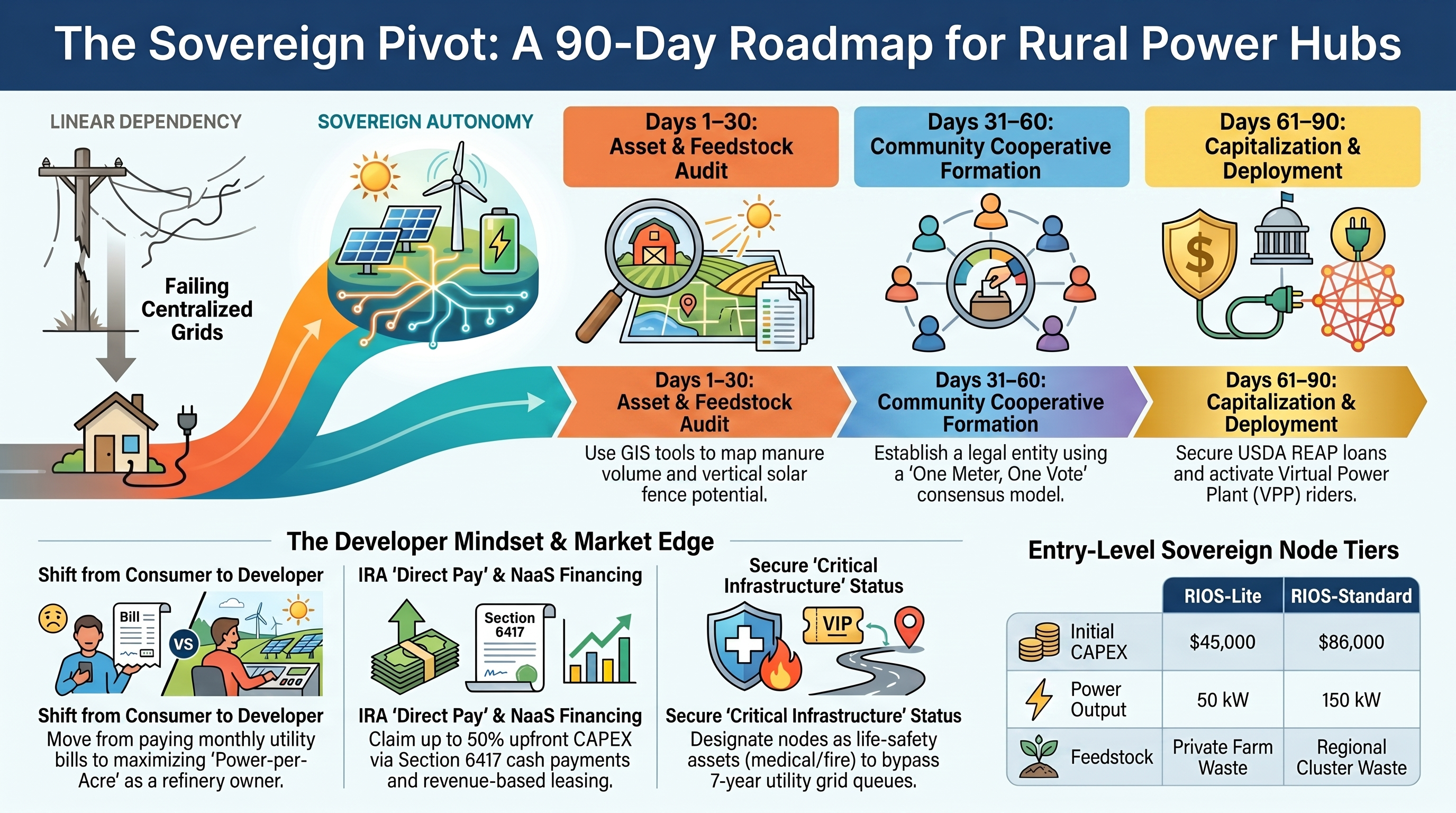
To bridge the initial 45k–86k CAPEX hurdle, we deploy Node-as-a-Service (NaaS) via Revenue-Based Financing (RBF).
- Arbitrage Logic: By producing energy at $0.04/kWh against a grid cost of $0.12/kWh, the $0.08 “Spark Spread” delta is captured and used to pay down the hardware investment, effectively turning the node into a self-liquidating asset.
The Locutus Ledger: Joules as Currency
The Locutus Ledger is a P2P settlement layer that tokenizes local energy and compute.
- Energy-Backed Tokens: These allow neighbors to trade energy surplus or buy into local production. This keeps capital within the community co-operative, preventing the “Capital Flight” typical of monthly utility bill cycles.
Federal Leverage
The financial model is further derisked through IRA Direct Pay (Section 6417), which allows non-profit co-ops and municipalities to receive elective cash payments from the IRS for 30–50% of the project cost. When combined with USDA REAP loans, these tools serve as critical equity-bridging mechanisms, turning localized green compute into high-value enterprise assets.
——————————————————————————–
5. Gap Analysis and Implementation: The 90-Day Sovereign Pivot
The primary barriers to rural industrial autonomy are the Financial Gap (upfront CAPEX) and the Protocol Gap (machine-to-machine market coordination). The following plan bridges these via structured implementation.
90-Day Implementation Action Plan
| Phase | Milestone | Focus Area |
| Days 1-30 | Asset Audit | Map feedstock volumes (manure/scraps) and vertical fence potential via GIS tools. |
| Days 31-60 | Entity Formation | Establish a community co-operative; implement “One Meter, One Vote” governance. |
| Days 61-90 | Capital & Setup | Deploy NaaS hardware; secure USDA REAP loans and activate RIOS-CC-1000 clusters. |
Bridging the Human Capital Gap
Autonomy requires a shift in education from traditional computer science to “Agentic Systemics.” The RIOS Academy focuses on training operators to transition complex industrial inputs into “Voice-in, Structure-out” conversational directives, allowing a single human to orchestrate a mesh of 5-10 automated agents.
The Right to Repair Strategy
A core implementation pillar is the use of the Field Foreman Agent to neutralize predatory OEM practices. By using RIOS to perform “over-the-air” diagnostics and bypass software locks on standard machinery like the John Deere 8R series, the owner regains total control over their physical capital, securing the node’s operational independence.
——————————————————————————–
6. Investment Outlook: 10-Year Proforma and Strategic Synthesis
As the “Physical AI Supercycle” drives national power demand 300% higher by 2030, Sovereign Nodes serve as the decentralized relief valve for a failing national grid.
Initial Unit Economics
| Component | RIOS-Lite | RIOS-Standard | Municipal-Grid |
| Initial CAPEX | $45,000 | $86,000 | $250,000+ |
| Feedstock Source | Private Farm Waste | Regional Cluster Waste | Industrial Sludge/Refuse |
| Power Output | 50 kW | 150 kW | 1 MW+ |
| OPEX (AI Maint.) | $200/mo | $500/mo | $2,000/mo |
| Human Supervision | 2 hrs/week | 5 hrs/week | Dedicated Remote Agent |
10-Year Proforma (Target Scaling: 50% YoY)
Values in thousands USD ($000s) except for Nodes Deployed.
| Year | Nodes Deployed | Rev per Node (Avg) | Gross Revenue | Enterprise EBITDA | Cumulative ROI |
| Yr 1 | 100 | $120 | $12,000 | $3,600 | -15% |
| Yr 3 | 225 | $132 | $29,700 | $11,800 | 45% |
| Yr 5 | 507 | $145 | $73,515 | $36,700 | 140% |
| Yr 10 | 3,848 | $185 | $711,880 | $498,300 | 700% |
Note: Calculations adjust for 5% annual inflation in electricity demand vs. 15% annual deflation in AI compute hardware costs.
Strategic Synthesis: The “Above the Line” Advantage
The DeReticular / Agra Dot Energy ecosystem provides a tier-1 investment vehicle at the nexus of energy, data, and the industrial supercycle. C-suite stakeholders should focus on three critical takeaways:
- Grid-Blind Autonomy: By deploying behind-the-meter, nodes bypass the 7-year interconnection queue, providing immediate energy security.
- Contextual Data Sovereignty: Air-gapped RIOS clusters stop “capital flight” to hyperscalers, keeping proprietary industrial data within the local business valuation.
- Molecular Arbitrage: Turning negative-cost waste into high-margin ASF™ fuel and green compute creates a resilient, self-liquidating revenue loop.
The shift from “The Line” to “The Node” is the ultimate industrial hedge for the next decade. By activating rural land as a high-density intelligence and energy refinery, we secure a sovereign future that is structurally immune to centralized failure.


