Beyond the Cloud 5 Surprising Lessons from the Sovereign Stack
1. Introduction: The Fragility of the Modern Grid
The modern digital world exists on a knife’s edge. We have outsourced our collective memory, commerce, and communication to massive, centralized data centers—monoliths of silicon that require surgical climate control and a constant, unwavering hum of grid power to survive. In the “Old World” of IT, a broken HVAC or a localized power surge is a crisis. In the “New World” envisioned by the DeReticular Academy, these systems are viewed as fundamentally fragile.
True resiliency isn’t found in a server rack; it is found in hardware that can survive “Kinetic Environments.” This is a world defined by heat, dust, vibration, and unpredictable threats like solar flares or even rats chewing through fiber lines. To meet this reality, the RIOS-CC-1000 has emerged. It is not a piece of IT hardware; it is a survival tool designed for a future where digital sovereignty is the only form of digital safety.
2. Takeaway 1: Your Server Should Breathe, Not Just Spin
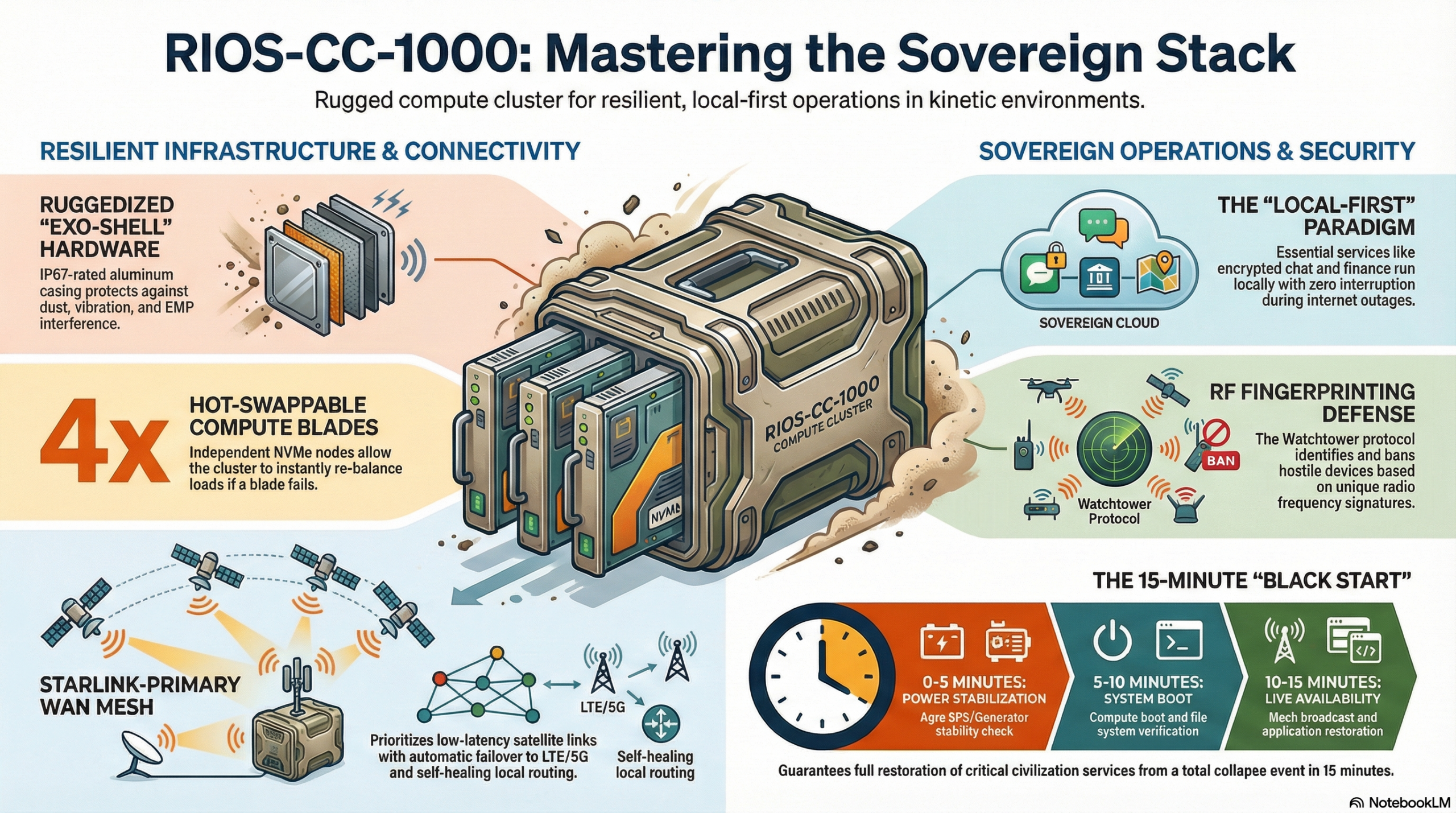
Traditional ruggedization usually involves sealing a server in a heavy box and hoping for the best. The RIOS-CC-1000 hardware philosophy is more active. Its “Exo-Shell” is an IP67-rated aluminum casing that serves a dual purpose: it is a waterproof barrier and a Faraday cage designed to shield internal components from light EMPs and Radio Frequency (RF) interference.
Unlike standard units, you won’t find exterior fans here—fans are a primary failure point in dusty or humid environments. Instead, the unit utilizes a “Positive Pressure Cycle” for thermal management, requiring intake filters to be checked only every 30 days. Inside, the architecture relies on four hot-swappable, NVMe-native “Compute Blades.” If a blade fails, the cluster instantly re-balances the load. However, the system is guarded by a high-stakes security feature: the “Seal Integrity Light.”
$ rios-vault status
Storage encryption: LOCKED / ACTIVE
If that light is Green, the chassis is sealed. If an administrator opens the unit without first engaging “Maintenance Mode,” the intrusion detection system triggers, instantly locking the encryption keys to prevent physical data theft.
“The RIOS-CC-1000 is not a server; it is a field deployable asset.”
3. Takeaway 2: Firewalls are Obsolete; RF Fingerprinting is the New Perimeter
In a sovereign environment, a digital firewall is a half-measure. An attacker isn’t just a remote IP address; they are often a physical presence. The RIOS “Watchtower Protocol” moves security from the digital layer to the physical RF layer.
The system identifies devices not by their easily spoofed MAC or IP addresses, but by their unique RF signature—the distinct radio “fingerprint” emitted by the hardware of a phone, drone, or laptop. Devices are sorted into a hierarchy:
- Green List: Trusted community members.
- Grey List: Guests, granted internet access only with zero local network visibility.
- Red List: Hostile devices or jammers.
By banning the physical signature, the administrator ensures that even if an intruder attempts to change their digital identity, they remain locked out of the “Zero-Trust Bubble.”
$ rios-sec ban --rf-sig [Signature_ID] --duration permanent
Result: Physical Disassociation.
“Traditional firewalls stop IP addresses. RIOS stops Physical Devices.”
4. Takeaway 3: The “Local-First” Paradigm (The Cloud in Your Pocket)
The Sovereign Stack rejects the dependency of the remote cloud. Through “Project Phoenix,” the RIOS-CC-1000 hosts a suite of “offline-first” applications locally. This starter pack includes Matrix (encrypted chat), Nextcloud (storage), and the Ghost platform for local news—a vital resource when global networks are dark.
The stack also includes a “Village Ledger” via a BTC/Lightning Node, allowing for local trade and finance when the global banking system is inaccessible. This is managed via the “Sync” concept: when the internet is live, data is backed up to off-site storage via satellite. When it is down, the community experiences zero interruption.
$ rios-app deploy btcpay --network mainnet --prune
Allocating CPU... Done.
Service mapped to: https://finance.local
“In a Sovereign Stack, ‘The Cloud’ is right in front of you.”
5. Takeaway 4: Self-Healing Meshes and the “Starlink-First” Strategy
Connectivity in a resilient setup follows a strict hierarchy. The RIOS unit prioritizes Starlink on WAN Port 1 as the primary uplink because of its independence from local terrestrial infrastructure. To ensure the RIOS unit acts as the primary brain, the Starlink router must be set to “Bypass Mode.” A secondary LTE/5G failover is connected to WAN Port 2.
$ rios-cli net configure --primary wan1 --secondary wan2 --mode failover
Internally, the LAN functions as a “Sovereign Mesh.” If a specific node is damaged or loses power, the traffic automatically reroutes to maintain the link—a self-healing architecture that ensures the Clinic can always talk to the School. To prevent lateral malware movement, “Client Isolation” is the default standard, ensuring every device on the mesh exists in its own isolated bubble.
6. Takeaway 5: The 15-Minute Promise to Reboot Civilization
The most critical protocol in the Certified RIOS Administrator’s (CRA) handbook is the “Black Start”—the procedure to restore services after a total collapse. This is not a theoretical exercise; it is guided by a physical “Red Card” checklist attached to the unit.
The process is tactile: isolate the unit, ensure the Agra Dot Energy generator is stable at 60Hz, and insert the “Master Key” USB into Port 0. After holding the physical reset for 10 seconds, the administrator listens for the “Heartbeat” beep code: 3 short beeps followed by 1 long beep.
This triggers the “15-Minute Promise” SLA:
- 0–5 Minutes: Power stabilization.
- 5–10 Minutes: Boot and File Integrity checks.
- 10–15 Minutes: Mesh broadcast and local app availability.
Even if the primary grid fails, the RIOS system can even manage its own survival; a dedicated Python script (SCRIPT_Auto_Shutdown.py) monitors the Agra generator and triggers a safe shutdown if fuel levels drop below 10%, protecting the “Sovereign Cloud” for a future restart.
“Civilization-critical services restored within a quarter-hour of total darkness.”
Conclusion: The Future is Decentralized and Resilient
The shift toward the Sovereign Stack represents a fundamental pivot in our relationship with technology. We are moving away from fragile, grid-reliant systems and toward resilient, field-deployable assets that can thrive in a kinetic world. For the Certified RIOS Administrator, this isn’t just about managing a server; it is about the responsibility of keeping the lights of civilization on when the rest of the world goes dark.
As you look at your own digital footprint today, the question remains: If the primary grid went dark today, would your digital world stay online, or would it vanish in the clouds?


