
Beyond the Cloud: A Primer on Localized AI and Digital Sovereignty
1. The Great Decentralization: Moving Intelligence to the Edge
For years, we have been told that the “Cloud” is the inevitable destination for all human intelligence and data. But this centralization has created a fragile reality where our digital lives depend on the whims of Big Tech and the stability of remote, opaque data centers. We are moving toward a necessary correction: the shift from fragile centralized grids to Sovereign Infrastructure. This isn’t just a technical change; it is a movement to reclaim the “brain” of our operations.
The mission is simple but profound: we must shift artificial intelligence from remote servers back to edge hardware that you—and only you—own and operate.
Sovereign Infrastructure is a post-cloud architecture designed to replace fragile centralized grids with localized hardware and software. Its core mission is to shift artificial intelligence from remote Big Tech servers directly to edge hardware owned and operated entirely by the user.
To understand why this shift is necessary, we must first examine the fundamental conflict at the heart of modern technology: The Privacy Paradox.
2. Decoding the Privacy Paradox
As a mentor to those building the future, I often see the “Privacy Paradox” manifest as a choice between two evils. On one hand, you have the incredible efficiency of modern AI—the ability to audit thousands of lines of code or summarize complex client meetings in seconds. On the other, you have the extreme risk of exfiltrating your Intellectual Property (IP) or client metadata to a third-party server where it becomes someone else’s training data.
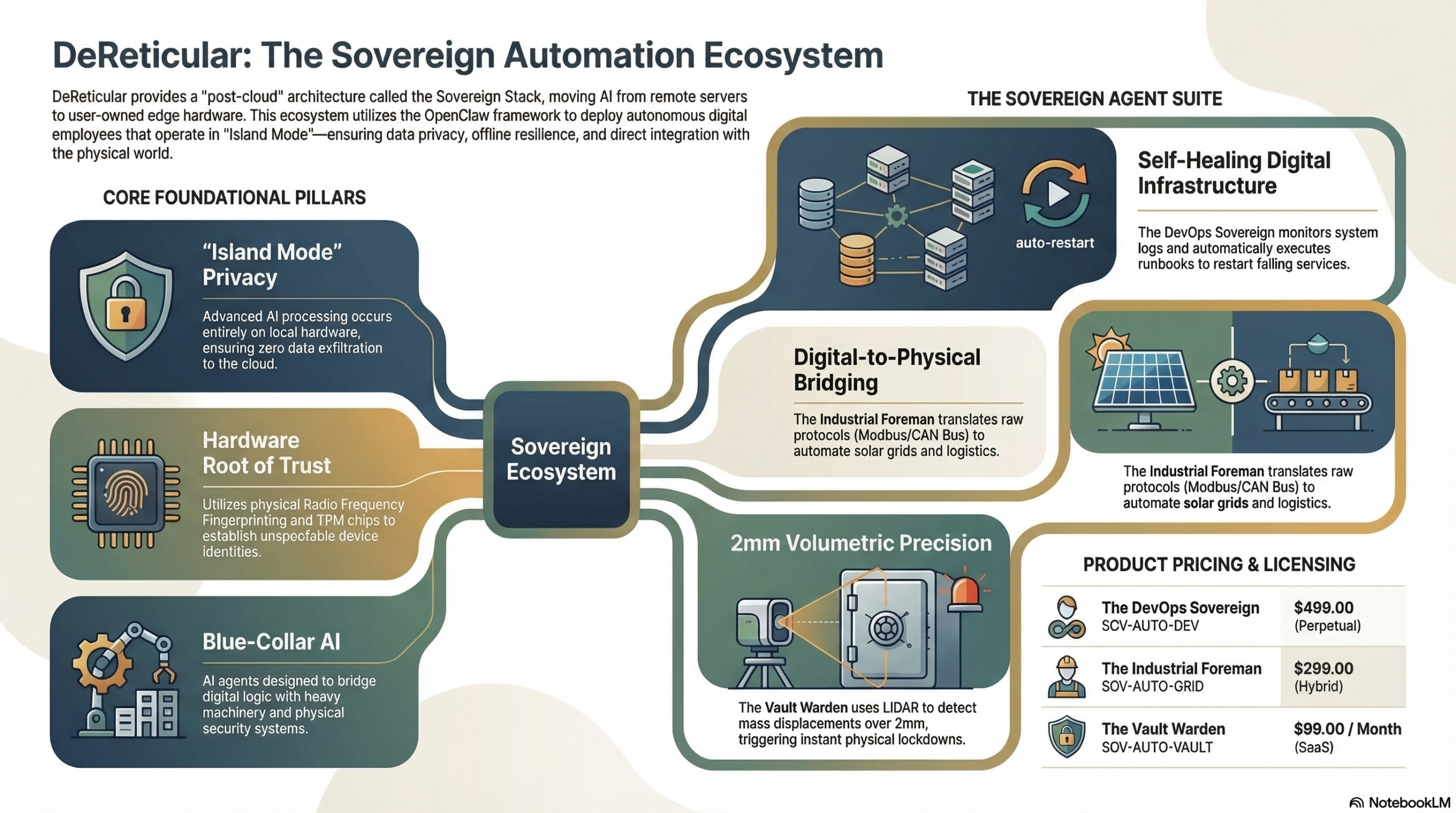
Localized AI resolves this conflict by operating in “Island Mode.” In this state, your system remains a high-functioning island of intelligence, capable of advanced reasoning while completely disconnected from the public surveillance grid.
| Feature | Cloud-Based AI vs. Localized AI (The Sovereign Stack) |
| Data Location | Cloud: Data resides on remote, third-party servers. <br> Localized: Data resides on user-owned edge hardware (Sentry/Nomad). |
| IP Risk | Cloud: High risk of data leaks or use in third-party model training. <br> Localized: Zero risk; proprietary data and code never leave the local “Island.” |
| Operational Independence | Cloud: Dependent on internet connectivity and recurring subscriptions. <br> Localized: Fully functional offline with perpetual ownership. |
For a business owner or developer, this is the “so what”: Sovereignty means you no longer have to choose between progress and privacy. You can deploy an advanced LLM to audit your most sensitive financial records or proprietary source code without a single byte ever leaving your server rack.
While protecting our data is vital, the true power of localized intelligence is found when it moves from our screens into the physical world.
3. Defining “Blue-Collar AI”: Intelligence with Hands
In my years as a systems architect, I’ve seen AI relegated to the role of a digital clerk—writing emails or generating images. But true sovereignty requires what I call “Blue-Collar AI.” This is intelligence with hands. It is called “Blue-Collar” because it bridges the gap between digital logic and physical machinery. It isn’t just thinking; it is doing.
Blue-Collar AI operates across three critical domains:
- Energy Management: Autonomously balancing solar inputs and battery states to prevent waste by routing excess power to physical “dump loads.”
- Supply Chain Logistics: Using geofencing to automatically generate and cryptographically sign customs manifests as a vehicle nears a border.
- Physical Security: Defending physical spaces through active, sensor-driven countermeasures that react faster than a human guard.
To ensure these systems can be trusted with physical machinery, they rely on a Hardware Root of Trust. By using Radio Frequency Fingerprinting and TPM chips, the system establishes an “unspoofable” identity. This ensures the AI is interacting with a verified physical environment, protecting the integrity of the hardware itself from digital tampering.
This physical integration requires a specialized foundation—a “stack” designed for resilience rather than just convenience.
4. The Anatomy of a Sovereign System
A sovereign system is built to be self-healing and financially autonomous. The DeReticular architecture achieves this through three integrated layers:
- The Rural Infrastructure Operating System (RIOS): This is the foundational “Sovereign Stack.” It manages the simultaneous flow of data, electrons (power), and edge computing.
- The OpenClaw Agent Framework: An open-source framework that allows us to build autonomous “digital employees” that can think and act locally.
- Sovereign Sentry & Nomad Nodes: Ruggedized hardware nodes—stationary for the home/office (Sentry) or mobile for the fleet (Nomad)—that provide the local compute power needed to keep the intelligence on-site.
The Flow of Sovereign Intelligence:
- Input: The system ingests raw sensor data, such as industrial Modbus protocols from energy inverters or high-resolution LiDAR point clouds for security.
- Processing: A local LLM—such as Llama-3—processes this data within the OpenClaw framework to determine the necessary response.
- Action: The system executes a physical trigger via GPIO (General Purpose Input/Output) pins, such as engaging a magnetic door lock or activating a relay.
With the architecture understood, we can look at how these concepts manifest as autonomous “digital employees” in the real world.
5. Case Studies in Sovereignty: The Automation Suite
These tools represent a radical departure from the subscription-heavy, data-hungry models we have grown accustomed to. They are specialized “employees” living on your hardware.
The DevOps Sovereign (Deep Admin) This agent acts as an air-gapped system administrator and code reviewer. It runs a Llama-3-8B-Instruct-v2 model, quantized to 4-bit, connected via an Ollama binary. Its “Log Sentinel” capability uses a combination of Regex and LLM semantic understanding to filter through system noise and identify real anomalies, such as brute-force attacks. By running locally, it ensures that your system logs and proprietary code are never exposed to the cloud.
The Industrial Foreman (Grid & Logistics) This is a “Hybrid Fulfillment” product, meaning it includes both software and a physical USB-to-RS485 adapter to bridge the gap to heavy machinery. It translates raw protocols like Modbus RTU and NMEA 0183 (GPS) into JSON. To protect your physical hardware, it enforces a mandatory “Hysteresis” delay—a 5-minute pause between relay toggles to prevent logic loops from damaging equipment. It ensures energy and logistics resilience even in complete “Island Mode.”
The Sovereign Executive (Office Edition) This agent serves as a private administrative assistant and archivist. It utilizes OpenAI-Whisper-local for voice transcription and the Tesseract-OCR engine for document scanning. It manages your schedules via local CalDAV files, explicitly avoiding Google Calendar to prevent metadata leaks. It protects your sovereignty by keeping your client interactions and meeting notes strictly within your owned infrastructure.
The Vault Warden (Provada Security) A high-stakes security agent designed for physical defense. It uses LiDAR to create a “Volumetric Cage” around assets, detecting mass displacements as small as 2mm. It also employs “Spectral Provenance” to verify the pigment density of artwork; if a mismatch is detected, the system triggers a “Ledger Burn,” instantly marking the digital counterpart of the asset as compromised. It bridges physical safety with digital value through physics-based security.
6. Conclusion: Reclaiming Digital Agency
The shift toward localized AI is more than a technical upgrade; it is a reclamation of your agency. By choosing Sovereign Infrastructure, you move from being a “data product” for Big Tech back to being an autonomous operator of your own digital and physical domain. The core pillars of this movement—Data Privacy, Offline Resilience, and Physical-Digital Integration—ensure that your tools serve you, and only you.
Learner’s Checklist for Sovereignty
- Compute Precision: Sovereignty requires power. Ensure your hardware meets the 32GB RAM requirement (specifically optimized for x86_64 / Intel i3-N305 architectures) to run advanced administrative models without “hallucinations” caused by resource starvation.
- Local-First Software: Audit your stack. Replace cloud-synced services with local alternatives like Nextcloud to ensure your metadata remains private.
- Physical Bridges: To move from “clerk” to “architect,” use hardware adapters (like the USB-to-RS485) to give your AI direct control over your environment.
- Resilient Security: Move beyond passwords. Use TPM chips and hardware-based identity to ensure your local network remains a “Hardware Root of Trust.”
In the age of the cloud, we were merely guests in someone else’s infrastructure. In the age of localized AI, you are the architect. Welcome home.


