
Bridging the Sovereignty-Scale Divide: A Regulatory Analysis of Hardware-Enforced Compliance Boundaries
1. Introduction: The Privacy Paradox and the Trusted Environment Fallacy
By 2026, the “Privacy Paradox” has become the primary bottleneck for enterprise AI adoption. This strategic conflict pits the operational necessity of hyperscale AI reasoning—required for complex cognitive parsing—against the stringent legal prohibitions of the CLOUD Act and regional jurisdictional compulsion. In highly regulated sectors such as Health, Finance, and Law, the risk of data exfiltration is no longer a manageable contingency but a catastrophic legal liability.
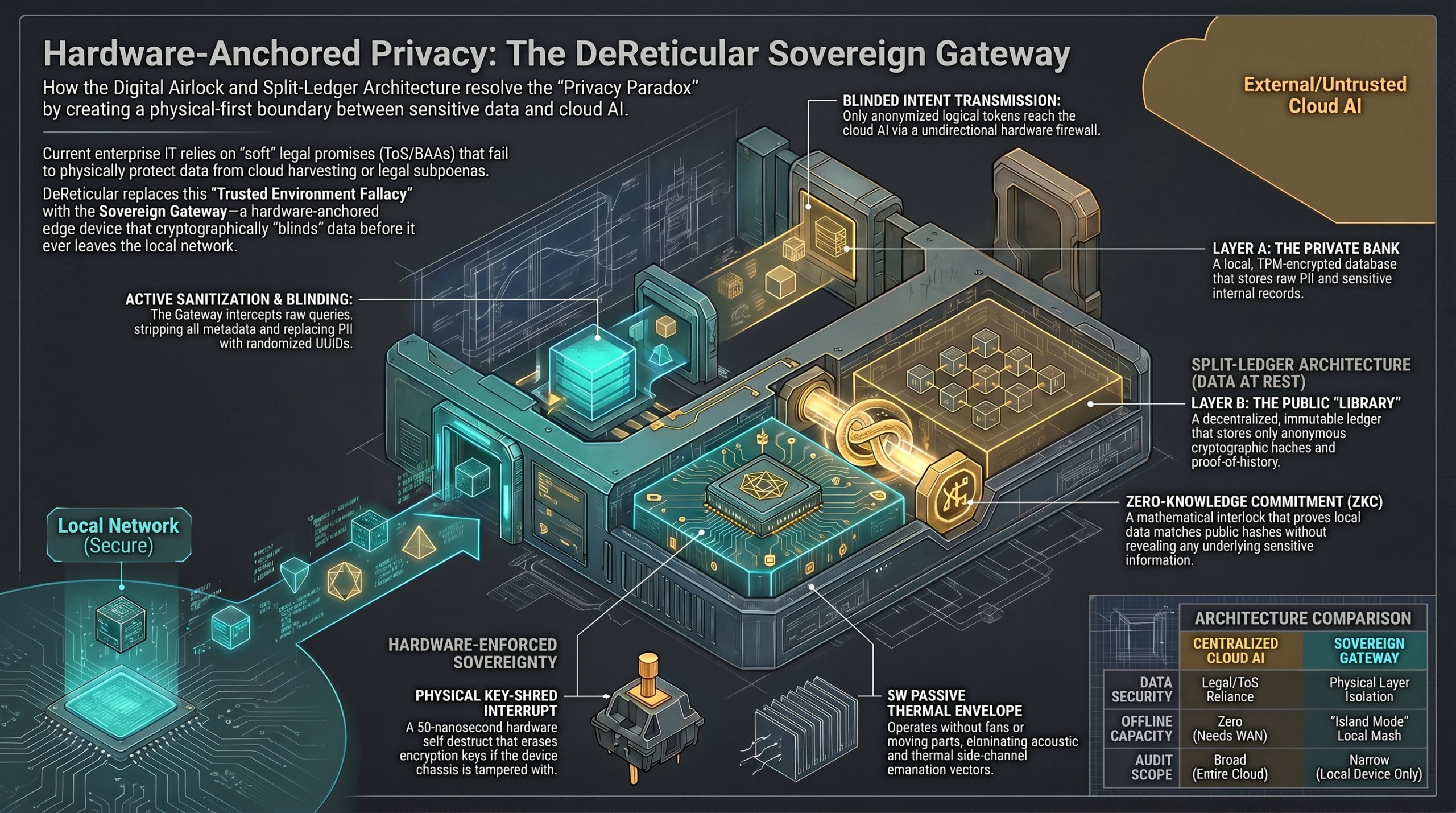
Historically, organizations have attempted to secure these boundaries through the “Trusted Environment Fallacy.” This fallacy posits that non-binding Terms of Service (ToS) and Business Associate Agreements (BAAs) provide a sufficient defense. From a cryptographic and compliance standpoint, relying on administrative promises constitutes an unacceptable operational vulnerability. Legal documents cannot physically prevent a third-party cloud provider from data harvesting, nor can they stop jurisdictional warrants from compelling the decryption of raw data at the hypervisor level.
This document analyzes a paradigm shift: the transition from soft administrative policies to deterministic physical constraints. By utilizing the Digital Airlock and Split-Ledger architectures, organizations can enforce data minimization at the silicon level, transforming compliance into a verifiable technical state.
2. The Sovereign Gateway: A Physical Root of Trust
Effective digital sovereignty must be anchored in physical silicon. Software-based security layers are inherently vulnerable to hypervisor-level compromises and orchestration-layer exploits. The Sovereign Gateway establishes a hardware-enforced translation boundary that mandates security at the network edge.
Hardware Specifications and Environmental Hardening
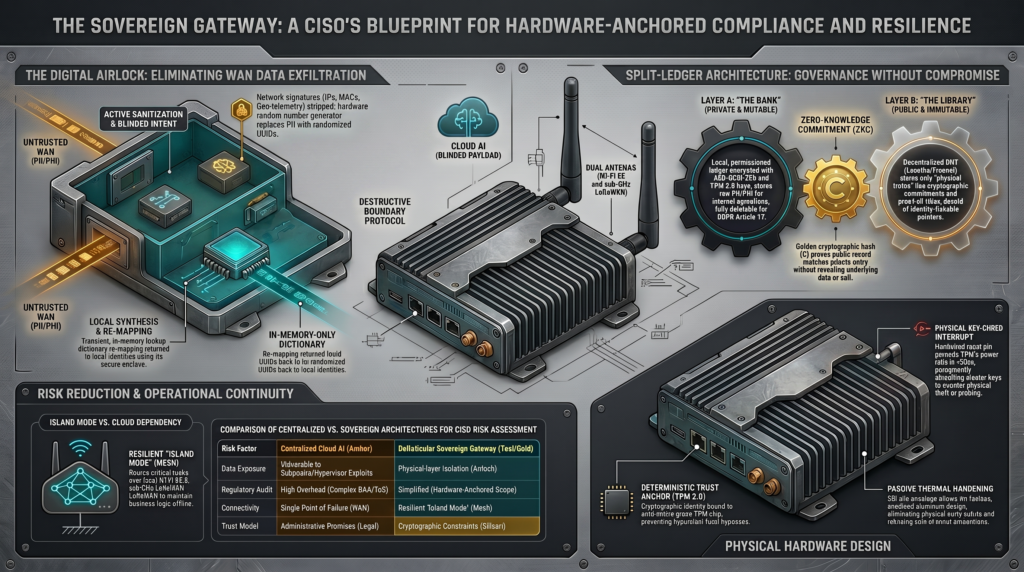
The Gateway is architected on a modified Apple M4 System-on-Chip (SoC) with 16 GB of Unified Memory, optimized to run within a 5W idle power envelope. This restrictive power profile allows the device to operate entirely via passive thermal dissipation.
The “So What?” Layer: The absence of moving parts and active cooling is a strategic security choice. It eliminates “acoustic and thermal emanation vectors,” effectively hardening the device against side-channel monitoring and preventing environmental degradation in industrial or agricultural deployments.
Local Trust and NFC Provisioning
The architecture rejects all cloud-account dependencies. Initialization is conducted out-of-band via a physical, zero-account protocol:
- Physical Bootstrap: The administrator performs a physical tap of a high-security NFC setup card against the chassis.
- Ephemeral Exchange: Proximity initiates an authenticated, localized key exchange.
- Hardware Minting: The Gateway’s discrete TPM 2.0 chip mints a localized cryptographic passkey (Secp256r1).
- Wallet Custody: The key is provisioned directly into the administrator’s hardware-backed mobile wallet, ensuring management credentials remain in physical custody.
The Key-Shred Interrupt: At-Risk Destruction
Security is maintained through a Discrete TPM 2.0 and a Physical Key-Shred Interrupt. Unlike traditional “at-rest” encryption, the Gateway provides “at-risk” protection. If the chassis is tampered with or the physical reset pin is depressed, a dedicated hardware interrupt pulls the TPM’s voltage rails to ground. This clears the master seed keys in less than 50 nanoseconds, rendering the local encrypted volume permanently unrecoverable.
Continuity via Island Mode
Managed by the Rural Infrastructure Operating System (RIOS), the Gateway ensures municipal continuity. During WAN failures, the device enters “Island Mode,” utilizing Wi-Fi 6E and sub-GHz LoRaWAN mesh topologies to maintain localized messaging and critical sensor routing without external dependencies.
3. The Digital Airlock: Technical Enforcement of Data Minimization
The Digital Airlock is a “destructive boundary” designed to decouple computational reasoning from sensitive identity state. It deconstructs queries into abstract variables before they exit the local enclave.
The Data Flow Protocol
- Intercept & Stage: The Sovereign Executive Agent intercepts queries in volatile memory; data never touches the local SSD.
- Active Sanitization: The engine strips IPs, MAC addresses, geo-telemetry, browser user-agents, and localized system clocks to prevent fingerprinting.
- Blinded Intent Generation: The engine maps PII/IP to randomized UUIDs using a Mapping Matrix: M = \{ \text{Entity} \to \text{UUID} \} This matrix is written to a transient, in-memory lookup table that exists only for the lifetime of the transaction loop.
- WAN Transmit: The blinded payload is serialized and passed through a physical-level firewall.
- Decentralized Routing: Traffic is routed through a Tor/Relay Mesh and onion relays to mask the enterprise IP footprint.
- Cloud Computation: The external AI (e.g., Google Project Remy) processes the abstract logic (e.g.,
{Subject_UUID_A}). - Blinded Response: The cloud returns structural vectors and logical results.
- Re-Mapping: The Gateway performs a reverse-lookup using the transient dictionary (M^{-1}).
- Local Synthesis: The resolved alert is delivered to the client (e.g., “Patient Alice Smith exhibits a risk factor”).
The “So What?” Layer: The Blinded Intent Generator mathematically prevents the cloud provider from linking requests to physical entities. By stripping device signatures and system clocks, the engine nullifies the utility of data harvesting and prevents upstream providers from fingerprinting the organization.
4. Split-Ledger Architecture: Balancing Immutability and Mutability
Enterprises face a Data Governance Paradox: the conflict between the legal Right to be Forgotten (Privacy) and the requirement for permanent, tamper-proof records (Audit). The Split-Ledger Architecture resolves this through two distinct layers.
| Feature | Layer A: “The Bank” | Layer B: “The Library” |
| Purpose | Private Authority for Identity/State | Public, Immutable Validation |
| Storage Mechanics | Local, TPM-Encrypted PostgreSQL / Raft | Decentralized Locutus DHT |
| Security Controls | AES-GCM-256 (TPM-Bound Keys) | Tokenless, Wasm Contracts |
| Data Content | Raw PII, PHI, Financial Balances | Hashes, Commitments, Timestamps |
The “So What?” Layer: The Cryptographic Interlock
The system utilizes a Zero-Knowledge Commitment (ZKC) mechanism to link the ledgers without exposing data. When a transaction occurs, the Gateway generates a commitment (C) and writes it to Layer B: C = \text{HMAC-SHA256}(\text{Transaction Data} \parallel \text{Salt } r)
Strategic Benefit: By utilizing the Locutus DHT—a decentralized, tokenless hash table—the architecture is immune to economic attack vectors, speculation, and gas fee manipulation. A global distributor can verify a transaction’s validity on Layer B without ever accessing the raw PII stored in Layer A.
5. Regulatory Analysis: HIPAA, GDPR, and SOC 2 Alignment
This architecture converts administrative promises into “verifiable technical evidence,” fundamentally altering the burden of proof for auditors.
- HIPAA Analysis: By isolating and sanitizing PHI at the gateway level, the external cloud network is entirely excluded from the PHI data flow path. This architecture renders the cloud provider physically incapable of seeing protected data, thereby eliminating the regulatory requirement for BAAs with model operators.
- GDPR Analysis: To satisfy Article 17 (Right to be Forgotten), the operator deletes the mapping in Layer A. This “Cryptographic Disconnection” renders the immutable hash on Layer B legally anonymous and mathematically un-linkable to any physical person.
- SOC 2 Analysis: The Gateway replaces soft administrative controls with deterministic proof. Hardware-enforced boot chains and physical self-destruct mechanisms provide auditors with mathematical certainty of security boundary enforcement.
6. Strategic Risk Register and Implementation Gap Analysis
The transition to a hardware-anchored edge model requires transparent management of new technical gaps.
Structural Gap Analysis Matrix
| Architectural Domain | Technical Gap | Remediation Path |
| Data Privacy | Payload translation latency | M4 unified memory for <12ms sanitization passes. |
| Edge Trust | Provisioning complexity & lockout risk | Implement M-of-N Cryptographic Sharding. |
| Ledger Compliance | Public DHT traffic analysis | Implement routing obfuscation for verification requests. |
| Operational Continuity | Local compute constraints (16GB) | RIOS hierarchical fallback to 2-bit/4-bit quantized models. |
SWOT Analysis
- Strengths: Hardware-anchored trust; deterministic data minimization; elimination of fan-based side-channels.
- Weaknesses: Upfront capital expenditure; transaction latency; risk of data loss from accidental key-shredding.
- Opportunities: Audit scope reduction; standardization of “Blinded Intent” schemas; municipal mesh resilience.
- Threats: Upstream API telemetry requirements; Advanced microarchitectural profiling; Sybil/Eclipse attacks on Layer B nodes.
Resilience via M-of-N Sharding
To mitigate the risk of administrative lockout or physical card loss, the system employs Shamir’s Secret Sharing. The master backup key is split into N fragments, requiring a quorum of M (e.g., 3-of-5) to reconstruct the root keys. This ensures recovery capability without creating a single point of failure.
7. Conclusion: The Future of Physical Digital Sovereignty
Digital sovereignty is a physical requirement. As AI integration deepens, the reliance on centralized cloud models becomes a liability for regulated industries.
Architecture Comparison
| Feature | Centralized Cloud AI | DeReticular Sovereign Gateway |
| Initial Cost | Zero upfront (OpEx) | Upfront physical CapEx |
| Data Exposure | Total (Hypervisors/Subpoenas) | Physical-layer isolation |
| Connectivity | Total WAN dependency | Resilient “Island Mode” |
| Audit Proof | Administrative Promises | Hardware-enforced boot chains |
The DeReticular architecture provides a mathematically bounded path for modern enterprise autonomy. By shifting the security boundary to physical silicon and cryptographic blinding protocols, organizations ensure their privacy is enforced by the laws of physics rather than the shifting wording of a contract.


