Briefing Document: DeReticular Energy Intelligence (DEI) and Node 5
Executive Summary
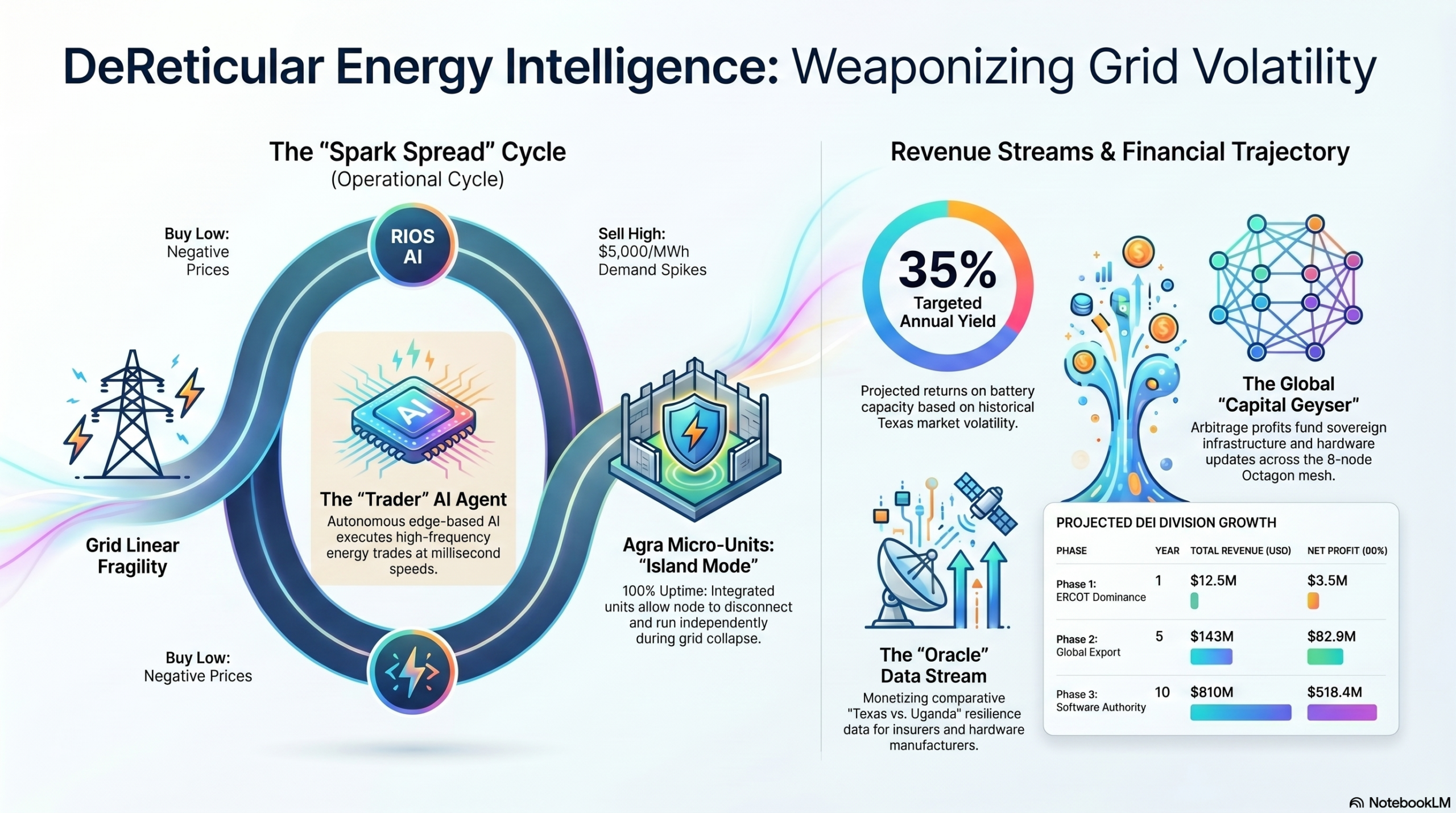
DeReticular Energy Intelligence (DEI) is a fintech-energy hybrid division of the DeReticular Conglomerate designed to exploit “Linear Fragility” in centralized power grids. Based at Node 5 in Fort Worth, Texas, DEI serves as the “Automated Treasury” for the broader Project Octagon ecosystem. By utilizing the proprietary Rural Infrastructure Operating System (RIOS) and specialized AI agents, DEI weaponizes grid volatility into fiat capital to fund global sovereign infrastructure.
The core operation centers on autonomous energy arbitrage within the ERCOT (Texas) market. DEI utilizes industrial-scale battery storage and localized plasma gasification to buy power at low or negative rates and discharge it during peak demand. This “University” node not only generates high-yield revenue but also produces critical resilience data and software logic that is exported to other nodes in the global mesh. DEI is projected to transition from a physical asset manager to a global software authority on energy resilience, with projected annual net profits exceeding $500 million by Year 10.
1. Strategic Mandate: The Texas “Hard Mode”
Node 5, designated “The Energy Student” or “The Urban Energy Lab,” was strategically relocated from St. Paul, Minnesota, to Fort Worth, Texas. This move was driven by the specific characteristics of the Electric Reliability Council of Texas (ERCOT) grid.
- Grid Isolation: ERCOT operates as an “energy island” disconnected from the rest of the U.S. grid, making it highly susceptible to extreme weather and demand spikes.
- Linear Fragility: DEI defines the legacy grid’s susceptibility to rolling blackouts and economic loss as an opportunity. In this “Hard Mode” environment, price swings range from -$100/MWh to over $5,000/MWh.
- Arbitrage Engine: Node 5 uses these fluctuations as an economic engine. It validates “Island Mode” technology—the ability to sever external ties and sustain operations indefinitely.
——————————————————————————–
2. The Sovereign Stack: Infrastructure and Intelligence
DEI operates through the “Sovereign Stack,” a modular framework consisting of three layers: Muscle, Motion, and Mind.
2.1 The Muscle: Energy Generation and Storage
Node 5 utilizes specialized hardware to maintain 100% uptime and grid independence:
- Agra Micro-Unit: A 10-ton-per-day (TPD) Plasma Gasification unit that converts local livestock biomass (sourced from the Fort Worth Stockyards) into carbon-negative baseload power.
- Industrial BESS: Battery Energy Storage Systems (e.g., Tesla Megapacks) managed by RIOS for rapid grid discharge and charging.
2.2 The Mind: RIOS and “The Trader”
The “Mind” is the network intelligence layer that automates complex decision-making without human intervention.
- “The Trader” AI Agent: An autonomous entity that monitors real-time pricing, weather forecasts, and grid telemetry.
- Spark Spread Algorithm: A proprietary logic that calculates the differential between electricity costs and digital compute value.
- Operational Logic:
- Low/Negative Prices: The AI charges batteries or directs power to high-density RIOS-CC-1000 racks for complex compute tasks.
- High Prices: The AI suspends compute and discharges stored energy to the grid for maximum profit.
- Grid Collapse: The node enters “Island Mode,” relying on Agra-generated power.
https://academy.dereticular.com/wp-content/uploads/2026/05/Deck-Sovereign_Energy_Intelligence.pdf
3. Revenue Streams and Financial Projections
DEI generates revenue through four primary commercial pillars, transforming resilience into a financial weapon.
| Revenue Stream | Function | Description |
| Energy Arbitrage | The Treasury | High-frequency buying and selling on deregulated wholesale markets. |
| Ancillary Services | The Peacekeeper | Paid contracts for Frequency Regulation and Voltage Support to stabilize the grid. |
| Resilience Data | The Oracle | Selling “Digital Twin” data (Texas vs. Uganda) to insurers and manufacturers to price risk. |
| Software Licensing | RIOS Energy | Licensing “The Trader” AI and grid-edge software to third-party operators. |
10-Year Financial Forecast (Selected Data)
Figures in $000s USD
| Year | Total Revenue | EBITDA | Net Profit (80%) |
| 1 | $12,500 | $4,375 | $3,500 |
| 3 | $55,000 | $24,750 | $19,800 |
| 5 | $143,000 | $78,650 | $62,920 |
| 8 | $438,000 | $306,600 | $245,280 |
| 10 | $810,000 | $648,000 | $518,400 |
——————————————————————————–
4. Operational Roadmap and Global Synergy
Node 5 serves a critical “University” function within Project Octagon, a planetary mesh of eight sovereign nodes.
- Phase 1 (Years 1-2): Scale Fort Worth to 100MWh BESS capacity and open a second “Hard Mode” site in West Texas.
- Phase 2 (Years 3-5): Export DEI software and arbitrage logic to Node 4 (Uganda) to maximize revenue from its 11MW industrial engine.
- Phase 3 (Years 6-10): Transition to “Energy-as-a-Software,” managing decentralized energy for 100+ sovereign nodes globally.
Comparative Analytics (The Digital Twin)
By comparing hardware performance in the Texas heat against the Ugandan equatorial climate, DEI generates high-value comparative data. This allows for “Longevity Modeling,” proving equipment resilience to global investors and insurers.
——————————————————————————–
5. Strategic Risk Mitigation
DEI identifies and mitigates risks through technical and structural siloing:
- Regulatory Shift: If ERCOT rules become unfavorable, Node 5 pivots to 100% internal use, focusing on AI compute or physical fuel production (Agra GTL).
- Hardware Degradation: Using “University” data, DEI implements predictive maintenance to swap BESS components before high-frequency cycling causes failure.
- Market Competition: DEI’s edge-based AI bypasses the latency issues faced by competitors who rely on public cloud infrastructure.
- Liability Siloing: Establishing DEI as a separate division protects the broader DeReticular ecosystem from energy-sector liabilities and allows for specific project financing against battery assets.
——————————————————————————–
6. Key Insights and Authoritative Quotes
- On Volatility: “Volatility destroys the fragile. To the sovereign node, volatility is simply unharvested kinetic energy.”
- The Mission of Node 5: “Node 5 is the system that learns how to catch the falling pieces [of the grid] and turn them into gold.”
- Strategic Positioning: DEI proves that in a world of failing grids, the most valuable commodity is not just power, but the intelligence required to manage it.
- The Global Mesh: If Project Octagon were a global power company, Node 5 would be its advanced research university—studying the hardest math problems of the grid to ensure the network stays powered on when the “lights go out for everyone else.”


