Briefing Document Node 2 (The Systems Architect)
Executive Summary
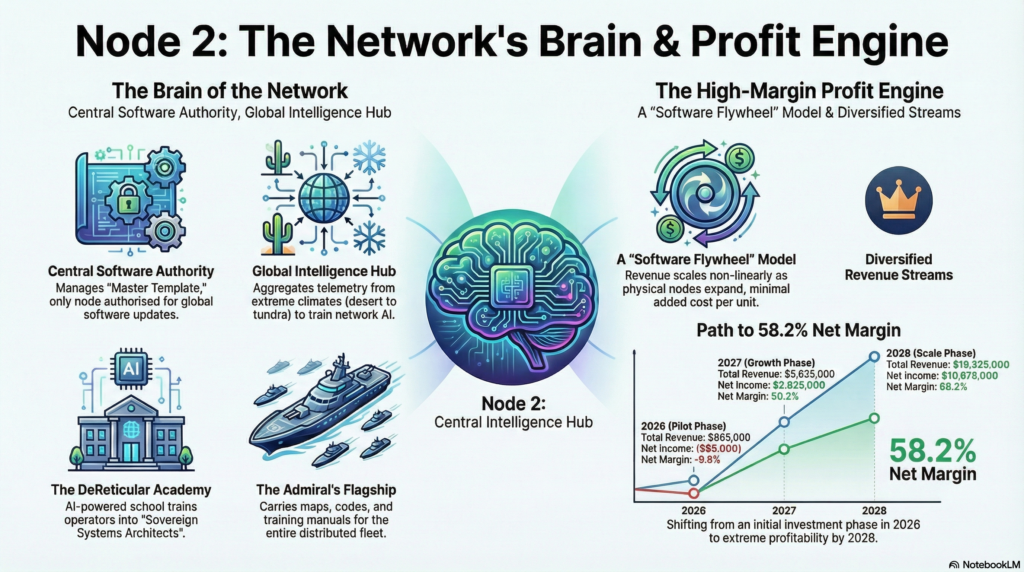
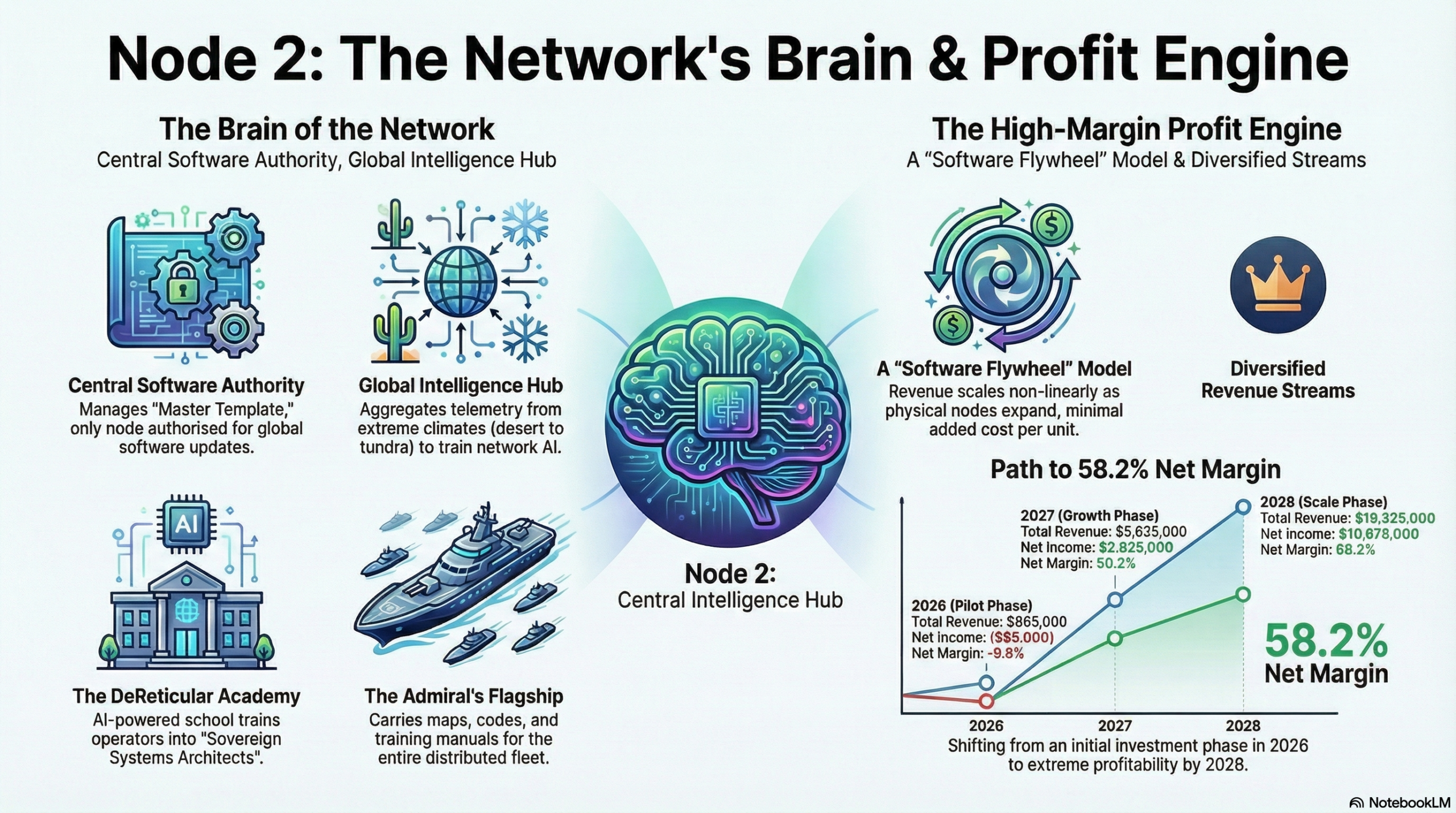
Node 2, designated “The Systems Architect” or “The Brain,” is the central software authority and intelligence hub for the DeReticular/Project Octagon network. Located in Canada and led by CTO Ash Aly, its mission is to manage the logic, security, and evolution of the global Rural Infrastructure Operating System (RIOS). Unlike industrial field nodes focused on physical output, Node 2 operates as a high-margin “Profit Engine” by selling intellectual property, education, and unique data assets.
Its core responsibilities include maintaining the global software “Master Template,” distributing over-the-air (OTA) updates, and aggregating telemetry from diverse climate zones to train global AI models. It is also home to the DeReticular Academy, which uses an AI-driven “Tutor” to train “Sovereign Systems Architects.”
Financially, Node 2’s model is built on software royalties, academy tuition, and future data sales. While projected to operate at a slight loss in its 2026 pilot phase due to high initial R&D costs, its profitability is expected to scale non-linearly as the physical network expands, reaching a projected net margin of 58.2% by 2028. The node’s success is critically dependent on the rapid physical deployment of other nodes across the network, a dynamic described as the “Software Flywheel.” Key strategic initiatives include the late 2026 launch of a “Clinic-in-a-Box” telemedicine module and the long-term monetization of its unique “Real-World Off-Grid AI Performance” dataset through a data arbitrage model.
1. Strategic Role and Identity
Node 2 serves as the high-level command and control center for the entire Project Octagon planetary mesh. Its strategic identity is defined by its focus on intelligence and software governance rather than physical production or environmental testing.
- Central Software Authority: Designated as “OS HQ,” Node 2 is the sole entity authorized to manage and deploy the RIOS software stack, ensuring version control and security across all nodes.
- “The Brain” of the Network: It is responsible for the “logic” of the distributed network, processing global data streams to generate system-wide optimizations.
- “The Admiral’s Flagship”: This analogy highlights its coordinating role. While field nodes are like cargo ships, Node 2 “carries the maps, the communication codes, and the training manuals that tell every other ship in the fleet how to navigate and survive.”
- The Profit Engine: In contrast to high-CapEx industrial nodes, Node 2 is designed as a high-margin, low-variable-cost entity that monetizes IP, making it the most scalable asset in the DeReticular portfolio.
2. Historical Evolution
Node 2’s current strategic role is the result of a significant realignment in project strategy from late 2025 to early 2026.
- Phase 1: The Replication Concept (Late 2025): The initial roadmap designated Node 2 as a “replication node” to be built in Uganda, intended simply to provide redundancy for African operations.
- Phase 2: The “Arctic” Realignment: As the project adopted a “Federated Learning” model, the need for diverse climatic data became a priority. This led to a strategic swap:
- The original “Arctic Test” node (formerly Node 3 in Canada) was relocated to Phoenix, Arizona, to become the “Desert Twin.”
- Node 2 was simultaneously moved to Canada and elevated to the status of “The Brain.”
- Phase 3: Centralization of Intelligence (Early 2026): By early 2026, Node 2 was formally codified as The Systems Architect, tasked with high-level software governance and managing the “Master Template” for the global OS.
3. Core Functions and Operational Mandates
Node 2’s operations are centered on software development, data aggregation, education, and physical validation.
3.1 RIOS Governance and Deployment
- Master Template Management: Node 2 maintains the “Golden Image” of the RIOS software stack, ensuring that every node in the network—from the Ugandan savanna to Texas—runs the exact same kernel and security protocols.
- Over-the-Air (OTA) Updates: It is the only node authorized to push critical system patches, security improvements, and software optimizations to the other seven nodes worldwide.
- Network Operations Center (NOC): It functions as the central monitoring hub, overseeing the global data stream to improve system performance.
3.2 Intelligence and AI Training
- Federated Learning Hub: Node 2 aggregates telemetry from diverse environments without compromising local data sovereignty. It uses this data to train global AI models.
- Climate-Driven Optimization: It ingests data from extreme climates, such as the 115°F Arizona desert (Node 3/7) and equatorial Uganda (Node 4), to optimize battery thermal management and energy loads across the entire mesh.
3.3 Physical Hardware Validation (“Tundra Mode”)
- Purpose: The strategic Canadian location is used to validate that RIOS hardware can survive sub-zero environments where traditional diesel generators frequently fail.
- Focus Areas: The team uses the Canadian winters to stress-test battery thermal management systems and enclosure seals, ensuring the physical resilience of the hardware.
3.4 Technical Configuration
- Compute Power Priority: Unlike field nodes that prioritize power efficiency, Node 2 prioritizes compute power to support its mission. An active Request for Quotation (RFQ) has been issued to upgrade its standard hardware with high-density GPU clusters and high-capacity NVMe storage to run massive AI simulations and process global telemetry.
4. The DeReticular Academy
Node 2 is the official home of the DeReticular Academy, an integrated educational authority designed to create a self-sustaining ecosystem of expert operators.
- Mission: To transition students from simple hardware operators into “Sovereign Systems Architects” (SSAs)—engineers capable of blueprinting and designing complex infrastructure stacks.
- “The Tutor” AI: The Academy utilizes an LLM-based AI agent hosted at Node 2. “The Tutor” provides multi-language technical instruction through AI-driven “Teaching Environments.”
- “Black Start” Capability: Consistent with the network’s resilience philosophy, the educational tools are designed to function locally and offline, even if primary satellite links are severed.
- Certification and Pricing: The Academy offers the RIOS Certified Technician (RCT) certification at a price of $3,500 per student. The 2026 pilot cohort is planned for 50 students.
5. Revenue Model and Product Offerings
Node 2’s financial model is a hybrid of high-value perpetual software licenses, recurring subscriptions, educational fees, and future data sales. It effectively acts as the “Franchisor” or IP holder for the network.
| Product/Service | Model | MSRP / Price | Value Proposition & Function |
| RIOS Sovereign Cloud Suite (SCS) | Perpetual License | $200,000 | Transforms hardware into a “Local Cloud Provider” (IaaS, PaaS, Data Vault), stopping capital flight to services like AWS/Azure. |
| RIOS Mobile Pro Optimum | Annual Subscription | $1,200 / year | Activates “Signal Fusion” (bonding Starlink + 5G) and allows edge devices to join the “Federated Learning” mesh. |
| DeReticular Academy | Certification Fee | $3,500 | Certifies RIOS Certified Technicians (RCTs), creating a skilled workforce to deploy and manage the system. |
| Clinic-in-a-Box (Future) | Software Module | TBD (Add-on License) | A telemedicine and encrypted health-data integration layer for remote nodes, opening the rural healthcare market. |
| Data Arbitrage (Future) | Data Sales | TBD | Sale of unique datasets on off-grid AI performance to insurers (for risk modeling) and hardware manufacturers (e.g., NVIDIA, Tesla). |
6. Financial Projections (2026–2028)
Node 2 is characterized by high margins and low variable costs, with profitability directly tied to the global expansion of physical nodes. The node is projected to retain 40% of the MSRP ($80,000) of every SCS license sold globally to fund ongoing R&D.
Pro Forma Income Statement
| Metric | 2026 (Pilot Phase) | 2027 (Growth Phase) | 2028 (Scale Phase) |
| Active Nodes | 8 | 50 | 150 |
| Total Revenue | $865,000 | $5,625,000 | $18,325,000 |
| Total Expenses | $950,000 | $2,800,000 | $7,650,000 |
| Net Income (EBITDA) | ($85,000) | $2,825,000 | $10,675,000 |
| Net Margin | -9.8% | 50.2% | 58.2% |
Growth Roadmap
- 2026 (The Investment Year): Operates at a slight loss, focusing on “Tundra Mode” validation, building the “Master Template,” and training the first cohort of 50 students. High AI training costs outpace initial royalties.
- 2027 (The “Software Flywheel”): Profitability explodes as revenue scales non-linearly with the physical deployment of nodes. The launch of the “Clinic-in-a-Box” module adds a new vertical.
- 2028 (The Data Arbitrage Era): Data sales become a significant, pure-profit stream, projected at $2.2M. Node 2 will possess a world-leading dataset on off-grid AI performance across all climate zones.
7. Strategic Analysis
SWOT Analysis
| Strengths | Weaknesses |
| High-Margin Revenue Model (58.2% projected net margin). | Initial Operating Deficit (Projected $85k loss in 2026). |
| Centralized Authority ensuring global version control via OTA updates. | Single Point of Failure (Security breach could compromise the entire mesh). |
| Integrated Education (DeReticular Academy) creates a skilled ecosystem. | Hardware Intensity (Requires more expensive GPUs/NVMe than field nodes). |
| Unique Data Assets on real-world off-grid AI performance. | Geographic Dependency for “Tundra Mode” validation on Canadian winters. |
| Opportunities | Threats |
| Data Arbitrage by selling telemetry to insurers and manufacturers. | Cybersecurity Risks as a high-value target for state-level actors. |
| Vertical Expansion into the rural healthcare market with “Clinic-in-a-Box”. | Regulatory Hurdles related to data sovereignty for data arbitrage sales. |
| Sovereign Asset Demand from regions seeking to avoid capital flight to AWS/Azure. | Scalability Speed (Profitability depends on the rapid deployment of other nodes). |
GAP Analysis (Current State vs. 2028 Goal)
The primary strategic gap for Node 2 is Compute & Scaling. Its financial success is entirely dependent on the physical expansion of other nodes. To achieve its 2028 “Data Arbitrage” goals, the network must grow by 1,775% (from 8 to 150 nodes) in two years. Therefore, the immediate priority is executing the advanced compute upgrade (GPUs) to ensure its AI infrastructure can handle the massive influx of data as the network scales.
8. Leadership: Ash Aly
As Node Leader, Sponsor, and CTO of the mesh, Ash Aly’s role is distinct from the industrial focus of other nodes. He acts as the “Guardian of the Network’s Logic.” His core responsibility is to ensure that while field hardware “gets dirty,” the central software remains “pristine, secure, and constantly evolving.” He oversees the Canadian development team and is currently architecting the “Clinic-in-a-Box” module.


