
Decoupling the Discovery: A Learner’s Guide to Registered Reports
https://academy.dereticular.com/podcast/integrity-and-crisis-in-the-us-research-ecosystem
- The “Funhouse Mirror” of Modern Science
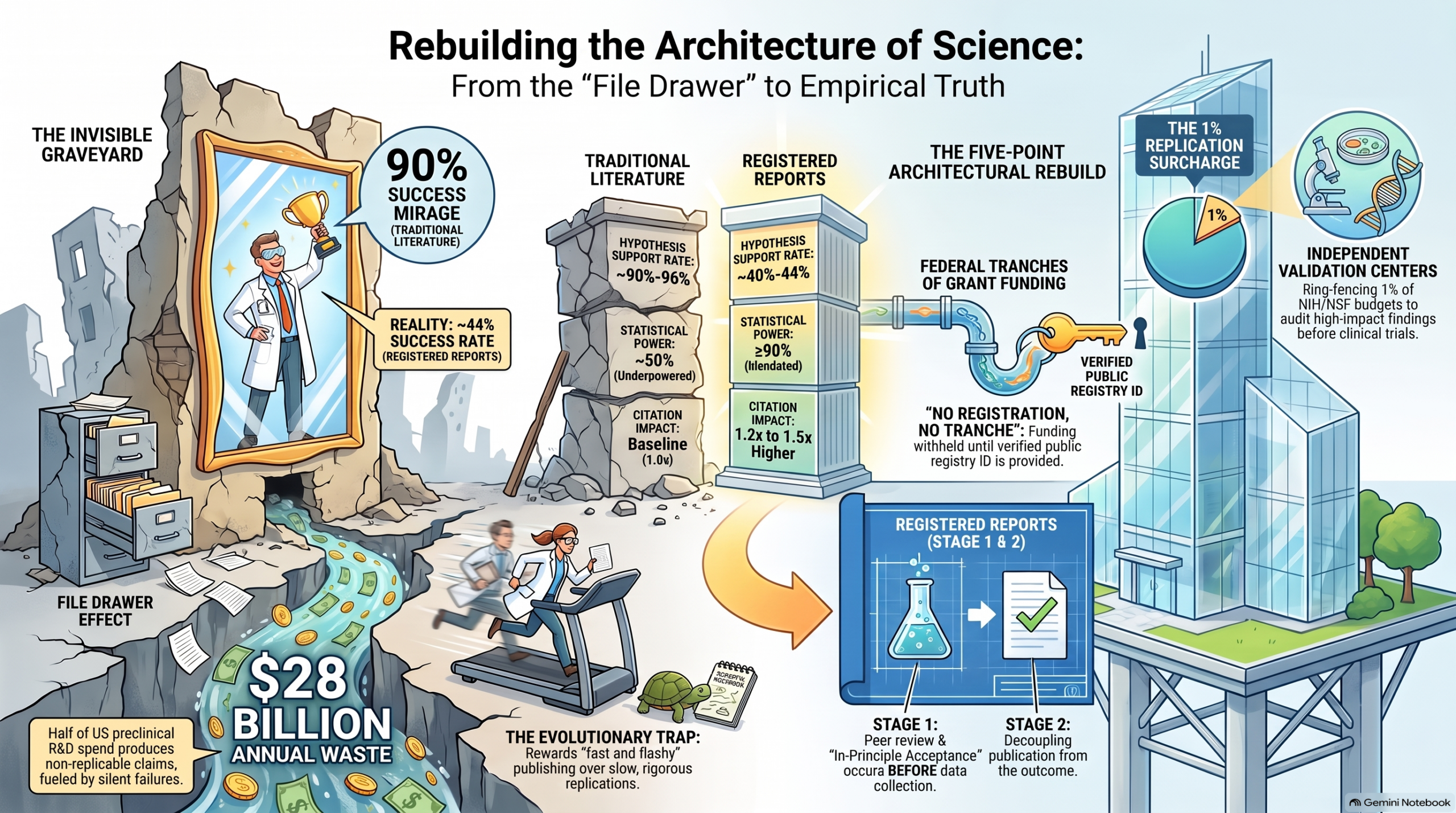
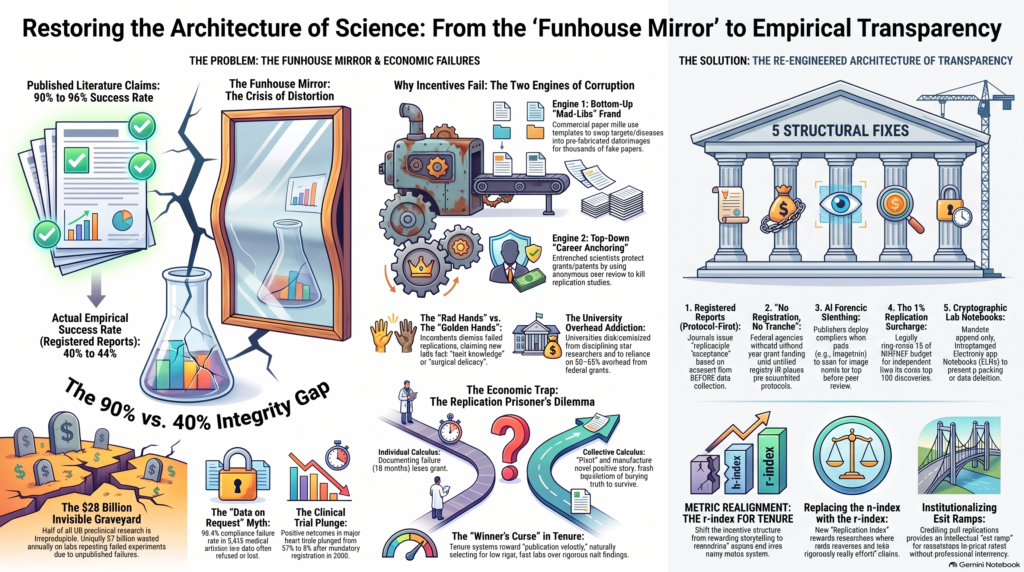
The current state of scientific publishing is an institutional market failure. In an ideal ecosystem, science acts as a self-correcting engine where empirical reality dictates which ideas survive. In practice, the system has created a “Funhouse Mirror” effect: the published record reflects the professional needs of researchers—tenure, grants, and prestige—rather than the actual state of the physical world.
This distortion sustains an “Invisible Graveyard” of failed experiments. Because journals systematically reject null results and failed replications, the literature is stripped of the very data needed to identify dead ends. This “file drawer effect” leads to a catastrophic waste of resources, as hundreds of laboratories independently and expensively repeat the same failed experiments in total isolation, unaware that their peers have already hit the same brick walls.
The Reality Gap
The following table illustrates the massive disconnect between empirical reality and the filtered version presented in high-impact journals.
Metric Physical World / Empirical Reality Published Literature Translational Pipeline
Hypothesis Outcomes ~75% True Nulls / ~25% True Effects >90% Positive Support 85% Phase II/III Failures (Cardiovascular)
Statistical Integrity Objective & Unbiased “The Funhouse Mirror” Translational Collapse
The Three Drivers of the “File Drawer Effect”
For the aspiring researcher, these three systemic pressures transform the scientific method into a high-stakes lottery:
- The Novelty Premium: High-impact journals prioritize “breakthroughs” over boring truths. A study showing a gene doesn’t cause a disease is viewed as a non-event, even though that knowledge is essential for resource allocation.
- Methodological Defamation: When a researcher fails to replicate a famous study, the original authors often claim the replicator suffered from “bad hands” or lacked “tacit knowledge.” This treats a null result as proof of personal incompetence rather than a falsified theory.
- The Early-Career Trap: PhD students and postdocs must produce “clean” narratives to secure faculty jobs. Burying a null result to pivot to a “sexier” project isn’t just a career move; it actively populates the “Zombie Literature”—a body of false findings that subsequent researchers will waste years trying to build upon.
These structural flaws necessitate a total inversion of the scientific workflow.
- The Traditional Publishing Cycle: A Post-Hoc Bottleneck
In the standard model, peer review occurs only after results are finalized. This creates a “Selection Truncation Filter” at the p < 0.05 threshold (z \ge 1.96). If data fails to clear this arbitrary barrier, the paper faces near-certain desk rejection.
The Winner’s Curse In an environment where only “significant” results are published, the studies that survive are often those featuring the most extreme upper-tail noise. In underpowered studies, this leads to effect-size inflation, where the reported benefit of a treatment is a statistical fluke rather than a true biological parameter.
To survive the “publish or perish” culture, researchers often treat theories as Reputational Sunk-Costs—economic assets that must be protected at all costs. This drives “Research Flexibility” tactics:
- P-Hacking: Massaging data or adding post-hoc covariates until the results cross the z \ge 1.96 barrier.
- HARKing (Hypothesizing After the Results are Known): Retrospectively changing the hypothesis to match accidental patterns in the data.
- Outcome-Switching: Swapping the primary target of a study once data collection reveals which variables “worked.”
The pressure to produce these narratives creates a self-perpetuating cycle of low-rigor science that looks perfect on paper but fails in the laboratory.
- The Registered Reports Model: The Two-Stage Architecture
The Registered Reports (RR) format is a structural solution designed to restore empirical parity. Its core mission is decoupling the publication decision from the results of the study. The review process is split into a two-stage architecture:
Stage 1: Protocol Review (The Plan)
- Submission: Before data collection, authors submit their Theory, Methodology, and a mandated Power Analysis (\ge 90%).
- Outcome: Reviewers evaluate the scientific question and protocol rigor. If approved, the journal grants In-Principle Acceptance (IPA).
Stage 2: Final Audit (The Truth)
- Submission: After the study is conducted, authors submit the Results and Discussion.
- Outcome: Reviewers perform a quality audit to ensure the protocol was followed and quality controls passed.
The Irrevocable Guarantee
Once IPA is granted, journals are structurally barred from rejecting the paper based on the direction or “nullness” of the outcome. This “Irrevocable Guarantee” removes the incentive to p-hack or hide data, ensuring the “Invisible Graveyard” is brought into the light. This shift has an immediate statistical impact on the integrity of scientific literature.
- Empirical Proof: Restoration of the Self-Correcting Engine
Data from meta-research, such as Scheel et al. (2021), proves that when we stop rewarding “storytelling,” the literature reflects reality.
Metric Standard Published Literature Registered Reports Literature
First-Hypothesis Support Rate ~90% to 96% (Severe Bias) ~44% (Empirical Reality)
Statistical Power ~50% average \ge 90% mandated
Incidence of p-Hacking Systemic / Undetectable Structurally Impossible
Citation Impact Baseline (1.0x) 1.2x to 1.5x Higher
Why This Matters: The Economic Impact
Meta-research identifies 28 billion** in annual preclinical waste in the US alone. However, this figures ignores the **Redundant Secondary Waste Factor (W_{sec}$). The true cost of the file drawer isn’t just the first bad study; it is the capital consumed by “Labs B, C, and D” repeating the same error in parallel silos. RRs act as a “Replication Surcharge” that saves resources by identifying scientific dead ends early, preventing billions from flowing into “zombie” theories.
- Advanced Infrastructure: PCI RR and FAIR Data
Virtue is not enough to reform science; we require an inescapable architecture.
PCI RR and the r-index
The Peer Community In Registered Reports (PCI RR) model severs journal dependency. Authors receive “journal-agnostic” Stage 1 review. Once awarded IPA, they can take their study to over 30 partner journals obligated to publish the results. Furthermore, the Replication Index (r-index) is emerging as a revolutionary career metric. Unlike the h-index, the r-index rewards researchers for publishing “disconfirming” results and conducting rigorous replications, aligning self-interest with truth.
The Remediation Architecture
- Cryptographic Electronic Lab Notebooks (ELNs): Append-only, timestamped logs that create a digital audit trail, making it impossible to delete failed experiments or change dates retroactively.
- FAIR Data Repositories: Data must be Findable, Accessible, Interoperable, and Reusable. This includes mandatory deposition of uncropped raw imagery to prevent the “Photoshopping” of results.
The Nelson Memo & Enforcement Effective 2025/2026, all federally funded research must be freely available immediately. Crucially, this shift includes the “No Registration, No Tranche” policy: the second year of grant funding will be withheld until a verified registry ID is filed.
- The Future Pipeline: From Narrative to Empirical Parity
The ultimate goal of these reforms is maximizing the Positive Predictive Value (PPV) of science—the probability that a published “finding” is actually true. Currently, low pre-study odds (R) and high bias (u) result in a PPV below 50%. The Reformed Scientific Pipeline addresses this:
- Hypothesis Design: Focus on high-powered math and rigorous theory.
- Stage 1 Review: Secure a “guarantee of publication” before spending capital.
- Execution/ELN Logging: Log every step in an immutable, cryptographic notebook.
- Stage 2 Publication: Publish the truth, whether the hypothesis was confirmed or refuted.
- Post-Publication Audit: Allow global peer review and AI forensics to verify the data.
An experiment is valuable not because of the result it obtains, but because of the truth it uncovers. In this new architecture, there are no “failed” experiments—only successful discoveries of what is real.


