
The Rural Mosaic: Navigating America’s Dual Economic Realities
- Introduction: Beyond the Monolith
To analyze the American landscape is to confront a fundamental spatial paradox: the territory classified as “Non-Metropolitan” covers 97% of the nation’s landmass but supports only 14% to 20% of its population. For the Senior Rural Economic Geographer, this landscape is not a monolith of decline; it is a complex “Rural Mosaic” defined by a structural divergence between two polarizing macro forces.
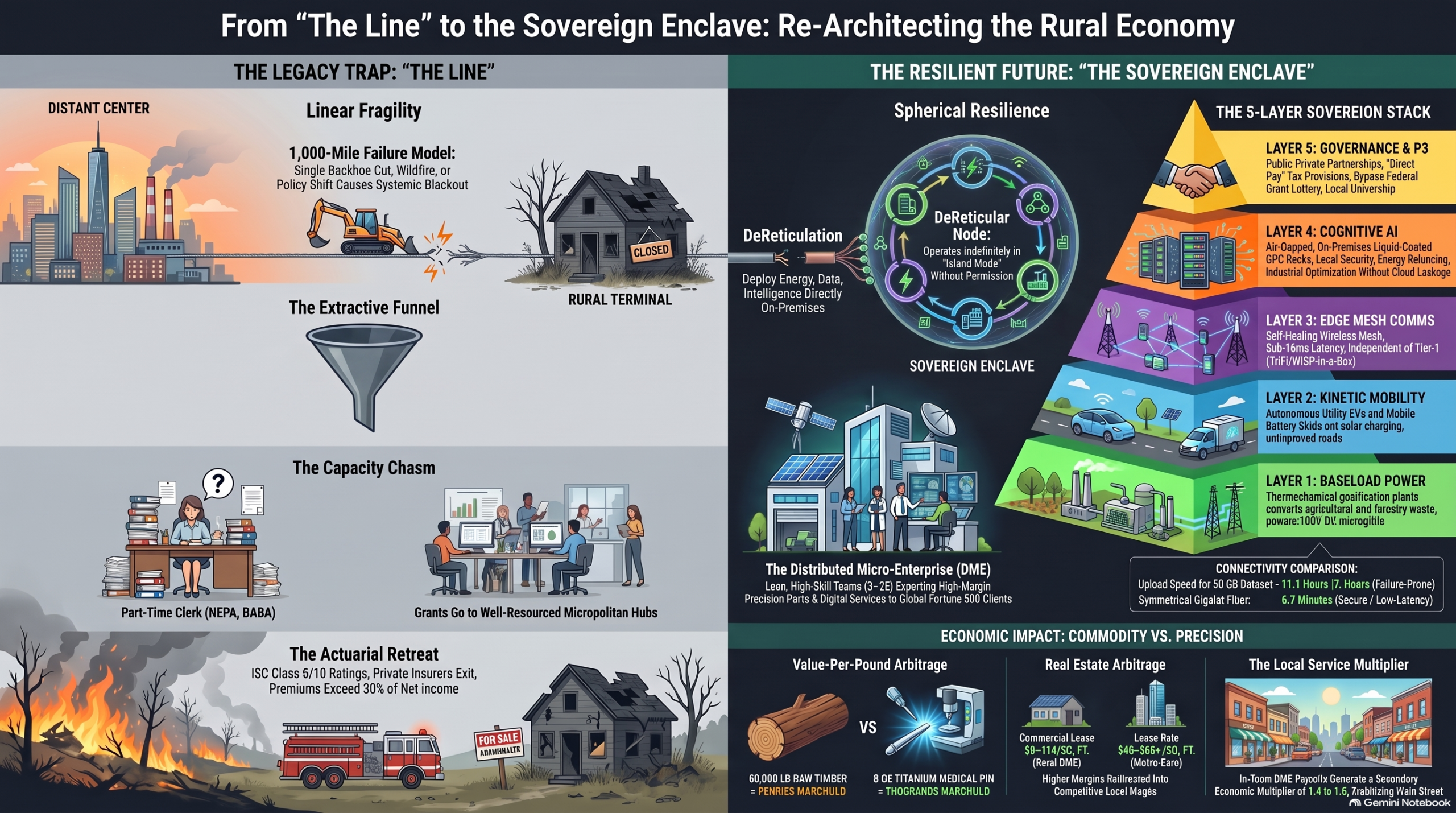
The “rural crisis” is not a singular event. It is a transition from an Extractive Funnel—where peripheral regions harvested low-margin bulk commodities for metropolitan refining—to a landscape of Distributed Nodes. This evolution is captured through the taxonomy of the Office of Management and Budget (OMB) and the USDA Economic Research Service (ERS), specifically the 9-tier Rural-Urban Continuum Codes (RUCC) and 12-tier Urban Influence Codes (UIC). Most critically, we must focus on the roughly 1,250 Non-Core counties that hold 18.5 million people across 50% of the U.S. landmass, representing the frontier of this geographic divergence.
Key Concept: The Federal Spatial Taxonomy
Federal classifications determine statutory eligibility for hundreds of billions in capital. The distinction between hubs and the interior is governed by the urban core:
- Micropolitan Hub (RUCC 4–5): A non-metropolitan county anchored by an urban cluster of 10,000 to 49,999 residents. These act as “capital sponges,” consolidating regional retail, medical services, and tax bases.
- Non-Core County (RUCC 6–9): Counties devoid of any urban cluster reaching 10,000 residents. These areas face the most severe Administrative Asymmetry and institutional blockage.
To understand rural America, we must look at where capital is saturating the landscape through amenity migration and where it is being structurally blocked by legacy institutional failures.
- The High-Amenity Enclave: The Crisis of Capital Saturation
In “Gateway” communities—such as the Bozeman/Flathead Valley (MT), Sandpoint (ID), and Transylvania County (NC)—the crisis is one of capital saturation. The “urban escape” and the decoupling of Tier-1 metropolitan salaries from local geography have fundamentally upended historic price-to-income ratios. In these enclaves, home values have surged to 7.0x–11.0x local median incomes.
The Displacement Mechanism (The Amenity Housing Funnel)
- Inbound Migration/Investment: High-earning migrants and institutional investors conduct all-cash transactions, outbidding local labor.
- STR (Short-Term Rental) Cannibalization: Short-term rentals now account for 15% to 30% of total residential inventory in these counties, eliminating long-term rental stock.
- Inventory Evaporation: As property assessments surge, existing stock becomes a speculative asset rather than a housing utility.
- Workforce Displacement: Essential workers are forced into peripheral counties, creating a demographic hollow.
This displacement triggers “Down-Valley Syndrome,” where nurses, teachers, and police officers face 45- to 90-minute commutes. This leads to profound Civic Fragility, most notably in the depletion of Volunteer Fire Department (VFD) rosters. When the people who serve the community can no longer afford to live in it, the community’s actuarial safety net begins to unravel.
- The Isolated Interior: The Three-Way Systemic Trap
While Gateway towns struggle with “too much” interest, the Isolated Interior—the Mississippi Delta, the Great Plains, and Central Appalachia—is caught in a reinforcing cycle of disinvestment known as the “Systemic Trap.”
The Barrier Operational Reality Impact on the Learner’s Understanding
Housing Obsolescence The Appraisal Gap: New construction (220–300/sq. ft.) far exceeds comps (90–140/sq. ft.). Why banks deny loans even for willing builders; residents remain in decaying pre-1970 stock.
Actuarial Retreat ISO Class 9/10 Ratings: Insurance carriers are withdrawing due to weather risks and depleted VFDs. Premiums consume 15–25% of net income, leading to mortgage delinquencies and title abandonments.
Administrative Deficit The “Two-Desk” Town Hall: Lack of GIS staff and grant writers. Why these towns lose the “Paper Availability” trap on FCC maps, disqualifying them from BEAD/IIJA funding.
In the South, this is compounded by the “Heirs’ Property Impasse,” where clouded titles prevent residents from securing USDA Section 504 repair grants. Furthermore, the “Black Belt Soil Impasse” requires engineered septic systems costing $20,000+—often exceeding the value of the home itself. These structural hurdles require a different kind of economic “architecture” to overcome.
- Comparative Landscape: Side-by-Side Reality Check
The divergence between these dual realities dictates the survival strategy for any given municipality.
Dimension Amenity/Exurban Corridors Isolated/Interior Communities
Real Estate Dynamics Hyper-appreciation: Workers priced out by 15-30% STR saturation. Depreciating Inventory: Structural appraisal gaps and “Vintage Degradation.”
Economic Base Remote Knowledge Work: High-end hospitality and Tier-1 service exports. Extractive/Industrial: Raw commodity extraction or industrialized farm tenancy.
Primary Risk Factor Loss of Identity: Civic collapse as essential VFD/EMS staff are displaced. Structural Abandonment: Infrastructure failures outpace the shrinking tax base.
- The Modern Pivot: Distributed Micro-Enterprises (DMEs)
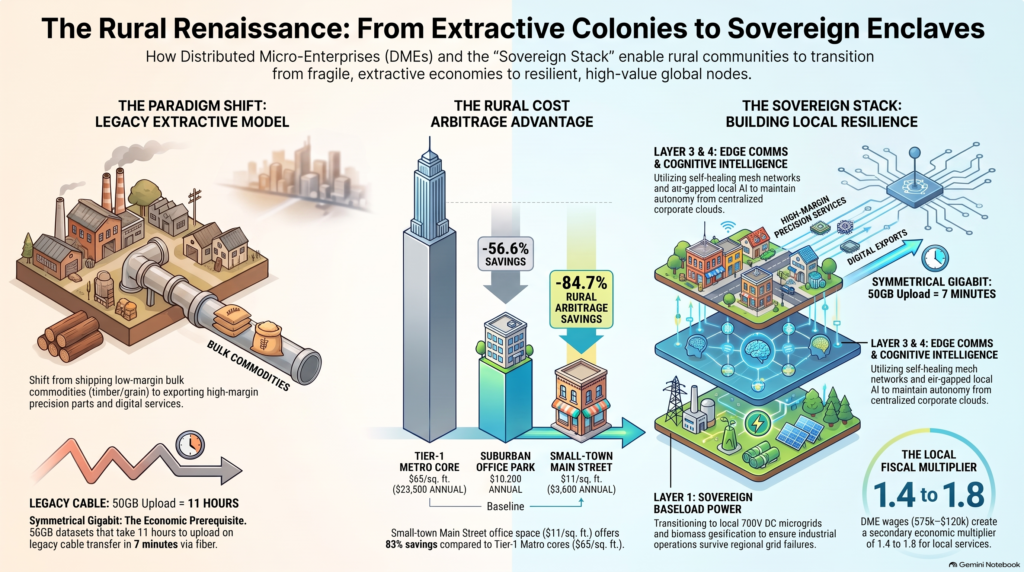
To break the “Line”—the fragile dependency on 1,000-mile supply chains—towns must transition to Distributed Micro-Enterprises (DMEs). This model leverages Real Estate Arbitrage (Small-town Main Street at $11/sq. ft. vs. Metro Core at $65/sq. ft.) to achieve a -84.7% savings in cost-per-workstation.
The technical prerequisite for a DME is Symmetrical Gigabit Fiber. Consider the Upload Bottleneck: transferring a 50GB geospatial dataset takes 11.1 hours on legacy asymmetric cable but only 6.7 minutes on a symmetrical fiber link.
The Four Pillars of Rural DME Diversification
- Forensic & Compliance Accounting: Utilizing secure tunnels to perform blockchain auditing and R&D tax credit defense for global clients.
- Geospatial & Civil Engineering: Processing high-density LiDAR point clouds and drone photogrammetry for national infrastructure.
- Distributed Digital Production: Using real-time engines (Unreal/Unity) for high-value architectural visualizations and VFX.
- Precision Light Manufacturing: Leveraging cloud-linked 5-axis CNC mills to export high-margin titanium surgical tools and aerospace sensor housings.
Geographic isolation no longer prevents access to global commerce, provided the local “sovereign stack” is built to bypass legacy central-office failures.
- Synthesis: A Learner’s Roadmap for the Future
A town’s survival is determined by its ability to DeReticulate—moving from Linear Fragility (dependency on the centralized net) to Spherical Resilience (the ability to function in “Island Mode”). This is achieved by deploying the 5-Layer Sovereign Stack:
- Baseload Power: Local microgrids/gasification (utilizing IRA Section 6417 Direct Pay).
- Kinetic Mobility: Autonomous utility EVs and battery skids.
- Edge Mesh Comms: Autonomous TriFi/Wireless canopy.
- Cognitive Intelligence: Air-gapped, on-premises AI nodes.
- Governance: Aggregated regional capacity hubs.
Learner’s Checklist for Rural Leadership
- Shift to Formula-Based Thinking: Stop playing “sucker’s games” in competitive grant tournaments; demand needs-based formula capital.
- Solve the “Capacity Chasm”: Aggregate administrative overhead through Regional Councils of Governments (COGs) to handle NEPA and BABA compliance.
- Dismantle Single-Use Euclidean Zoning: Adopt form-based codes that allow clean precision micro-manufacturing (DMEs) to operate in historic downtown cores.
- Leverage the Sovereign Enclave: Use IRA Section 6417 to receive direct cash payments for municipal energy independence.
The future of the Rural Mosaic is not a choice between universal decline or a uniform renaissance; it is the deliberate construction of sovereign, distributed nodes of production that export value while recycling wealth locally.


