DeReticular Sovereign Infrastructure Ecosystem: Strategic Briefing 2026
Executive Summary
The DeReticular ecosystem represents a paradigm shift in industrial infrastructure, moving away from centralized, fragile systems toward a decentralized physical infrastructure network (DePIN) known as the “Sovereign Stack.” Managed by DeReticular, a founder-owned holding company and venture studio, the ecosystem unifies four specialized divisions—Agra Dot Energy (Power), Kurb Kars (Logistics), Biz Builder Mike (Software/Intelligence), and DAOSRUS (Identity/Governance)—to create self-sustaining “Sovereign Nodes” or “Digital Hamlets.”
The cornerstone of this initiative is Project Octagon, a global mesh of eight interconnected primary nodes designed for “Spherical Resilience,” ensuring continuity even during regional grid collapses. Strategically, the conglomerate is transitioning from a “boutique” manufacturing phase into an industrial scaling phase, with an aggressive 2026 revenue target of $120 million. Key to this growth is the “Digital Flywheel” economic model, which converts local waste into power and AI compute capacity, allowing nodes to self-liquidate capital expenditures through the sale of cryptographically verified “Green Compute” credits.
- Ecosystem Architecture and Philosophy
1.1 The Central Bank Holding Model
DeReticular operates as the parent entity and IP holder, functioning as a central bank for its subsidiaries. Instead of external equity dilution, it utilizes intercompany debt facilities to fund Research & Development.
- Total Deployed Capital (as of Dec 31, 2025): $49,700,000.
- Subsidiary Breakdown:
- Agra Dot Energy (“The Heart”): Industrial power via plasma gasification.
- Kurb Kars (“The Muscle”): Autonomous logistics and defense mobility.
- Biz Builder Mike (“The Brain”): RIOS software architecture and vocational education.
- DAOSRUS (“The Interface”): Experience layer and zero-trust identity (RFF).
1.2 Core Strategic Tenets
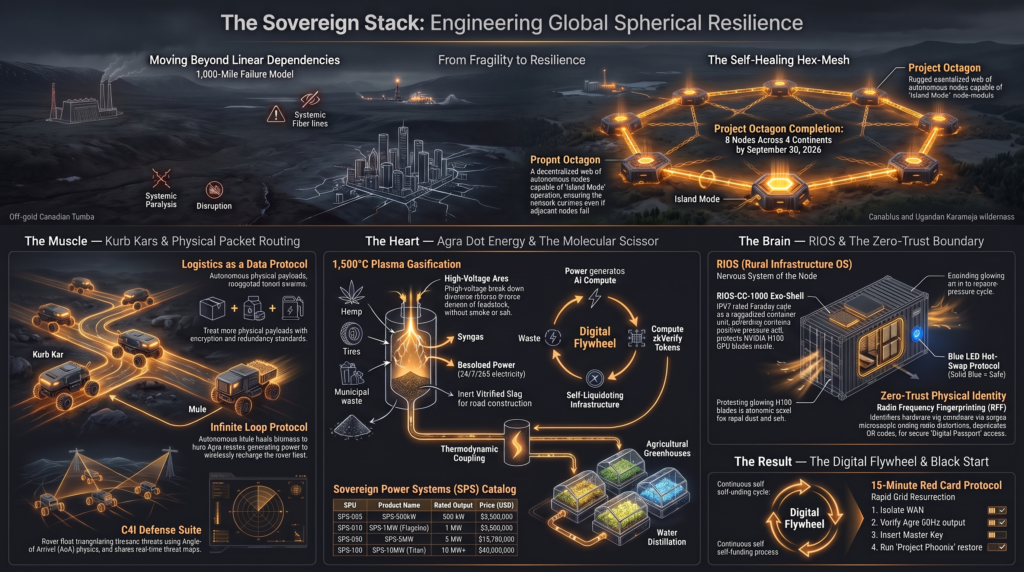
- “The Death of the Line”: The rejection of centralized transmission grids (“The Line”) in favor of a distributed mesh (“The Octagon”).
- “The Farm is the New Power Plant”: Agriculture’s shift from exporting food to exporting energy and compute by processing biomass waste.
- The Velcro Principle: The thermodynamic coupling of disparate sectors. For example, piping waste heat from AI server racks into greenhouses for year-round food production.
- Spherical Resilience: A Hex-Mesh topology where nodes operate in “Island Mode,” independent of central failures.
- Core Technology Pillars
2.1 Plasma Gasification (ADE-SPS Series)
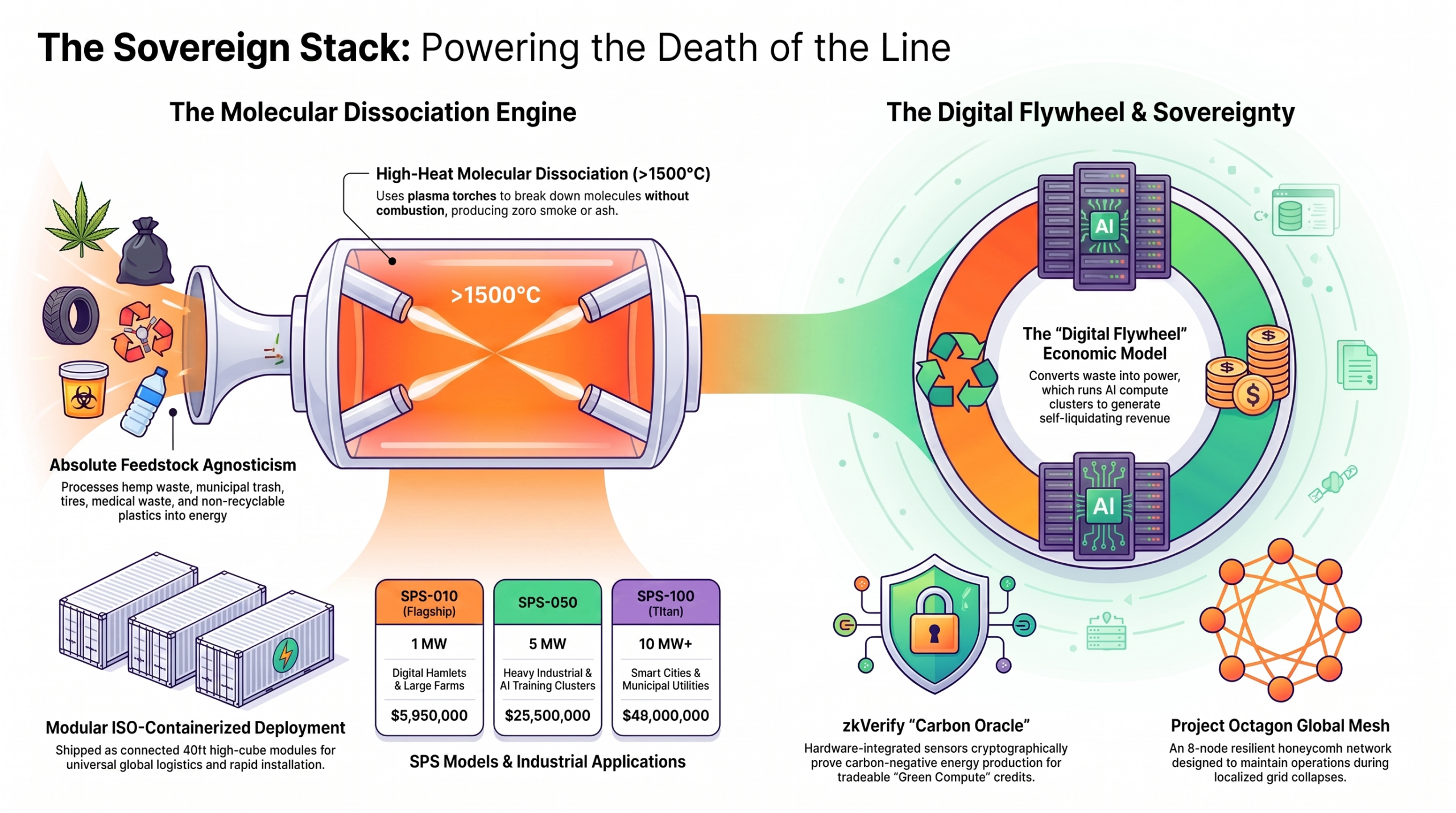
Unlike biological digestion, Agra Dot Energy utilizes high-temperature molecular dissociation.
- Process: Plasma torches exceeding 1,500°C break feedstock into basic elements.
- Outputs: Continuous baseload electricity, high-hydrogen syngas, and vitrified slag (an inert glass used for construction aggregate).
- Agnostic Intake: Processes hemp waste, municipal solid waste (MSW), tires, medical waste, and non-recyclable plastics.
2.2 Micro-GTL (Gas-to-Liquid) Synthesis
Excess syngas is converted into drop-in liquid hydrocarbons via Fischer-Tropsch reactors:
- Agra Synthetic Diesel: ASTM D975-compliant fuel for heavy machinery.
- Agra Synthetic Jet: Paraffinic kerosene for autonomous logistics drones (Kurb Kars).
2.3 RIOS and the Carbon Oracle
The Rural Infrastructure Operating System (RIOS) manages node telemetry and load balancing.
- zkVerify Integration: Physical flow meters use Zero-Knowledge Proofs to verify carbon-negative energy production.
- Verified Green Compute: These proofs allow the monetization of environmental offsets directly through the decentralized network.
- Product Catalog: The Sovereign Stack
Standardized hardware offerings are organized into four tiers, ranging from portable command units to full-scale industrial campuses.
Tier Product Name Category MSRP (USD) Primary Components
1 RIOS Pilot: Expeditionary Turnkey $45,000 3 Pelican cases, Starlink bonding, Edge AI compute, battery management.
2 RIOS Pilot: Standard Turnkey $78,500 10ft containerized micro-data center and field office.
3 RIOS Campus Lite Turnkey $125,000 SD-WAN Gateway, 5x Trifi routers, 5x Revofi nodes.
4 RIOS Campus Enterprise Turnkey $5,000,000+ 1MW Agra SPS generator, RIOS-CC-1000 compute clusters, Rover fleet.
— SPS-1MW (Flagship) Power $5,950,000 Plasma gasifier processing 10-20 tons of waste per day.
— Sovereign Reserve 1000 Storage $549,000 1 MWh LFP Battery for voltage stabilization and “Black Starts.”
- Operational Strategy: Project Octagon
Project Octagon is the master plan for a global 8-node honeycomb mesh. Three primary nodes serve as the reference “stress test” environments:
- Node 4: “The Green Industrial Engine” (Uganda): The “Crown Jewel.” A 10MW system powering a 7,000-acre hemp industrial park and AI compute cluster.
- Node 3: “The Blast Furnace” (Arizona): R&D headquarters used for testing thermal limits in extreme heat (>115°F).
- Node 2: “The Brain” (Canada): Primary software repository used for testing “Cold Iron” start-up protocols in sub-zero tundra.
- 2026 Strategic Roadmap: Operation Pathfinder
DeReticular enters 2026 under high-IP, low-cash conditions, executing a “Proof-First” financial strategy to unlock a $1,000,000 Private Placement Memorandum (PPM).
- Q1 (Operation Pathfinder): Use “scrappy” founder capital (25k-35k) to ship a rudimentary RIOS Explorer to Uganda. Establish a data uplink from Kaabong by late February to prove connectivity to investors.
- Q2 (The Capital Raise): Close the $1M PPM round. Purchase 7 Tier 1 kits and upgrade Node 4 with a “Booster Pack” of heavy compute blades.
- Q3 (Global Production): Scale Octagon nodes across four continents. Node 2 (Canada) and Node 3 (Arizona) go live.
- Q4 (Governance & Maturity): Execute the first binding DAO vote to select Node 6. Reach a $120M consolidated revenue target.
- Strategic GAP and SWOT Analysis
6.1 SWOT Analysis
Strengths (Internal) Weaknesses (Internal)
Technological Superiority: 24/7 baseload power; feedstock agnostic. High CapEx: Entry point of $3.5M limits the target demographic.
Vertical Integration: Unified hardware/software stack (RIOS/Agra/Kurb). Operational Complexity: Requires highly skilled “Alchemist” technicians.
Financial Innovation: zkVerify “Green Compute” credit monetization. Lead Times: 6–14 month manufacturing delay.
Opportunities (External) Threats (External)
AI Power Crisis: High demand for off-grid power for data centers. Small Modular Reactors (SMRs): Competition if nuclear regs ease.
Data Sovereignty: Rural nodes positioned as secure “Data Vaults.” Regulatory “Green Tape”: Misclassifying plasma as “incineration.”
Grid Instability: Increasing failure rates of national transmission grids. Supply Chain: Dependence on exotic alloys from unstable regions.
6.2 Key Strategic Gaps
- The Strategic Gap (Production Velocity): Current lead times of 6–14 months are too slow to capture the immediate demand of the AI power shortage.
- The Human Capital Gap (The “Alchemist” Bottleneck): Hardware sales exceed the training rate of certified Sovereign Power Technicians (SPTs).
- The Perception Gap: Brand confusion with “Agra Energy Corp” (Wisconsin) and regulatory hurdles regarding plasma dissociation versus incineration.
- Critical Operational Protocols
7.1 The “Black Start” Sequence
The tactical protocol to reboot a node from zero without external grid assistance:
- Cold Iron: Modular assembly completed but unpowered.
- Ignition: Plasma torches fired using Sovereign Reserve (BESS) DC power.
- Stabilization: Reactor reaches operational temperature (>1,500°C).
- Handover: Turbine takes the load; system becomes self-sustaining.
- Digital Integration: RIOS Power Core registers the node and performs the zkVerify handshake.
7.2 Watchtower RF Identification
The ecosystem rejects software-only firewalls. Instead, it uses Radio Frequency Fingerprinting (RFF) to identify devices by unique microscopic hardware flaws in their transmitters. This protocol categorizes all local emitters into Green (Trusted), Grey (Guest), or Red (Hostile) lists.
7.3 The Blue LED Protocol
To prevent data corruption in kinetic environments, RIOS-CC-1000 compute blades may only be hot-swapped when the status light is Solid Blue. A Flashing Blue light indicates an active write; extraction during this state results in terminal drive corruption.


