Strategic Briefing: DeReticular Ecosystem, Sovereign Infrastructure, and the Agentic Economy
- Executive Summary
The provided documentation outlines a comprehensive paradigm shift in digital and physical infrastructure, moving away from centralized, fragile “linear” grids toward a model of Sovereign Resilience. Central to this shift is DeReticular, a technology provider facilitating the “digital re-industrialization” of rural and tactical edge environments through its Rural Infrastructure Operating System (RIOS).
Key strategic pillars include:
- The Agentic Economy: A transition from human-centric “click-and-buy” commerce to autonomous Agentic Commerce (A-Commerce), projected to influence $3 trillion to $5 trillion in global retail spending by 2030.
- Software-Defined Memory (SDM): The integration of Kove:SDM™ to virtualize RAM, allowing stationary “Anchor Nodes” to pool memory dynamically for massive AI workloads, bypassing the physical limitations of local hardware.
- Project Oasis: A 50 MW Eco-Industrial Park in Karamoja, Uganda, serving as a flagship for Behind-the-Meter (BTM) microgrids and industrial symbiosis, producing “Green Marble” for global markets.
- Split-Ledger Architecture: A dual-ledger system that separates private financial/KYC data (“The Bank”) from public, immutable physical attestations (“The Library”), solving the “Oracle Problem” through hardware-bound cryptography (TPM 2.0).
- The Sovereign Agentic Economy (A-Commerce)
The global economy is moving toward an autonomous model where AI agents function as economic proxies for individuals and enterprises. This shift renders traditional SEO and UX metrics obsolete, replacing them with Generative Engine Optimization (GEO) and machine-readable data structures.
2.1 The Trust Stack and Identity (KYA)
For autonomous agents to exchange value safely, a four-layer “Trust Stack” is required:
- Hardware Foundation: Trusted Execution Environments (TEEs) and TPM chips.
- Identity & Trust (Know Your Agent – KYA): Cryptographically binding an agent’s ID to a verified principal (human/org) through digital passports and Decentralized Identifiers (DIDs).
- Payment Credentials: Using Shared Payment Tokens (SPTs) and Multi-Party Computation (MPC) wallets to secure transactions.
- Governance: Delegated consent, hard spending limits, and programmatic “kill switches.”
2.2 Core Machine Web Protocols
Protocol Lead Developers Functional Description
ACP OpenAI, Stripe, Meta Transaction Layer; handles searches, carts, and checkouts inside AI models.
UCP Google, Shopify Discovery Layer; syncs merchant inventory with AI “Answer Engines.”
MCP Anthropic, Stripe Integration Layer; connects LLM agents to external data (CRMs, inventory).
x402 Coinbase, xpay Micropayment Layer; optimized for sub-cent machine-to-machine exchanges ($0.001).
A2A Google Cloud, PayPal Communication Layer; enables buyer agents to negotiate with seller agents.
AP2 Google, PayPal Financial Execution; verifies user mandates and executes secure payments.
- DeReticular Architecture and Hardware Tiers
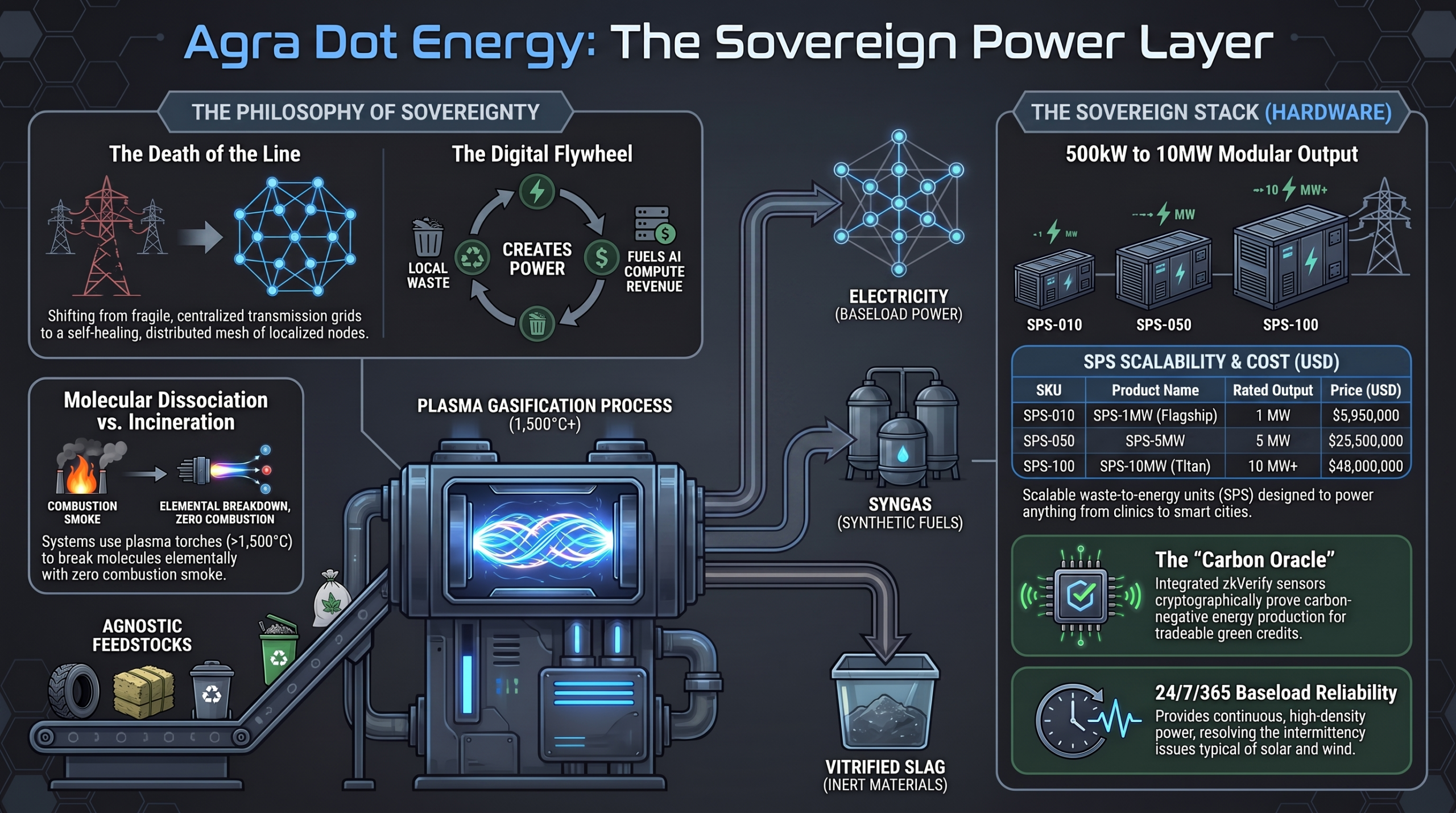
DeReticular operates on the “Trinity Stack” model: The Heart (Waste-to-energy/Solar power), The Brain (RIOS OS), and The Soul (Human capital/Academy). Its infrastructure is designed for “Island Mode,” remaining fully functional during internet or power failures.
3.1 Hardware Product Hierarchy
Tier Name Form Factor Key Specifications Use Case
Tier 1 Expeditionary 3x IP67 Hard Cases Intel Xeon, NVIDIA A2 GPU, 2kWh Battery. Tactical edge, disaster response.
Tier 2 Standard 10ft ISO Container 4.4kW Solar, 20kWh Battery, 9,000 BTU HVAC. Village utility hub, regional office.
Tier 3 AI Core 20ft ISO Container Dual Xeon Platinum, NVIDIA A100 GPU, 60kWh Battery. Supercomputing, deep learning training.
3.2 RIOS Software and Licensing
DeReticular employs a dual-engine business model:
- SaaS Engine (RIOS Mobile Pro): MSRP $1,200/year. Focuses on Intelligent Signal Fusion (ISF), bonding Starlink and 5G to provide 1 Gbps throughput.
- Perpetual Engine (Sovereign Cloud Suite): MSRP $200,000. A high-ticket license transforming compute clusters into regional, HIPAA-compliant cloud data centers.
- Software-Defined Memory (Kove:SDM™)
To legitimize sovereign infrastructure against centralized clouds like AWS, DeReticular incorporates Kove:SDM™.
- Technology Breakthrough: Decouples memory from the CPU, allowing a cluster to treat collective RAM as a single, liquid pool. A server can “borrow” RAM from neighbors over a network in nanoseconds.
- Connectivity Requirements: Requires a high-speed data plane using RDMA (Remote Direct Memory Access) via RoCE v2 or InfiniBand.
- Compatibility:
- Incompatible: Raspberry Pi 5 and Intel N100 Mini-PCs (lack RDMA-capable NICs; software emulation introduces too much latency).
- Compatible: Rack-mounted servers, Sentry Pro Clusters, and Tier 3 AI Cores.
- “Sovereign Core” Concept: A proposed 4U Rack Cluster acting as a “Mothership” that dynamically pools 512GB+ of RAM to process heavy AI tasks offloaded from edge nodes.
- Project Oasis: Industrial Symbiosis
Located in Karamoja, Uganda, Project Oasis is a 50 MW Eco-Industrial Park utilizing Behind-the-Meter (BTM) power generation to avoid national grid instability and tariff charges (30%–40% of standard bills).
5.1 Thermal Symbiosis Loop
The park repurposes waste heat across three temperature grades:
- Low-Grade: Data center waste heat (35°C-45°C) is piped to marble curing rooms, saving 2-4 MW of electricity annually.
- Medium-Grade: Hydrogen electrolyzer heat (60°C-80°C) powers a Multi-Effect Distillation (MED) plant for water purification.
- Cold-Chain: Refrigeration compressor heat (50°C-70°C) pre-heats water for electrolyzers, boosting efficiency by 10%–15%.
5.2 Agrivoltaics and “Green Marble”
- Solar-Plus-Grazing: Elevated panels (2.5m clearance) reduce soil evaporation by 25%–30%, supporting a “Peace Herd” of cattle and goats. This increases dairy yields by approximately 40%.
- Green Marble Certification: By using 100% renewable BTM power, the marble produced is exempt from EU Carbon Border Adjustment Mechanism (CBAM) taxes, commanding a 15%–20% price premium.
- Trust Mechanics: Split-Ledger Architecture
To solve the “Crisis of Trust” in global supply chains (e.g., HempGrade AI), DeReticular utilizes a split-ledger model to balance transparency with privacy.
- Layer A (Private – “The Bank”): Built on Hyperledger Fabric or Horizen. Manages KYC/AML, farmer identities, and financial settlements. Restricted to admins and regulators.
- Layer B (Public – “The Library”): Built on Freenet (Locutus). Stores physical grading metrics, timestamps, and hardware signatures. Open to public verification.
- The Hardware Oracle: Ed25519 Private Keys are burned into the physical TPM 2.0 chips during manufacturing. This allows the hardware to sign data at the source, ensuring that a specific machine at a specific geohash processed the asset, eliminating human bias or data spoofing.
- Key Operational Metrics and Financials
7.1 Quantitative Data
- Conversion Rate Multiplier: AI-agent shoppers convert at 4x the rate of traditional human web browsers.
- Transaction Velocity: Machine systems target sub-150ms authorization, compared to 2-3 seconds for human credit card gateways.
- Project Oasis ROI: The marble processing unit has a projected payback period of 2.8 years and an IRR of 26.4%.
- Carbon Sequestration: The agrivoltaic zone at Project Oasis is projected to remove 9,450 tons of CO2e over 10 years.
7.2 Notable Quotes and Definitions
- “The Death of the Line”: The philosophy that centralized linear grids are inherently fragile and prone to economic extraction.
- “Blue-Collar AI”: The focus on deploying edge-native AI directly to the physical world to manage machinery and utilities.
- GEO (Generative Engine Optimization): Structuring inventory and data so AI “Answer Engines” can parse and recommend products.
- “Island Mode”: An operational state where hardware and software run autonomously without relying on centralized cloud providers.
- “The Visibility Gap”: The loss of merchant web analytics during an agent’s discovery phase, as browsing occurs locally within the user’s AI model.


