Engineering Design Manual: The Karamoja Diamond Integrated Eco-Industrial Hub
1. Strategic Framework for Grid-Independent Industrialization
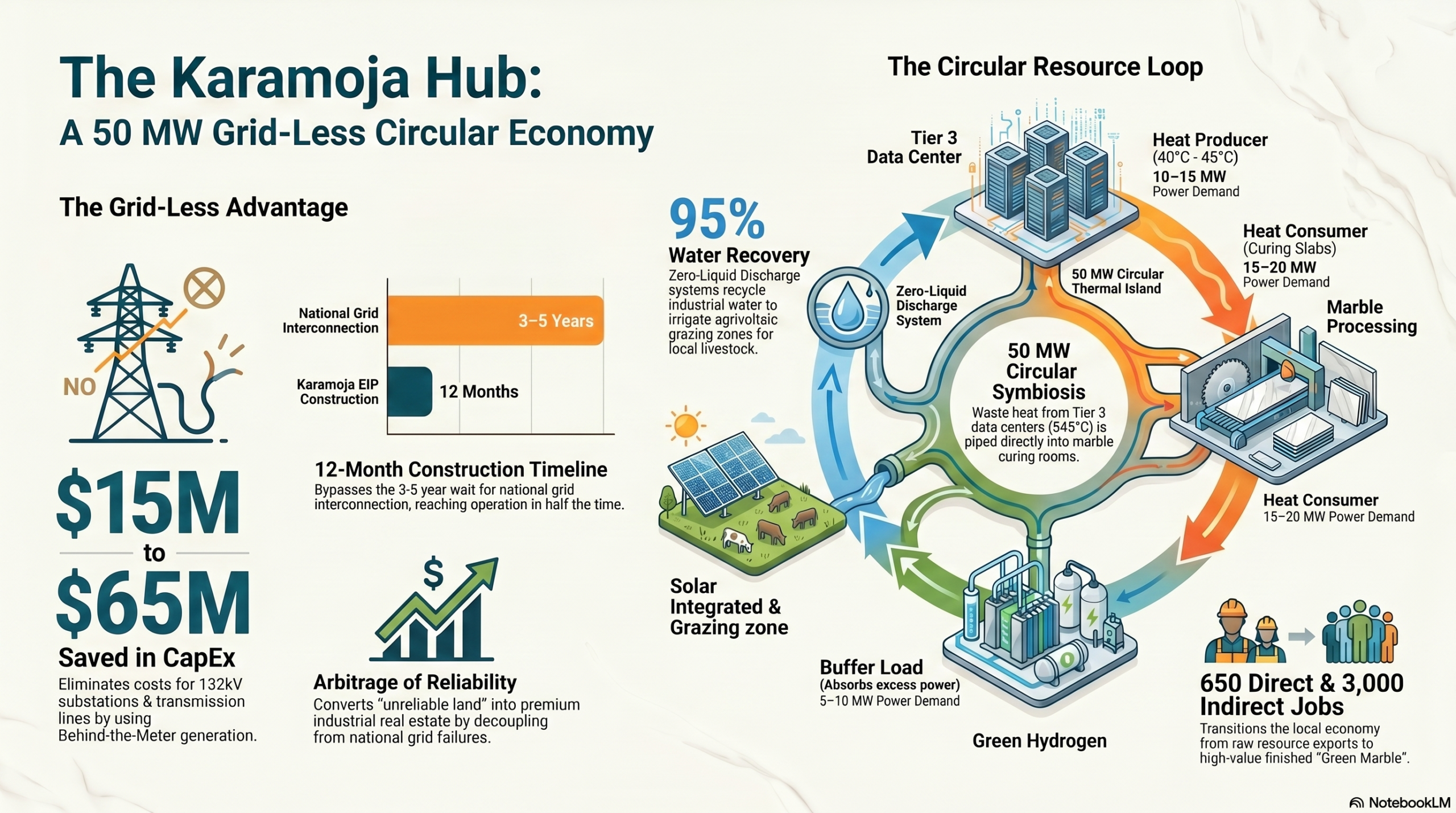
In the context of frontier industrialization, “Behind-the-Meter” (BTM) generation is not merely an energy preference but a strategic imperative. In remote regions like Karamoja, decoupling from the national grid transforms geographic isolation into a distinct competitive advantage. By co-locating 50 MW of hybrid generation directly within the industrial boundary, we eliminate the infrastructure bottlenecks, tariff volatility, and transmission losses that traditionally stifle remote development. This model enables a “Gross Margin optimization” by avoiding the 30–40% Transmission and Distribution (T&D) charges inherent in national utility bills, while simultaneously removing the requirement for expensive, external infrastructure.
Financial Advantage of Grid Independence
| Infrastructure Component | National Grid Connection (Estimated Cost) | BTM Private Microgrid Advantage |
| 132/33kV Substation | $12 Million – $25 Million | Eliminated (Integrated into internal plant) |
| Transmission Lines | ~$10 Million (for 30km link) | Eliminated (Zero-mile transmission) |
| Interconnect Wait Time | 3 – 5 Years | Reduction to 18 – 24 Months |
| Operating Expenses | Subject to 30–40% T&D charges | Avoided (Direct consumption arbitrage) |
This model captures a significant “Green Premium” and “Impact Alpha” by utilizing 100% renewable energy and circular resource loops. This allows finished exports, such as Karamoja “Green” Marble, to command a 15–20% price premium in EU and US markets where Net-Zero compliance is a prerequisite for high-end construction. The resulting financial logic dictates a rigorous spatial arrangement to ensure resource flows are optimized across the site.
2. Spatial Engineering: The “Karamoja Diamond” Layout
The “Karamoja Diamond” is a spatial optimization strategy designed to harmonize industrial output with the region’s unique environmental factors. The layout accounts for the southeasterly prevailing winds and high dust potential of stone processing, while the compact “diamond” shape minimizes thermal transport losses. Central to this arrangement is a $4 million “Thermal Backbone”—a 2-kilometer loop of insulated High-Density Polyethylene (HDPE) piping that facilitates the exchange of energy between sectors.
Industrial Zoning and Engineering Logic
- South (Generation Zone): Heat/Power Source This zone hosts the primary 50 MW Solar, Wind, and CSP arrays. It is positioned to maximize sun exposure and utilize the “high albedo” of Karamoja soil to boost the efficiency of bifacial PV panels. It is kept separate from industrial activity to prevent dust interference.
- Southeast (Upwind Zone): Tier 3 Data Center As a primary producer of low-grade heat (35-45^\circC), the data center is positioned upwind. This ensures the intake of clean, dust-free air, which is critical for server hardware longevity.
- Center (The Hub): BESS & Thermal Exchange The 200 MWh Battery Energy Storage System (BESS) and the central thermal switching station are located here. This minimizes the length of both insulated thermal pipes and DC cables, reducing voltage drops and thermal bleed across the hub.
- North (Mid-Stream Zone): Meat & Hydrogen Processing These facilities act as producers of medium-grade heat (50-80^\circC). Clustering these “hot” processes together allows for efficient thermal cascading for water purification and pre-heating roles.
- Northwest (Downwind Zone): Marble Processing As the primary heat consumer and dust generator, the marble facility is placed downwind. This ensures stone dust is carried away from the energy generation and sensitive data zones.
Environmental Resilience Features
- Green Buffer: A natural filter of Neem and Acacia trees is planted between the Marble sector and the Data Center to mitigate particulate drift.
- Flash-Flood Harvesting: The 20,000 m^2 of combined rooftop space is engineered to channel seasonal rains into underground sand dams, providing year-round industrial water.
Zonal optimization dictates the mechanical routing for the following energy and resource flows.
3. The 50 MW Microgrid and Energy Infrastructure
The semi-arid, high-altitude environment of Karamoja necessitates a hybrid energy model to provide a stable industrial baseline. Inspired by the Wumatang project, this system integrates Bifacial PV to capture high ground albedo, Wind for night-time smoothing, and Concentrated Solar Power (CSP) utilizing 8.6-meter large-aperture collectors.
Technical Specifications
- Generation Mix: 50 MW total capacity.
- Storage (BESS): A 200 MWh Battery Energy Storage System provides 4 hours of duration and handles the high inrush currents required for industrial marble-cutting saws.
- CSP Component: Parabolic Trough technology utilizing 8.6-meter large-aperture collectors for high-efficiency thermal capture.
- Microgrid Controller (EMS): Manages real-time demand and stabilizes the 220kV regional interface with Black-Start Capability, allowing the hub to restart independently after any shutdown.
Operational Continuity and Load Logic
The EMS utilizes a strict Load Shedding Logic to protect critical operations, treating Green Hydrogen as a flexible “buffer load” to absorb excess generation during peak hours.
- Priority 1: Cold Storage (preserving meat and dairy value chains).
- Priority 2: Data Center (digital sovereignty).
- Buffer Load: Green Hydrogen Electrolyzers (automatically disconnected during generation dips to protect refrigeration and servers).
Strategic generation is only half of the efficiency equation; the secondary byproduct—thermal energy—is recovered via a cascading system.
4. Mechanics of the Three-Stage Thermal Symbiosis Loop
The hub functions as a “Circular Thermal Island,” employing the principle of Thermal Cascading, where waste heat is diverted to its most efficient subsequent use via the $4 million HDPE Thermal Backbone. HDPE was selected specifically for its durability and resistance to thermal expansion in semi-arid environments.
Stage 1: The Low-Grade Loop (Data Center to Marble)
The Data Center produces constant heat at 35-45^\circC. This energy is diverted to Marble Curing Rooms, which require a stable 21-27^\circC (70-80^\circF) environment for epoxy resins to cure. This mechanical exchange eliminates the need for electric space heaters, saving approximately 3.2 GWh of energy annually (roughly 2–4 MW of electrical capacity).
Stage 2: The Medium-Grade Loop (Hydrogen to Water)
Green Hydrogen electrolyzers generate heat at 60-80^\circC. This powers Multi-Effect Distillation (MED) units. By using this waste heat to purify water, the park achieves high levels of self-sufficiency, providing distilled water for cooling and human consumption.
Stage 3: The Cold-Chain Loop (Meat to Hydrogen)
Rejection heat from the meat sector’s industrial compressors (50-70^\circC) is utilized as a “pre-heater” for the Hydrogen Electrolyzer. Feeding the electrolyzer warm water instead of cold increases hydrogen production efficiency by 10–15%.
This thermal integration ensures that every unit of energy is utilized multiple times before eventual rejection via air-cooled condensers.
5. The Water-Gold Loop and Agrivoltaic Integration
In water-scarce Karamoja, a “Net-Zero Water” strategy is essential. The hub prioritizes water recovery over consumption, utilizing Air-Cooled Condensers (ACC) to preserve groundwater, despite a ~4% peak-heat efficiency trade-off.
Daily Industrial Water Demand
| Sector | Demand (m^3/day) | Cooling/Usage Type | Recycling/Recovery |
| Data Center | 0 – 5 | Air-Cooled (Dry) | N/A |
| Marble Processing | 150 | 95% Recycled (Blade Lubrication) | 95% Recovery Rate |
| Meat Processing | 120 | High sanitation need | Zero Liquid Discharge (ZLD) |
| Green Hydrogen | 80 | Electrolysis (9L H_2O:1kg H_2) | N/A |
| PV Cleaning | 10 | Automated dry-brushing | N/A |
| TOTAL (Net Draw) | ~250 – 300 | Equivalent to one borehole | Net draw minimized via IS |
Agrivoltaic Mechanism and Livestock
The 150-hectare solar array is elevated to 2.5 meters to support the “Peace Herd” of 54 Cattle and 360 Goats. This configuration utilizes the Tropical Livestock Unit (TLU) calculation where 1 TLU equals a 250kg animal. The shading “boost” reduces soil evaporation by 25–30%, improving the carrying capacity from 4.0 ha/TLU (open range) to 2.8 ha/TLU. This extends grazing seasons by 3–5 weeks.
As a de-risking tool for social license, the hub provides 50,000 liters of purified surplus water daily to surrounding manyattas.
6. Industrial Output: Green Marble and Value-Added Exports
The transition from raw block export to finished goods is underpinned by the “Green Marble” status, which allows for premium global pricing.
The Triple-Lock Legal Framework
- ANSI/NSI 373 Platinum: Certification for sustainable stone production, requiring 90% water recycling and 100% renewable energy use.
- EU CBAM Compliance: Zero-carbon production exempts the marble from the EU’s Carbon Border Adjustment Mechanism taxes.
- Blockchain Ledger: The park’s data center maintains a secure ledger tracking the renewable energy source for every specific slab, providing verifiable proof of “Green” status for luxury markets.
Material Ingredient Report (LEED v4.1 Eligibility)
To qualify for Building Product Disclosure and Optimization credits, the marble slabs maintain the following chemical inventory:
- Calcium Carbonate: 98.8%
- Magnesium Carbonate: <1.0%
- Epoxy Resin (Cured): 0.15%
- Hardener (Amine-based): 0.05%
- Volatile Organic Compounds (VOCs): 0 g/L (Non-emitting)
- Embodied Carbon: 0.00 kg CO_2e (Cradle-to-Gate)
7. Implementation Roadmap and Logistics
The BTM design enables an accelerated 12-month construction timeline by bypassing the 3–5 year grid-connection wait times prevalent in the region.
Quarterly Construction Phases
- Q1: Mobilization: Logistics hub setup in Moroto; earth-moving for the Diamond layout; foundation drilling.
- Q2: Energy Core: Installation of 50 MW bifacial array and 200 MWh BESS; completion of the Data Center shell; first power hot-testing.
- Q3: Industrial Hub: Installation of diamond wire saws; completion of Cold Storage; vocational training for 200 workers; commissioning of the 5 MW Green Hydrogen pilot.
- Q4: Commissioning: Full symbiosis/heat transfer verification; final audit for Platinum Certification; first export shipment.
Multi-Modal Logistics Strategy
The hub employs a “Green Logistics” model to move finished slabs 920 kilometers to the Port of Mombasa:
- Leg 1 (Road): Moroto to Malaba via 30-ton flatbed trucks fueled by Green Hydrogen produced on-site.
- Leg 2 (Rail): Malaba to Mombasa via the Standard Gauge Railway (SGR), reducing transport costs by 35% with a $2,700 per container cost and a total 6.5-day lead time.
- Quality Control: Steel A-frames with GPS shock monitoring ensure zero-breakage delivery.
10-Year Economic Value
Over its first decade, the hub is projected to generate $30.0 million in gross economic value, broken down as follows:
- Processed Marble Exports: $25.0 Million
- Avoided Energy Costs: $3.5 Million
- Dairy & Meat Revenue: $1.3 Million
- Carbon Credit Revenue: $0.2 Million
This total confirms the hub’s status as a self-sustaining industrial organism, delivering a bankable ROI while securing a resilient future for the Karamoja region.


