
Evolutionary Trends in Cellular IoT and Next-Generation Connectivity: A Comprehensive Study Guide
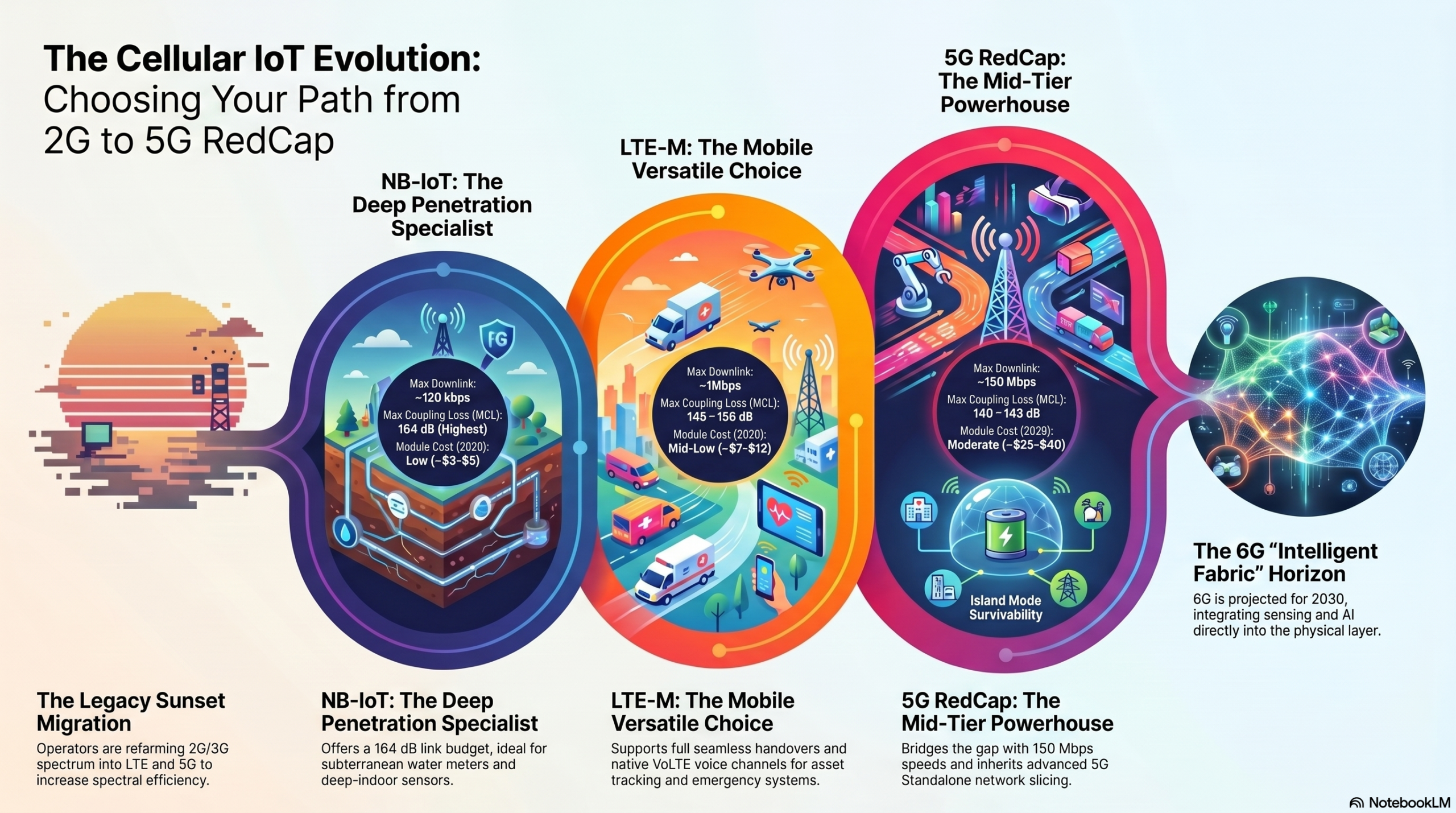
This study guide provides a detailed synthesis of the technical evolution from legacy 2G networks to 4G LTE, 5G RedCap, and the emerging 6G standards. It covers architectural transitions, radio frequency (RF) propagation physics, security paradigms, and the strategic shift toward sovereign, edge-resilient infrastructure.
——————————————————————————–
Link to the Technical White Paper https://dereticular.com/technical-white-paper-securing-the-kinetic-edge-a-sovereign-stack-evaluation-of-nb-iot-lte-m-and-5g-redcap/
Part I: Short-Answer Quiz
1. What is Circuit-Switched Fallback (CSFB) and why was it necessary during the initial deployment of LTE? CSFB is a mechanism where an LTE device drops its radio connection to a legacy 2G or 3G network to complete a voice call. This was necessary because early LTE networks were entirely packet-switched and did not natively support traditional circuit-switched voice services before the maturation of Voice over LTE (VoLTE).
2. Explain the “Subterranean Advantage” of NB-IoT in terms of Power Spectral Density (PSD). NB-IoT achieves superior penetration by concentrating its transmit power into an ultra-narrow 180 kHz bandwidth rather than diluting it across a wide channel. This high PSD concentration increases the signal-to-noise ratio, allowing the signal to survive severe attenuation from barriers like reinforced concrete, soil, and steel.
3. What are the primary differences between 5G RedCap (Release 17) and eRedCap (Release 18)? 5G RedCap operates with a 20 MHz bandwidth and peak speeds of 150 Mbps, whereas eRedCap scales complexity down further to a 5 MHz bandwidth and 10 Mbps peak speeds. While RedCap is designed for mid-tier IoT, eRedCap specifically targets the ultra-low-cost segment currently served by LTE Cat-1 and Cat-1bis.
4. Why is 2G considered structurally insecure compared to LTE and 5G standards? 2G networks suffer from unidirectional authentication, where only the device authenticates to the network, allowing “IMSI Catchers” to mimic towers and intercept traffic. Additionally, 2G uses weak, compromised encryption algorithms (like A5/1) and lacks data integrity protection, making it vulnerable to real-time cracking and tampering.
Link to the Podcast https://academy.dereticular.com/podcast/evolution-of-cellular-iot-from-5g-redcap-to-6g-foundations/
5. Define “Island Mode” within the context of the Sovereign Stack and resilient infrastructure. Island Mode refers to the ability of localized operational infrastructure to remain fully functional and autonomous even if the link to a centralized cloud or carrier backhaul is severed. It requires edge-based coordination, private cellular cores, and local orchestration to prevent a single point of network failure.
6. What is the “Structural Deficit” of 5G RedCap coverage, and how is it mitigated? RedCap devices typically use only 1 or 2 receive antennas compared to the 4 antennas found in standard 5G devices, resulting in a 3 dB to 4 dB coverage penalty. To recover this loss, 3GPP introduced techniques such as slot aggregation, inter-slot frequency hopping, and transport block scaling.
7. How do Power Saving Mode (PSM) and Extended Discontinuous Reception (eDRX) improve device longevity? PSM allows a device to enter a deep sleep while staying registered with the network, avoiding energy-heavy re-attachments upon waking. eDRX extends the time between paging cycles—from milliseconds to hours—reducing the frequency with which a device must power its receiver to check for incoming data.
8. What role does Integrated Sensing and Communication (ISAC) play in the 6G vision? ISAC enables 6G infrastructure to use radio signals for both data transmission and environmental perception, essentially acting as a radar-like sensor network. This allows for centimeter-level spatial positioning and the digital twinning of environments without the need for external dedicated sensors.
9. Why is LTE-M described as the “practical sovereign edge layer” for modern IoT deployments? LTE-M is considered practical because it balances 1 Mbps data rates, full mobility (handovers), and VoLTE support with a mature ecosystem of low-cost hardware and stable private cores. It is easier to operationalize than full 5G while offering significantly more flexibility and security than legacy 2G or NB-IoT.
10. What are the main economic barriers to the widespread adoption of 5G RedCap in 2026? The primary barrier is a significant module pricing gap; as of 2026, 4G LTE Cat-1bis modules cost approximately 4–6, while 5G RedCap modules remain in the 25–40 range. This premium makes LTE hardware more attractive for short-lifecycle devices, even as RedCap offers superior future-proofing.
——————————————————————————–
Part II: Answer Key
- CSFB: A transition mechanism for voice calls from LTE to legacy networks; required because early LTE lacked native voice support.
- NB-IoT PSD: High power concentration in a narrow 180 kHz band; enables penetration through thick physical barriers.
- RedCap vs. eRedCap: RedCap (20 MHz, 150 Mbps) vs. eRedCap (5 MHz, 10 Mbps); eRedCap is lower complexity/cost.
- 2G Insecurity: Unidirectional authentication (vulnerable to Stingrays), weak encryption (A5/1), and lack of data integrity.
- Island Mode: Localized network autonomy that functions without external backhaul or centralized cloud links.
- RedCap Deficit: 3-4 dB loss due to fewer antennas; mitigated by slot aggregation and frequency hopping.
- PSM/eDRX: PSM keeps the device registered during deep sleep; eDRX lengthens the interval between signal checks.
- ISAC: Merges communication with radar-like environmental sensing for high-precision positioning and digital twinning.
- LTE-M Practicality: Offers mobility and voice on a mature, cost-effective, and secure ecosystem.
- Economic Barriers: High module costs (25-40) compared to legacy LTE (4-6).
——————————————————————————–
Part III: Essay Format Questions
- The Spectrum Refarming Challenge: Analyze the strategic trade-offs telecommunication operators face when sunsetting 2G/3G networks. Discuss how regional differences in infrastructure (e.g., Europe vs. North America vs. Developing Markets) influence the timeline and technology selection for migration.
- RF Propagation and Deployment Feasibility: Compare the Maximum Coupling Loss (MCL) and frequency band dependencies of NB-IoT, LTE-M, and 5G RedCap. Explain how these physical layer characteristics dictate the specific use cases for which each technology is physically suited.
- The Architecture of Sovereignty: Evaluate the role of private 5G Standalone (5G SA) cores and edge computing in building “Sovereign Stacks.” How does the shift from centralized cloud backhaul to localized routing change the security and reliability profile of critical infrastructure like smart grids?
- The Security Evolution of Cellular Standards: Trace the advancement of security protocols from 2G’s unidirectional authentication to 5G’s mutual authentication and SUCI encryption. Discuss how hardware Roots of Trust (TPM/HSM) complement these cellular standards to ensure data integrity in hostile environments.
- The Road to 6G: Discuss the conceptual shift in 6G from “faster data” to an “intelligent fabric” integrating AI-native architectures, Non-Terrestrial Networks (NTN), and Terahertz spectrum. What are the material and geopolitical hurdles that could delay the 2030 commercial target?
——————————————————————————–
Part IV: Glossary of Key Terms
| Term | Definition |
| 5G RedCap (Reduced Capability) | A 3GPP Release 17 standard (NR-Light) designed to bridge the gap between low-power IoT and high-speed 5G eMBB. |
| 6G (IMT-2030) | The next generation of wireless tech (target 2030) integrating sensing, computing, and AI-native communications. |
| Circuit-Switched Fallback (CSFB) | A protocol that moves a device from an LTE network to a 2G/3G network to perform a voice call. |
| eDRX (Extended Discontinuous Reception) | A power-saving feature that increases the interval a device sleeps between checking for network pages. |
| eRedCap | An enhanced version of RedCap (Release 18) with further reduced bandwidth (5 MHz) and lower peak data rates (~10 Mbps). |
| FR1 / FR2 | Frequency Range 1 (sub-6 GHz/sub-7 GHz) and Frequency Range 2 (mmWave/high-band spectrum). |
| IMSI Catcher (Stingray) | A device that mimics a cell tower to exploit 2G/3G security weaknesses for tracking or interception. |
| Island Mode | An operational state where a local network continues to function autonomously without an external cloud or backhaul link. |
| LTE-M (eMTC) | A low-power wide-area standard supporting mobility, VoLTE, and 1.4 MHz bandwidth. |
| Maximum Coupling Loss (MCL) | The maximum signal attenuation (in dB) a system can tolerate while maintaining a connection; higher is better for coverage. |
| Mutual Authentication | A security process where both the device and the network must verify each other’s identities; introduced in LTE. |
| NB-IoT (Narrowband IoT) | An LPWAN standard optimized for stationary, subterranean, and deep-indoor sensors using 180 kHz bandwidth. |
| Network Slicing | A 5G feature allowing operators to create virtual, isolated network segments with specific performance guarantees. |
| Power Saving Mode (PSM) | A state allowing a device to sleep for long periods while remaining registered, reducing energy use. |
| Power Spectral Density (PSD) | The measure of signal power distributed over a frequency; high PSD improves penetration through barriers. |
| SUCI (Subscription Concealed Identifier) | An encrypted version of a user’s ID (SUPI) used in 5G to prevent identity tracking by passive eavesdroppers. |
| Time-Sensitive Networking (TSN) | Technology inherited by 5G RedCap that allows for microsecond-level synchronization of industrial machinery. |
| VoLTE / VoNR | Voice over LTE and Voice over New Radio (5G); methods for delivering high-quality voice over packet-switched networks. |


