From Diesel Slavery to Sovereign Swarms: The Quiet Revolution Rewiring the American Heartland
The $800,000 Crisis
The modern American farm is at a terminal breaking point known as the “Capital Gap.” Today, a single high-end combine or autonomous tractor commands a price tag between $500,000 and $800,000—surpassing the cost of many family homes. This massive financial barrier has created a state of “Structural Decay,” where the mounting costs of maintenance, debt service, and global fuel logistics are beginning to exceed total operational profits. Rural landowners are no longer farmers; they are increasingly indentured to a centralized industrial complex.
podcast
We are witnessing the final failure of “The Line”—a fragile, linear supply chain of global petroleum and aging utility grids that functions as an Entropy Trap. To survive, the rural entrepreneur must pivot to “The Node,” a localized, resilient model of nodal autonomy. This is the shift from being a “Price Taker,” vulnerable to the next global market spike, to a “Market Maker” who generates energy and intelligence exactly where they are consumed. This is not just a technological upgrade; it is the decoupling from global entropy.
The End of “Heavy Iron”: Why Swarms Outperform Giants
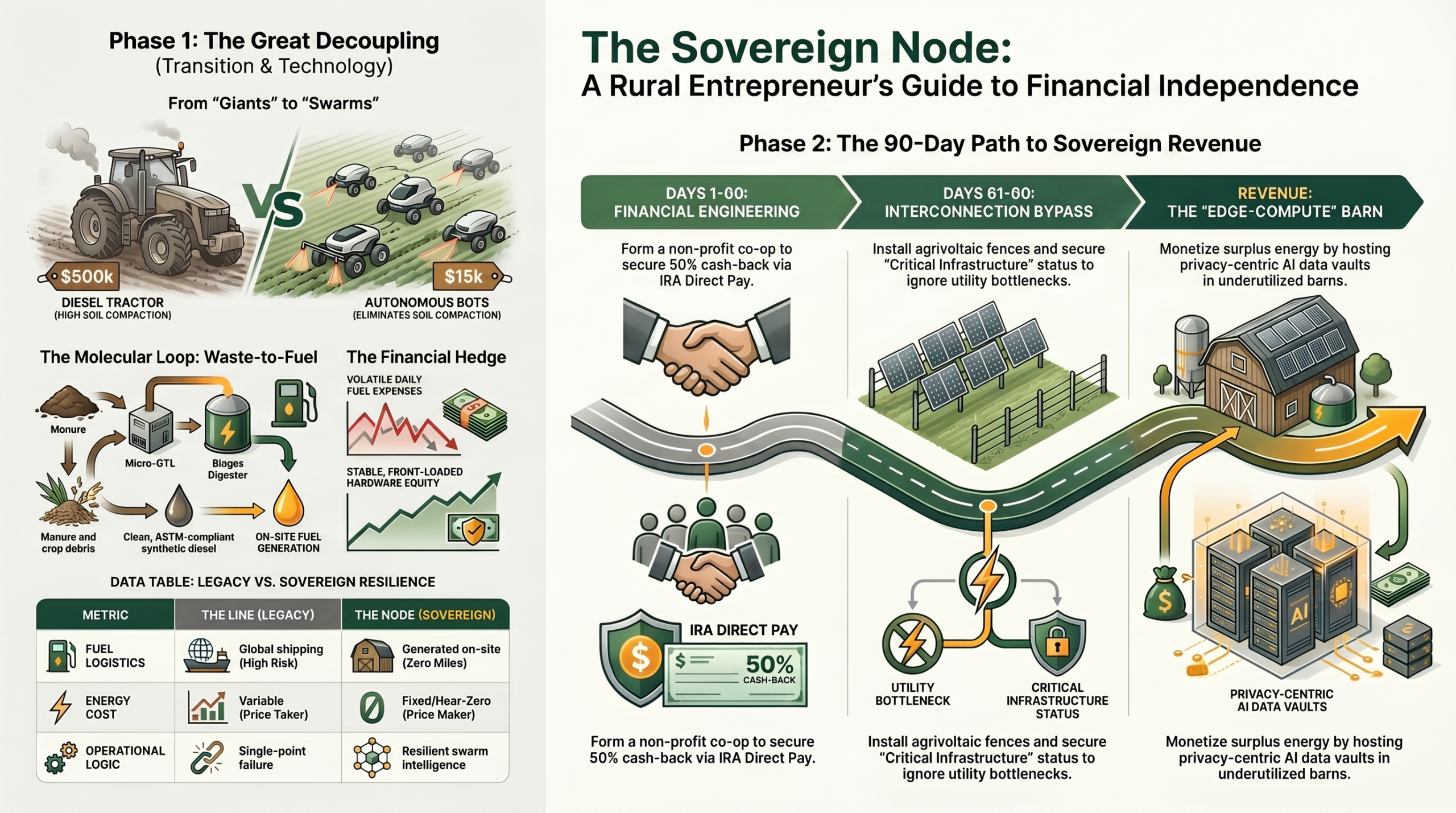
Legacy agriculture relies on “Giants”—20-ton monolithic machines that represent a single point of failure. If a $600,000 tractor suffers a sensor malfunction or a “Right to Repair” software lockout, the entire operation halts. In contrast, the Agricultural Autonomy-as-a-Service (AaaS) model utilizes “Swarm Logic.” By deploying fleets of small, 800-lb autonomous nodes, the operator achieves “anti-fragile” infrastructure. If one node fails, 95% of the fleet remains operational, and the modular unit can be swapped in minutes.
The metrics of productivity are shifting from “Driver-to-Horsepower” to “Compute-per-Plant.” While legacy giants compact soil up to three feet deep—reducing potential yields by 10–20%—swarm bots have a ground pressure lower than a human footprint. These bots use high-frequency cameras and Edge AI to identify and treat individual plants 24/7. This is “Metabolic Efficiency”: the system no longer moves 20 tons of iron to apply a single ounce of herbicide.
“Productivity is no longer about speed of travel (mph); it is about certainty of action… we are entering the era of ‘Swarm Logic,’ where productivity is governed by ‘Compute-per-Plant.'”
The Localized Energy Loop: Harvesting Energy Where You Spend It
To break “Diesel Slavery,” the sovereign entrepreneur must adopt the Localized Energy Loop (LEL). This circular infrastructure eliminates the “Transport Tax”—the 3–5% energy loss inherent in hauling fuel from regional depots—by replacing it with three pillars of on-site regeneration. Utilizing Agra-Dot Energy Micro-GTL units, entrepreneurs convert biological waste into ASF™ (Agra Synthetic Fuel). This fuel meets ASTM D975 standards, allowing it to power existing diesel equipment or generators with zero hardware modification.
The true “Molecular Loop” synergy lies in the thermal recapture: waste heat from the Fischer-Tropsch synthesis process is recycled to warm anaerobic digesters during winter, maintaining optimal fuel production speeds year-round. When combined with Vertical Agrivoltaic Fences and LFP Battery Vaults, the node achieves a front-loaded CAPEX model. Once the hardware is owned, the marginal cost of energy is statistically near zero, insulating the entrepreneur from the volatility of global oil markets.
“The Sovereign Node achieves stable, low-marginal-cost production compared to centralized conglomerates… the AI robot swarm ‘lives off the land’—harvesting energy exactly where it spends it.”
video
From “Field Hand” to “Fleet Commander”
The rural entrepreneur is evolving from manual labor to high-level orchestration. Using RIOS (Rural Infrastructure Operating System), an operator acts as a “Fleet Commander,” supervising 10–20 bots across multiple properties from a home office. This utilizes the “30% Human Rule”: the entrepreneur focuses their 30% effort on “Agility Arbitrage” and market navigation, while AI handles 70% of the repetitive operational data and navigation.
The business logic of AaaS is built on “Outcome-Based” revenue. Instead of predatory equipment loans, the operator provides precision services. A high-margin model is “Chemical Displacement” pricing, where the commander takes 30% of the farmer’s saved costs—often a 90% reduction in herbicide spend. Furthermore, they monetize “Green Data,” packaging soil-carbon and nitrogen telemetry to sell to carbon registries via the Locutus Ledger.
Protecting the “Biological Capital” of Soil
Soil structure is a form of equity that “Giants” are currently liquidating. The 20-ton machines of legacy conglomerates crush the earth, necessitating expensive chemical fertilizers and aggressive tillage just to maintain basic yields. This degradation is a hidden cost of the Entropy Trap. By contrast, the swarm model allows biological capital to compound over time.
Because these modular electric nodes can operate on saturated soil without getting stuck or damaging the earth, the “planting window” is effectively extended. Soil health is preserved, water infiltration is maintained, and root growth is unrestricted. The sovereign developer understands that a farm’s value is no longer just in its acreage, but in the structural integrity and intelligence of its soil.
Beyond Farming: The “Lifeboat” Economy
A Sovereign Node generates more than just crops; it generates high-margin intelligence. Vacant farm structures are being converted into “Privacy-Centric Hubs” for Edge-Compute. These data vaults provide AI inference services for industries like healthcare or defense that cannot trust the centralized cloud with sensitive data. The hub also functions as a “Medic & Rescue Lifeboat,” providing uninterrupted emergency power, medical cold storage, and mesh communications during grid blackouts.
Achieving “Critical Infrastructure (CI) Status” is the ultimate defensive move. By linking the node’s energy output to essential local services—like fire-breaks or emergency clinics—the entrepreneur gains a legal shield against utility lobbying and regulatory friction. In this model, the farm is a vital, un-killable utility. If the centralized grid tries to block the node, they are effectively blocking emergency medical logic and regional safety.
The 90-Day Bypass: Hacking the Financial System
Launching a sovereign node does not require traditional bank debt. The “Bypass Formula” utilizes a tactical 90-day roadmap to move “Above the Line.”
- Phase I (Days 1–30): Asset Audit. Identify feedstocks (manure, sun, waste) and pivot from a “Consumer Mindset” (tracking monthly bills) to a “Developer Mindset” (tracking asset yield).
- Phase II (Days 31–60): Financial Engineering. Form a non-profit cooperative to access IRA Direct Pay (Section 6417). This allows you to stack credits: a 30% base credit + 10% Domestic Content + 10% Energy Community for a total of 50% cash-back on hardware. Partner with DeReticular for Node-as-a-Service (NaaS) financing to cover the remaining balance through revenue share.
- Phase III (Days 61–90): Deployment. Execute a “Behind-the-Meter” build. By focusing on internal use and local adjacency, you bypass the 4–7 year utility interconnection queue and enter “Island Mode” immediately.
Conclusion: Decoupling from Entropy
The rural entrepreneur wins by moving “Above the Line”—shifting away from commoditized tools and into industry-specific workflows and energy sovereignty. By decoupling from the entropy of global logistics, the sovereign node achieves a “Structural Leverage” that multi-national conglomerates, burdened by their legacy “Heavy Iron,” simply cannot match.
This shift requires a fundamental transition in identity. It is no longer about buying a machine from a dealer; it is about owning the autonomous infrastructure of your county. The era of the price-taking farmer is over; the era of the sovereign developer has begun.
Ask yourself: In your current business and life, are you a Price Taker, vulnerable to the next global collapse, or a Market Maker, anchored in the resilience of your own sovereign node?


