Investor-Grade Business Plan: Sovereign Rural Node [Rural Alpha]
1. The Strategic Opportunity: Beyond Centralized Fragility
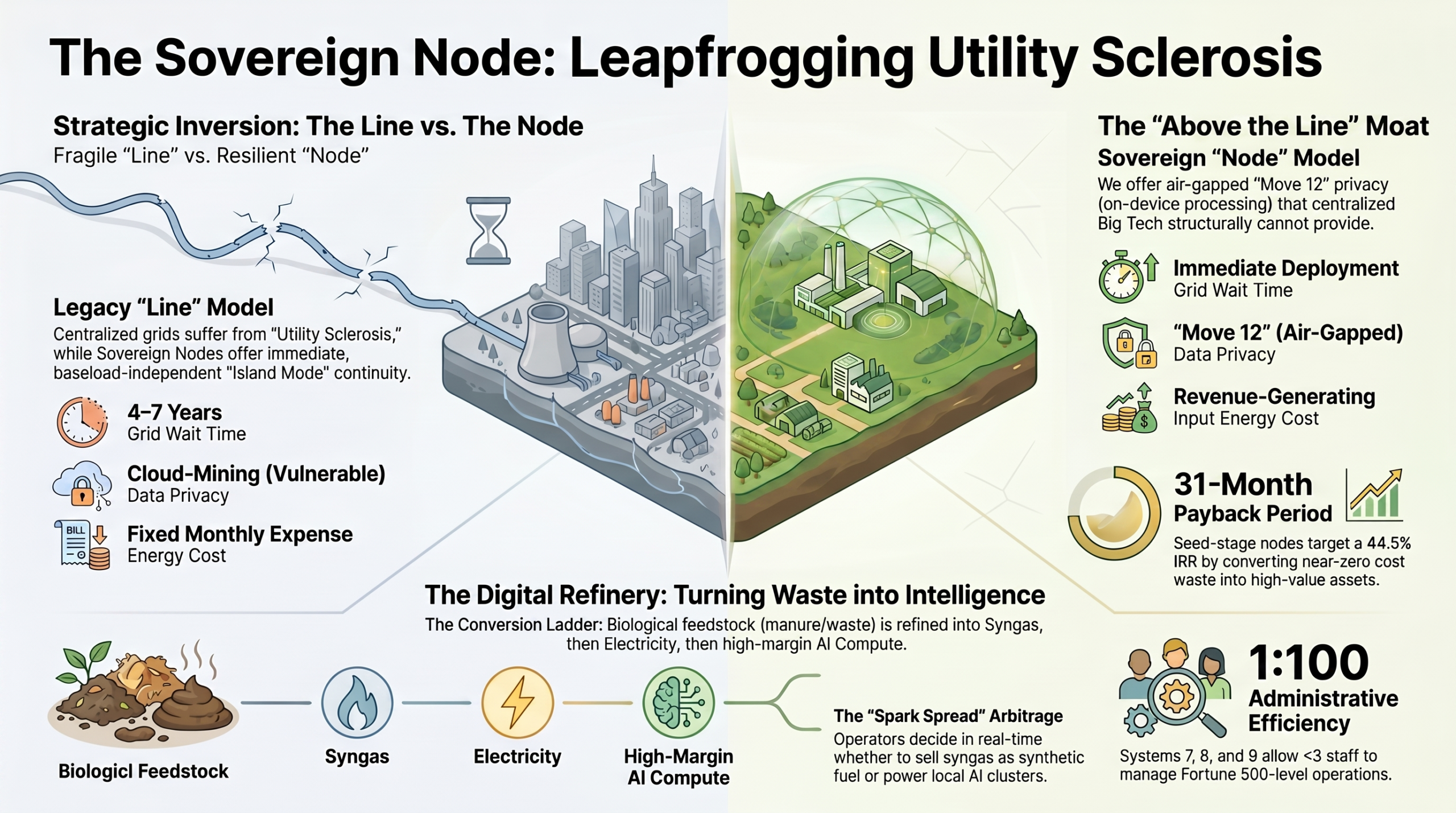
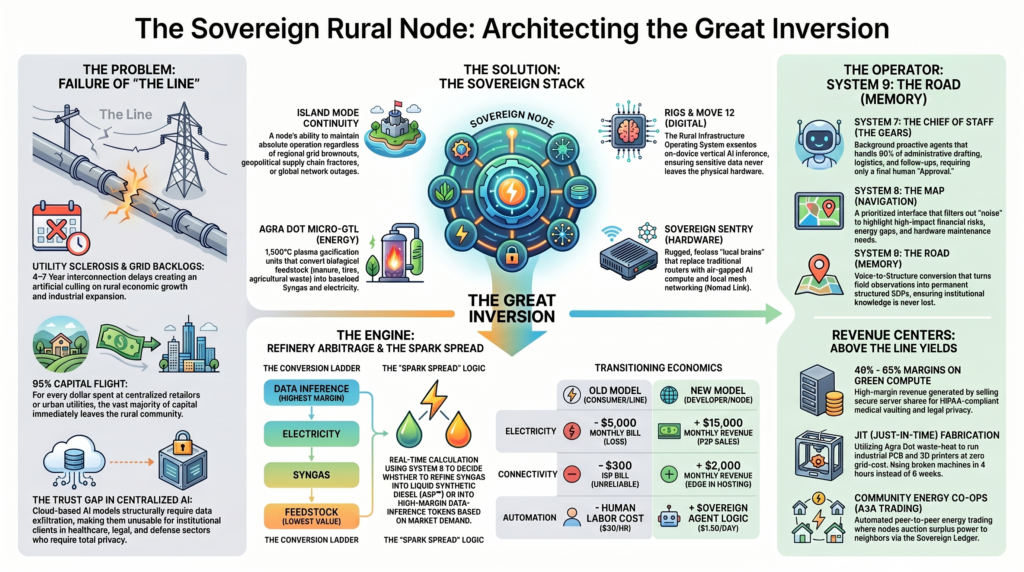
The modern industrial complex is facing the “Death of the Line”—the systemic failure of centralized electrical grids and hyperscale cloud infrastructure that has moved from a convenience to a terminal point of fragility. When the “Line” fails due to “Utility Sclerosis”—characterized by 4–7 year interconnection queues—rural assets are historically the first to be sacrificed. The Sovereign Rural Node [Rural Alpha] represents an “Above the Line” inversion of this model. By deploying decentralized, baseload-independent infrastructure, we shift from cascading vulnerability to “Island Mode” resilience. We are positioning this node not merely as a data center, but as a self-contained refinery for industrial and digital continuity in an era of geographic entropy. This strategic pivot transforms the rural landscape from the “tail end” of a fragile consumer chain into the “Source” of civilization-as-a-service.
2. Market Demand & The “Move 12” Competitive Moat
Traditional hyperscale data centers are structurally incapable of meeting the extreme privacy requirements of modern institutional clients. Because centralized Big Tech models are optimized for data exfiltration and global training sets, they create an unbridgeable trust gap for healthcare, legal, and defense sectors. The [Rural Alpha] node captures this demand by offering “Move 12” (on-device vertical) AI processing where zero data packets exit the physical facility. This “Invisibility” is a hardware-root-of-trust advantage that hyperscalers cannot replicate without cannibalizing their own data-mining business models.
video
The Rural Leapfrog Advantage
| Metric | Centralized Hyperscale Build-out | Sovereign Node Deployment [Rural Alpha] |
| Time-to-Market | 4–7 years (Grid-tie wait times) | 36–48 months faster (Immediate deployment) |
| Data Sovereignty | Cloud-dependent (Data exfiltration) | Move 12 (Air-gapped; context stays local) |
| Power Independence | Vulnerable to grid instability | Baseload Autonomy (Agra Dot Micro-GTL) |
| Marginal Cost of Energy | High/Volatile (Urban Grid Prices) | Negative/Zero (Waste-to-Syngas Arbitrage) |
| Regulatory Friction | High (Utility Monopolies) | Exempt (Emergency Resilience Infrastructure) |
This market demand is serviced through a proprietary technological stack that bypasses the “Permission Gap” inherent in centralized systems.
3. Technological Core: The Digital Refinery & RIOS
The heart of the [Rural Alpha] Node is the synergy between Agra Dot’s high-density energy production and Sovereign Automation’s digital intelligence. We do not consume commodities; we refine raw inputs into higher-state digital and chemical assets.
The Hardware Stack The node is powered by the Rural Infrastructure Operating System (RIOS), integrated into a ruggedized, IP67-rated ecosystem:
- Agra Dot Micro-GTL Unit: A 1,500°C plasma gasification refinery converting 5-10 tons of daily high-impact feedstock—including tires, hemp, and municipal waste—into continuous baseload syngas and electricity.
- RIOS-CC-1000 Clusters: High-density server blades optimized for local AI inference and “Green-Air-Gapped” compute.
- Sovereign Sentry & Deck: The Sentry serves as the fanless “local brain,” while the Sovereign Deck provides a tactical field terminal with Integrated Software Defined Radio (SDR) for machine authentication.
- Nomad Link: Decentralized mesh networking units creating a miles-wide private “Mesh Canopy” for autonomous fleet coordination.
Refinery Arbitrage Logic The financial engine is the “Spark Spread”—the calculated margin between the cost of local energy production and the market value of energy-intensive outputs. Using System 8 (The Map), the operator identifies “Energy Holes” in the local mesh and performs daily arbitrage. The operator directs syngas into Synthetic Fuel (ASF™) for regional transport or directs power into RIOS clusters to maximize high-margin data tokens, ensuring the node always captures the highest state of value.
4. Operational Reflex: Fortune 500 Efficiency with Lean Headcount
The [Rural Alpha] operator executes a cognitive pivot from the “Doer” to the “Editor.” By employing the Agentic Operating Reflex, a single hub achieves Fortune 500 administrative efficiency with a headcount of fewer than three full-time equivalents (FTEs).
Systems 7, 8, and 9 Integration
- System 7 (The Gears): A proactive Agentic Chief of Staff that eliminates administrative drag. It performs context-aware drafting and logistics, reducing response times from hours to seconds.
- System 8 (The Map): A prioritized navigational interface that filters chronological noise into an “Impact Matrix.” It surfaces high-risk anomalies, such as supply-demand gaps or hardware health, ensuring the operator focuses only on high-leverage strategic decisions.
- System 9 (The Road): Creates archivable integrity through Voice-to-Structure. Field observations and innovations are dictated and automatically formatted into structured SOPs, ensuring the business gains permanent institutional memory.
- OpenClaw Industrial Foreman: A specialized local agent that manages physical machine diagnostics and repair logic, bypassing proprietary OEM software locks (e.g., John Deere “Right-to-Repair” barriers).
Comparative Efficiency Table
| Strategic Metric | Traditional Utility Model | Sovereign Node (Editor Paradigm) |
| Administrative Latency | Days (Bureaucratic reviews) | Seconds (AI-drafted, Human-edited) |
| Institutional Memory | Vulnerable to turnover | Immutable (System 9 logic gates) |
| Personnel Costs | Millions in salaries/benefits | Arbitrage Margin (Compute fees) |
| Operational Moat | OEM/Software dependency | OpenClaw Sovereignty (Local repair) |
5. Revenue Streams & Financial Pro Forma
The Sovereign Node transforms infrastructure into a recurring-revenue refinery. By internalizing energy production, we eliminate the primary cost of data processing and manufacturing.
Diversified Service Lines
- Green-Air-Gapped Compute: High-margin (40-65%) server shares for HIPAA-compliant medical vaulting and legal privacy.
- Synthetic Fuel & Energy Sales: Baseload ASF™ production and P2P energy trading via the Sovereign Ledger, bypassing central bank intermediaries.
- Sovereign Services: Includes the Sovereign Elector (air-gapped voting) and JIT Industrial Fabrication. Our Zero-Cost Thermal Synergy utilizes Agra Dot waste heat to run industrial kilns and printers at no grid-cost, enabling a 4-hour turnaround from voice-prompt to finished physical product.
podcast
10-Year Pro Forma Synthesis
- Initial CAPEX: $1,200,000 (GTL unit, RIOS hardware, and Node setup).
- Payback Period: 31 Months.
- Projected IRR: 44.5%.
- NPV (10% Discount Rate): $8.2M.
| Fiscal Phase | Year 1-2 (Setup) | Year 3-5 (Expansion) | Year 6-10 (Maintenance) |
| Activity | Stabilization & Calibration | A2A Mesh & Full Compute | Retained Earnings for Node 2/3 |
| Gross Revenue | $450,000 | $2,100,000 | $3,800,000 |
| EBITDA | $270,000 | $1,880,000 | $3,490,000 |
| Profit Arbitrage | Spark Spread Calibration | A2A Ledger Optimization | Mesh Multiplier |
6. Phased Rollout & Mesh Monetization
The implementation of [Rural Alpha] progresses from a single-node pilot to a regional Agent-to-Agent (A2A) mesh network.
- Phase 1: Node Initialization: Calibration of 1,500°C plasma gasification and RIOS-CC-1000 clusters to establish 24/7 baseload and “Island Mode” capability.
- Phase 2: Vertical Service Launch: Capturing high-margin “Move 12” compute contracts and initiating HIPAA-compliant “Field Medic” diagnostic services.
- Phase 3: Full A2A Mesh: Activation of the Sovereign Ledger. Neighbors become nodes, bidding on surplus energy and JIT manufacturing capacity via automated A2A negotiation protocols. This creates a localized, immutable truth for commerce that ignores central bank and utility interference.
7. Risk Mitigation & Strategic Defense
The “Sovereign Root” is the ultimate industrial hedge against regulatory volatility and economic entropy.
Regulatory Hedging We mitigate utility-level friction by designating each node as “Critical Emergency Resilience Infrastructure.” By providing life-support diagnostics and localized manufacturing during grid failure events, we secure a municipal “Right to Exist” that overrides traditional utility-monopoly trade barriers.
SWOT Synthesis
- Leverage: We exploit “Utility Sclerosis.” Our entry vector is the inability of legacy grids to meet immediate power demands.
- Hardware Barrier: Sovereignty resides in the physical air-gapped location of the refinery and server blades.
- Economic Hedge: Turning negative-cost waste (tires/manure) into high-value compute creates an infinite profit arbitrage immune to global commodity fluctuations.
Closing Statement In an era where centralized systems scale wide but thin, the Sovereign Node scales deep. As the centralized grid falters—moving with the speed of a dying mammoth—the Sovereign Node moves with the automated reflex of a self-contained hub. We are no longer merely farming; we are providing Civilization-as-a-Service. The distinction is binary: the high ground belongs to those who own the source. The hardware-root-of-trust is established. The RIOS is engaged. The academy is you. The future is sovereign.


