
The 66GB Breakeven: How Micro-WISPs are Disrupting Big Telecom
1. Introduction: The End of Digital Dependency
For decades, our digital existence has been defined by a “reticular” geometry—a term describing systems that are net-like, highly intertwined, and deeply codependent. In infrastructure terms, this represents the “tangle” of big telecom: fragile, centralized monopolies that keep users trapped in a state of dependency. For the rural landowner, the remote resort operator, or the off-grid entrepreneur, the internet has traditionally been a passive cost center—a recurring utility bill that extracts capital from the community and sends it to a corporate headquarters thousands of miles away.
The emergence of the Sovereign WISP (Wireless Internet Service Provider) shifts this paradigm entirely. By adopting the DeReticular “Civilization-in-a-Box” philosophy, individuals are no longer mere consumers at the end of a line; they become independent operational nodes. This model transforms high-speed connectivity into a ruggedized, revenue-generating asset, bridging the gap between software philosophy and physical reality.
video
2. The 66GB Breakeven: Turning an Expense into an Asset
At the heart of the Sovereign WISP model is a mechanism known as the “Financial Flywheel.” In standard off-grid scenarios, high-performance connectivity is a heavy monthly liability. By integrating DeReticular hardware with Starlink Business via partners like TriFiWireless, that liability is converted into an automated profit center.
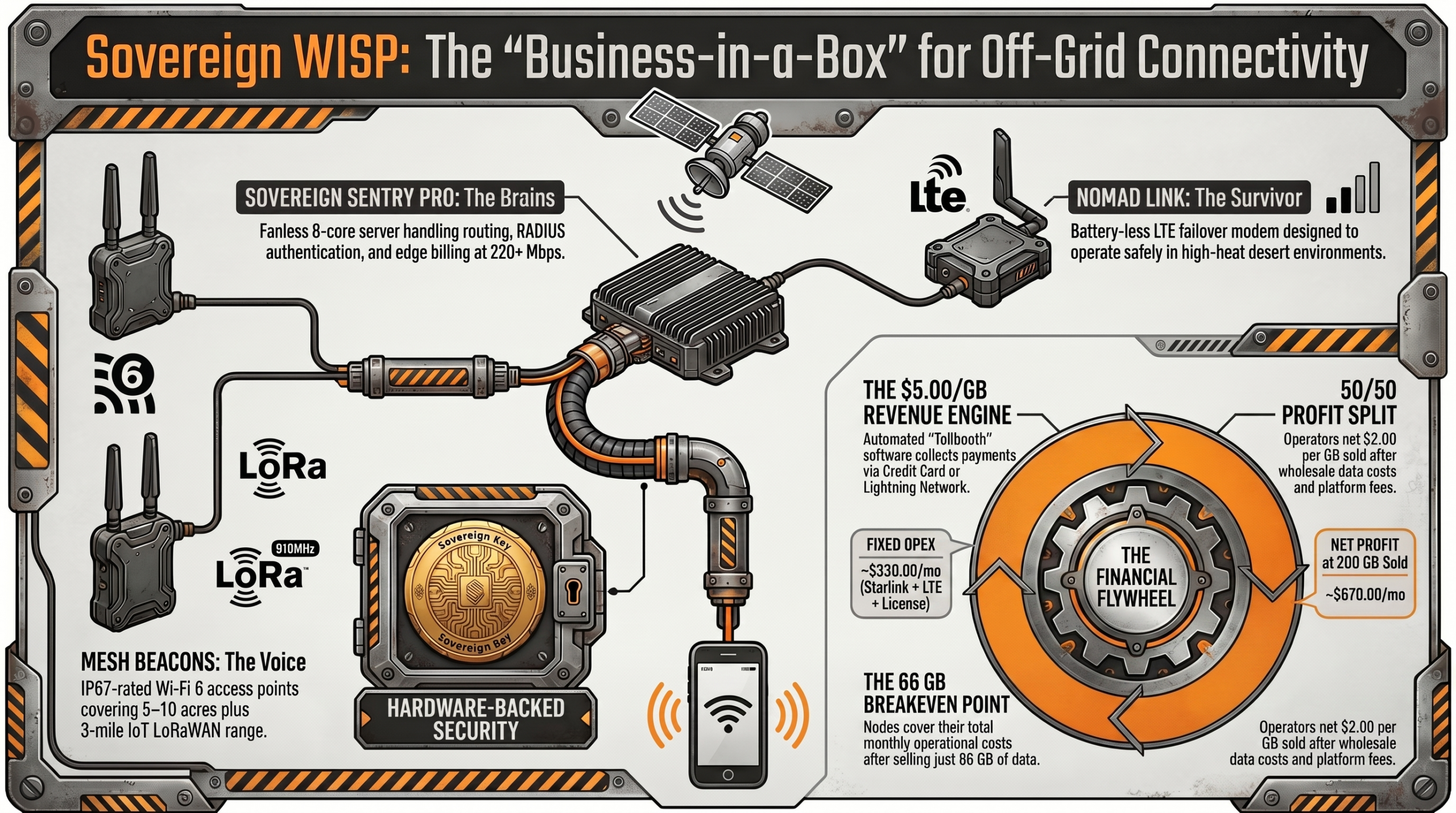
The math is precise. A typical node carries a monthly Operational Expenditure (OPEX) of approximately $330.00—which includes $250.00 for a 1TB Starlink Priority data plan, $50.00 for an LTE backup, and $30.00 for RIOS software licensing. Under the standard retail model, the operator sells data to transient users (RV tourists, contractors, or campers) at a rate of $5.00 per Gigabyte (GB).
This is the “66GB Breakeven.” When the node generates $330.00 in gross revenue—the point at which exactly 66 GB of retail data has been sold—the system has completely offset its own monthly operating costs. To ensure this financial longevity, the “Tollbooth” billing agent enforces hard Quality of Service (QoS) limits (15 Mbps download / 2 Mbps upload per client), preventing a single user from draining the backhaul while maintaining a premium experience for all.
“Every gigabyte sold past that point is pure, recurring profit split directly to your wallet.”
After accounting for the $1.00 per GB Cost of Goods Sold (COGS), the remaining $4.00 net profit is split 50/50 between the operator and the DeReticular platform. For a landowner, selling 200 GB of data doesn’t just cover the bill; it generates approximately $670.00 in net profit, turning a “dead” utility into a thriving micro-business.
podcast
3. The Safety Paradox: Why the Best Remote Hardware Has No Battery
In the world of ruggedized networking, true safety is often defined by what is absent. Most consumer-grade hotspots and LTE modems rely on internal lithium-ion batteries. In high-heat environments—such as a vehicle dashboard in the Arizona sun or a metal solar utility box in the Mojave—these batteries swell, degrade, and eventually pose a catastrophic fire hazard.
The Nomad Link (SKU: RIOS-NL-01) addresses this via the “Safety Paradox.” To achieve a “Zero Fire Risk” rating, DeReticular removed the lithium battery entirely. In its place is a custom DC-DC Battery Elimination Circuit (BEC). By pulling power directly from a vehicle’s 12V block or a solar battery bank, the Nomad Link operates safely in extreme environments ranging from -40°C to 85°C. This highlights a fundamental truth for infrastructure strategists: durability in the wild requires stripping away the consumer-grade components that were never meant to survive it.
4. Physical Keys for a Digital Kingdom: Air-Gapped Security
As nodes begin to handle sensitive financial transactions and localized billing records, digital-only security becomes a critical vulnerability. To mitigate the risk of remote administrative hijacking, the RIOS ecosystem utilizes the Sovereign Key (SKU: RIOS-OP-KEY).
This is a gold-plated, NFC/USB-C physical hardware token that is FIDO2/PIV compliant. Its role is to provide uncompromisable local security by physically air-gapping administrative access. On the Sovereign Sentry Pro server (SKU: RIOS-SS-PRO), root login is completely disabled by default. No amount of remote hacking can bypass this; the physical token must be inserted into the chassis or tapped via NFC to unlock the deep-administration panel.
“Your physical passport to the Sentry Pro’s deep-administration panel.”
This ensures that while the node is connected to the global web, the “keys to the kingdom” remain in the physical possession of the operator, shielding the billing ledger from remote exploitation.
5. From Starlink to Multi-Orbit Resilience: The Gen 4 Leap
While the current Generation 3 (Gen 3) pilot has proven the viability of micro-WISPs, the upcoming Generation 4 (Gen 4) represents a massive technological leap toward “Multi-Orbit Resilience.”
Current systems are primarily locked to a single provider for backhaul. Gen 4 moves to a provider-agnostic, multi-constellation architecture using dynamic SD-WAN bonding. This integrates Starlink with emerging networks like Amazon’s Project Kuiper and Eutelsat OneWeb. A key feature of this shift is Inter-Satellite Laser Routing (OISL), which allows Gen 4 nodes to bypass local ground stations during severe weather, routing traffic through space-based mesh networks to the nearest clear gateway.
Furthermore, Gen 4 replaces vulnerable MAC-based captive portals with Cryptographic Zero-Trust Network Access (ZTNA). By utilizing 3GPP Release 19 5G Non-Terrestrial Network (NTN) standards, these nodes will maintain emergency and transaction routing directly to orbital cellular payloads even if the primary satellite dish is obstructed.
6. The Self-Healing Network: Edge AI as the New Admin
Managing a remote network has traditionally required manual auditing. Currently, operators use the Sovereign Deck—a $1,299 ruggedized field tablet running Kali Linux—to scan the RF spectrum and hunt down “rogue” nodes or interference.
The Gen 4 infrastructure automates this labor-intensive process through Edge AI and Software Defined Radio (SDR) arrays. By integrating dedicated Neural Processing Units (NPUs) into the Sentry nodes, the system performs autonomous local telemetry filtering and ML-driven RF scanning.
This creates a “self-healing” network. Instead of a technician physically diagnosing a dropped connection, the node detects interference in real-time and automatically shifts its broadcast bands or modifies its beamforming arrays to maintain throughput. This intelligence ensures the network remains profitable and operational with minimal human intervention.
7. Conclusion: Becoming Your Own Telecommunications Czar
The partnership between DeReticular and TriFiWireless has bridged the chasm between “software philosophy” and “physical reality.” By providing the tools to deploy “Civilization-in-a-Box,” the RIOS ecosystem allows independent operators to bypass the traditional telecom hierarchy and establish their own ruggedized, profitable networks.
As we move toward a future of multi-orbit resilience and self-healing edge intelligence, the definition of infrastructure is fundamentally changing. We are entering an era where bandwidth is no longer a centralized commodity, but a locally owned, sovereign resource.
How many of your current passive cost centers could become independent, revenue-generating operational nodes if you owned the infrastructure?


