Navigating the Digital Derivatives Frontier: A Learner’s Guide to the New U.S. Ecosystem
1. The Big Picture: Why the Rules are Changing Now
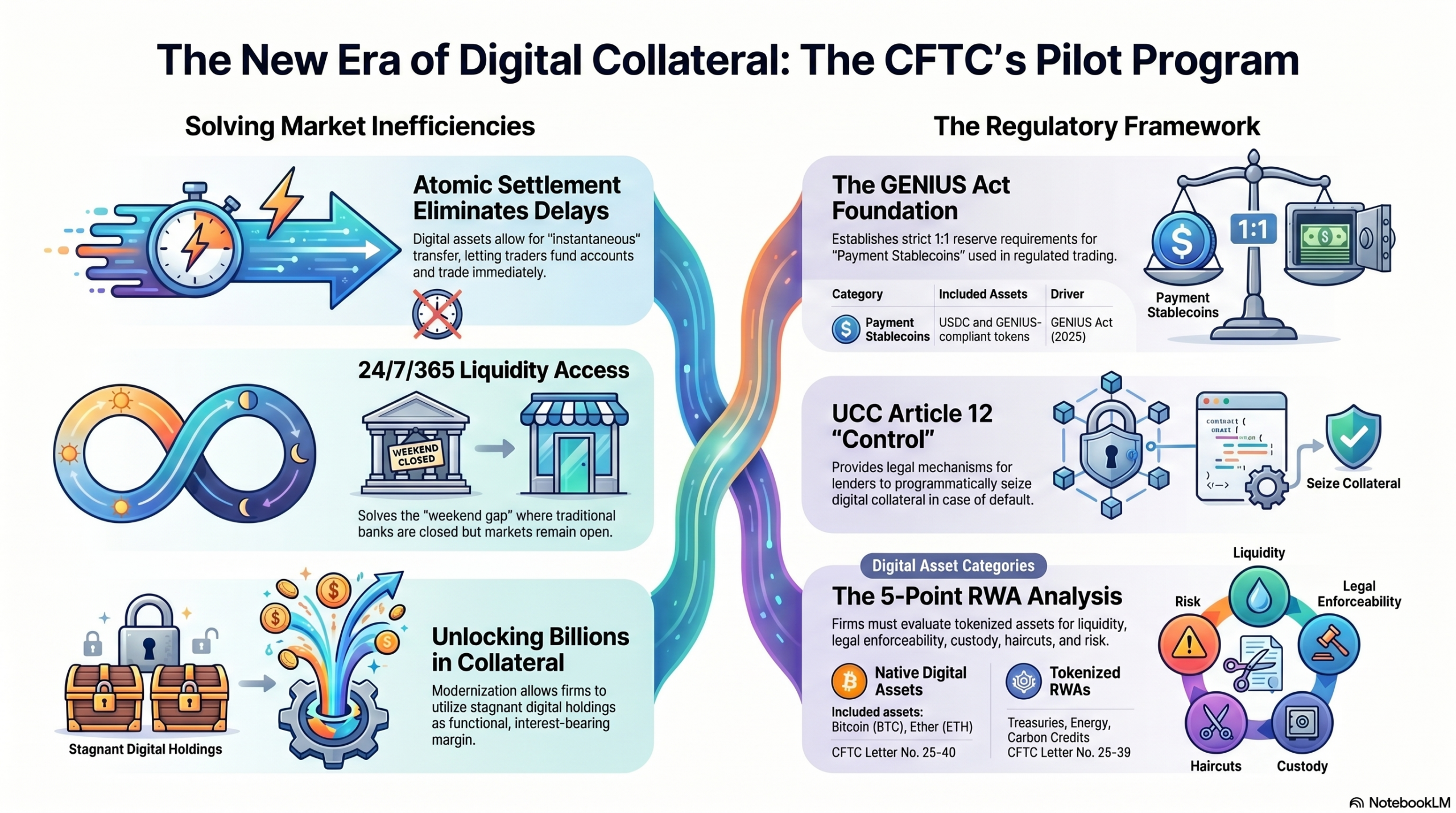
For decades, the traditional financial system and the digital asset market operated in siloed environments. This separation ended in late 2025. Following the landmark enactment of the Guiding and Establishing National Innovation for U.S. Stablecoins (GENIUS) Act on July 18, 2025, the regulatory landscape reached a fever pitch. On December 8, 2025, the Commodity Futures Trading Commission (CFTC) launched its Digital Assets Pilot Program, supported by a series of guidance letters that effectively bridged the gap between these two worlds.
The “so what?” for the modern learner is simple: this represents the formal legitimization of digital assets as mainstream regulated collateral. No longer just speculative instruments, these assets can now be used as the high-speed “security deposits” that power the multi-trillion dollar U.S. derivatives market.
Key Insight: This regulatory shift is estimated to unlock billions of dollars of digital collateral that was previously “trapped” or ineligible within the traditional financial system, allowing for unprecedented capital efficiency in regulated trading.
This event signals a move toward a high-velocity financial system. To navigate it, we must first understand the organizations serving as the architects of this new infrastructure.
2. The Gatekeepers: Understanding Key Organizations
The digital ecosystem operates through a “jurisdictional handshake” coordinated by the President’s Working Group (PWG) Report on Digital Asset Markets (July 30, 2025). This report established the boundaries: the CFTC oversees the derivatives and commodities markets, while the SEC maintains its focus on securities and investment contracts.
| Organization | Abbreviation | What They Do in the Digital Ecosystem |
| Commodity Futures Trading Commission | CFTC | The primary regulator for derivatives; they issued the 2025 Pilot Program to integrate digital assets as margin. |
| Securities and Exchange Commission | SEC | Oversees digital assets classified as “securities” and coordinates with the CFTC on the “handshake” to ensure market integrity. |
| Futures Commission Merchants | FCMs | Regulated brokers that accept customer collateral; they are the primary entities authorized to hold digital assets under the new Pilot Program. |
| Derivatives Clearing Organizations | DCOs | The “plumbing” of the system; they ensure trades are settled and manage the overall risk of the collateral pools. |
Knowing who makes the rules helps us understand the categories of assets they regulate, as different classifications lead to vastly different compliance costs and operational requirements for firms.
3. The Three Pillars: Categorizing Digital Assets
Under the 2025 framework, digital assets are not treated as a monolith. They fall into three distinct pillars:
- Commodity Cryptocurrencies
- Specifically Bitcoin (BTC) and Ether (ETH).
- These are the primary “non-security” digital assets recognized by the CFTC for use as initial margin.
- Payment Stablecoins
- Regulated by the GENIUS Act, these digital assets are obligated to be redeemed for a fixed monetary value (e.g., 1-to-1 for U.S. Dollars).
- The 2025 Nuance: Payment stablecoins issued after the July 18, 2025 enactment are classified as a new regulatory category—neither “commodities” nor “securities.” Those issued before that date are generally treated as “commodities.”
- Issuers must maintain 1-to-1 reserves in highly liquid assets like cash or Treasury bills.
- Tokenized Real-World Assets (RWAs)
- Digital “twins” of traditional assets, such as U.S. Treasury bonds or physical commodities.
- Tokenization allows for fractional ownership and faster transfers, but the underlying value remains tied to the physical or traditional asset.
The emergence of these pillars poses a fundamental question: does moving an asset to a blockchain change what it actually is?
4. The Golden Rule: Why “Digital” Doesn’t Mean “Different”
The core principle of the 2026 landscape is that technology is merely a “rail”—it does not transform the fundamental risk of the asset being carried. Tokenization is viewed as a process of representation, not a transformation of the underlying asset’s nature.
The December 8 Guidance Stated: “[T]he use of digital ledger technology to tokenize an asset need not change the fundamental characteristics of that asset.”
To ensure the “Golden Rule” is followed, the legal mechanism of UCC Article 12 was established to govern Controllable Electronic Records (CERs). This provides the legal teeth for firms to “control” and “perfect” their interest in digital collateral. When analyzing tokenized RWAs, learners must evaluate five key factors:
- Liquidity: Can the asset be sold instantly in a crisis?
- Legal Enforceability: Does the ownership hold up in court via CERs and UCC Article 12?
- Segregation & Custody: Is the asset kept in a secure wallet separate from the firm’s balance sheet?
- Haircuts: Is the value sufficiently discounted to protect against volatility?
- Operational Risk: Are there protections against smart contract exploits or blockchain “forks”?
5. Practical Magic: Solving Real-World Problems
The primary reason for adopting digital collateral is to replace the “Slow Model” of legacy banking with a “Fast Model” of internet-native finance.
| Feature | Legacy Financial System | The Digital Pilot Framework |
| Settlement Speed | Days (Wires, Checks, ACH) | Atomic Settlement (Simultaneous transfer of asset and payment) |
| Trading Hours | “9-to-5” (Closed weekends) | 24/7/365 (Always accessible) |
| Asset Access | Manual/Physical Verification | Programmatic Control (Automated via smart contracts) |
| Capital Use | Delayed by clearing cycles | Instant Liquidity (Immediate trading after posting) |
Vocabulary Spotlight: The “Haircut” A “haircut” is a discount applied to collateral value to account for risk. For tokenized assets, regulators often require deeper (larger) haircuts than their non-tokenized equivalents. This isn’t because the asset is worse, but to account for “settlement frictions” and the reliance on third-party technology providers.
6. Case Study: From Ugandan Farms to Global Markets
The most profound example of this system in action is the Node 4 project in Kaabong, Uganda. By using the Rural Infrastructure Operating System (RIOS), this project demonstrates the “Sovereign Banking” paradigm.
The Physical-to-Digital Flow:
- Physical Production: The farm produces industrial hemp and converts waste into energy via Plasma Gasification, producing Syngas.
- Verification (zkVerify): On-site sensors capture “Empirical Feasibility Data” (harvest weight, energy output) and prove it using Zero-Knowledge technology. RIOS acts as a “Truth Machine.”
- Tokenization (RWA NFT): This verified data is minted into a “Digital Twin” NFT, classified as a Controllable Electronic Record (CER).
- Instant Liquidity (Capital Velocity Engine): The farm posts this NFT as collateral to an FCM. Instead of waiting 6 months for payment, they borrow against their own proven production instantly.
The “so what?” is transformative: the farm bypasses traditional bank delays and functions as its own bank, using its verified physical output to self-finance growth in real-time.
7. Summary Checklist for the Aspiring Learner
As you evaluate assets in the 2026 landscape, remember these four pillars of analysis:
- [ ] Jurisdiction: Is it a security (SEC) or a commodity (CFTC)?
- [ ] Legislation: If it’s a stablecoin, does it meet the 1-to-1 reserve requirements of the GENIUS Act?
- [ ] Operational Risk: Does the tokenization process introduce new smart contract or “digital plumbing” vulnerabilities?
- [ ] Legal Title: Is the asset a “Controllable Electronic Record” under UCC Article 12?
The 2026 regulatory landscape is an evolving marriage of law and logic. By standardizing how real-world value is verified and collateralized, we are moving toward a global market that is faster, more inclusive, and powered by the speed of thought.


