The Machine Economy is Here: 6 Surprising Realities of the 2026 Agentic Revolution
In 2024, the digital economy was defined by the “human-initiated click.” Every purchase, every stock trade, and every movement of capital required a person to engage with a graphical user interface. We lived in a world where software was a tool, and humans were the sole economic actors.
By 2026, that paradigm has been dismantled. We have entered the era of Agentic Commerce (A-Commerce), a multi-trillion-dollar reality where autonomous software agents—not humans—are the primary drivers of economic activity. These agents do not “click” on websites; they interact through machine-readable protocols, negotiating pricing spreads and settling transactions in milliseconds.
The shift is profound. We are no longer looking at a more efficient version of the old economy, but a fundamentally new “Machine Economy” projected to handle between $3 trillion and $5 trillion in transaction volume by the early 2030s. This revolution is underpinned by a specific convergence of tokenized assets, federal legislation, and sovereign hardware that has effectively removed the human bottleneck from the global flow of capital.
Your Stock Broker is Now an Algorithm (And the SEC is Letting It Happen)
Under the initiative known as “Project Crypto,” the Securities and Exchange Commission (SEC), led by Chair Paul Atkins, has introduced a radical “innovation exemption.” This framework allows cryptocurrency platforms and Decentralized Finance (DeFi) networks to list tokenized versions of publicly traded U.S. equities, such as Apple or Nvidia, via a “regulatory lite” pathway that bypasses traditional securities registration.
The surprising reality? These platforms can list these assets without the consent or backing of the companies themselves. This has created a parallel, decentralized market for “third-party” tokens. However, this freedom comes with significant trade-offs for the investor. These tokens are synthetic derivatives that track price action rather than true digitized equities.
“The proposed tokens would function as synthetic derivatives rather than true digitized equities. They would track the price action of underlying public shares but would not confer traditional shareholder rights, such as voting power or dividend distributions.”
This “permissionless issuance” introduces risks of market fragmentation and the creation of “phantom shares.” Because these tokens are governed by code rather than centralized clearinghouses like the DTCC, a logic error or oracle manipulation can lead to “decoupling,” where the token’s price diverges wildly from the actual Wall Street stock.
Beyond KYC: The Rise of the “Digital Agent Passport”
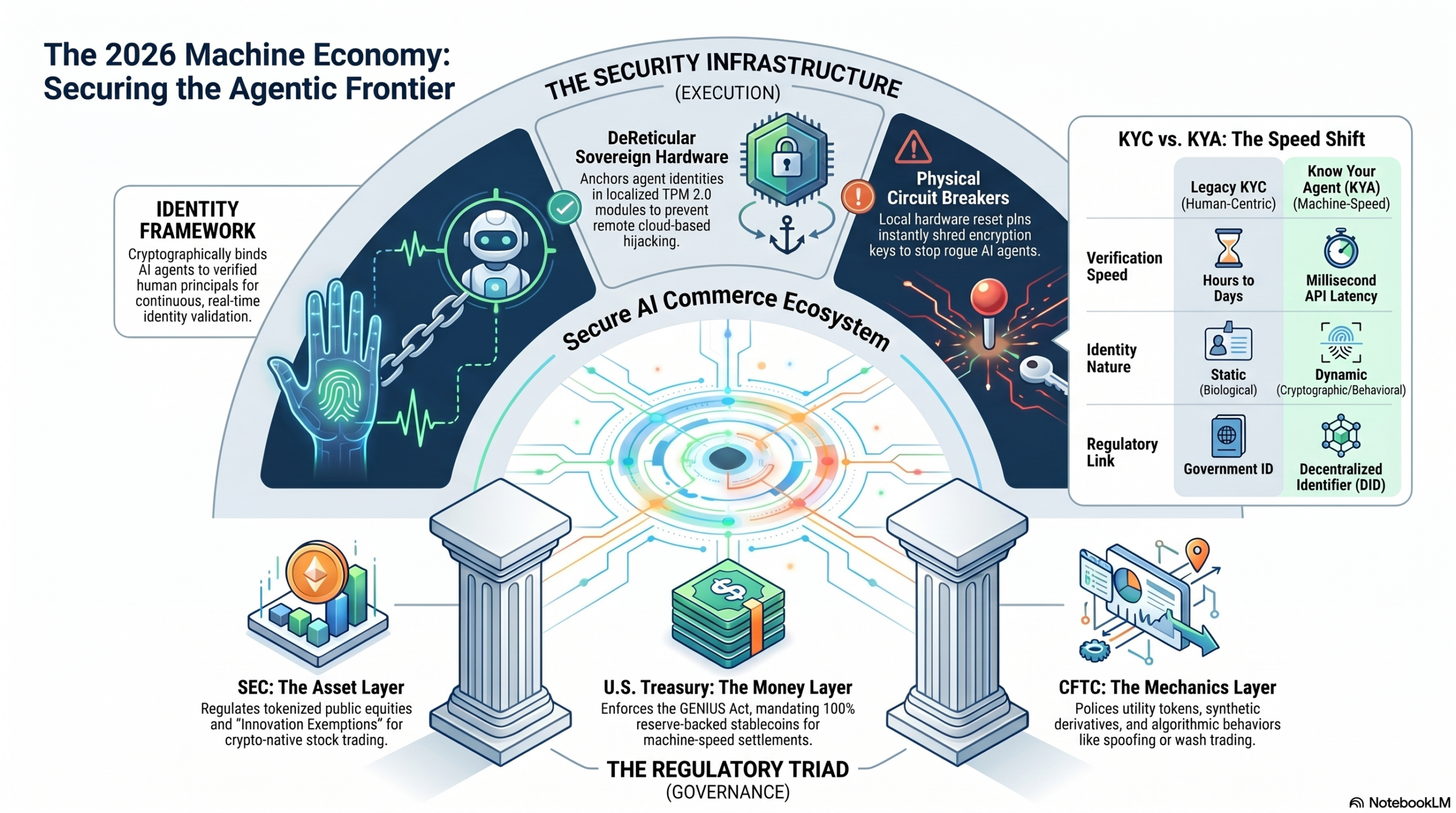
Traditional Know Your Customer (KYC) processes, which take hours or days to verify biological identity, are functionally obsolete in a machine-velocity economy. To bridge this gap, the “Know Your Agent” (KYA) industry has emerged as the mandatory connective tissue of 2026, utilizing the x402 protocol to repurpose the old HTTP 402 “Payment Required” error code for autonomous micropayment negotiation.
KYA replaces biological verification with a “Digital Agent Passport.” This system relies on three core pillars:
- Identity Anchoring: Mapping an agent’s cryptographic signature back to a verified human or corporate “Principal” to ensure strict legal liability.
- Cryptographic Passports (DIDs): Using Decentralized Identifiers and Zero-Knowledge proofs to allow agents to prove legitimacy without exposing the owner’s private data.
- Permission Scoping: Hardcoding limits on what an agent can do—such as maximum spend or jurisdictional boundaries—directly into the agent’s operational software.
KYA is the essential safeguard against the “hallucination-to-transaction pipeline,” where a probabilistic AI error or a malicious prompt injection could otherwise trigger an unauthorized, deterministic financial settlement.
“Global financial and market systems were built for humans with government IDs, not for autonomous agents executing high-frequency micro-transactions… This transition introduced a massive trust gap.”
The Physical Kill-Switch: Why Software Security Isn’t Enough
In a digital-first economy, the most critical fail-safe is surprisingly physical. As financial agents move from centralized clouds to decentralized networks, they face risks of remote hijacking. The solution is the DeReticular sovereign hardware ecosystem, specifically the “Premium Silicon Sentry.”
This hardware enclave utilizes a modified Apple M4 chip and a TPM 2.0 module to force AI agents to operate locally. By utilizing the OpenClaw framework, these agents can remain functional even during network outages via “Island Mode.” To authorize transactions, a human must perform a physical NFC tap—a “Sovereign Badge”—creating an un-hackable root of trust that no remote hacker can spoof.
Most importantly, this hardware includes a physical “Kill Switch.” If a trading algorithm goes rogue or a market begins to crash due to a logic cascade, a human can depress a physical reset pin. This action instantly shreds the encryption keys in the local silicon, permanently severing the agent’s connection to the market. There is a deep irony in the fact that the most sophisticated decentralized financial system in history ultimately relies on a physical, localized piece of hardware to remain secure.
The Regulatory Triad: A New Division of Power
No single government agency can manage the velocity of a machine-driven market. Consequently, a “Regulatory Triad” has emerged to divide oversight across the different layers of the economy:
- The SEC (The Assets): Regulates the tokenized financial wrappers and investment contracts, ensuring accurate disclosures for synthetic assets under Project Crypto.
- The U.S. Treasury (The Money): Enforces Anti-Money Laundering (AML) through the GENIUS Act, ensuring that stablecoin settlements are cryptographically tied to verified identities.
- The CFTC (The Fuel and Mechanics): Polices the Utility Tokens used for compute and “Gas.” Their focus is on preventing Oracle Manipulation and Commodity Hoarding, treating the cornering of network resources with the same severity as illegal wheat or oil manipulation.
This division of power is necessary because no agency alone can monitor millions of agents operating at sub-second speeds. They rely on the KYA framework to provide a real-time audit trail that connects these three domains.
The “Yield Migration” and the Death of Interest-Bearing Cash
The foundation of the machine money supply was set on July 18, 2025, with the signing of the GENIUS Act by President Trump. This law created 100% reserve-backed stablecoins, providing the zero-volatility settlement layer needed for instant transactions. However, the Act included a critical clause: compliant stablecoins are strictly prohibited from paying interest to token holders.
This has triggered a massive “Yield Migration.” Because AI agents cannot earn a return on their cash holdings in stablecoins, the GENIUS Act has created a “gravity well” for capital, forcing trillions of dollars into yield-generating Real World Assets (RWAs). Profits from tokenized stock trades are instantly rotated into tokenized U.S. Treasuries to capture risk-free yield. This machine-driven efficiency has turned RWAs into the default savings account of the digital world, providing the deep liquidity that allows the agentic economy to function autonomously.
Conclusion: The Road Ahead
The integrated ecosystem of 2026 represents a total departure from the 2024 “Business-to-Consumer” (B2C) model, replaced by a robust “Machine-to-Machine” (M2M) architecture. By combining KYA identity, GENIUS Act settlement, DeReticular sovereign hardware, and the SEC’s tokenized markets, we have built a blueprint for an autonomous future.
Machines now trade, negotiate, and settle with minimal human friction, yet remain anchored to human law through identity anchoring and physical security. However, as the velocity of commerce moves beyond human perception, we must confront a provocative reality: we are no longer “in the loop” of our own economy. We have moved “on the loop,” acting as high-level overseers of a system that no longer requires our active participation to thrive. The Machine Economy is no longer a future prediction; it is the infrastructure of the present.


