Shattering the Permitting Wall: Behind-the-Meter Edge AI and the Sovereign Stack
Executive Summary
The United States has reached a critical “Permitting Wall” where the centralized electric grid can no longer support the scaling velocity of artificial intelligence. With data centers projected to consume 7% to 12% of total U.S. electricity by 2028, the legacy infrastructure—hampered by five-year interconnection queues and regulatory bottlenecks—has become a liability.
This briefing document outlines a structurally independent alternative: Behind-the-Meter (BTM) Edge AI Compute. Utilizing the RIOS-CC-1000 modular compute container and the Sovereign Stack architecture, infrastructure developers can bypass the transmission grid entirely. By integrating 1,500°C plasma waste-to-energy gasification with vertical agrivoltaic arrays, these units operate in “Island Mode,” providing carbon-negative baseload power. Economic viability is maintained through the Spark Spread algorithm, which dynamically arbitrates energy use between high-margin AI inference and the synthesis of Advanced Synthetic Fuel (ASF™). This decentralized model offers a rapidly deployable blueprint for computational and energetic self-determination.
1. The Centralization Crisis: The Permitting Wall
The maturation of proactive, agentic AI is currently restricted by the physical and regulatory realities of the centralized utility pipeline.
1.1 The Transmission Logjam
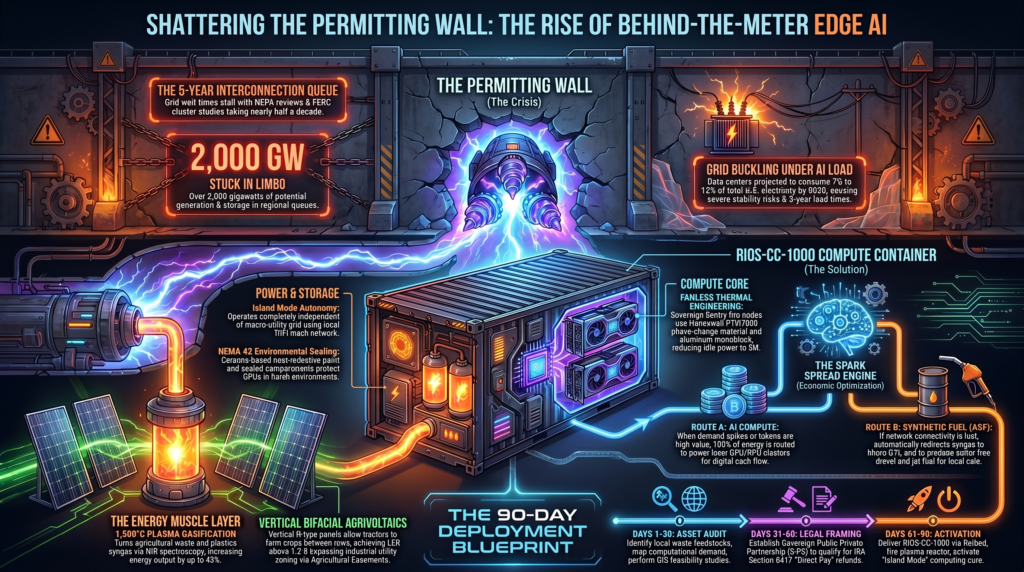
The Federal Energy Regulatory Commission (FERC) currently tracks over 2,000 gigawatts (GW) of capacity sitting in regional interconnection queues. Despite attempts at reform via FERC Order 2023, physical constraints remain.
- Wait Times: Average interconnection agreements now exceed five years.
- Regulatory Hurdles: Securing multi-state rights-of-way and navigating the National Environmental Policy Act (NEPA) takes an average of 4.5 years per Environmental Impact Statement (EIS).
- Infrastructure Fragility: High-voltage step-up transformers currently face lead times of 3 to 4 years.
1.2 Policy Stagnation and Security Risks
Federal programs designed to support infrastructure are currently underperforming or frozen:
- BEAD Program: The $42.5 billion broadband initiative is stalled by administrative overhead and permitting disputes.
- USDA REAP Freeze: As of March 2026, the USDA halted Rural Energy for America Program grant awards to rewrite procurement guidelines, stalling capital for rural clean energy.
- National Security: The concentration of load centers creates single-point-of-failure vulnerabilities. Cyberattacks on SCADA systems or extreme weather events threaten massive computing clusters dependent on a buckling grid.
podcast
2. Technical Architecture: The RIOS-CC-1000
To circumvent the transmission bottleneck, the RIOS-CC-1000 serves as an off-grid “Pilot Command Center” designed for total autonomy.
2.1 Hardware Specifications
The unit is housed in a 10-foot High-Cube ISO shipping container with NEMA 4X environmental sealing and ceramic-based heat-reflective paint.
| Component | Specification |
| Compute Core | Sovereign Sentry Pro nodes |
| Thermal Management | Fanless monoblock; Honeywell PTM7950 Phase Change Material (PCM) |
| Power Storage | 400 kWh Lithium Iron Phosphate (LFP) BESS |
| Connectivity | TriFi mesh network (5.8 GHz and 6 GHz spectrum) |
| Operating System | RIOS Core (Edge-native microkernel) |
2.2 Thermal and Operational Innovation
Traditional active cooling is replaced by passive thermal engineering. The Sovereign Sentry Pro nodes utilize an aluminum monoblock heatsink and Honeywell PTM7950 PCM, which liquefies at 45°C to provide a thermal conductivity rate of 8.5 W/mK. This design eliminates mechanical fans and reduces idle power draw to 5W.
2.3 “Island Mode” Functionality
The RIOS-CC-1000 operates independently of centralized fiber and utility lines. It utilizes localized ledger validation and a self-healing mesh network to maintain 100% operational uptime, even when disconnected from the macro-grid.
3. The Energy Muscle Layer
Continuous, behind-the-meter baseload power is achieved through a hybrid of thermal conversion and dense solar arrays.
3.1 1,500°C Plasma Gasification (Agra Dot Energy)
Unlike standard incineration, plasma gasification uses an ionized gas arc to perform “molecular cracking.”
- Feedstocks: Agricultural waste, biomass, municipal solid waste, tires, and plastics.
- Efficiency: Integrated Near-Infrared (NIR) Spectroscopy analyzes feedstock in real time, automatically adjusting oxygen and plasma intensity to increase energy output by 30% to 43%.
- Yields: Produces high-purity syngas, Advanced Synthetic Fuel (ASF™), biochar for soil enhancement, and vitrified slag for construction.
3.2 Vertical Bifacial Agrivoltaics
N-type bifacial solar panels are installed vertically with 7-meter row spacing.
- Land Equivalent Ratio (LER): The system achieves an LER above 1.2, making the land 20% more productive by allowing simultaneous crop cultivation and power generation.
- Regulatory Bypass: Maintaining active agricultural production allows the site to operate under Agricultural Easement protections, bypassing industrial utility zoning restrictions.
4. The Spark Spread Engine: Mathematical Optimization
The financial viability of the node is managed by a real-time arbitrage algorithm that determines the most profitable use of generated energy.
4.1 Real-Time Arbitrage
The Sovereign Sentry Pro edge server monitors local energy production and market demand to route power to one of two primary paths:
- Edge AI Inference: High-margin processing on GPUs/NPUs to earn utility tokens.
- Advanced Synthetic Fuel (ASF™): Refining syngas into liquid diesel or jet fuel via a Micro-GTL (Gas-to-Liquids) unit.
4.2 Optimization Logic
The system maximizes net yield (\Pi) by adjusting the allocation factor (a). If network connectivity is lost or compute demand drops, the value of computing (V_{compute}) decreases relative to the value of fuel (V_{ASF}). The engine automatically shifts all resources to fuel production. This automated protection ensures that the hardware remains self-financing and immune to market volatility.
5. Strategic and Financial Frameworks
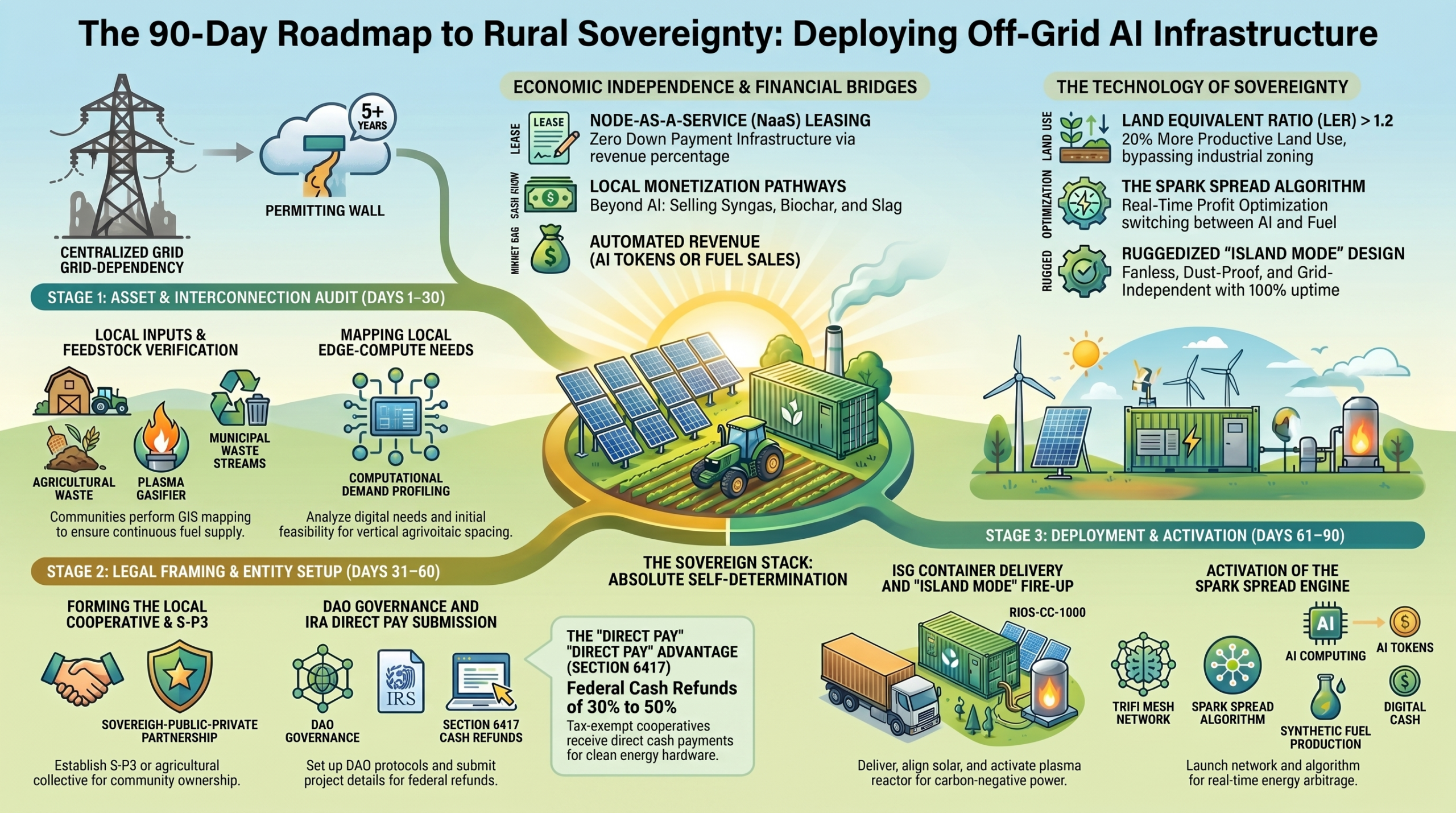
To overcome high upfront capital expenditures, the Sovereign Stack utilizes three primary financial bridges:
- Node-as-a-Service (NaaS): Communities can deploy hardware with zero down payment. Costs are covered by sharing a percentage of the automated “Spark Spread” revenue (AI mining and fuel sales).
- S-P3 and IRA Section 6417 (Direct Pay): Non-profit cooperatives and rural municipalities can leverage the Inflation Reduction Act’s “Direct Pay” provision to receive cash refunds for 30% to 50% of the initial hardware cost.
- Intercompany Sovereign Debt: DeReticular provides low-interest debt to node cooperatives to protect them from predatory external creditors and maintain community ownership of assets.
6. 90-Day Deployment Blueprint
The implementation roadmap focuses on a rapid transition from auditing to active “Island Mode” operations.
| Phase | Duration | Key Actions |
| Stage 1: Asset Audit | Days 1–30 | Audit waste streams; map computational demand; verify local feedstock. |
| Stage 2: Legal Framing | Days 31–60 | Form S-P3/Cooperative; set up Direct Pay entity; finalize NaaS leaseback. |
| Stage 3: Deployment | Days 61–90 | Deliver ISO container; align agrivoltaic arrays; activate plasma reactor. |
Conclusion: The RIOS-CC-1000 represents a shift away from the fragile, centralized grid toward a model of absolute computational and energetic self-determination. By distributing computing power directly to the energy source, developers can effectively “shatter” the Permitting Wall.


